Original Author: Smac, Partner at Compound VC
Original Compilation: Saoirse, Foresight News
Editor's Note: Hot market themes are emerging one after another. The AI frenzy is sweeping the board, with some questioning if it will follow the fate of the metaverse hype. Amidst the noisy market swings, people are often swept up by the latest trends, losing sight of the long-term trajectory. To make rational judgments, one must learn to adopt a higher perspective. In this article, Smac, a partner at Compound, uses a weather analogy to dissect the underlying market logic behind these successive bubbles.
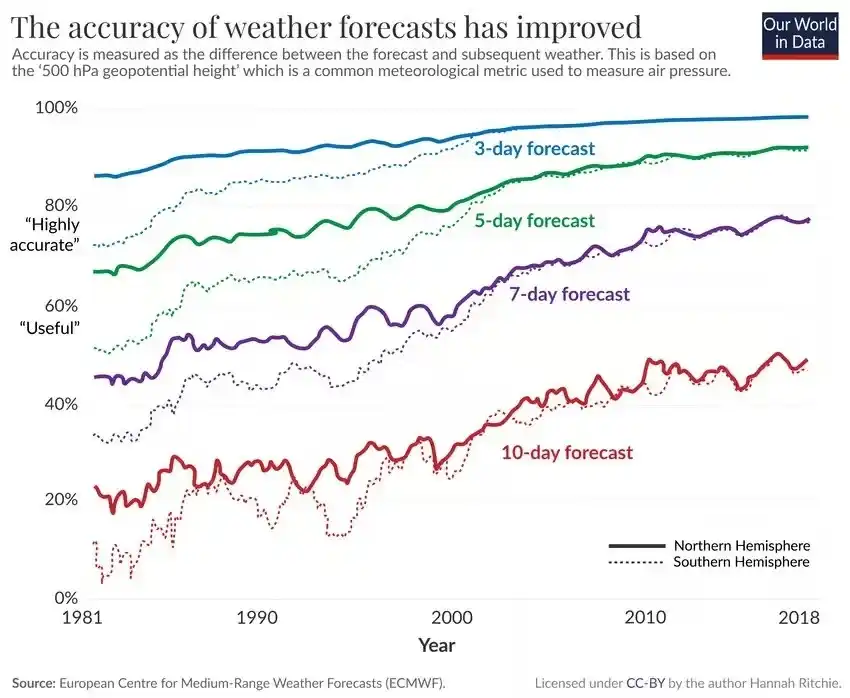
Meteorology is a fascinating field. Over the past fifty years, various weather prediction tools have continuously evolved, improving forecast accuracy. Today's five-day forecast is as accurate as the single-day forecast was thirty years ago.
Most people perceive weather as a single, coherent, moving system: clouds roll in, rain falls, rain stops, sunshine returns. Imagine a winter front approaching. The picture in your mind is likely a vast grey cloud blanket covering hundreds of miles, bringing heavy snowfall. Meteorologists call this type of weather a stratiform system—simply put, like a layered cake, where areas under the cloud cover experience the same weather changes.
But weather isn't always like this. If you've seen summer thunderstorms over plains, you'll notice they operate quite differently. First, individual convective cells form: warm, moist air near the surface rises, meets cold air aloft, water vapor condenses, and towering, localized cumulonimbus clouds develop. Within just an hour, hail, lightning, and torrential rain can strike, reducing visibility to less than a hundred meters.
Once the cell reaches its peak and releases its energy, it gradually dissipates. The cold air descending from the storm spreads outward at speeds up to 40 miles per hour. When this cold air collides with the still warm, moist air surrounding the original storm, it acts like a wedge, forcing the warm air upward again.
As long as sufficient atmospheric instability exists, this "cold air wedge" can trigger a new convective cell about a dozen miles away from the original storm.
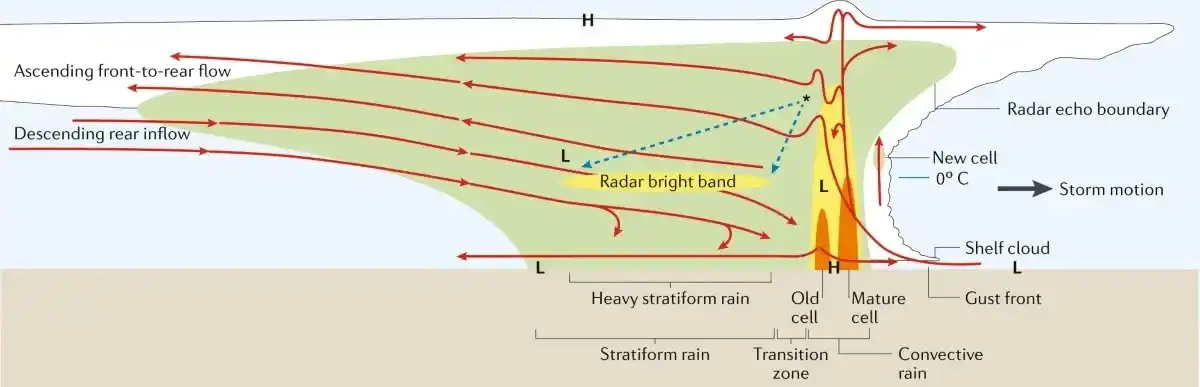
The new cell couldn't have formed on its own; the atmosphere had already stored the energy but lacked a trigger, which the dying storm provided. This new cell then repeats the life cycle of the previous storm.
When multiple convective cells form in succession, they create a mesoscale convective system. On the ground, people experience each storm individually; each one feels like the entire weather system. On one side, calm prevails with no awareness of the coming storm; on the other, the rain has already passed. But from a satellite's perspective, you see a line of distinct cells, each at a different stage of development, moving forward until they exhaust the supply of warm, moist air along their path.

Supercell storm clouds near Amistad, New Mexico at sunset
This chain-reaction storm system forms under very different conditions than a single frontal system. It relies on a specific atmospheric environment:
- Warm, moist air near the surface acts as the storm's "fuel."
- Dry, cold air aloft prompts continuous upward motion of warm air, creating atmospheric instability.
- Winds blowing in different directions at different altitudes, known as wind shear, cause the storm to rotate and move laterally.
When these three conditions are met, successive storms will roll through.
With that meteorological detour, let's get back on topic: The current financial market landscape looks almost exactly like the weather phenomenon described above.
The markets of the past resembled a stratiform weather system: a long bull market followed by a bear market, with sector themes rotating slowly, each lasting for years. The period from 1982 to 2000 was a prolonged bull market, followed by the internet bubble, then the 2003-2007 real estate and credit cycle. These cycles were long and their trajectories clear. Even if an investor's timing was off by a few years, understanding the major trend could still lead to profits.
But today's market is nothing like that. We are in a convective chain-reaction market: one hot sector after another hits like successive storms. To those caught in one, it feels all-consuming and overwhelming.
Capital flows out of fading narratives, fueling new ones in adjacent areas. The pace of theme rotation has accelerated dramatically. AI infrastructure, GLP-1s (a class of diabetes drugs that gained popularity for weight loss, now a hot investment theme), stablecoins, quantum technology, nuclear energy, distributed autonomous technologies, robotics, aerospace... each sector experiences a full hype cycle, complete with devoted participants, a compelling narrative arc, and an inevitable cool-down. The "cold air" spreading from the demise of one trend then ignites the next hotspot in a new area.
Refusing to acknowledge that the market has fundamentally changed is self-deception. People love to mock the phrase "this time is different," but deliberately ignoring the permanent structural shifts in the financial market environment is either intellectual laziness or stubborn nostalgia for the old market.
A Market Unlike Any Before
For a long time after World War II, financial markets moved like slow-moving weather systems. A bull market could last ten, fifteen, or even twenty years, with sector rotations centered around long-term mega-trends.
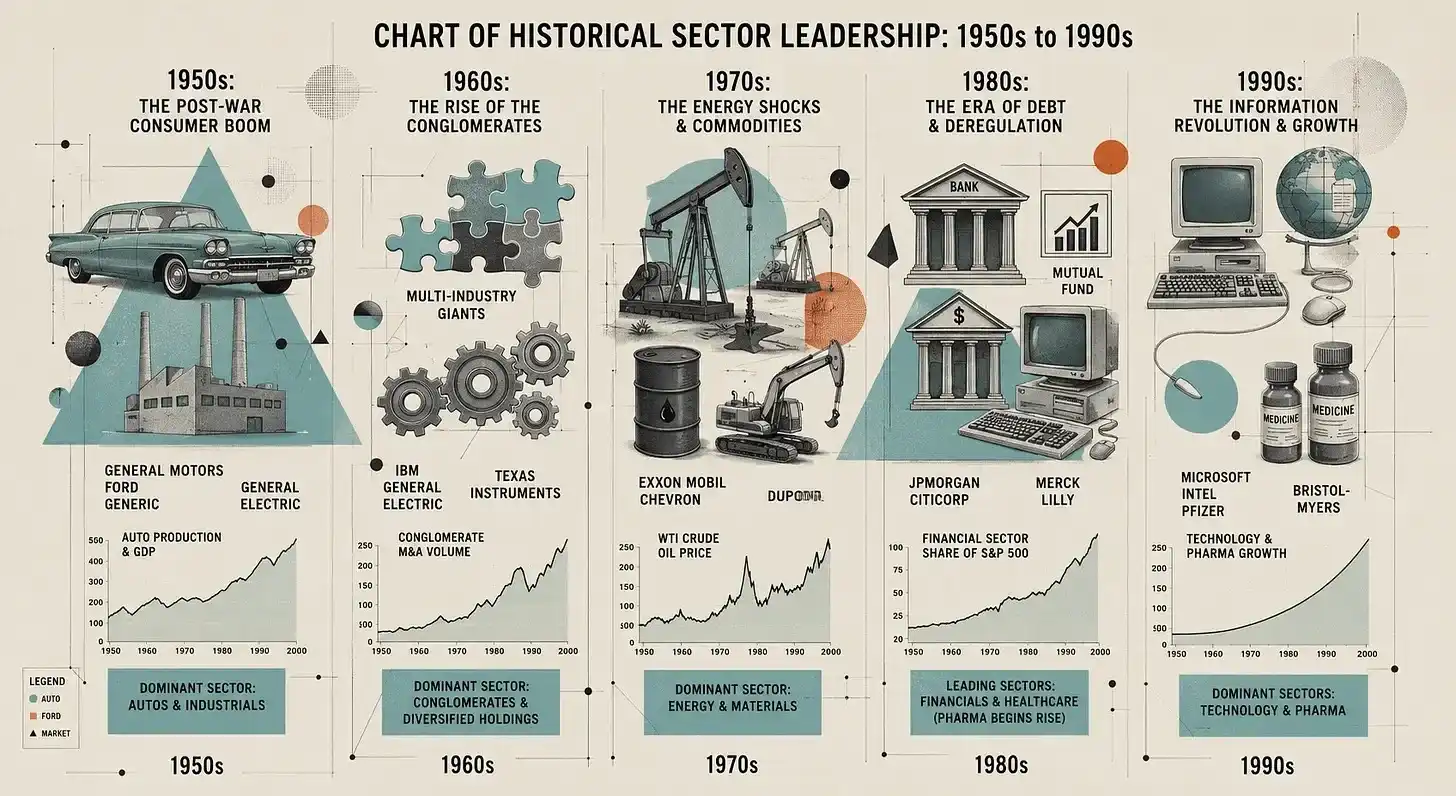
Approximate timeline of sector themes and leading industries
Back then, sector shifts occurred within a unified macro environment. Only at iconic turning points—like the collapse of the Bretton Woods system, Volcker's anti-inflation policies, the peak of the internet bubble, or the global financial crisis—would the market's grand structure be upended.
This market form was shaped by many structural factors: high transaction costs, extremely low retail participation which forced a long-term holding mindset, pensions as the primary vehicle for retirement savings, and S&P 500 index dominated by manufacturing, energy, banking, and retail firms whose earnings growth largely tracked GDP, resulting in stable, predictable performance. Information also traveled slowly; after an annual report was released, it took weeks for most investors to learn its contents.
Market volatility was also relatively balanced. Bull markets were followed by deep corrections where leverage unwound slowly over extended periods; bear market rallies were gradual. The market lingered in different sentiment regimes for long stretches, with overall shifts measured in quarters and years.
In weather terms, the old market had: moderate fuel, high atmospheric stability, weak wind shear, resulting in long, gentle trends allowing for patient planning. Today, all environmental conditions have changed, some even reversed, leading to a fundamental transformation in market structure.
Where Did the Change Come From?
Numerous changes intertwine and amplify each other, each alone sufficient to reshape the market. In summary, there are eight core transformations:
- Democratization of Speculation
- Formation of Perpetual Bid
- Passive Investing Creates Inelastic Counterparties
- Rise of Multi-Strategy Funds & HFT; Disappearance of Market Middle
- Artificial Suppression of Volatility
- Complete Change in Index Composition
- Total Elimination of Information Lag
- Shift in Fiscal & Monetary Environment
Democratization of Speculation
The composition of market participants has visibly changed. In the 1990s, retail trading volume accounted for only about 10% of total US equity volume. High commissions meant retail investors largely bought and held stocks, with little active speculation.
Robinhood pioneered zero-commission trading with payment for order flow; in Fall 2019, Schwab eliminated trading commissions, followed by Fidelity, TD Ameritrade, and E*Trade, rewriting the industry rulebook.
COVID-19 accelerated this trend: fiscal stimulus, idle time at home, and mobile trading apps gamifying investing saw retail's share of trading volume surge to 25% in 2020-2021. Many thought this was temporary, but high retail participation persists. On April 29, 2025, amid market turmoil from tariff policies, JPMorgan data showed retail order flow hit a record 48% of total volume. On normal days, retail volume is more than double pre-pandemic levels; during high-volatility days, it can reach up to 35%.
The deeper change is in what retail trades. Single-stock options are now mainstream for retail, with zero-day-to-expiry options exploding in popularity. New participants are often younger, with concentrated holdings, chasing market themes. Crucially, these investors often use leverage (not reflected in traditional margin data), making decisions based more on price action than fundamentals, and are prone to herd behavior.
In weather terms: The market's near-surface "warm, moist air" is now more abundant than ever, storing unprecedented potential energy.
Formation of Perpetual Bid
I've written about this before. In short, the US retirement system shifted from defined-benefit pensions to defined-contribution plans. Individuals are now responsible for their own retirement savings. Market-wise, this means a massive, price-insensitive, passive flow of money automatically buys stocks with every pay cycle, creating an automated perpetual bid.
Traditional pensions worked differently: defined-benefit plans needed to match liabilities and manage duration risk. Managers actively judged market valuations, reducing equity exposure if deemed too expensive, and increasing bonds. Even if slow, this was far more active than today's purely passive perpetual bid.
This is crucial: marginal trading flows now exert far greater influence on prices than before.
Passive Investing Creates Inelastic Counterparties
The nature of passive index investing is buying and selling based solely on index weights, regardless of price. The higher a stock's market cap, the more passive buying it receives, and vice versa. This embeds momentum inherently into the market's plumbing: stronger performers get more passive flows, a key reason for the dominance of the "Magnificent Seven" tech stocks.
Many articles have analyzed index concentration in top names. Of course, these companies are also exceptionally profitable and growing, so the concentration isn't baseless. But the core issue: passive flows have no natural "profit-taking switch."
Rise of Multi-Strategy Funds & HFT; Disappearance of Market Middle
While the passive perpetual bid formed, active trading underwent its own revolution, marked by the rise of multi-strategy platforms. Firms like Citadel, Millennium, Point72, Balyasny house hundreds of independent portfolio managers, each running a specific strategy under strict risk controls. Their AUM has exploded, with concentration mirroring that in indices.
Simultaneously, high-frequency trading now accounts for 50%-60% of US equity volume and up to 75% in futures. This combination creates a fragile market microstructure: funds trade against each other, weakening price discovery. Much of the volume is just capital churning within the market.
Under normal conditions, bid-ask spreads are tiny, which is good. But when a narrative breaks, positioning becomes extreme, or multiple firms' risk limits are triggered simultaneously, the microstructure can fail. Portfolio managers have highly correlated exposures and similar stop-loss rules; if one is forced to sell, others follow. The market drops in February 2018, August 2019, March 2020, and August 2024 are examples. The market structure that breeds these events is now entrenched and will repeat.
Traditional fundamental long/short hedge funds are being squeezed out. These funds relied on deep research, held 20-40 stocks for multiple quarters. Now, they are either absorbed into large platforms or move to private markets, family offices, or single-strategy funds. In my view, significant alpha can still be found by understanding theme rotation and being patient with short-term flows.
Artificial Suppression of Volatility
Given the above four points, today's volatility behavior is understandable. Data shows that since 1990, the VIX has closed below 20 two-thirds of the time; volatility exhibits ~85% day-to-day correlation, meaning today's level strongly predicts tomorrow's.
But volatility regime shifts have become extreme and asymmetric: extensive research shows suppressed volatility, once it breaks, can explode higher in just a few days, while the decline back to low levels is slow, often taking weeks.
Multiple structural reasons exist: a massive "short volatility" industry has emerged. The rise of zero-day options means market makers' hedging further suppresses intraday moves. The market stews in low volatility, allowing risk to build, then everyone rushes for the exits during tail events.
Simply put, volatility distribution is increasingly pathological: long periods of calm build up to more violent spikes.
Complete Change in Index Composition
The sixth change is the composition of the indices themselves. In 1980, the S&P 500 was dominated by industrial, materials, energy, financials, and consumer staples firms. Their earnings growth largely tracked GDP, with smooth curves and valuation multiples that mean-reverted. Projecting P&G's earnings five years out wasn't wildly off.
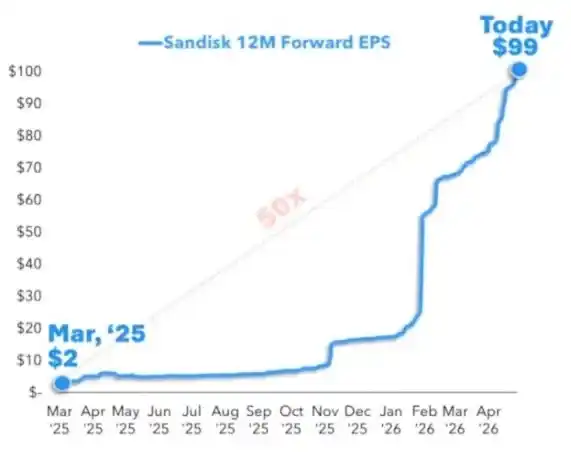
Today is different. Information Technology, Communication Services, plus tech-heavy names in Consumer Discretionary like Amazon and Tesla, collectively make up over 40% of the S&P 500. These companies don't grow linearly: software has near-zero marginal distribution costs; AI is deeply uncertain—will AI labs become the core infrastructure for the next half-century or money-losing science projects? Opinions are polarized.
For such firms, estimating near-term earnings is hard; long-term value is highly uncertain, leading to wild valuation swings. Valuation relies less on financial statements and more on narrative. For investors who can anticipate technological shifts, understand competitive moats, and position for emerging markets, this creates massive alpha opportunities.
Traditional industrials expand capacity gradually; DCF models are relatively stable, and multiples mean-revert. Today, valuation often hinges on the market's belief in a company's story. I'm not saying traditional valuation is dead; it's just the reality for these new-era firms.
Major indices are now packed with these long-duration, narrative-driven companies. The steeper the atmospheric temperature gradient, the more energy stored; similarly, the more such companies, the greater the market's latent energy, leading to more violent moves when triggered.
Total Elimination of Information Lag
Everyone feels this intuitively, but its impact is often underestimated. For most of financial history, market-relevant information dissemination was constrained by distribution channels. Today, information travels with near-zero lag.
Especially positioning information spreads faster than ever. Investors see real-time reactions from prominent figures; more people publicly share their holdings. A torrent of real-time data fuels FOMO, with profit screenshots everywhere, stories of turning thousands into millions going viral, and constant anxiety about missing out.
Shift in Fiscal & Monetary Environment
This needs little elaboration; the core summary:
- Long-term accommodative US monetary policy, low real rates.
- Quantitative Easing expanding the Fed's balance sheet.
- Low discount rates inflating all long-duration asset prices.
- Activist fiscal policy with subsidies, industrial bills.
- Full employment, wartime-level fiscal deficits.
- K-shaped economic recovery, decoupling financial markets from the real economy.
How Storms Form
Combining all these changes, rotating market bubbles become an inevitable outcome.
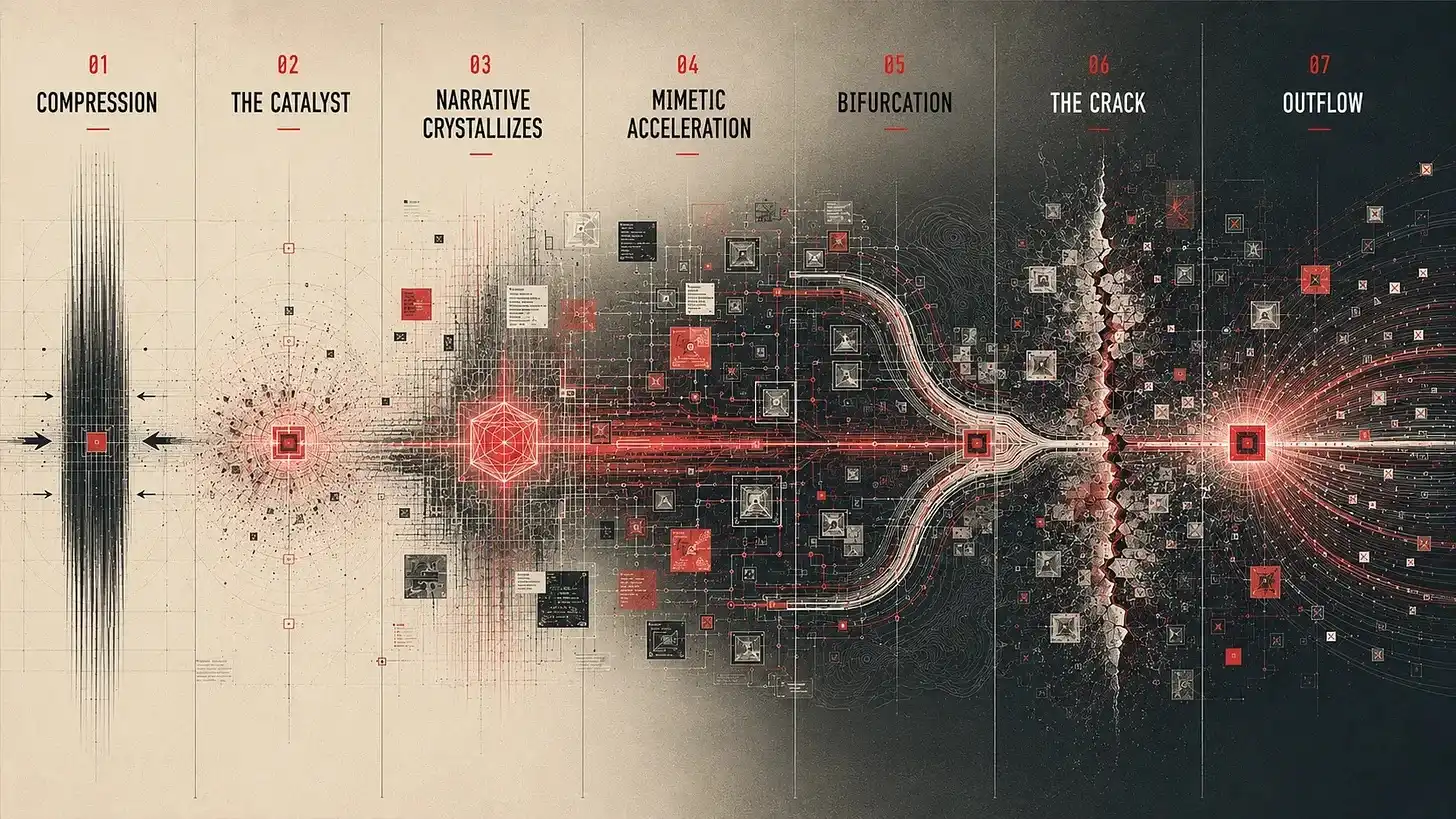
The life cycle of a theme is straightforward with distinct stages:
- Dormancy: Various sectors languish in obscurity, receiving little attention. Even if out of favor, people keep working within them.
- Ignition: A tangible catalyst—a technological breakthrough, regulatory shift, earnings beat—is spotted first by deep domain experts.
- Narrative Formation: A marketable concept emerges, lowering the communication barrier. Even if purists dislike the simplification, a simple story enables broader participation.
- Bifurcation: A clear divergence emerges. Beyond true believers, marginal buyers dwindle, and the gap between bullish and bearish valuations widens.
- Breakdown: In hindsight, the top is always clear. Today, participants are eager to call the top early, a byproduct of online discourse and performance chasing. Once the narrative cracks, positioning unwinds, and capital seeks a new home.
- New Theme Ignition: The outflowing capital moves to a new area, acting like the cold air wedge, sparking the next storm.
Looking Ahead
The implications of this new market regime are profound. We can predict the *shape* of moves but not precisely *where* each bubble will ignite.
Post-COVID, many argued market anomalies were temporary or specific to low rates. Some of that was true, but it's now clear the structural shift is permanent. The eight trends mentioned won't reverse:
- Trading commissions won't rise again.
- Passive investing won't shrink.
- Traditional defined-benefit pensions are gone from the mainstream.
- Social media and information flow will only accelerate.
- Large multi-strategy platforms might evolve, but given their scale and profitability, they aren't disappearing soon.
- Information lag won't re-appear.
Today's environment is the new "climatology." Expecting a return to the slow, stratiform markets of the 80s and 90s is refusing to face reality.
One argument is that successive bubbles will have shorter durations. This is hard to predict as markets become a game of anticipating others' anticipations. But one thing is certain: each cycle educates participants, potentially speeding up the next. Crypto traders are also adopting traditional finance playbooks. However, narrative-driven cycles have a natural lower bound; they can't accelerate infinitely.
This rotating bubble regime primarily benefits two types of investors: First, deep domain experts who understand the underlying technology, regulation, supply chains, and business models, and can judge if expectations are realistic. AI tools will make many mistakenly believe they belong here—a major risk. Second, trend observers. Most investors fall here, focusing on discerning what the sophisticated players are doing.
Meanwhile, the pipeline of investable themes remains rich: AI infrastructure & applications, robotics, embodied AI, precision medicine, crypto, materials science, fusion & advanced fission, grid storage, space, brain-computer interfaces, quantum. Even within a mega-theme, different subsectors and parts of the stack will experience their own mini-cycles.
Retail investors have inherent advantages in this market: time flexibility, agility, no investment committee meetings, no quarterly redemption pressures. The long-proven "buy the dip" strategy has also served them well. With proper risk management, retail can thrive in the new market.
Rising Above the Storm
Analyzing the causes of this market structure might sound like I'm making a value judgment. I do have opinions. In private markets, we can choose not to fund projects with negative social externalities. But in public markets, a common mistake is expecting the market to behave as you think it *should*.
This is a deep-seated human emotional flaw; even Newton fell victim to it, suffering massive losses.
Emotion is a major drag on returns. Perennially, asset managers appear in media predicting market tops and recessions—predictions repeated yet rarely realized.
The market isn't going back. Is this chain-reaction storm regime more pathological than the old one? I'm not sure. Objectively, many changes enabling it are positive: lower barriers to entry, automated retirement savings, accessible passive instruments, real-time information, democratizing market participation.
On the ground, each storm feels all-encompassing, vision limited to the immediate squall. That's exactly how participants in each sector bubble feel: it's a black hole absorbing all liquidity. Only by consciously raising your vantage point can you see the full chain: one theme fading, the next igniting, on and on. Participants in each cycle are mired in their own moment's euphoria or despair.
Financial markets fascinate because they constantly evolve, yet price discovery remains human-driven. Humans are emotional and repeat past mistakes. This tension creates what we see: seemingly chaotic and frenzied up close, but from a higher view, just one rolling bubble after another.
The core intent of this article is to encourage stepping out of the immediate storm, observing the market from a higher dimension, discerning the direction of thematic flows, and trying not to be swept away by the emotions of any single hotspot.
It's simple in concept but requires immense discipline. Easier said than done.