Suspending IPO but Accelerating Expansion: Kraken's 'Strategic Retreat for Advancement'

比推Опубликовано 2026-03-19Обновлено 2026-03-19

Введение

Kraken has paused its IPO plans, initially filed confidentially with the SEC in November 2025, citing unfavorable market conditions. The decision comes amid a significant crypto market downturn, with Bitcoin falling over 52% from its October 2025 high and total market capitalization dropping 42.5%. Other recently listed crypto firms like Gemini and Bullish also saw steep stock declines. Despite the IPO delay, Kraken continues to expand its services. Recent initiatives include a partnership with Nasdaq to develop tokenized stocks, approval for a Federal Reserve master account enabling direct access to Fedwire, and the launch of new products like crypto-backed loans and regulated tokenized stock perpetual futures. Financially, Kraken’s parent company Payward reported strong 2025 results with a 33% increase in adjusted revenue and 26% growth in adjusted EBITDA. However, regulatory developments and ongoing market volatility have created uncertainty, leading Kraken to adopt a wait-and-see approach. The move reflects broader industry challenges as crypto firms navigate shifting regulations and investor sentiment while expanding beyond pure trading into diversified financial services.

Author: Nicky, Foresight News

Original Title: Kraken Suspends IPO Plans, Can Exchanges Not Navigate Bull and Bear Markets?


On March 18, according to CoinDesk, cryptocurrency exchange Kraken has temporarily shelved its IPO plans after confidentially submitting an application to the U.S. Securities and Exchange Commission in November 2025. Sources indicated that the company may reconsider when market conditions improve. This decision follows the surge in crypto company listings in 2025—firms like Circle, Bullish, and Gemini collectively raised $146 billion last year, making Kraken's pause particularly notable.

Kraken's suspension of its IPO is closely tied to the current downturn in the crypto market. According to Bitget data, Bitcoin's price has been declining since hitting an all-time high of $126,200 on October 6, 2025, dropping to around $60,000 by February 6, 2026, a maximum decline of over 52%. As of March 19, it is still hovering near $70,000. During the same period, the total market capitalization of cryptocurrencies shrank from $4.23 trillion to $2.43 trillion, a decrease of 42.5%.

Coinbase, a bellwether for crypto in the U.S. stock market, also experienced significant volatility. After reaching a historic high of $444.6 on July 18, 2025, its stock price fell to a near one-year low of $139.36 on February 12, 2026, a maximum drop of 68.65%. It closed at $202.29 on March 18, with a market cap of $53.42 billion, but market confidence has not fully recovered.

Other recently listed crypto companies are also facing severe challenges. Since its listing on September 12, 2025, Gemini's stock price has fallen from its first-day close of $32 to a low of $5.57 on February 23, 2026, a decline of nearly 82.6%. It closed at $5.96 on March 18, with a market cap of approximately $701 million.

Bullish, after listing on August 13, 2025, saw its stock price drop from $68 to a historic low of $24.79 on February 5, 2026, a decline of 63.5%. It closed at $38.28 on March 18, with a market cap of $5.754 billion.
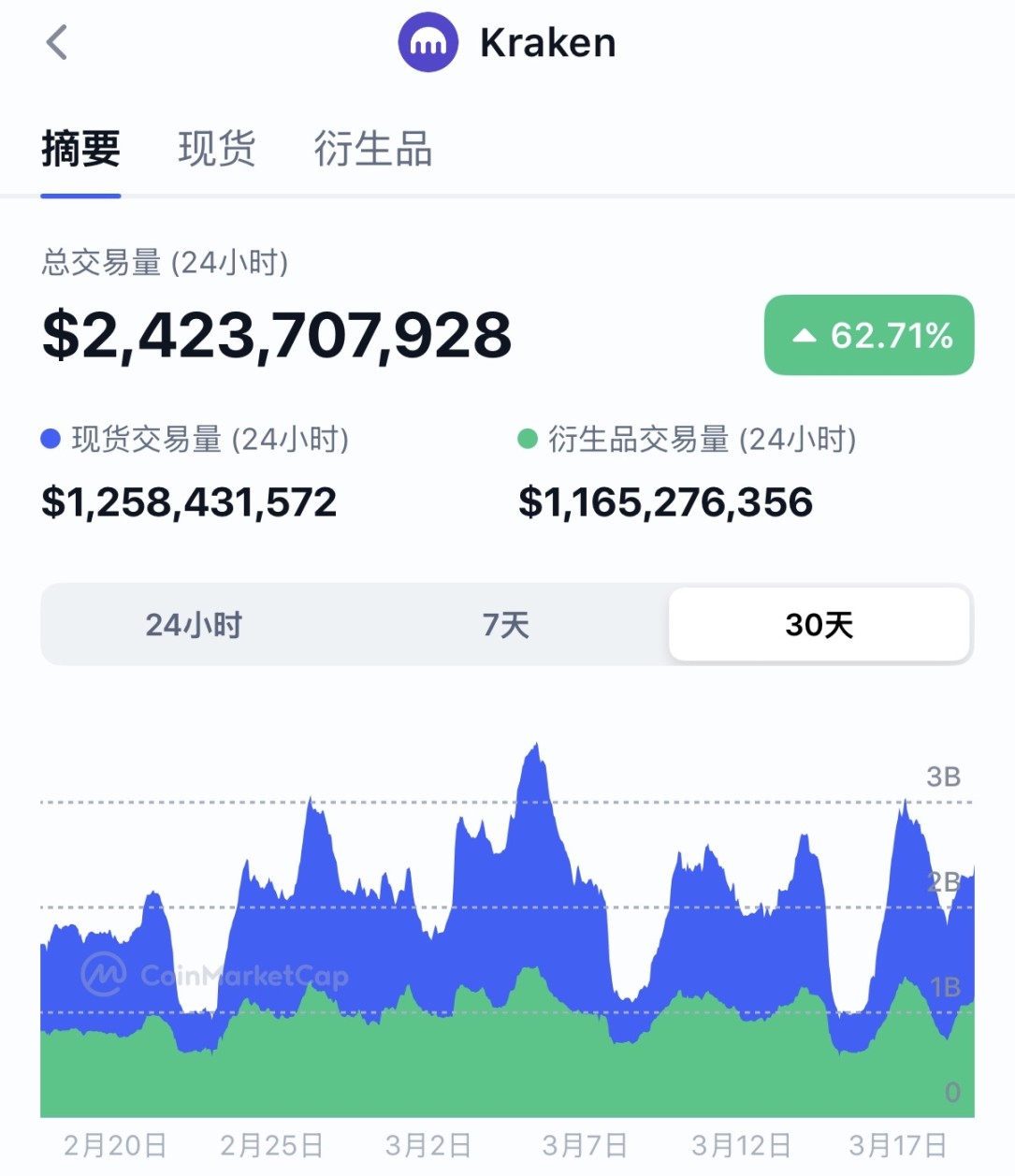
In terms of business scale, Kraken ranks in the middle globally among exchanges. According to CoinMarketCap data, Kraken's spot trading volume in the last 24 hours is approximately $1.2 billion, ranking 14th globally; its derivatives trading volume is about $1.1 billion, ranking 10th. In comparison, Coinbase's spot trading volume in the last 24 hours is around $1.86 billion, ranking second globally, while Binance leads with over $10 billion in spot trading volume and $65.18 billion in derivatives trading volume.

Financially, Kraken's parent company Payward reported 2025 results with adjusted revenue of $2.2 billion, a 33% year-over-year increase; adjusted EBITDA grew 26% to $531 million. Trading business revenue accounted for 47% of total revenue, with the remainder coming from non-trading businesses such as custody, payments, and financing. Total annual trading volume increased 34% to $2 trillion, platform assets grew 12% to $48.5 billion, and the number of customer accounts rose 50% to 5.7 million.

Despite the IPO plans being shelved, Kraken has been active in business expansion and regulatory compliance in recent months. On March 9, 2026, Nasdaq announced a partnership with Kraken to develop tokenized stocks and exchange-traded products, expected to launch in early 2027, focusing on using blockchain technology to streamline corporate governance processes.

On March 4, Kraken received approval for a Federal Reserve master account, becoming the first cryptocurrency company to access the Fed's core payment system, allowing direct use of the Fedwire interbank payment network. On February 25, the company launched its crypto asset staking loan service Flexline, enabling professional traders to access liquidity without selling their holdings. On February 24, Kraken announced the launch of regulated tokenized stock perpetual futures contracts, available to qualified non-U.S. users in over 110 countries, with initial products covering tokenized versions of major indices like the S&P 500 and Nasdaq 100.

Changes in the regulatory environment have added uncertainty to Kraken's path to listing. On March 18, the U.S. Securities and Exchange Commission and the Commodity Futures Trading Commission jointly issued interpretive guidance clarifying the classification standards for crypto assets, ending over a decade of regulatory ambiguity. This document provides clearer compliance guidance for the market but also means companies need to reassess how their business structures align with regulatory requirements. Meanwhile, cryptocurrency market structure legislation advancing in Congress is expected to pass in 2026, further clarifying the regulatory归属 of digital assets.

Kraken's decision to pause its IPO reflects the structural challenges crypto companies face in capital markets. On one hand, the industry is expanding from pure cryptocurrency trading to broader financial services, including stock trading, tokenized assets, and payment infrastructure; on the other hand, market volatility and regulatory uncertainty make investors cautious about valuing such assets.

For the entire cryptocurrency industry, Kraken's delayed listing may signal a turning point. Laura Katherine Mann, a partner at international law firm White & Case, previously noted that 2025 was a test year for crypto company IPOs, and 2026 would be the key node to test the long-term sustainability of digital asset IPOs. The market is judging whether crypto IPOs are a sustainable asset class or a cyclical trade that only during bullish markets. In the current market environment, Kraken's choice to wait for a more opportune moment may be a more prudent strategy.

It is worth noting that other leading players in the crypto industry are also actively adjusting their strategies to adapt to market changes. On March 19, Kris Marszalek, CEO of crypto trading platform Crypto.com, announced that the company is全面推进 its AI transformation, integrating AI tools and talent to enhance operational scale and precision. As part of this strategic adjustment, the company has targeted a reduction of about 12% of positions不适应 the new landscape.


Twitter:https://twitter.com/BitpushNewsCN

Bitpush TG Discussion Group:https://t.me/BitPushCommunity

Bitpush TG Subscription: https://t.me/bitpush

Original Link:https://www.bitpush.news/articles/7621233

Связанные с этим вопросы

QWhy did Kraken decide to pause its IPO plans according to the article?

AKraken paused its IPO plans due to the current downturn in the cryptocurrency market and unfavorable market conditions, with the possibility of reconsidering when conditions improve.

QWhat significant partnership did Kraken announce in March 2026 regarding tokenized assets?

AIn March 2026, Kraken announced a partnership with Nasdaq to develop tokenized stocks and exchange-traded products, leveraging blockchain technology to simplify corporate governance processes.

QHow did the performance of other recently listed crypto companies like Gemini and Bullish compare in the market?

AGemini's stock price fell nearly 82.6% from its first-day close, while Bullish experienced a 63.5% decline from its IPO price, both reflecting severe market challenges.

QWhat regulatory development in the U.S. was highlighted as adding uncertainty to crypto asset classification?

AThe SEC and CFTC jointly issued interpretive guidance clarifying the classification standards for crypto assets, ending over a decade of regulatory ambiguity and requiring companies to reassess their compliance.

QHow does Kraken's business diversification strategy extend beyond cryptocurrency trading?

AKraken has expanded into services such as custody, payments, financing, crypto-asset staking loans, and regulated tokenized stock perpetual futures, aiming to become a broader financial services provider.

Похожее

The End of the Crypto Premium? Market Logic Shift Seen Through Gemini's Post-IPO Struggles

The article "The End of the Crypto Premium? Market Logic Shifts as Gemini Struggles Post-IPO" examines the dramatic downturn of cryptocurrency exchange Gemini following its public listing in September 2025. Initially part of a wave of crypto IPOs, including Bullish, which saw soaring valuations and massive investor interest, Gemini's stock price has since collapsed by over 80%, falling from $28 to around $5. The company has cut 30% of its workforce, exited international markets, and faces significant financial strain, including $330 million in Bitcoin-denominated debt. The core argument is that Gemini's struggles reflect a broader market shift where the "excess premium" once associated with crypto assets is disappearing. Two key factors are identified: the erosion of regulatory arbitrage, as compliance costs rise for all players (up 22.5% for small firms in 2026), and the decline of liquidity scarcity premiums, as institutional investors now access crypto via low-friction ETFs and stocks rather than volatile altcoins. The approval of Bitcoin and other crypto ETPs, which now manage $1.8 trillion globally, has diverted institutional capital away from altcoins, causing their liquidity to dry up and volatility to increase. For Gemini, its strategy of being "the most compliant exchange" became a liability in a bear market, as fixed compliance costs remained high while trading revenue fell. The article concludes that the era of narrative-driven crypto valuations is ending, giving way to a market logic focused on fundamentals like actual usage, liquidity depth, and sustainable institutional adoption.

marsbit42 мин. назад

The End of the Crypto Premium? Market Logic Shift Seen Through Gemini's Post-IPO Struggles

marsbit42 мин. назад

Utexo Partners with x402 to Provide Near-Instant USDT Settlement for the Agent Economy

Utexo, a Bitcoin-native stablecoin payment execution and settlement layer, has partnered with x402 to integrate USDT compatibility into the x402 payment protocol. This collaboration enables near-instant settlement for agent-to-agent transactions, with speeds as fast as 50 milliseconds. x402 is an open protocol that uses the HTTP 402 "Payment Required" status code to embed payment functionality directly into HTTP requests. This allows applications, APIs, and autonomous systems to pay for services in real-time without requiring pre-funded accounts. The integration expands x402’s initial USDC support to include USDT, one of the most widely used stablecoins globally. Utexo’s infrastructure is designed for high-frequency, low-latency transactions, making it well-suited for machine-driven payments. According to Utexo CEO Viktor Ihnatiuk, supporting USDT within the x402 framework significantly broadens access and provides developers the performance needed for real-time agent-based systems. Kevin Leffew of x402 at Coinbase added that expanding stablecoin access improves performance and accelerates developer adoption. This partnership supports growing use cases where software systems autonomously conduct transactions—such as paying for API calls, accessing data on-demand, and coordinating services across platforms without human intervention. By combining x402’s protocol with Utexo’s settlement infrastructure, the collaboration enables a payment model where transactions are as fast and efficient as the requests that trigger them.

marsbit3 ч. назад

Utexo Partners with x402 to Provide Near-Instant USDT Settlement for the Agent Economy

marsbit3 ч. назад

Торговля

Спот
Фьючерсы
活动图片