Stablecoin usage in Venezuela likely to keep expanding amid economic instability

cointelegraphОпубликовано 2025-12-14Обновлено 2025-12-14

Введение

Venezuela's economic instability and hyperinflation are driving increased reliance on stablecoins, particularly USDT, as essential tools for daily transactions and as a store of value. According to TRM Labs, nearly a decade of economic crisis, sanctions, and failing traditional infrastructure has made crypto adoption a necessity. Peer-to-peer platforms and crypto-to-fiat conversions are critical in a low-banking environment, with over 38% of Venezuelan crypto site visits going to a major P2P service. Despite regulatory uncertainty, stablecoins are primarily used for payroll, remittances, and commerce rather than speculation. Venezuela ranks 9th globally in crypto adoption when adjusted for population size.

Venezuelans are already heavily reliant on blockchain technology for banking after suffering through a decade of economic pressures; however, usage is likely to keep growing if conditions worsen in the South American country, blockchain intelligence firm TRM Labs says.

As regional and geopolitical tensions continue to rise, driven in part by US-Venezuela tensions, the TRM Labs team predicted in a report on Thursday that macroeconomic instability and the bolívar’s continued devaluation will likely sustain demand for stablecoins as both a store of value and a medium of exchange.

At the same time, regulatory ambiguity and continued uncertainty surrounding the country’s crypto regulator, SUNACRIP’s, authority and enforcement capacity, and eroding trust in traditional banking infrastructure could prolong the population’s dependence and drive more usage.

“Absent a material shift in Venezuela’s macroeconomic conditions or the emergence of cohesive regulatory oversight, the role of digital assets — particularly stablecoins — is poised to expand.”
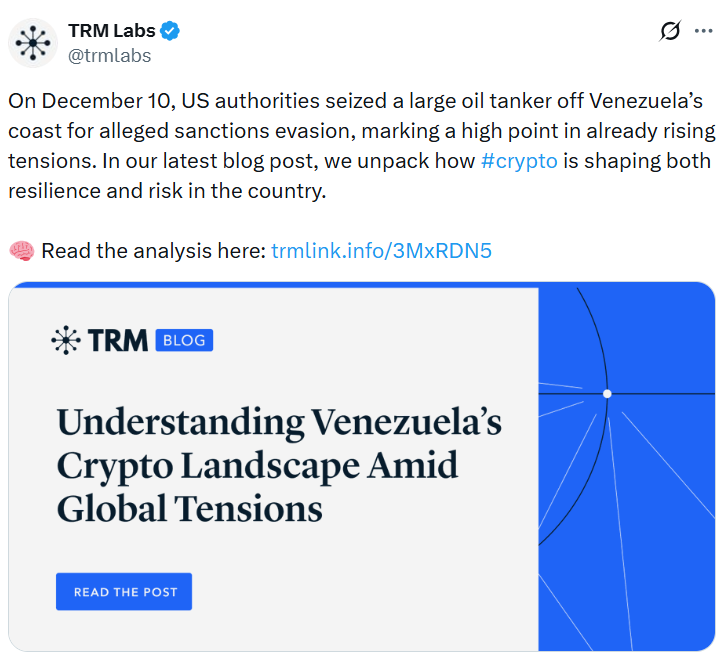
Source: TRM Labs

Venezuela is 18th globally for crypto adoption, the Chainalysis 2025 Crypto Adoption Index report found, but its rank increased to 9th when adjusted for population size.

Peer-to-peer transactions a key service for Venezuelans

Peer-to-peer (P2P), transfers made from one person to another through an intermediary, along with USDT (USDT) to-fiat conversions, have emerged as key services Venezuelans are using in the absence of reliable domestic banking channels, according to TRM Labs.

The blockchain intelligence firm tracked Venezuelan IP addresses and found that more than 38% of site visits were to a lone global platform that offers P2P trading functionality, which underscores its “role in facilitating crypto access in Venezuela’s low-banking environment.”

“A significant share of crypto-to-fiat activity is facilitated through platforms supporting informal settlement rails — even amid reports of intermittent service disruptions.”

Related: Venezuela blocks Binance, X amid presidential election dispute

“Local platforms also play a key role, particularly those offering mobile wallets and bank integrations suited to domestic users,” the team added.

Venezuela’s crypto industry created out of desperate necessity

Venezuela’s crypto ecosystem is ultimately the product of nearly a decade of economic collapse, international sanctions pressure, and state experimentation with digital financial alternatives, the TRM Labs team said.

Stablecoins, especially USDT, play a central role in household and commercial transactions in Venezuela, and despite compliance and sanction evasion concerns, stablecoins remain “overwhelmingly driven by necessity rather than speculation or criminal intent.”

“For most Venezuelans, stablecoins now operate as a substitute for retail banking — facilitating payroll, family remittances, vendor payments, and cross-border purchases in the absence of consistent domestic financial services.”

Magazine: Quantum attacking Bitcoin would be a waste of time: Kevin O’Leary

Похожее

Fei-Fei Li's Team Clarifies the Concept of 'World Models', Sora Merely a Renderer

"World Models" has become a widely used yet confusing term in AI. To address this, a team led by Fei-Fei Li and World Labs proposed a functional taxonomy based on the Partially Observable Markov Decision Process framework. This taxonomy categorizes systems called "world models" into three distinct projections: Renderers, Simulators, and Planners. Renderers, like OpenAI's Sora and other video generation models, focus on producing photorealistic visual outputs for human perception. They prioritize visual fidelity over physical accuracy. Simulators, such as NVIDIA Omniverse, aim to compute precise future environmental states for computational tasks like engineering analysis or digital twins. Planners, like Vision-Language-Action models, take in observations and goals to output executable actions for robots or agents. The article clarifies that most current "world models," including Sora, are primarily Renderers. They generate convincing visuals but lack the core ability to simulate state transitions based on actions, a key requirement for a true world model in classic reinforcement learning definitions. This conceptual confusion has practical implications, leading to potential misalignment in technology selection, investment, and public understanding of AI capabilities. Clear categorization is crucial. It helps enterprises avoid costly mistakes (e.g., using a renderer for robot training), allows investors to accurately assess markets, and enables researchers to build comparable benchmarks. While future systems may integrate these functions, recognizing current boundaries is essential for honest assessment and progress.

marsbit12 мин. назад

Fei-Fei Li's Team Clarifies the Concept of 'World Models', Sora Merely a Renderer

marsbit12 мин. назад

Bloomberg Uncovered: How Do China's Wealthy Circumvent the Annual $50,000 Limit to Transfer Assets?

**Summary: How Wealthy Chinese Circumvent $50,000 Annual Foreign Exchange Limits** Despite China's strict capital controls, including an annual $50,000 per person foreign exchange quota, an estimated $150 billion in funds still leaves the country annually via various gray and underground channels. This report outlines the evolution of China's "capital wall" and the methods used to bypass it. **The Evolving Capital Controls:** * **Foundation (1994):** The system of "current account convertibility with strict capital account controls" was established. * **Quota Set (2007):** The $50,000 individual annual forex purchase limit was formalized. * **Crackdown Begins (2015-2017):** Following market volatility, enforcement tightened. Banks were required to scrutinize transactions, and channels like using UnionPay cards for Hong Kong insurance premiums or buying overseas property were blocked. * **Digital & Legal Upgrades (2024-2026):** Enhanced algorithms now flag suspicious patterns (e.g., "smurfing"). The Common Reporting Standard (CRS) provides Chinese tax authorities with data on citizens' offshore accounts. Unlicensed cross-border brokers have been targeted. **Five Primary Methods for Moving Capital:** 1. **Underground Banking / "Hawala" (Duiqiao):** The largest-scale method. No money crosses borders. Clients pay RMB to a domestic account; an overseas associate deposits equivalent foreign currency into the client's offshore account. Risks include high fees, account freezes, and legal penalties. 2. **"Smurfing" or "Ant Moving":** Using multiple individuals' $50,000 quotas to pool funds for one offshore recipient. Increasingly detected by anti-money laundering algorithms. 3. **Trade Invoice Manipulation:** Businesses over-invoice imports or under-invoice exports via offshore shell companies, creating a pretext to transfer excess funds abroad under the guise of trade. 4. **Channel Migration:** After a crackdown on internet brokers, funds flow toward more compliant but costly channels like major banks' cross-border wealth management services or Qualified Domestic Institutional Investor (QDII) quotas. 5. **Structural Arrangements:** High-net-worth individuals use complex, high-cost legal structures involving offshore trusts, insurance, and investment migration programs to transfer asset ownership. **Regulatory Response: Focusing on People, Not Just Money** The current strategy extends oversight from enterprises to **individual residents**. Tools like CRS allow retroactive visibility into offshore assets. Cryptocurrencies, once seen as a potential loophole, are now actively monitored and prosecuted as an illegal channel. The underlying driver remains: with significant wealth concentrated among millions of affluent households seeking diversification amid domestic economic shifts, the incentive to move assets offshore persists despite regulatory barriers.

marsbit31 мин. назад

Bloomberg Uncovered: How Do China's Wealthy Circumvent the Annual $50,000 Limit to Transfer Assets?

marsbit31 мин. назад

Ethereum's Ballmer Moment: As Everyone Is Bearish, the Circulating Supply Is Disappearing

"Ethereum's Ballmer Moment: Circulation Shrinks Amid Bearish Sentiment" Amid widespread bearish sentiment, with prominent figures like Bankless founder David Hoffman selling ETH and young developers flocking to Solana, some argue Ethereum is entering its "Ballmer era"—akin to Microsoft's perceived stagnation under Steve Ballmer. While surface-level criticisms about slow protocol development, cautious leadership, and competitive pressure are valid, underlying fundamentals tell a different story. Approximately 30% of ETH is staked, major holders like BitMine are accumulating, and spot ETFs continue to absorb supply. Regulatory clarity, including the SEC/CFTC's March ruling on staking rewards and the potential passage of the CLARITY Act, is transforming crypto from a regulatory threat into a legitimized framework. This institutionalization, alongside a shrinking circulating supply (with net issuance around 0.23% annually), creates significant buy-side pressure independent of fee-based value capture. The broader crypto total addressable market is expanding through regulated stablecoins, tokenized assets, and institutional adoption. While public chains face competition from permissioned alternatives, the winning model appears to be permissioned assets settling on public chains like Ethereum and Solana. The author advocates a non-maximalist, barbell strategy: holding ETH for its institutional role and supply squeeze, SOL for consumer/throughput trends, BTC as a macro hedge, and a basket of next-gen L1s. Key bullish drivers for ETH include rapid circulation shrinkage, potential Q2 staked ETF approvals, regulatory tailwinds solidifying its role as a default settlement layer, and the optionality of an eventual "Satya moment" leadership shift. Despite bearish consensus, the current setup—where crypto is "not hot" and regulatory groundwork is being laid—presents a compelling investment opportunity. The crypto cycle's focus may have shifted to AI, but blockchain infrastructure is gaining a legal and institutional foothold precisely while attention is elsewhere.

marsbit32 мин. назад

Ethereum's Ballmer Moment: As Everyone Is Bearish, the Circulating Supply Is Disappearing

marsbit32 мин. назад

Торговля

Спот
Фьючерсы
活动图片