Following Jensen Huang's fervent endorsement, Marvell confirmed exceptionally strong AI-related orders at the Evercore TMT Summit and raised its fiscal year 2027 revenue guidance to approximately $11.5 billion. The growth expectation for its interconnect business was increased from around 50% to over 70%. Custom ASIC business is projected at about $2 billion this year, with a goal to double next year. The company's stock has surged nearly 140%-158% cumulatively since 2026, far outpacing peers and the market average, with several instances of single-day gains exceeding 30% and significantly amplified trading volume.
Most reports interpret this series of signals as Marvell solidifying its position as the leader in AI interconnect, with its data center business becoming the absolute core. However, the current growth driver remains its proven Scale-Out business, leveraging mass production advantages in PAM DSP, TIA drivers, and pluggable optical modules. The more strategically significant Scale-Up optics and CPO (Co-Packaged Optics), which represent higher value per cluster, are still preparing for mass production in 2027. The execution certainty from early deployment to forming hundreds of millions in annualized revenue by 2028 is key to judging whether the growth momentum can extend into 2028, whether the company can transition from a component supplier to a strategic partner for cloud providers, and whether the current high valuation already fully reflects optimistic expectations.
Summit Updates Show AI Orders Indeed Strong
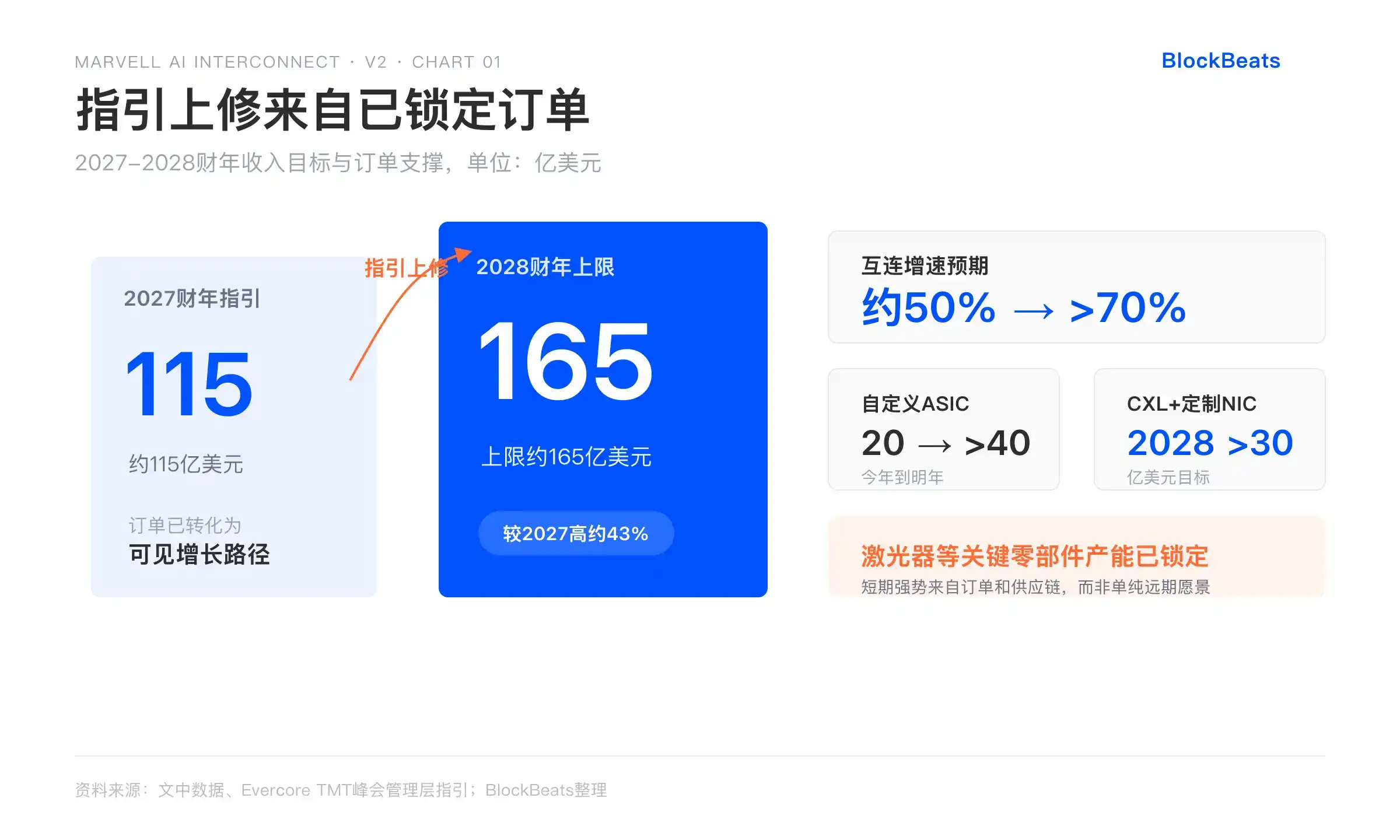
Marvell based its revised guidance at the summit on secured AI orders and locked-in supply chains, not on distant visions. Fiscal year 2027 revenue guidance was raised to about $11.5 billion, with the upper bound for 2028 further increased to approximately $16.5 billion. The interconnect business's year-over-year growth for 2027 was revised upwards to over 70%. Custom ASICs are expected to contribute around $2 billion this year, targeting over $4 billion next year, and the external CXL plus custom NIC business aims for over $3 billion by 2028.
These figures have concrete support. Management repeatedly mentioned that capital expenditure-driven demand is very robust, orders have translated into a visible growth path, key components like lasers, though facing tight lead times, have secured capacity, and PAM DSP maintains a first-to-market rhythm each generation (1.6T deployed at scale this year, 3.2T sampling next year). This aligns with the path outlined in previous earnings calls, pointing to real demand, not just optimistic projections.
However, the stock price has already traded this story aggressively in advance. Year-to-date returns far surpass industry peers and indices. Post-surge, volatility and option-implied volatility have risen simultaneously. Market discussion has shifted from identifying beneficiaries to 'how much longer can it rise?' and downside risks. This creates a stark contrast: the near-term order-driven momentum is clear, but market pricing already incorporates many mid-to-long-term optimistic assumptions.
Following the strong guidance, investors naturally question which specific businesses are driving this growth and the respective contributions from Scale-Out and Scale-Up segments.
Current Growth Driver is Mature Scale-Out Business
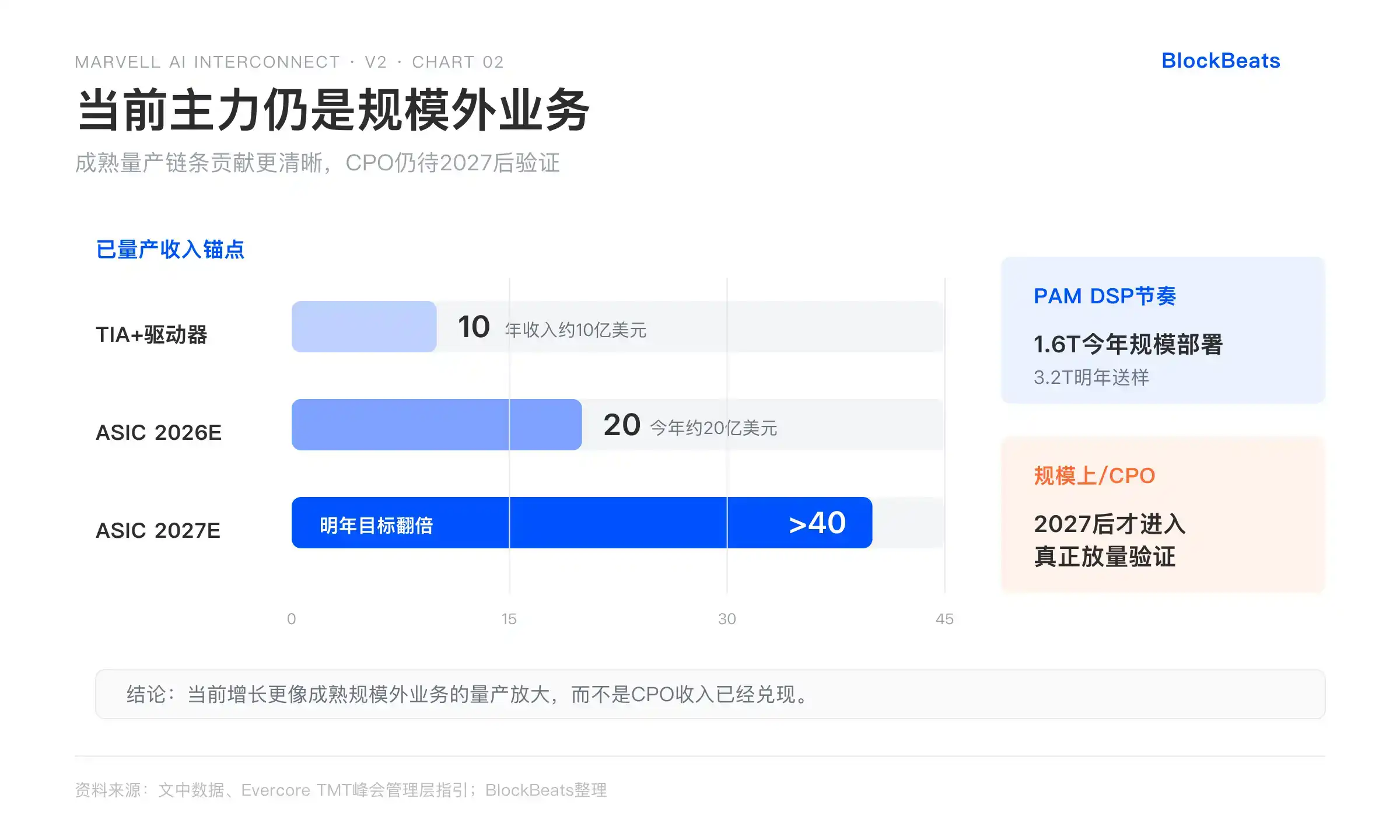
The current mainstay of the interconnect business remains the Scale-Out segment. PAM DSP, TIA drivers, and 400G, 800G, 1.6T pluggable optical modules have formed mature product lines. Being first to market each generation helps the company maintain market share, with TIA plus driver business reaching an annual revenue level of around $1 billion. Complete coverage from long-haul coherent to more streamlined high-speed PAM gives the company a favorable position in the market for horizontal scaling between data centers.
The Scale-Up business is transitioning from its start-up phase into acceleration. As AI clusters scale from tens of thousands of GPUs or XPUs to the million-unit level, front-end compute acts like an engine upgrade, while back-end interconnect is like a highway needing expansion from a single lane to multiple lanes. Internal cluster bandwidth demand is roughly 10 times that of the front-end. Power and density bottlenecks are pushing the industry from traditional pluggable optical modules toward Near-Package Optics and CPO. This shift can significantly increase chip loading per rack and expand the overall market size.
The core of CPO lies in co-packaging the optical engine with the XPU or switch, reducing electrical-to-optical conversion losses to improve bandwidth density and lower overall power consumption. This is not simply swapping a part but a system-level solution addressing the new bottlenecks of massive-scale clusters. Marvell, through SerDes IP, DSP capabilities accumulated from previous acquisitions and recently integrated Celestial AI technology, is attempting to build integration advantages in this direction. However, the current contribution from the Scale-Up business remains limited, with true volume ramp-up awaiting mass production landing after 2027.
If Scale-Up represents higher per-unit content value and market expansion opportunities, then how does Marvell's technical roadmap, capacity preparation, and ramp-up execution look in this emerging field?
How Does the CPO Mass Production Path Look Post-Celestial Acquisition?
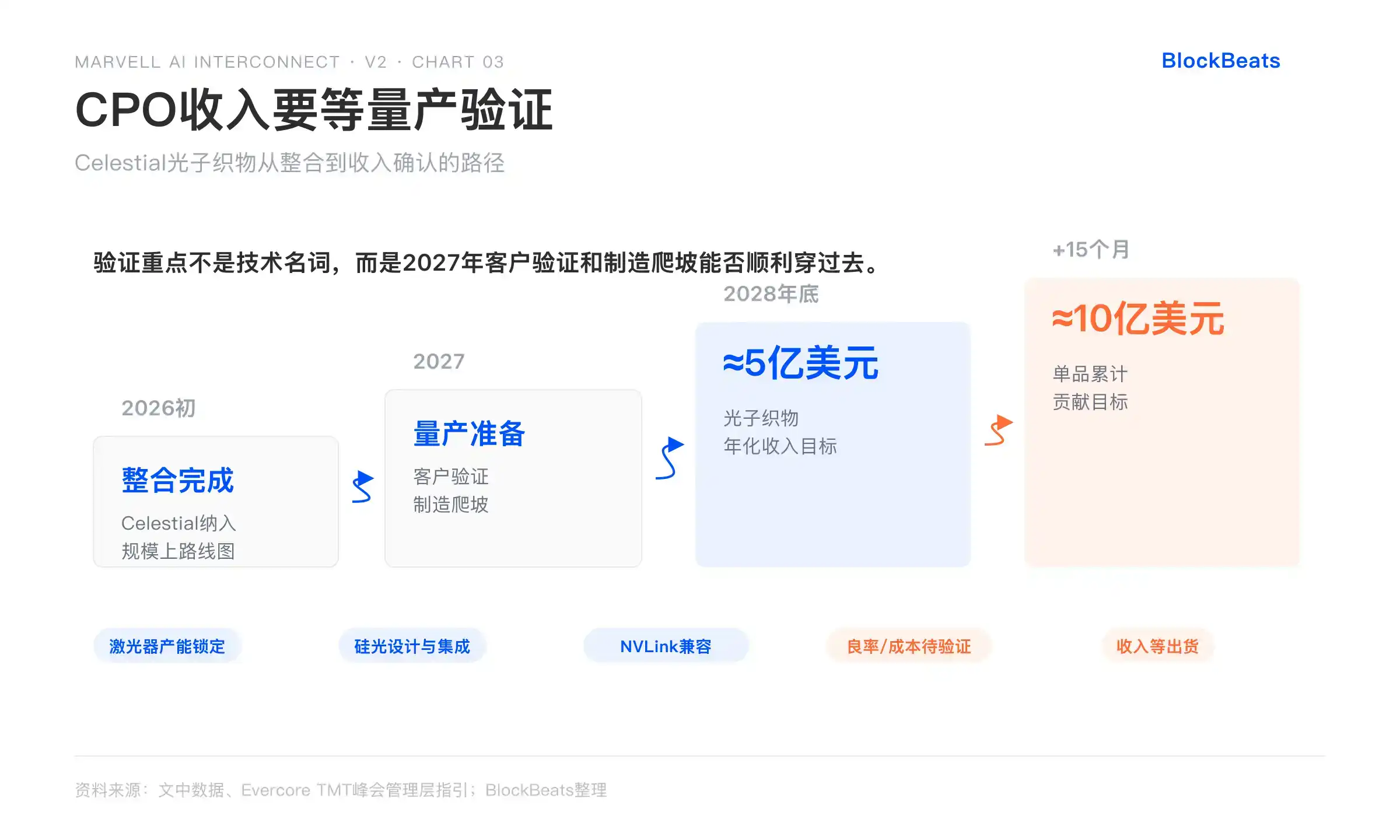
The Celestial AI acquisition was completed and integrated in early 2026. Its Photonic Fabric technology has been incorporated into Marvell's Scale-Up roadmap and will be co-packaged with custom XPUs and Scale-Up switches. Management expects to enter formal mass production preparation in 2027, targeting approximately $500 million in annualized revenue from the Photonic Fabric by the end of 2028, subsequently moving towards doubling, with a cumulative contribution of around $1 billion over 15 months (on a per-product basis). This path is somewhat optimized compared to earlier outlooks but still relies on smooth progress in customer validation and manufacturing ramp.
Supply chain details show improved certainty. Laser lead times are tight, but Marvell has secured relevant capacity. The company focuses on silicon photonics chip design and integration, not laser production itself. Collaboration with NVIDIA on NVLink Fusion further covers silicon photonics, network interoperability between custom XPUs and NVIDIA clusters, and OCTEON baseband support for AI-RAN. This not only enhances technical compatibility but also bolsters credibility in hyperscaler tenders, making Marvell's heterogeneous computing solutions more likely to be included in next-generation AI factory planning.
If million-XPU clusters widely adopt CPO, leading to significantly reduced power consumption and increased bandwidth density, it would directly increase Marvell's content value per rack and support revenue and margin expansion. Conversely, if the 2027 production ramp is slower than guidance, customer validation cycles lengthen, or yield and cost curves fall short of expectations, the 2028 contribution could be below current market-implied levels, increasing pressure to meet overall guidance. All current statements remain forward-looking guidance; actual shipments and share data will require harder validation by 2027.
With its full-stack layout from SerDes, DSP to optical engines and custom XPUs, and support from ecosystem partners, can Marvell maintain differentiation and translate it into actual share gains in the competition?
Can Marvell Maintain Its Differentiation Against Broadcom?
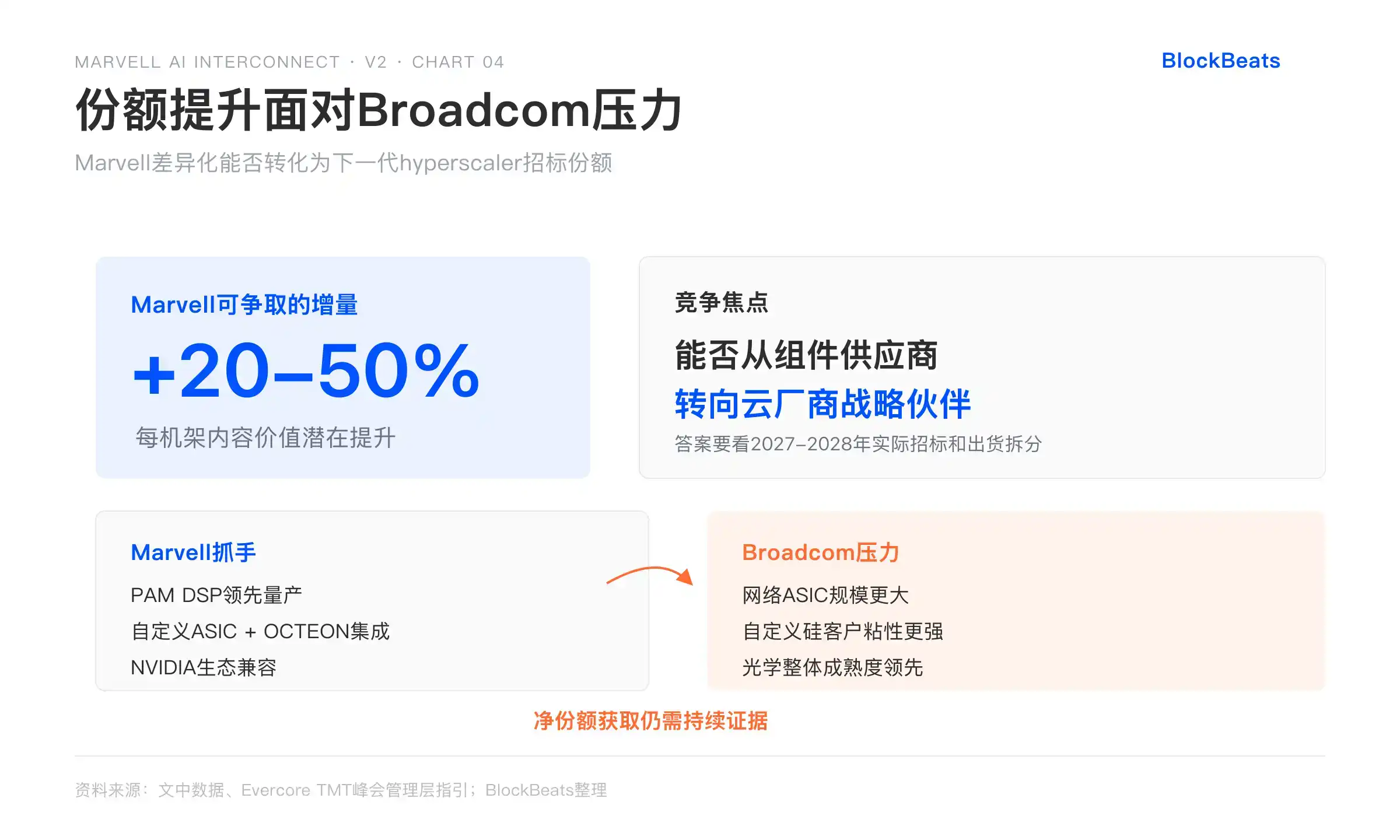
Marvell's leadership in the PAM DSP market, comprehensive coverage from long-haul coherent to 1.6T and 3.2T, and integration advantages of custom ASICs with OCTEON are real achievements. The NVIDIA collaboration also provides an additional option for heterogeneous computing. These elements give the company competitiveness in certain hyperscaler projects, especially in scenarios requiring rapid mass production and ecosystem compatibility.
However, Broadcom still maintains a clear lead in network ASICs, overall optics scale, and maturity. Broadcom's custom silicon projects are larger in scale with stronger customer stickiness. In overlapping areas of Scale-Out and Scale-Up, Marvell still needs to rely on higher integration and specific technological routes to compete for incremental share. The positioning as an "Interconnect Strategic Partner" is currently more of a goal; its ultimate realization depends on actual tender results and shipment breakdowns in 2027-2028, not the current breadth of its portfolio.
For investors, this means that in the next generation of hyperscaler tenders, Marvell's content value per rack could potentially increase by 20-50% from current levels, supporting revenue visibility and margin expansion potential. However, if the CPO ramp is slower than guidance, or if Broadcom gains an advantage in more custom projects, 2028 growth could fall short of the optimal scenario implied by the current valuation, increasing stock price correction pressure. The current high-beta nature amplifies gains driven by narrative while also amplifying volatility if execution falls short of expectations.
CPO Large-Scale Adoption Remains the Largest Unverified Variable
Despite strong AI orders, PAM's lead in mass production, and NVIDIA compatibility providing real medium-term momentum and option value, CPO, as a new technology, still faces core constraints for sustainable growth into 2028 regarding yield, cost curves, thermal management, supply chain stability, and whether hyperscaler capital expenditures can maintain the current pace. Historical experience shows that new technologies typically require multiple iterations from early mass production to generating meaningful revenue; CPO is still in this early stage.
Marvell has a decent track record of meeting guidance, but this ramp target is relatively aggressive. Valuation has already risen sharply in 2026, incorporating many best-case scenario assumptions. Increased market discussion crowding has also pushed up volatility. Broadcom's scale advantage won't disappear in the short term, and net share gains still require ongoing evidence. The current phase is one of acceleration, but early signs of late-stage crowding have emerged—sharp price swings and a shift in discussion focus towards execution pressure are manifestations of this characteristic.
Investors should not only focus on the vision presented at the summit but should closely track the actual revenue breakdown in 2027, shipment milestones, specific CPO customer validation progress, and the pace of hyperscaler capital expenditures. These variables are most likely to alter current judgments. If 2027 milestones are met strongly, the trend of structural improvement in interconnect content value will gain firmer support; if delays occur or market share falls short of expectations, high valuations will face correction pressure. The structural opportunity in AI interconnect indeed exists, and Marvell's full-stack layout provides differentiated options, but the ultimate degree of realization depends on execution details, making 2027 the key validation window.