15% of US citizens made crypto transactions as of mid-2022

cryptoslateОпубликовано 2022-12-14Обновлено 2022-12-15

Введение

JP Morgan’s recent report revealed that almost 15% of individuals in the U.S. have issued transfers into crypto accounts, according to numbers from mid-2022. The detailed demographic data also indicates that Men, Asians, and higher-income youth have the highest crypto adoption in the country.

JP Morgan’s recent report revealed that almost 15% of individuals in the U.S. have issued transfers into crypto accounts, according to numbers from mid-2022. The detailed demographic data also indicates that Men, Asians, and higher-income youth have the highest crypto adoption in the country.

JP Morgan looked into its 5 million active checking account customers and estimated the results accordingly. The report comments on the main finding and states:

“The trend has potential implications for the health of household balance sheets, given market volatility and uncertainty of how use of crypto-assets may evolve.”

Demographics

According to the numbers, the Millennials have the highest crypto adoption, with 20%. Generation X and Baby Boomers follow the Millenials as the second and third, with 11% and 4%, respectively.
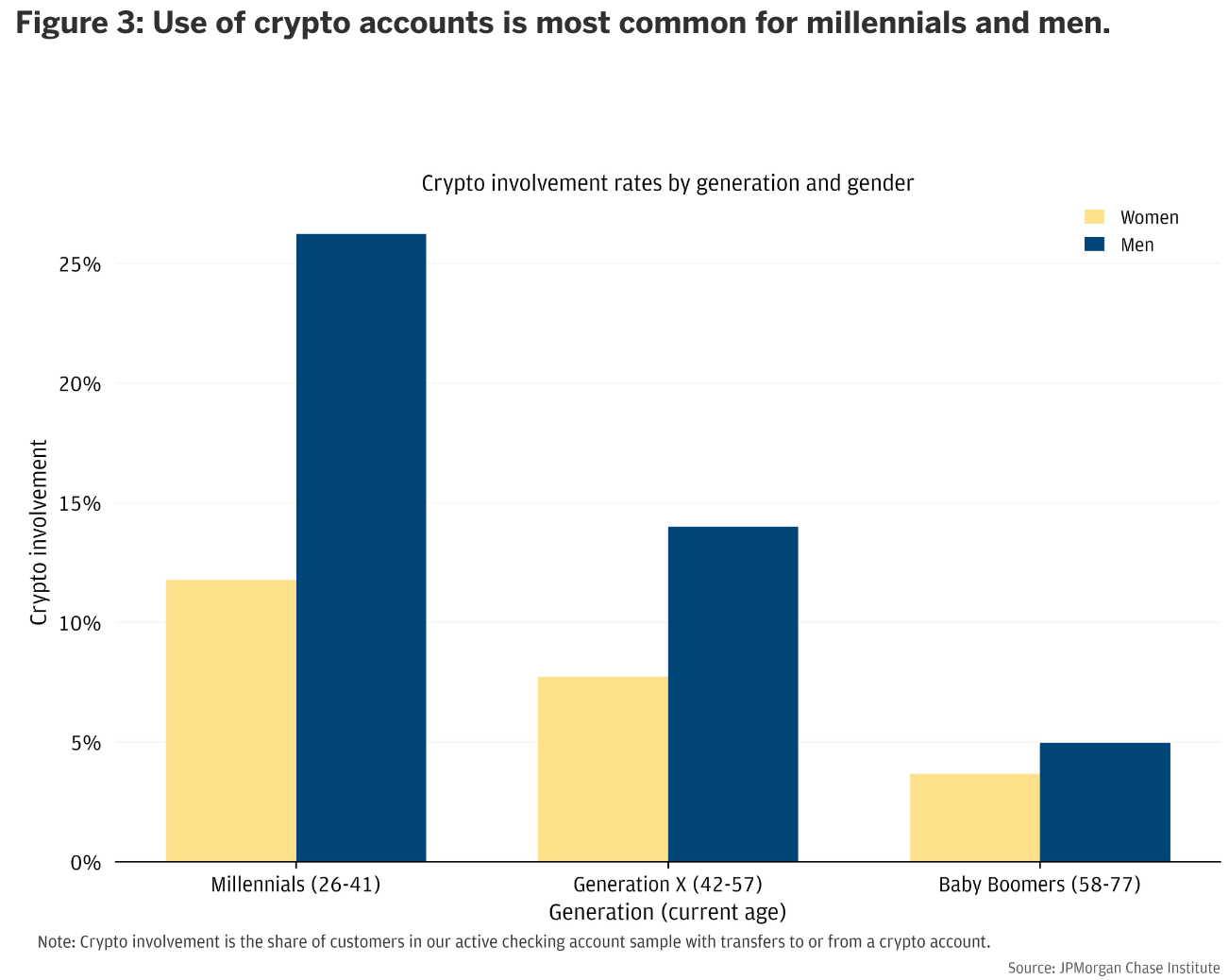
Crypto adoption by generations and gender

Crypto adoption by generations and gender

Men are represented with the blue blocks, while women are shown with the yellow ones. The data shows that men have nearly twice as much adoption as women across all generations. In addition, the median total gross transfers for men is around $1,000 and only $400 for women.

The racial statistics are focused only on the millennials since they constitute the majority of crypto users in the sample. However, the data shows that users of Asian origin have the highest involvement rate, with 27%.
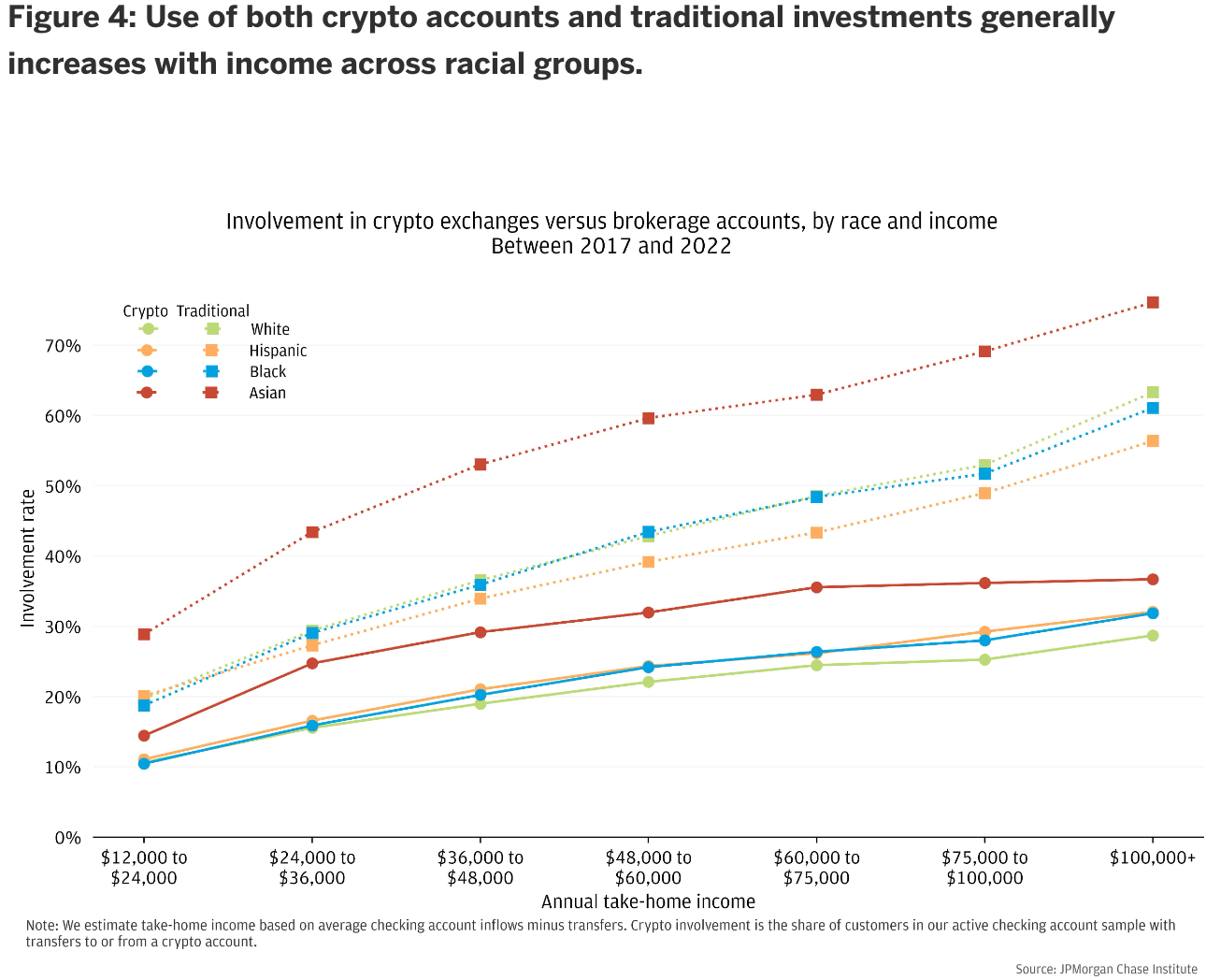
Crypto adoption by race and income

Crypto adoption by race and income

Hispanic and Black users shared the second place with 21% adoption, while users identified as White appeared to have the lowest adoption rate with around 10%.

Income

Racial statistics also proved that the amount transferred into a crypto-related account increased as the users’ income increased, regardless of race.

The correlation between the income and the amount transferred to a crypto account is valid for all individuals in the sample. While acknowledging that the level of crypto engagement is higher for higher-income individuals, the report also stated that the median gross amount transferred to crypto across the sample is around $620.

Crypto users surge during peak market.

According to the report, the number of users who transferred funds into a crypto account tripled during the COVID-19 crisis.
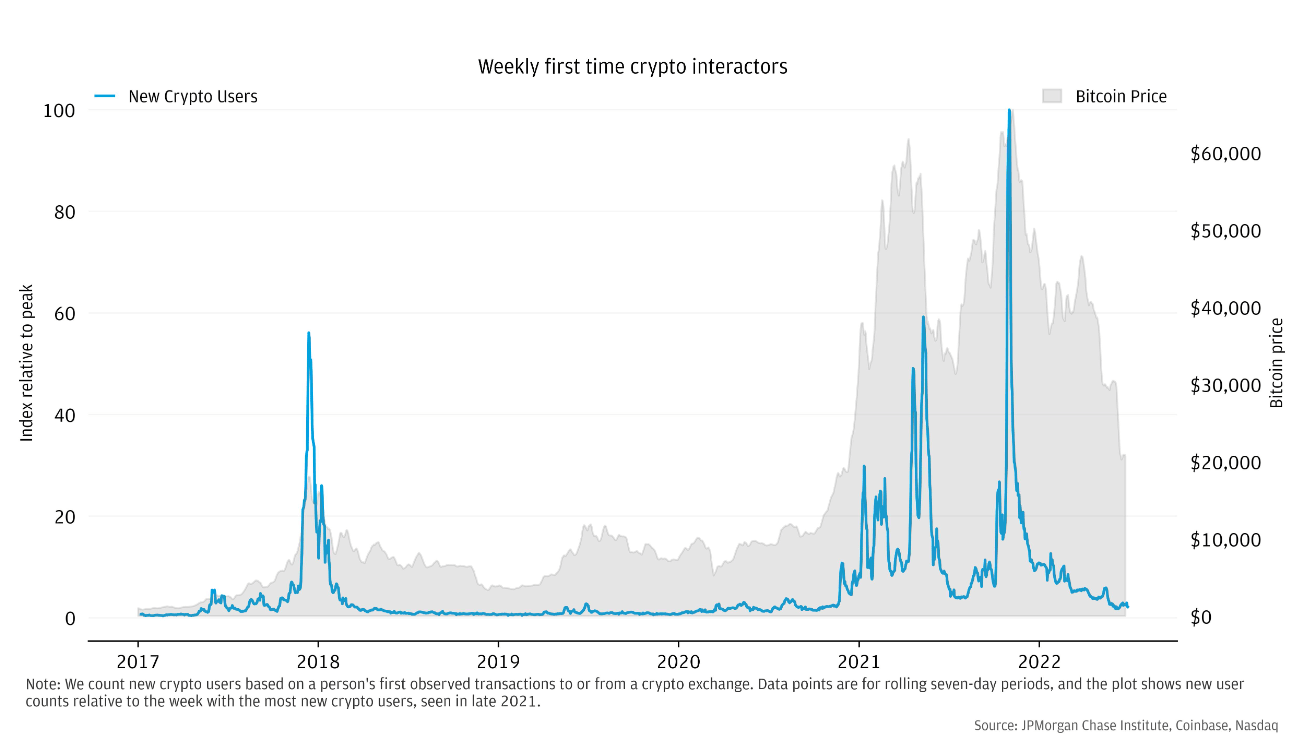
Fist time crypto users 2017-2022

First-time crypto users 2017-2022

Most users issued their first transactions during the same five months, corresponding with the peak BTC price.

The data also revealed that individuals in the highest income group purchased crypto while the prices were relatively low. On the other hand, users in the lowest income group purchased from the higher price levels, which suggests lower investment returns.
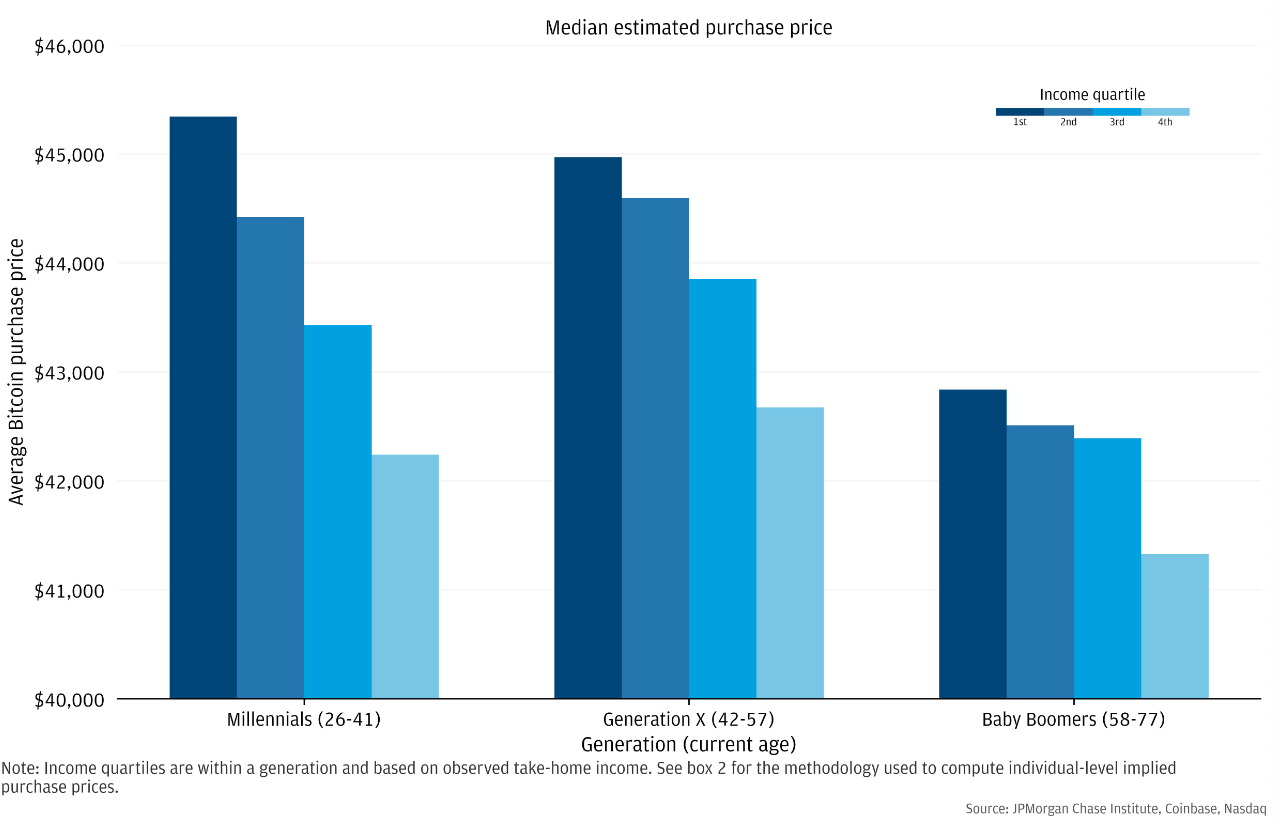
BTC prices and first-time crypto purchases based on income quartiles for millennials

BTC prices and first-time crypto purchases based on income quartiles for millennials

The chart above only considers the millennials and groups them based on their gross income levels. The lowest income quartile appears to have purchased crypto for the first time while the BTC price was lingering around $45,500.

On the other hand, members of the highest income quartile had purchased crypto when BTC was as low as $42,400.


Похожее

More and More People Are Using Xiaohongshu as an AI Incubator

"More and more people are turning Xiaohongshu into an AI incubator," observes an article exploring a shift in China’s tech innovation landscape. The AI wave is no longer dominated by experienced tech experts; instead, young people—often with humanities backgrounds, and increasingly Gen Z or even younger—are driving creativity. This reflects a broader trend: AI is transforming entrepreneurship from a capital-heavy, top-down model into a lightweight, accessible process. The rise of "AI Native" creators was highlighted at a recent Xiaohongshu hackathon, where diverse teams showcased projects targeting highly specific, everyday problems—from AI-generated PPT improvements to brain-controlled wheelchairs and apps that simplify communication with hairstylists. The winning project, "Pocket Guitar," offers a portable, user-friendly music tool that mimics real guitar playing. These innovators embrace a "Build in Public" approach: they share ideas, progress, and failures openly on Xiaohongshu, turning development into a collaborative, community-driven process. This method helps validate demand, recruit team members, and grow user bases organically. For instance, one 23-year-old founder assembled a distributed team through technical discussions on the platform, while a 13-year-old award winner used AI to learn coding and solve real-world problems. Two key factors enable this movement: AI democratization (lowering technical barriers) and the power of social communities (enabling open collaboration and instant feedback). Xiaohongshu, originally a lifestyle and shopping guide platform, has thus evolved into a vital innovation infrastructure. It connects creators with real user needs, facilitates low-cost prototyping, and fosters a culture of co-creation. This shift signals a new era of innovation—defined not by grand narratives and scale, but by granular insights, individual creativity, and trust-based community support. Xiaohongshu’s role is expanding from answering "what to buy" to "what to create," positioning it as a potential "App Store for the AI era."

marsbit20 мин. назад

More and More People Are Using Xiaohongshu as an AI Incubator

marsbit20 мин. назад

Institutional Adoption of Prediction Markets Stuck at the Third Stage

Prediction markets are transitioning from niche platforms focused on elections and sports to mainstream financial tools, as highlighted at Kalshi Research's inaugural conference. While sports still dominate trading volume (around 80%), non-sports categories like macroeconomics, politics, and entertainment are growing faster, signaling a shift from entertainment-based trading to information and risk management tools. Institutions, including Wall Street firms, are increasingly using prediction markets for data reference (Stage 1 adoption), with some progressing to system integration (Stage 2). However, full-scale trading (Stage 3) is limited due to the lack of margin trading, requiring full collateral for positions—a barrier for leverage-dependent entities. Kalshi is working with regulators to introduce margin mechanisms. Key insights from participants like Goldman Sachs and CNBC emphasize the value of real-time pricing for events (e.g., Fed decisions, tariffs), providing benchmarks previously unavailable. The path to maturity mirrors historical financial instruments like options, with expectations that prediction markets will become institutional staples within five years. Political leaders, including Trump and Schumer, now cite Kalshi odds, underscoring its growing influence. The platform rewards domain expertise over traditional finance backgrounds, attracting diverse participants from fields like music and poker. Ultimately, prediction markets are evolving into critical infrastructure for pricing uncertainty.

marsbit58 мин. назад

Institutional Adoption of Prediction Markets Stuck at the Third Stage

marsbit58 мин. назад

Торговля

Спот
Фьючерсы
活动图片