$55,000 Will Be Bitcoin's Make-or-Break Line

marsbitОпубликовано 2026-02-10Обновлено 2026-02-10

Введение

Bitcoin is currently testing a critical threshold at $55,000, which may determine the structural integrity of its four-year market cycle. Historical data shows diminishing peak-to-peak growth multiples: 15.9× (2013–2017), 3.5× (2017–2021), and a projected 1.8× for the current cycle (2021–2025). This compressed upside—coupled with a recent drawdown exceeding 44% from the anticipated peak of ~$126,000 to ~$60,000—threatens the sustainability of Bitcoin’s long-term growth model. A drop below $55,000 would imply a 56% retracement and break key technical supports, including the 3000-day trendline and the previous cycle’s all-time high of $69,000. Such a breach could signal the failure of the classic cycle model, where high volatility no longer justifies reduced returns. The market now faces three potential paths: glory (reduced volatility, stabilized growth), destruction (cycle model breakdown), or reset (new demand drivers like sovereign adoption or structural capital inflows). The outcome hinges on whether Bitcoin can hold above $55,000. If it fails, the historical cycle framework may be irreparably broken.

Original Author: Dom

Original Compilation: Luffy, Foresight News

Bitcoin's price touched $60,000 last week. Under the model of diminishing returns, this is by no means simple noise. The market is touching the most fragile link in the entire four-year cycle and the logarithmic growth framework.

When the gains at the peak of Bitcoin's cycle have been severely compressed, if there is another historically deep correction, the appeal of its classic cycle will be completely lost.

This is not a prediction; it is mathematical law.

Cycle Peak Gains Are Compressing

Historical peaks of Bitcoin cycles:

  • 2013: ~$1,242
  • 2017: ~$19,700
  • 2021: ~$69,000
  • 2025: ~$126,000

Multiples of gains between cycle peaks:

  • 1,242 → 19,700 = 15.9x
  • 19,700 → 69,000 = 3.5x
  • 69,000 → 126,000 = 1.8x (weakest in history)
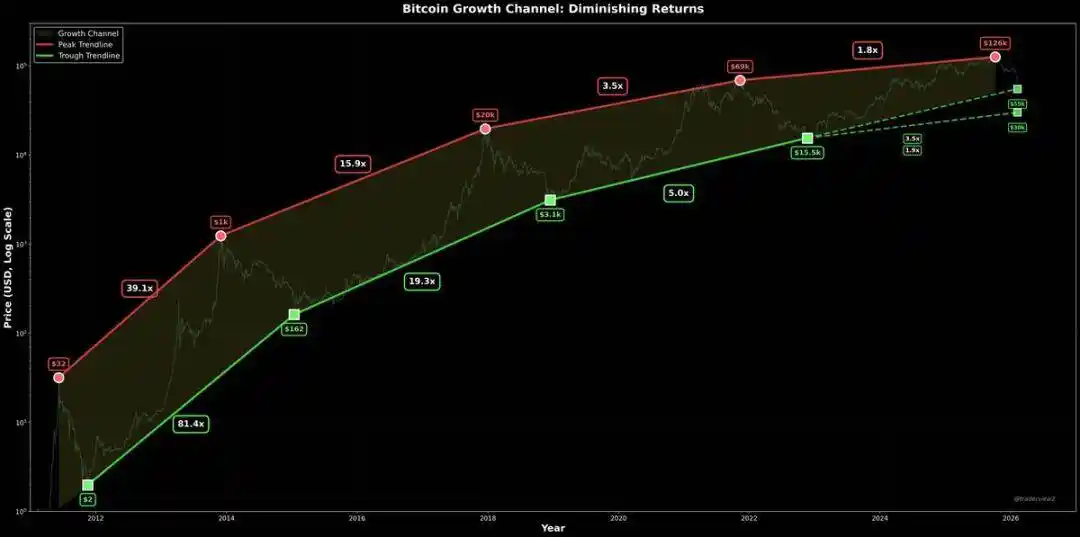
This 1.8x says it all. Compared to history, the upside potential in this cycle is minimal. This pattern cannot withstand a significant drop; otherwise, Bitcoin's growth will completely flatten.

This 1.8x gain is the core truth of the current market. Relative to historical levels, Bitcoin's upside space is now extremely narrow. This cycle pattern can no longer withstand a major pullback; otherwise, Bitcoin's long-term growth momentum will completely stall.

Pure Mathematical Constraint Formula

Definitions:

  • m = Cycle peak multiple = Current cycle peak ÷ Previous all-time high
  • d = Drawdown from peak (as a decimal)

Then, the bottom level of the next cycle relative to the previous high equals the current peak gain multiple multiplied by the remaining price proportion after the drawdown.

To ensure the bottom of the next cycle is not lower than the previous all-time high, the following condition must be met:
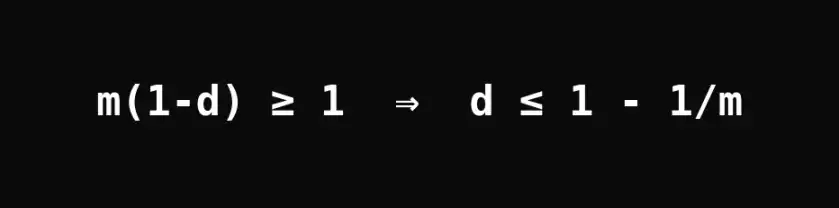
Substituting current cycle data: Previous ATH ≈ $69,000, Current cycle peak ≈ $126,000, we get:

Current peak multiple ≈ 1.8x. To maintain an intact bull market structure, the maximum allowed drawdown is approximately 44%. Currently, Bitcoin's drawdown has broken through this critical value.

Falling from about $126,000 to $60,000, Bitcoin's drawdown has exceeded the 44% "safety limit."

This means that if the previous all-time high was supposed to act as structural support, the current market is forcibly breaking through this support, forcing the market to a final conclusion.

$55,000 is the Key Make-or-Break Line

If Bitcoin falls to $55,000, two key signals will appear:

  • A drawdown of 56%, far exceeding the 44% allowed upper limit
  • The bottom price will be 20% lower than the previous all-time high ($69,000)

Once the price stays below $55,000, it means the market accepts that in this weak cycle with only a 1.8x gain, the cycle bottom can be significantly lower than the previous all-time high.

The subsequent impact will be: If the next cycle still maintains a 1.8x gain multiple, Bitcoin's price will rise from $55,000 to $99,000, and long-term growth momentum will stagnate. This is essentially a structural failure of the growth model; the market must change.

This is the core contradiction: Bitcoin's profit space has been severely compressed, but its volatility has not decreased proportionally. It's still a highly volatile market, but the peak gains have shrunk drastically. Such a cycle model is simply unsustainable.

Technical Support Near $55,000
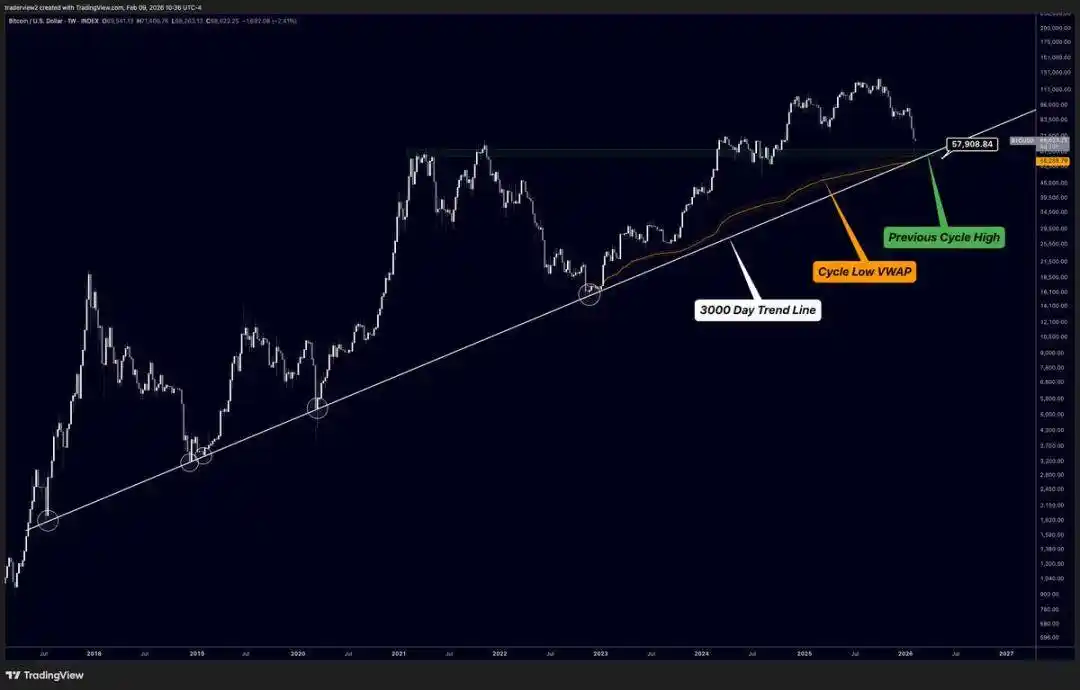
From a technical perspective, the mid-$55,000 range has extremely strong structural support, mainly including:

  • The 3000-day trendline (spanning over 8 years)
  • The Volume-Weighted Average Price (VWAP) of the 2022 cycle low
  • Support extension from the previous cycle's all-time high ($69,000)

Let's ponder: Why would an asset whose core belief is "long-term ultra-high returns" break below this triple structural support built up over years? Especially with the formal launch of convenient investment channels like ETFs, such a trend is completely contrary to the long-term growth trajectory.

The Cliff of Risk-Adjusted Returns

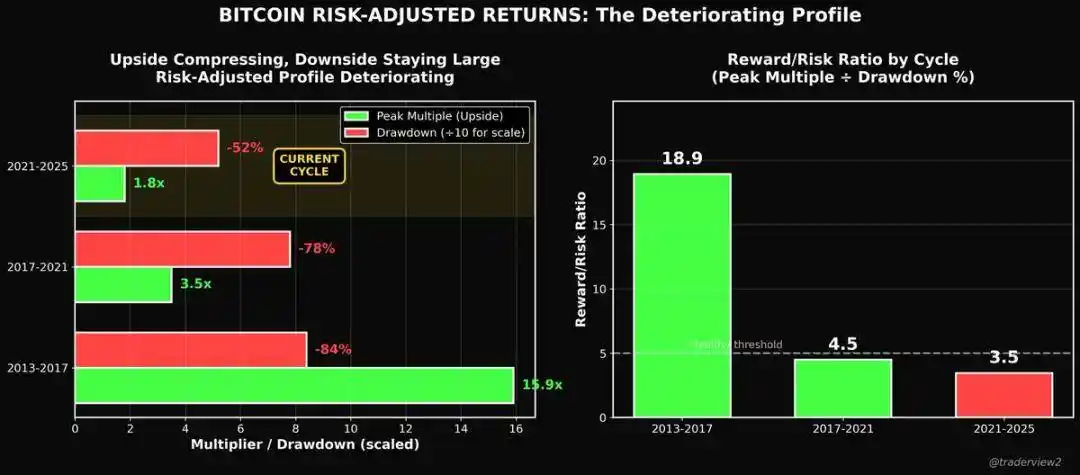
This contradiction makes Bitcoin's entire cycle logic black and white: If the cycle peak multiple continues to shrink, but the drawdown magnitude does not shrink proportionally, Bitcoin's risk-reward ratio will completely deteriorate:

  • The potential upside of the four-year cycle is only 20% to 50%
  • The downside risk could still reach 50%
  • Cycle trading would completely lose its meaning.
Faced with this dilemma, the market has only three ways out:

  • Volatility contracts significantly (Path to Glory)
  • The four-year cycle framework completely fails (Path to Ruin)
  • A new demand driver emerges, resetting the growth curve and ending the trend of decaying gain multiples

ETFs are the most commonly mentioned potential driver, but they have already been launched. To truly reset the growth curve, three types of power are needed more: large-scale structural capital allocation, adoption at the sovereign national level, or sustained, price-insensitive rigid demand.

The Harsh Reality: Why This Cycle is So Different

When I entered the crypto market in 2017, the entire industry was full of hope and innovative vitality. People firmly believed these blockchain networks could bring real solutions to the world.

Nearly nine years later, it's hard to say that any large crypto ecosystem has truly achieved sustainable mainstream utility value matching the initial promises.

This cycle has harvested countless participants; the vast majority of tokens have performed almost nothing. More and more people are realizing the truth of the market: For the vast majority of crypto assets, this is essentially a PvP game where participants rely on leverage, liquidations, and capital rotation to profit from other participants, not from the value growth of the assets themselves.

The market's selection rule has never failed: In the long run, the vast majority of cryptocurrencies will eventually go to zero. Bitcoin, along with a few quality assets in the crypto space, still has a chance to escape this fate and achieve true value breakthrough.

The Choice Between Glory and Ruin

Path to Glory

Bitcoin achieves "breaking the circle and upgrading": Volatility contracts significantly, drawdowns are far below historical levels, and the previous all-time high region re-establishes itself as solid structural support. Although the cycle peak multiple shrinks, the asset's stability improves significantly, the risk-reward ratio optimizes greatly, and it truly becomes a sustainable long-term investment.

Path to Ruin

The four-year cycle framework completely fails. It's not that Bitcoin itself perishes, but the cycle logic that has sustained it for years no longer holds. Volatility remains at historical highs, but the profit space continues to compress. The previous all-time high no longer acts as a bottom support. The past growth channel becomes a historical relic. Bitcoin may still experience阶段性上涨 (periodic rises) in the future, and may continue to gain adoption, but the former cycle规律 (laws) will no longer be the dominant rules of the market.

Path to Reset

A全新的 (brand new) demand driver强势出现 (forcefully emerges), completely breaking the model of decaying gain multiples and reshaping Bitcoin's growth curve. This could come from large-scale structural capital allocation, widespread adoption by sovereign nations, or passive buying by institutional funds forming long-term support.

Additional Hidden Danger: The Long-Term Test at the Protocol Layer

This is not a core factor affecting the current market, but it is worth long-term attention: In the long run, Bitcoin must prove that it can evolve at the protocol layer, especially possessing quantum resistance. The core of the quantum issue concerns the security of Bitcoin ownership and protocol upgrade coordination, not mining itself. The security of early Bitcoin (like Satoshi's holdings) is the real potential threat.

If Bitcoin hopes to become a long-lasting asset, it must ultimately pass the test of "completing protocol upgrades without破坏市场信任 (destroying market trust)". This is like a background timer, not yet triggered, but始终是 (always is) an important hidden danger for Bitcoin's long-term development.

Simple Judgment Criteria

If, after the washout, Bitcoin reclaims and holds firmly above $69,000: The cycle structure is preserved, and the path to glory remains highly possible.

If Bitcoin's price remains in the $55,000 to $69,000 range: The market is under maximum pressure, and the cycle model faces its final test.

If Bitcoin's price stays consistently below $55,000: Against the backdrop of a weak cycle with a 1.8x peak multiple, a structural breakdown occurs, and the market structure is highly likely to undergo a fundamental change.

Conclusion

Bitcoin cannot long-term possess two traits simultaneously: low-gain asset, high-drawdown asset. If risk-adjusted returns still have meaning, the two cannot coexist long-term.

Bitcoin's touch near $60,000 is the market testing this life-and-death boundary in real time. Once the price falls below the $50,000 range, all debates will end, and the market will deliver its final verdict, either走向荣耀 (heading towards glory) or坠入毁灭 (plunging into ruin).


Связанные с этим вопросы

QWhat is the critical price level for Bitcoin according to the article, and why is it considered a 'life or death' line?

AThe critical price level is $55,000. It is considered a 'life or death' line because if Bitcoin falls and sustains below this level, it would signify a structural breakdown of its long-term logarithmic growth model. A drop to $55,000 represents a 56% drawdown from the projected cycle peak of ~$126,000, far exceeding the mathematically 'safe' maximum drawdown of 44% required to keep the bull market structure intact. This would mean the cycle low has fallen below the previous all-time high (~$69,000), potentially leading to a complete failure of the classic four-year cycle framework and a stagnation of Bitcoin's long-term growth trajectory.

QWhat are the three potential paths (outcomes) for Bitcoin's future that the article outlines?

AThe article outlines three potential paths for Bitcoin's future: 1. The Path to Glory: Bitcoin 'breaks through' with significantly reduced volatility and drawdowns. The previous all-time high becomes solid structural support, and it transforms into a sustainable long-term investment despite smaller cycle peaks. 2. The Path to Ruin: The four-year cycle framework completely fails. Volatility remains high while potential gains shrink further. The previous growth channel becomes a historical relic, and the old cyclical规律 are no longer the market's dominant rules. 3. The Path to Reset: A new, powerful demand driver emerges (e.g., massive structural capital allocation, sovereign adoption) that resets the growth curve and breaks the trend of diminishing peak multiples.

QAccording to the mathematical constraint formula, what is the maximum allowed drawdown from the projected cycle peak to maintain the bull market structure, and what is the current situation?

AAccording to the mathematical constraint formula, the maximum allowed drawdown from the projected cycle peak (~$126,000) to maintain the bull market structure (i.e., ensuring the next cycle's bottom doesn't fall below the previous all-time high of ~$69,000) is approximately 44%. The current situation is that Bitcoin's drawdown has already breached this critical 'safety limit,' having fallen from ~$126,000 to around $60,000, which is a drawdown of over 44%.

QWhat does the compression of cycle peak multiples (from 15.9x to 3.5x to 1.8x) indicate about Bitcoin's market?

AThe compression of cycle peak multiples from 15.9x (2013-2017) to 3.5x (2017-2021) to a projected 1.8x (2021-2025) indicates that Bitcoin's potential upside gains in each four-year cycle are diminishing dramatically. This 'weakest ever' 1.8x multiple suggests that the market's upward space is extremely narrow compared to its historical performance. This compressed growth model cannot withstand significant price retracements without risking the complete flattening of Bitcoin's long-term growth trend and the potential failure of its classic cyclical model.

QWhat underlying contradiction does the article highlight regarding Bitcoin's current market profile?

AThe article highlights a core contradiction: Bitcoin's potential reward space (upside gains per cycle) has been severely compressed, but its volatility (the magnitude of price swings and drawdowns) has not decreased proportionally. It remains a highly volatile asset while offering dramatically reduced peak gains. This combination of high risk (large potential losses) and low reward (small potential gains) creates an unsustainable and severely worsened risk-adjusted return profile, which fundamentally threatens the logic and appeal of trading based on its four-year cycles.

Похожее

Why Do You Always Lose Money on Polymarket? Because You're Betting on News, While the Pros Read the Rules

Why do you always lose money on Polymarket? Because you bet on news, while the pros study the rules. This article explains how top traders ("che tou") profit by meticulously analyzing market rules, not just predicting events. Polymarket, a prediction market platform, often sees disputes over event outcomes due to ambiguous rule wording. For instance, a market asking "Who will be the leader of Venezuela by the end of 2026?" was misinterpreted by many who bet on Delcy Rodríguez, assuming she held power. However, the rules specified "officially holds" as the formally appointed, sworn-in individual. Since Nicolás Maduro was still recognized as president officially, he won the market—even being in prison. To resolve such disputes, Polymarket uses a decentralized arbitration system via UMA protocol. The process involves: 1. Proposal: Anyone can propose a market outcome by staking 750 USDC, earning 5 USDC if unchallenged. 2. Dispute: A 2-hour window allows challenges with a 750 USDC stake; successful challengers earn 250 USDC. 3. Discussion: A 48-hour period on UMA Discord for evidence and debate. 4. Voting: UMA token holders vote in two 24-hour phases (blind then public). Outcomes require >65% consensus and 5M tokens voted; otherwise, four re-votes occur before Polymarket intervention. 5. Settlement: Results are final and automatic. Unlike traditional courts, Polymarket’s system lacks separation between arbitrators and stakeholders—voters often hold market positions, creating conflicts of interest. This leads to herd mentality in discussions and non-transparent outcomes without explanatory rulings, preventing precedent formation. Thus, success on Polymarket hinges on deep rule interpretation, not just event prediction, exploiting gaps between reality and contractual wording.

marsbit1 ч. назад

Why Do You Always Lose Money on Polymarket? Because You're Betting on News, While the Pros Read the Rules

marsbit1 ч. назад

DeepSeek Funding: Liang Wenfeng's 'Realist' Pivot

DeepSeek, a leading Chinese AI company, has initiated its first external funding round, aiming to raise at least $300 million at a valuation of no less than $10 billion. This move marks a significant shift from its founder Liang Wenfeng’s previous idealistic stance of rejecting external capital to maintain independence. Despite strong financial backing from its parent company, quantitative trading firm幻方量化 (Huanfang Quant), which provided an estimated $700 million in revenue in 2025 alone, DeepSeek faces mounting challenges. Key issues include a 15-month gap in major model updates, delays in its flagship V4 release, and the loss of several core researchers to competitors offering significantly higher compensation. The company is also undergoing a strategic pivot by migrating its infrastructure from NVIDIA’s CUDA to Huawei’s Ascend platform, a move aligned with China’s push for technological self-reliance amid U.S. export controls. However, DeepSeek lags behind rivals like智谱AI and MiniMax—both now publicly listed—in areas such as product ecosystem, multimodal capabilities, and commercialization. The funding round, though relatively small in scale, is seen as a way to establish a market-validated valuation anchor, making employee stock options more competitive and facilitating talent retention. It also signals DeepSeek’s transition from a pure research-oriented organization to a commercially-driven player in the global AI ecosystem.

marsbit1 ч. назад

DeepSeek Funding: Liang Wenfeng's 'Realist' Pivot

marsbit1 ч. назад

Торговля

Спот
Фьючерсы

Популярные статьи

Как купить S

Добро пожаловать на HTX.com! Мы сделали приобретение Sonic (S) простым и удобным. Следуйте нашему пошаговому руководству и отправляйтесь в свое крипто-путешествие.Шаг 1: Создайте аккаунт на HTXИспользуйте свой адрес электронной почты или номер телефона, чтобы зарегистрироваться и бесплатно создать аккаунт на HTX. Пройдите удобную регистрацию и откройте для себя весь функционал.Создать аккаунтШаг 2: Перейдите в Купить криптовалюту и выберите свой способ оплатыКредитная/Дебетовая Карта: Используйте свою карту Visa или Mastercard для мгновенной покупки Sonic (S).Баланс: Используйте средства с баланса вашего аккаунта HTX для простой торговли.Третьи Лица: Мы добавили популярные способы оплаты, такие как Google Pay и Apple Pay, для повышения удобства.P2P: Торгуйте напрямую с другими пользователями на HTX.Внебиржевая Торговля (OTC): Мы предлагаем индивидуальные услуги и конкурентоспособные обменные курсы для трейдеров.Шаг 3: Хранение Sonic (S)После приобретения вами Sonic (S) храните их в своем аккаунте на HTX. В качестве альтернативы вы можете отправить их куда-либо с помощью перевода в блокчейне или использовать для торговли с другими криптовалютами.Шаг 4: Торговля Sonic (S)С легкостью торгуйте Sonic (S) на спотовом рынке HTX. Просто зайдите в свой аккаунт, выберите торговую пару, совершайте сделки и следите за ними в режиме реального времени. Мы предлагаем удобный интерфейс как для начинающих, так и для опытных трейдеров.

1.1k просмотров всегоОпубликовано 2025.01.15Обновлено 2025.03.21

Как купить S

Sonic: Обновления под руководством Андре Кронье – новая звезда Layer-1 на фоне спада рынка

Он решает проблемы масштабируемости, совместимости между блокчейнами и стимулов для разработчиков с помощью технологических инноваций.

2.2k просмотров всегоОпубликовано 2025.04.09Обновлено 2025.04.09

Sonic: Обновления под руководством Андре Кронье – новая звезда Layer-1 на фоне спада рынка

HTX Learn: Пройдите обучение по "Sonic" и разделите 1000 USDT

HTX Learn — ваш проводник в мир перспективных проектов, и мы запускаем специальное мероприятие "Учитесь и Зарабатывайте", посвящённое этим проектам. Наше новое направление .

1.8k просмотров всегоОпубликовано 2025.04.10Обновлено 2025.04.10

HTX Learn: Пройдите обучение по "Sonic" и разделите 1000 USDT

Обсуждения

Добро пожаловать в Сообщество HTX. Здесь вы сможете быть в курсе последних новостей о развитии платформы и получить доступ к профессиональной аналитической информации о рынке. Мнения пользователей о цене на S (S) представлены ниже.

活动图片