NVIDIA's AI Sweeps ARC-AGI-3, Chinese-Led Team Aces All 183 Levels in One Go

marsbitОпубликовано 2026-08-24Обновлено 2026-08-24

Введение

NVIDIA's general-purpose coding agent AVO has achieved a perfect 100.00 RHAE score on the ARC-AGI-3 benchmark. It solved all 183 levels across 25 game environments in just 6,624 steps. ARC-AGI-3 is a notoriously difficult test where agents are placed into unfamiliar games with no instructions, forcing them to deduce rules and goals through trial and observation. Top models like Claude Opus 5 typically score only around 30% when acting alone. AVO's breakthrough comes not from improving the underlying AI model (Claude Opus 5), but from adding an intelligent external framework or "harness" around it. This framework addresses three key failure modes: misunderstanding global rules, misapplying familiar mechanics, and failing to learn correctly from success. Two core mechanisms drive AVO's performance: 1. **Persistent Memory:** It stores past attempts, compiler outputs, and reasoning across tasks, preventing the model from resetting and re-exploring dead ends when its context window fills. 2. **Supervisor Agent:** A separate module monitors the main agent's progress, intervening to redirect strategy when it gets stuck or repeats unproductive actions. Notably, AVO processed the visual game environments using a pure 64x64 text grid representation, without any image tokens. Originally developed for GPU kernel optimization, AVO autonomously evolved CUDA code for 7 days, producing attention kernels that outperformed NVIDIA's own cuDNN and the leading open-source implementation, F...

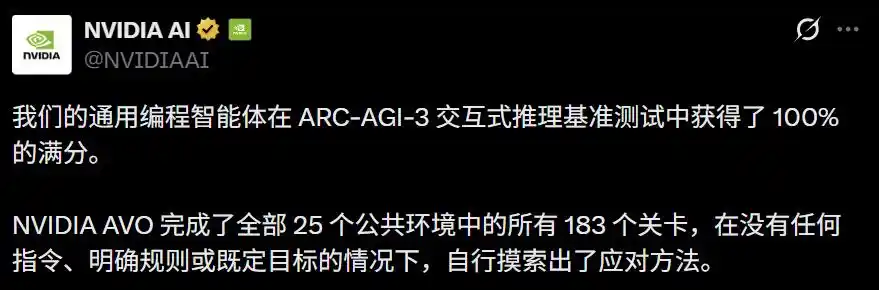
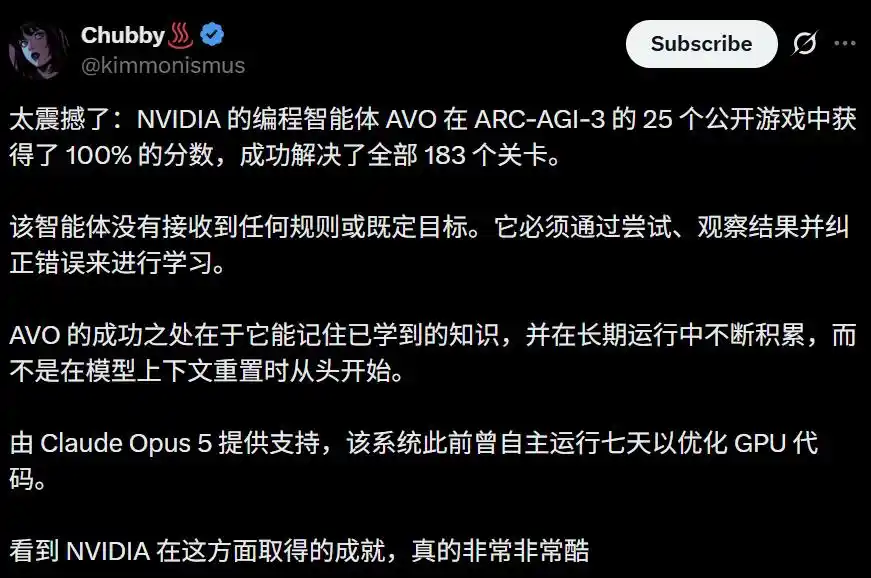
Just moments ago, NVIDIA's general-purpose coding agent AVO achieved a perfect score on ARC-AGI-3!

It cleared all 183 levels across 25 game environments, using only 6624 steps in total, achieving an RHAE score of 100.00.
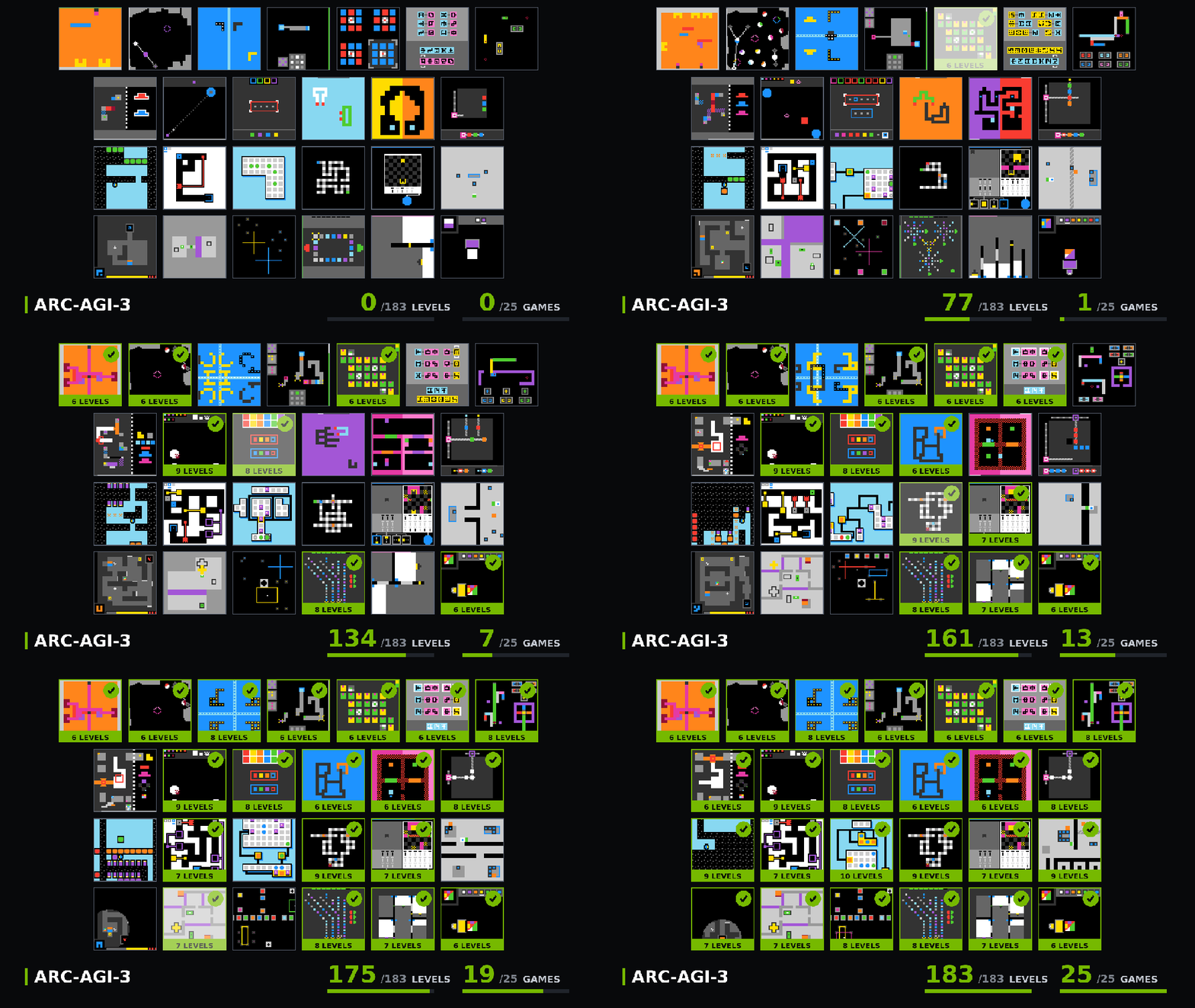
It's important to note that ARC-AGI-3 is notoriously unforgiving. It drops the agent directly into an unfamiliar game, providing no rules or objectives, forcing it to press, observe, and guess on its own.

Some environments allow movement up, down, left, or right, navigating through corridors; hitting a dark blue block rotates the entire screen 90 degrees. Others don't even allow movement, only clicking, relying on clicks to cycle tile colors into the target pattern.


Each environment has at least six levels, getting progressively harder; a level solvable in five steps at the beginning might require fifty steps by the sixth level.

The agent only has access to a 64×64 grid and a few buttons.

Cutting-edge models trying to brute-force their way through simply cannot handle it.

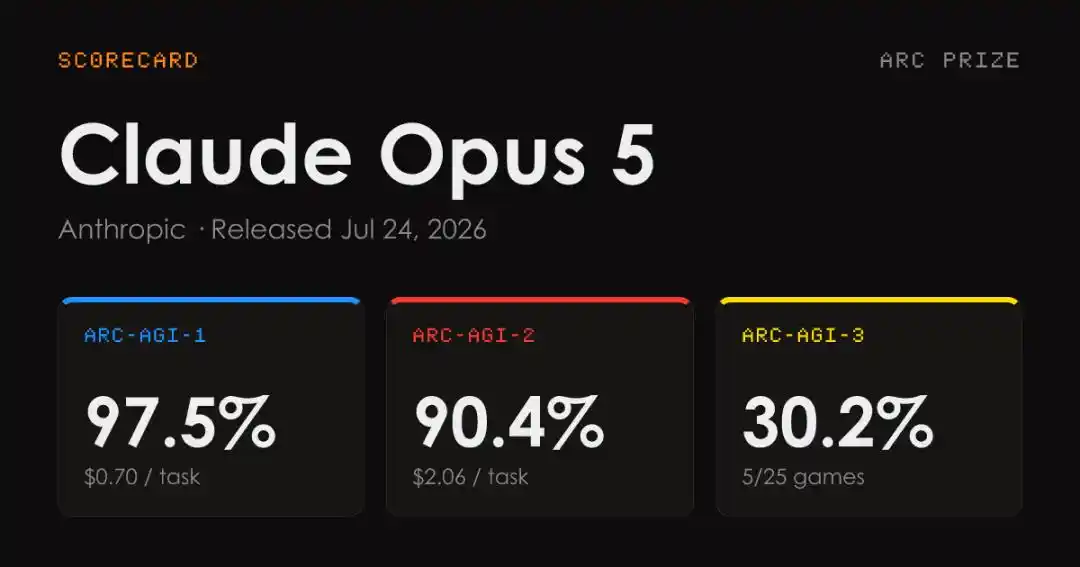
The model used by AVO this time was Claude Opus 5. However, when tested alone, its score was only 30.16%, which still made it the official top-ranking model on the leaderboard.
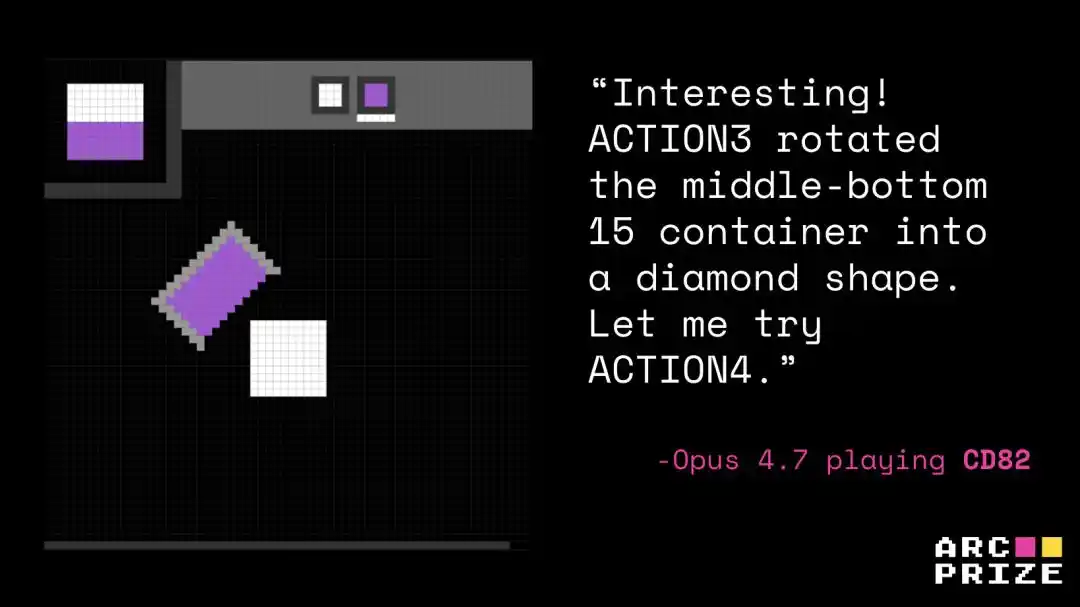
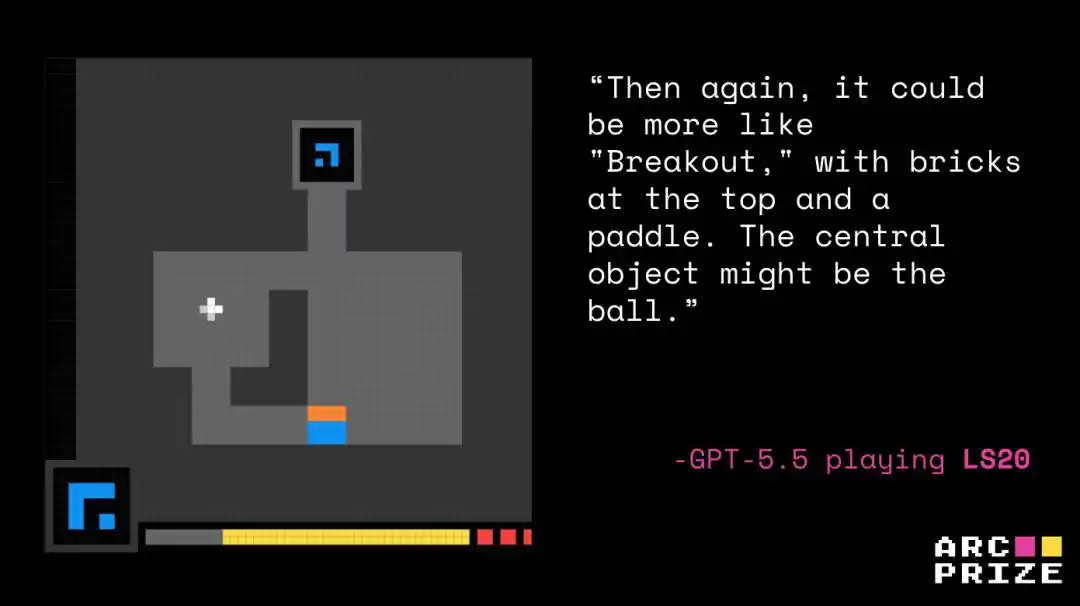
The ARC Prize team analyzed replays from the previous generation and summarized three typical types of errors.

  • First, understanding locally but not globally.
  • Second, forcing unfamiliar mechanics to fit familiar game patterns.
  • Third, passing a level without actually learning.

The third type is the most critical. Opus once cleared the first level of ka59 in just 37 steps, but its understanding of the click mechanism was fundamentally wrong from the start. When it reached the second level, it stubbornly clung to that incorrect theory and eventually got stuck.
NVIDIA's approach was to leave the model untouched and only add an outer layer.

Thus, the same Claude Opus 5's score jumped directly from 30 points to a perfect score.

This immediately caused an uproar on X. Posts like "ARC-AGI-3 has fallen" and "Time to find a new leaderboard to climb" flooded the feed, while others praised NVIDIA's move as absolutely brilliant.

Given this momentum, the next model-level leap might not come from waiting for a new model, but from an update to the harness.
The 100-Point Leap, Deconstructed into Just Two Components

So what exactly did NVIDIA put around the model to fill these three pitfalls at once?

Similar to the recently trending DeepSeek Harness and Codex Harness, AVO also manages the surrounding layer outside the model.

This includes what context to provide, what tools to give, how to store state, how to handle feedback, what to do when stuck, and how to proceed after the context window is full, among other things.
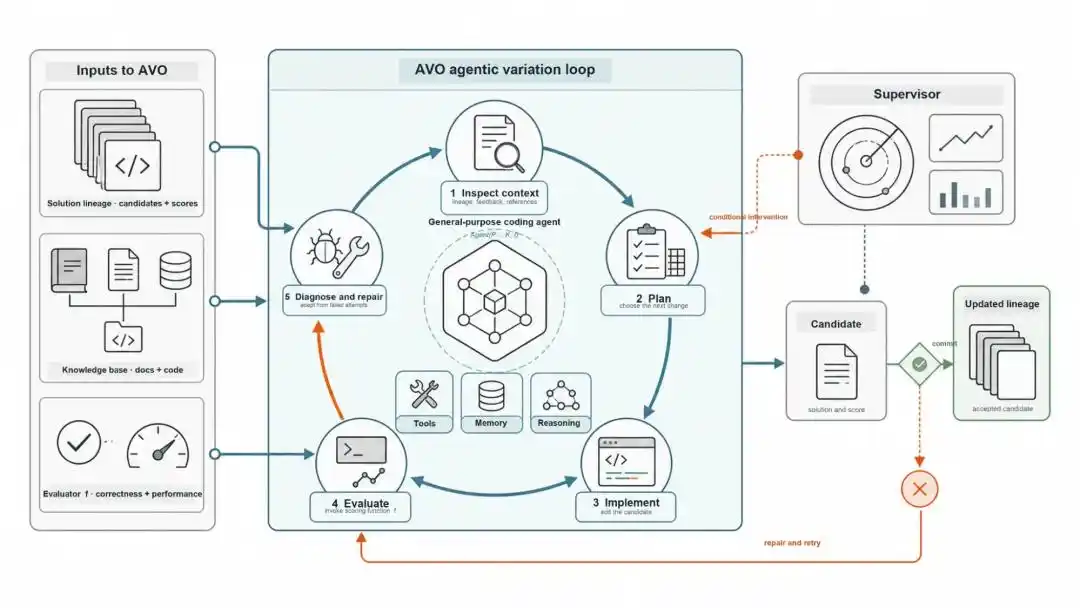
Specifically regarding mechanisms, there are two key components that truly make a difference.

The first is persistent memory.

The biggest challenge in long-horizon tasks is that the context window fills up.

Once full, the model's memory is wiped clean. Everything tried before, which paths were dead ends, what the profiler outputted—all gone.

When the next round begins, it starts from scratch, retracing the same mistakes.

AVO saves all of this: past implementation versions, results from each evaluation, outputs from compilers and analyzers, accumulated reasoning processes—everything is stored.

After a context reset, the agent continues from the current state rather than reconstructing the entire search from zero.

The second is a supervisor.

The main agent focuses on getting the work done, deciding what to look at, what to change, what to test, and what to submit.

The supervisor doesn't do the work; it only monitors the entire search trajectory from the sidelines. Once it detects stalled progress or the agent stuck in loops of unproductive actions, it intervenes to steer the main agent towards different strategies.

There's another detail.

AVO ran the entire ARC-AGI-3 challenge using pure text modality. Each frame observation fed to the model was a precise 64×64 text grid—no images at all, not a single visual token sent.

In other words, in a game filled with pixels, the model never actually "saw" the screen from start to finish.

This mechanism is what yielded the report card of clearing 183 levels in 6624 steps with a perfect RHAE score.
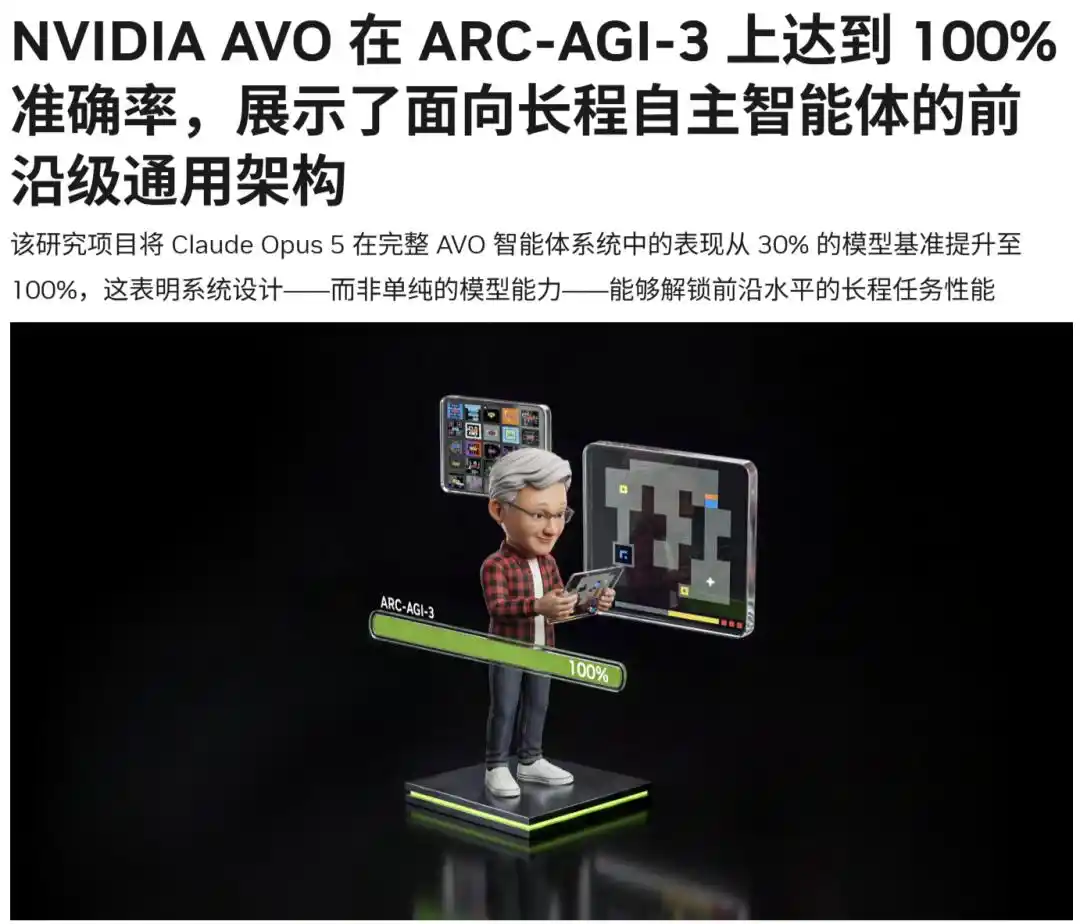
NVIDIA's conclusion from this is that long-horizon capability has never been something a model possesses alone; it's something the entire system assembles.

Memory determines what carries over to the next round, tools determine what actions the agent can perform, and feedback lets it know if it's going astray.

And the ability to get back on track when a hypothesis is disproven determines whether the job can continue.

It's First Revolutionizing NVIDIA's Own Domain

The interesting part is that AVO wasn't built for gaming at all. Its main battleground is GPU kernel optimization.

On March 25th this year, NVIDIA uploaded a paper to arXiv titled "AVO: Agent-based Variational Operators for Autonomous Evolutionary Search."
Paper address: https://arxiv.org/abs/2603.24517

Two words in the title are key: evolutionary search and variational operators.

Evolutionary search itself isn't complicated. You hold a batch of candidate code, modify it, run it, keep the fastest version, then continue modifying, pushing forward generation by generation.

The component responsible for the "modify" step is called a variational operator in evolutionary algorithms. In the past, it was hard-coded, with modifications predetermined by humans; later, using LLMs to modify was just generating a piece of code per call.

AVO's approach is to replace the entire variational operator with an autonomous agent.
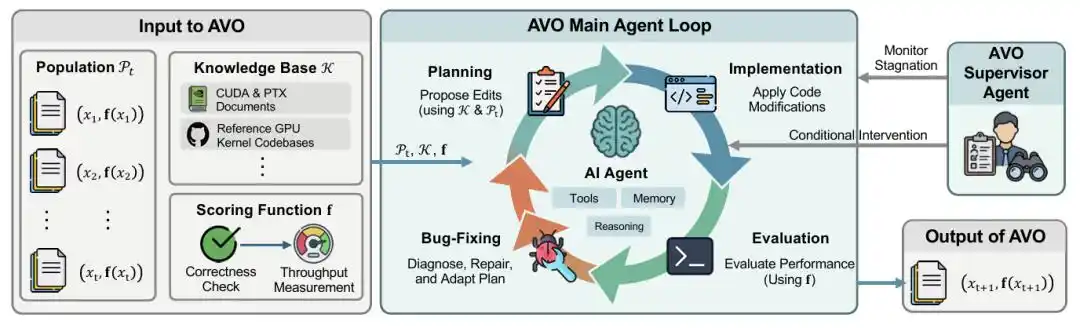
This way, it can not only consult CUDA programming guides and PTX architecture documentation, run tests, read profiler outputs, but also self-diagnose correctness failures, and then decide where to modify next.

The team deployed it on B200, tasked with optimizing an attention kernel—the most heavily squeezed operator in Transformers. Then they stepped back.

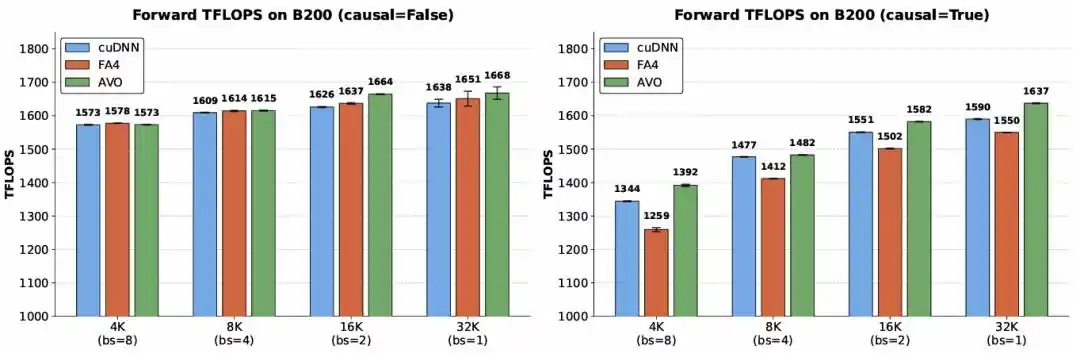
AVO autonomously ran continuously for 7 days, exploring over 500 optimization directions, ultimately submitting 40 valid kernel versions.

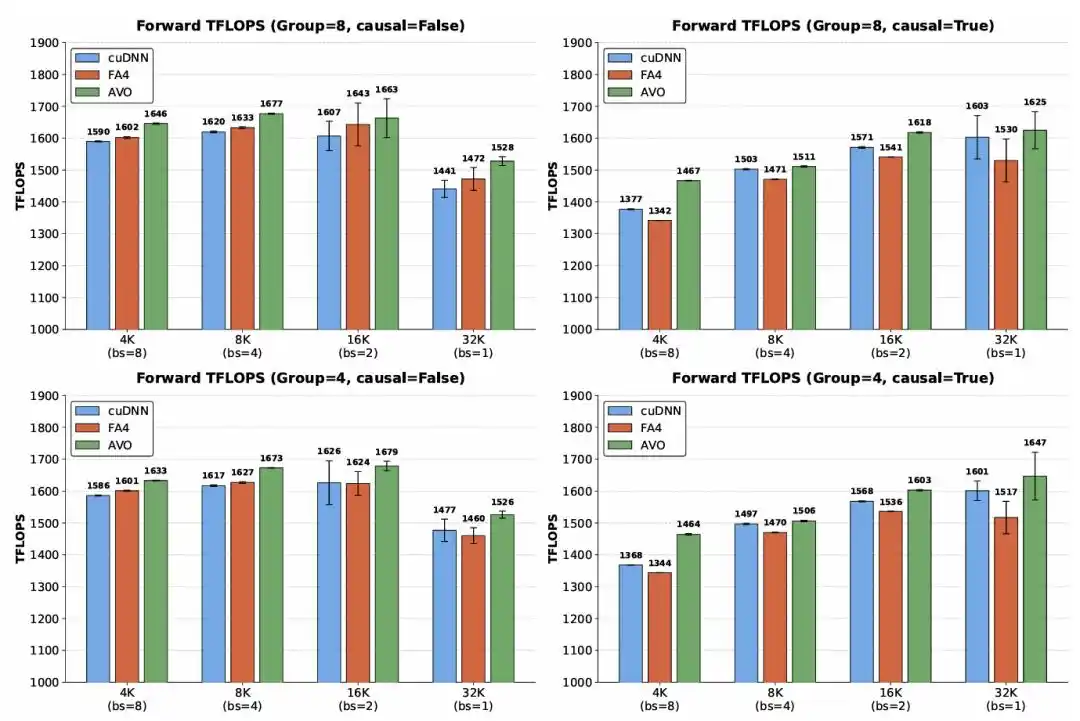
The resulting multi-head attention kernel was up to 3.5% faster than NVIDIA's own closed-source cuDNN and up to 10.5% faster than the state-of-the-art open-source implementation FlashAttention-4.

Subsequently, it applied the same optimization to GQA, the mainstream architecture for current large models. This time, after autonomous runs of about 30 minutes, the new kernel was 7.0% faster than cuDNN and 9.3% faster than FlashAttention-4.

Handwriting CUDA kernels has always been one of the highest barriers in this ecosystem, and AVO is the first to surpass it.
And the 25 games in ARC-AGI-3 run on this same system.

Tuning kernels and playing games sound like completely unrelated tasks. But in NVIDIA's view, the same underlying loop powers both.

The agent first forms a hypothesis from incomplete evidence, acts to test it, observes results, stores useful state, and refines its understanding of the problem. If the hypothesis is wrong, it falls back and rethinks, then rolls forward iteration after iteration.

In NVIDIA's own words, what transfers isn't domain knowledge, but the mechanism that sustains long-horizon autonomous advancement.

It Was Built by a Team of Chinese Origin

Looking at the author list of the AVO paper reveals a string of very familiar names.

With 23 authors, it almost assembles key figures from the open-source deep learning infrastructure of the past decade.

One of the co-first authors, Bing Xu, is a Distinguished Engineer at NVIDIA and the creator of MXNet. Earlier, he was also the fourth author of the original 2014 GAN paper, co-authored with Yoshua Bengio under the University of Montreal.

Tianqi Chen, creator of TVM and XGBoost, is also on the list. The TVM connection leads to Luis Ceze; the two co-founded OctoAI, which NVIDIA acquired in September 2024, with Ceze subsequently joining NVIDIA to continue work on machine learning compilers.

Further down are Ye Zihao, creator of FlashInfer, and CUDA compiler veteran Vinod Grover.

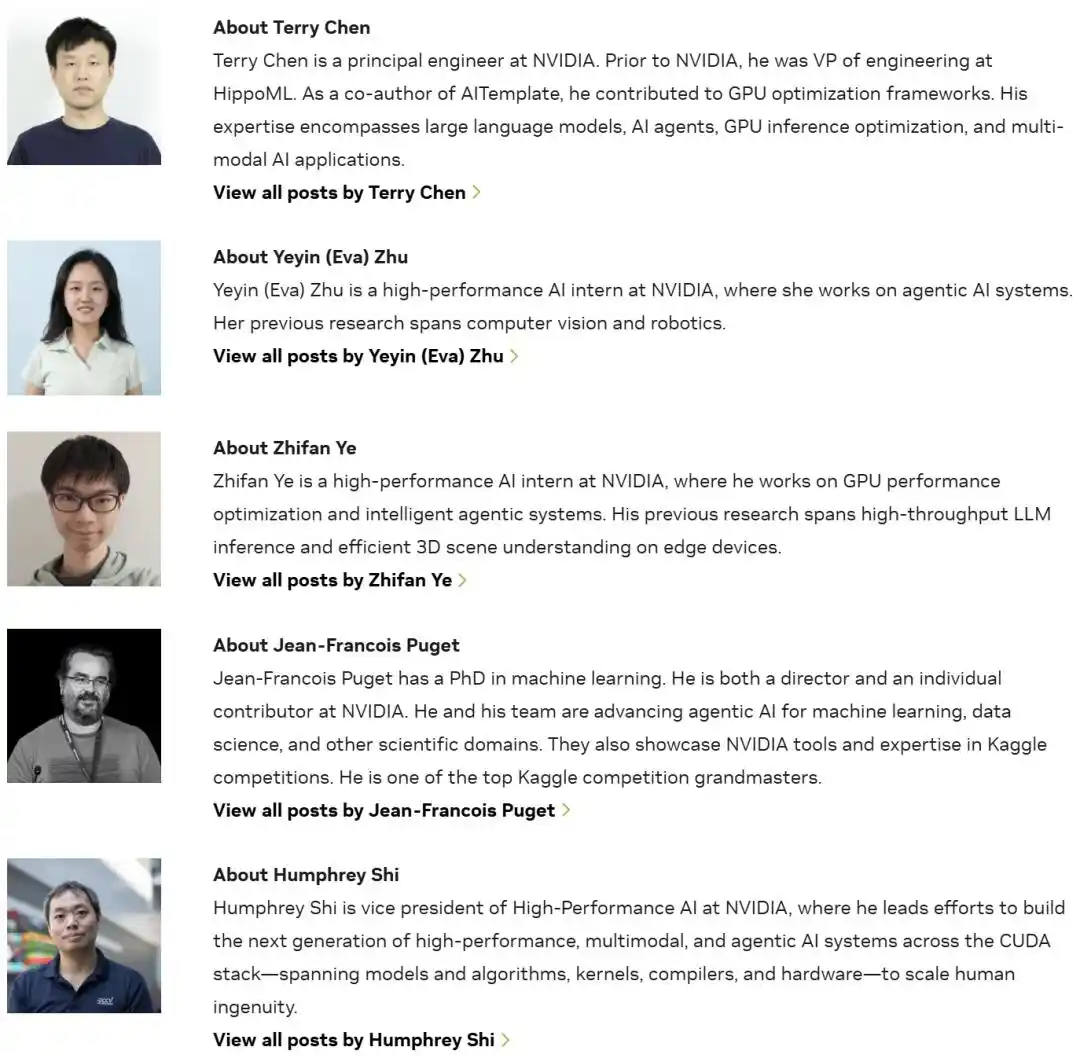
Overseeing the project is Humphrey Shi, NVIDIA's VP of High-Performance AI and also a professor at Georgia Tech. Another co-first author, Zhifan Ye, is a Ph.D. student at Georgia Tech.

The blog post announcing this result bears five names, four of which are of Chinese origin: besides Humphrey Shi, there are Terry Chen, Zhifan Ye, and Yeyin Zhu. The remaining author is Jean-Francois Puget, a two-time Kaggle Grandmaster at NVIDIA.
The most interesting anecdote comes from Bing Xu's earlier self-description on X.

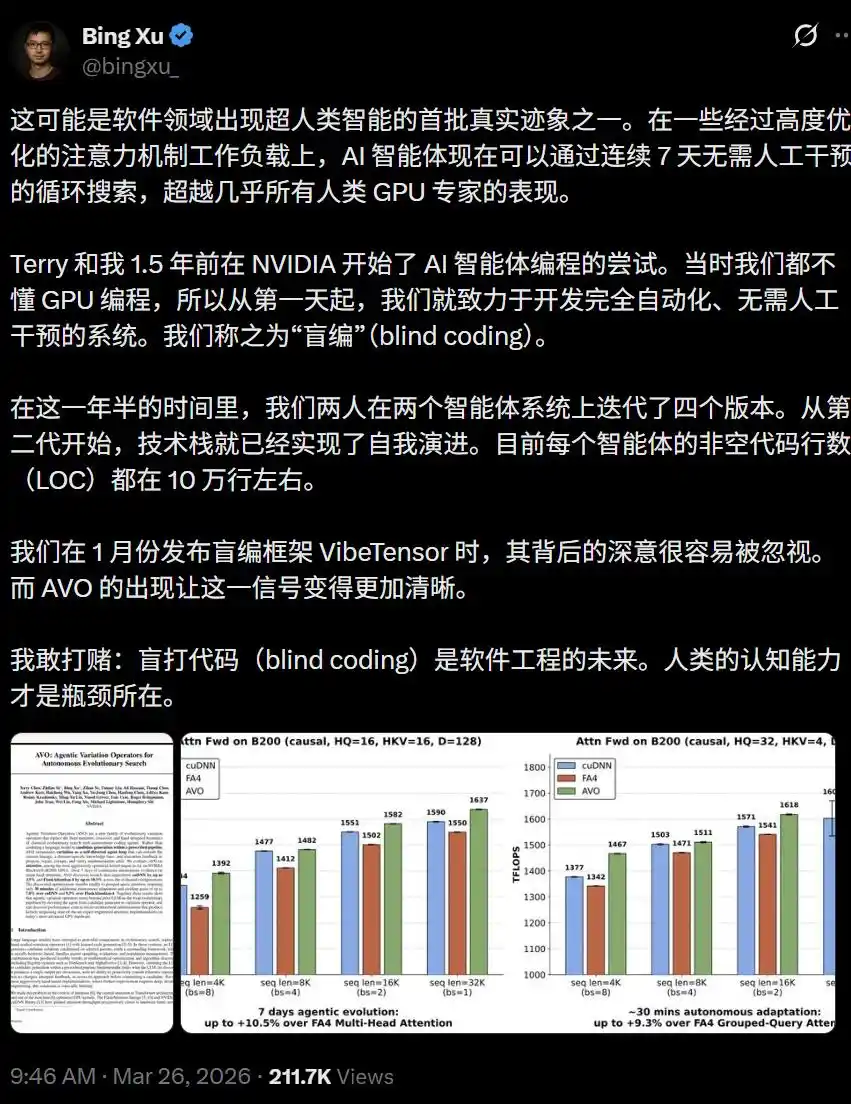
A year and a half ago, when he and Terry Chen first started working on agent programming at NVIDIA, neither of them knew GPU programming.

Precisely because they didn't know, they aimed from day one to build a fully automatic system requiring no human intervention, coining the term "blind programming" for this approach.

A year and a half later, this system, operating without human direction, outperformed kernels that human experts had optimized for months.
The Bill Ultimately Lands on Jensen's GPUs

Why would a company that sells graphics cards spend a year and a half building an agent that requires no human input?

Because this shell layer can work with anyone's model.

AVO has been tested across models. On the same levels, pairing with GPT-5.6 Sol took less time, while pairing with Opus 5 was more step-efficient.

NVIDIA doesn't make money selling models, but it can dominate this layer. This aligns with its overall strategy in recent years.

On the model side, it pursues open source. The Nemotron 4 project, advancing this August, targets trillion-parameter scale, with training expected to finish in the fall. The models will be given away for free, with revenue coming from subsequent GPU and software stack sales.

On the compute side, long-horizon agents are precisely the kind of workload it wants most. Jensen Huang's judgment at GTC this year was that the inference inflection point has arrived. Compute demand has grown about 10,000-fold in the past two years, while usage has only grown about 100-fold—the difference is being consumed by inference.

So whose model is used isn't important. As long as agents take on longer, heavier tasks, the bill will ultimately land on their graphics cards.

As for the term "100 points," it is indeed depreciating rapidly at the moment.

In March, no one could score even 1 point. Tycho was the first to achieve a perfect score at the end of July, VISTA achieved it again on August 5th, and AVO's result is already the third perfect score in six weeks—all three exclusively powered by Claude Opus 5.
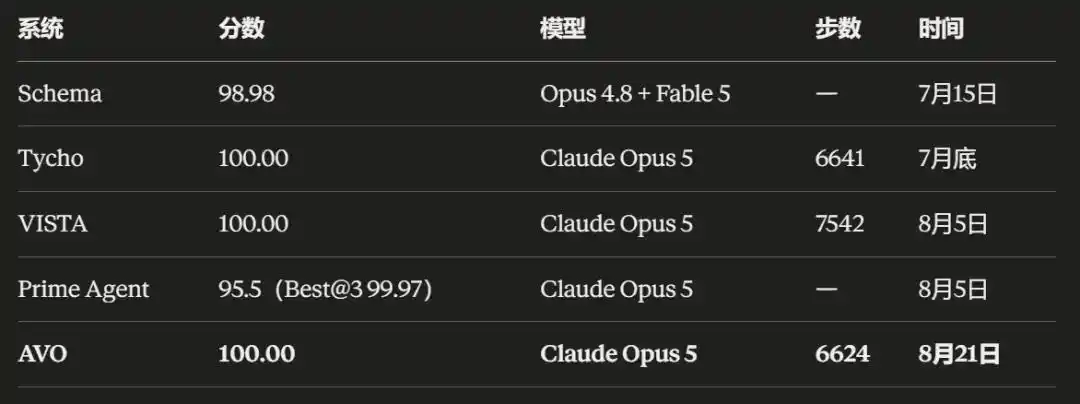
But what AVO accomplished won't shrink in value because of this.

An architecture born to squeeze out the last few percentage points of performance from FlashAttention on B200 was almost directly transplanted to a pixel game—and it worked.

The only things changed were the task interface and evaluation method; the core loop remained untouched line by line.

As NVIDIA wrote at the end of its blog post, models are important, but they are not the entirety of an agent.

References:

https://developer.nvidia.com/blog/nvidia-avo-reaches-100-on-arc-agi-3-demonstrating-a-frontier-level-general-purpose-architecture-for-long-horizon-autonomous-agents/

This article is from the WeChat public account "New Zhiyuan," author: ASI Apocalypse, editor: Moses


Трендовые криптовалюты

Связанные с этим вопросы

QWhat is the key achievement of NVIDIA's AVO agent mentioned in the article?

ANVIDIA's AVO agent achieved a perfect score of 100.00 RHAE on the ARC-AGI-3 benchmark, successfully completing all 183 levels across 25 game environments in just 6,624 steps.

QAccording to the article, what were the two main mechanisms in AVO's external 'harness' that contributed to its success?

AThe two key mechanisms were Persistent Memory, which stores past attempts and data across context resets, and a Supervisor, which monitors the main agent's progress and redirects it when it gets stuck or loops.

QWhat was AVO's original purpose, as stated in the article?

AAVO was originally developed for GPU operator optimization, specifically to autonomously search for and generate highly optimized CUDA kernels, such as for attention mechanisms in Transformers.

QHow does the article connect AVO's performance to NVIDIA's business strategy?

AThe article states that NVIDIA's strategy involves focusing on the 'harness' layer (which can work with any AI model) and providing long-horizon workloads for its GPUs. As agents take on longer, more complex tasks, the computational demand ultimately translates to increased sales of NVIDIA's GPUs.

QWhat is a significant point made about the underlying model (Claude Opus 5) used by AVO?

AThe article highlights that while Claude Opus 5 alone scored only about 30% on the ARC-AGI-3 benchmark, when integrated into AVO's system (the 'harness'), its performance jumped to a perfect 100%, demonstrating that the system architecture is crucial for long-horizon agent capabilities.

Похожее

Почему Dogecoin, MemeToro и TRUMP — лучшие мемкоины для покупки в 2026 году

Рынок мемкоинов в 2026 году демонстрирует новые тенденции. Dogecoin (DOGE) сохраняет статус одного из самых узнаваемых активов благодаря сильному сообществу и признанию. Токен TRUMP показывает, как политические нарративы могут быстро привлекать ликвидность, подчеркивая силу культурного внимания. В то же время проект MemeToro представляет собой новый подход, предлагая инфраструктуру для запуска мемкоинов с использованием искусственного интеллекта на BNB Chain. Его публичный пресейл в настоящее время находится на 6-м этапе. Вместе эти три проекта иллюстрируют разные стороны рынка: устоявшуюся силу сообщества, мощные нарративы и развивающуюся инфраструктуру для создания токенов, что делает их интересными для изучения инвесторами.

bitcoinist26 мин. назад

Почему Dogecoin, MemeToro и TRUMP — лучшие мемкоины для покупки в 2026 году

bitcoinist26 мин. назад

Лучший мем-коин для покупки в 2026 году: MemeToro объединяет AI-агентов и инфраструктуру BNB Chain

Поиск лучшей мем-монеты для покупки в 2026 году смещается в сторону проектов с практической инфраструктурой. MemeToro выбирает особый путь, объединяя AI-агентов с инфраструктурой BNB Chain. Его цель — создать экосистему, где искусственный интеллект поддерживает поиск, проверку и запуск новых мем-токенов. BNB Chain обеспечивает важное преимущество благодаря низкой стоимости транзакций и высокой скорости, что подходит для частых запусков токенов и розничной торговли. MemeToro строит на этой основе AI-платформу для запуска и анализа мем-коинов. Ключевая особенность MemeToro — использование автономных AI-агентов. Они могут отслеживать рыночные тенденции для обнаружения новых проектов, проверять смарт-контракты на наличие рисков и помогать трейдерам быстро фильтровать возможности в динамичном рынке мем-токенов. В отличие от таких монет, как DOGE (ликвидность) или SHIB (утилита Shibarium), MemeToro фокусируется на инфраструктурной модели. Это позволяет ему получить выгоду от роста всего сектора мем-коинов, не завися полностью от собственной виральности. Токен $MT в настоящее время находится на 6-м этапе предпродажи.

bitcoinist35 мин. назад

Лучший мем-коин для покупки в 2026 году: MemeToro объединяет AI-агентов и инфраструктуру BNB Chain

bitcoinist35 мин. назад

EIP-8363: количественный разбор. Отказ от «субсидирования» стейкинга — что Ethereum хочет получить взамен?

EIP-8363 предлагает сокращать долю вознаграждений валидаторов, отправляя их на сжигание, при этом сжигание достигает 100%, когда в стейкинге находится 50% от общего предложения ETH. Анализ показывает, что механизм сжигания комиссий (EIP-1559) сейчас неэффективен, компенсируя лишь 2.4% годовой эмиссии. Таким образом, регулирование эмиссии становится основным инструментом влияния на предложение ETH. При текущем уровне стейкинга (~35%) предложение сократится примерно на 58.6%, а не обнулится. Механизм саморегулируется: при ожидаемой доходности 2% система стабилизируется на уровне стейкинга ~26% и годовой инфляции ~0.48%. Статистика не показывает значимой связи между доходностью стейкинга и ценой ETH. Предложение перераспределяет богатство: сокращая ежегодную эмиссию на ~633k ETH ($1.55 млрд), оно перенаправляет средства от стейкеров (35% держателей) ко всем остальным держателям ETH (65%). Хотя это укрепляет экономику ETH в долгосрочной перспективе, концентрированные интересы крупных стейкинг-провайдеров (таких как Lido) делают политическое принятие提案 маловероятным.

marsbit39 мин. назад

EIP-8363: количественный разбор. Отказ от «субсидирования» стейкинга — что Ethereum хочет получить взамен?

marsbit39 мин. назад

Валидаторы TON готовят обновление нод перед голосованием по коллатору

Валидаторы сети TON получили инструкции обновить программное обеспечение своих узлов (коммит 140320b) и инструмент mytonctrl (коммит 7e90e26) перед голосованием по конфигурации, связанному с новой архитектурой коллаторов. Голосование запланировано на 21 августа в 08:00 UTC. Важно подчеркнуть, что это этап подготовки и голосования; активацию коллаторов не следует считать завершённой до окончания этого процесса. Обновление важно, поскольку архитектура коллаторов может повлиять на организацию производства блоков и распределение обязанностей валидаторов по мере масштабирования сети. Координация валидаторов критична для любых обновлений блокчейна — проблемы могут привести к задержкам или несогласованной работе сети. Коллаторы обычно отвечают за сбор транзакций и подготовку кандидатов в блоки, что способствует повышению пропускной способности и эффективности сети. Для TON это часть усилий по масштабированию инфраструктуры, особенно в контексте интеграции с экосистемой Telegram. Следующим шагом будет подтверждение результатов голосования и, в случае успеха, активация новой конфигурации. Рынку следует дождаться окончательного статуса активации, прежде чем считать обновление завершённым.

bitcoinist41 мин. назад

Валидаторы TON готовят обновление нод перед голосованием по коллатору

bitcoinist41 мин. назад

Стоимость токенизированных активов Avalanche превысила $3 млрд на фоне роста тренда на RWA

Стоимость токенизированных реальных активов (RWA) в блокчейне Avalanche превысила 3 миллиарда долларов. Этот рубеж был достигнут благодаря совокупному росту, а не появлению новых средств за один день. Основной вклад внесла миграция ценных бумаг Progmat на сумму 1,2 миллиарда долларов, а также активность таких платформ, как OpenTrade (около 190 млн долларов) и Grove Finance (примерно 260 млн долларов). Рост RWA укрепляет нарратив Avalanche как инфраструктуры для институциональных финансов, выходящей за рамки розничного DeFi. Сеть делает ставку на субсети и кастомизацию, что подходит для регулируемых активов, требующих контроля и соответствия нормам. Важно отметить, что данный показатель отражает общую стоимость токенизированных активов, а не напрямую влияет на цену нативного токена AVAX. Для сети ключевым станет вопрос, сможет ли она превратить этот объем в активную финансовую инфраструктуру с реальной торговлей, использованием в качестве залога и ростом расчетных операций. Тем не менее, достижение отметки в 3 миллиарда долларов укрепляет позиции Avalanche в конкурентной гонке за институциональную токенизацию активов.

bitcoinist45 мин. назад

Стоимость токенизированных активов Avalanche превысила $3 млрд на фоне роста тренда на RWA

bitcoinist45 мин. назад

Торговля

Спот

Популярные статьи

Как купить ONE

Добро пожаловать на HTX.com! Мы сделали приобретение Harmony (ONE) простым и удобным. Следуйте нашему пошаговому руководству и отправляйтесь в свое крипто-путешествие.Шаг 1: Создайте аккаунт на HTXИспользуйте свой адрес электронной почты или номер телефона, чтобы зарегистрироваться и бесплатно создать аккаунт на HTX. Пройдите удобную регистрацию и откройте для себя весь функционал.Создать аккаунтШаг 2: Перейдите в Купить криптовалюту и выберите свой способ оплатыКредитная/Дебетовая Карта: Используйте свою карту Visa или Mastercard для мгновенной покупки Harmony (ONE).Баланс: Используйте средства с баланса вашего аккаунта HTX для простой торговли.Третьи Лица: Мы добавили популярные способы оплаты, такие как Google Pay и Apple Pay, для повышения удобства.P2P: Торгуйте напрямую с другими пользователями на HTX.Внебиржевая Торговля (OTC): Мы предлагаем индивидуальные услуги и конкурентоспособные обменные курсы для трейдеров.Шаг 3: Хранение Harmony (ONE)После приобретения вами Harmony (ONE) храните их в своем аккаунте на HTX. В качестве альтернативы вы можете отправить их куда-либо с помощью перевода в блокчейне или использовать для торговли с другими криптовалютами.Шаг 4: Торговля Harmony (ONE)С легкостью торгуйте Harmony (ONE) на спотовом рынке HTX. Просто зайдите в свой аккаунт, выберите торговую пару, совершайте сделки и следите за ними в режиме реального времени. Мы предлагаем удобный интерфейс как для начинающих, так и для опытных трейдеров.

1.0k просмотров всегоОпубликовано 2024.04.12Обновлено 2026.06.02

Как купить ONE

Обсуждения

Добро пожаловать в Сообщество HTX. Здесь вы сможете быть в курсе последних новостей о развитии платформы и получить доступ к профессиональной аналитической информации о рынке. Мнения пользователей о цене на ONE (ONE) представлены ниже.

活动图片