With Mining Profits Depressed, What Kind of Mining Companies Can Survive a Bear Market?

Foresight NewsОпубликовано 2026-07-07Обновлено 2026-07-07

Введение

Mining Profitability Slumps: Which Miners Can Survive the Bear Market? A comprehensive Bitcoin miner stress indicator has recently hit a historically low "extreme stress" zone, aligning with the typical market cycle pattern where industry bottoms coincide with severe miner pressure. The current situation presents a direct survival test: if hashprice (daily USD revenue per PH/s of computing power) remains weak, only the most robust mining firms will endure. Hashprice, which incorporates block rewards, transaction fees, network difficulty, and BTC price, is the core metric for mining profitability. Despite Bitcoin's price holding above previous lows, profitability is shrinking due to rising difficulty and low fees. Recent data shows hashprice around $32-33/PH/s/day, with a significant divide: newer, energy-efficient rigs (<19 J/TH) generate ~$81 per megawatt, while older, inefficient models (25-38 J/TH) make only ~$43/MW. This gap is forcing inefficient operators to shut down. The industry has a self-correcting mechanism. As high-cost miners power down, the network's total computing power (hashrate) drops. This eventually triggers a downward adjustment in mining difficulty, increasing the rewards for remaining miners. Data from Q2 2026 shows the hashrate has already fallen by 5.8%, with an estimated 252 EH/s of inefficient mining capacity idled. Firms at risk of淘汰 (elimination) are those reliant on old hardware, high electricity costs, and significant debt. Survivors will l...


Author: Liam Akiba Wright

Compiled by: Chopper, Foresight News


Recently, a comprehensive Bitcoin miner stress indicator circulated on X platform dropped to a historically rare zone of extreme pressure, once again confirming a classic bull-bear cycle logic: market bottoms are often accompanied by collective pressure on miners.


The practical impact of this cycle is more direct. If the hash price continues to weaken, the industry will face a survival test. Only high-quality mining companies can maintain continuous operation of their hash rate equipment, avoid forced Bitcoin sales, and wait for mining revenue to recover.


Analyst Gaah issued a recent signal that the Bitcoin miner cycle comprehensive stress indicator has dropped to a new low in 2026, entering a historically deeply undervalued zone. BitcoinNewsCom supplemented this view, describing it as a composite indicator of the Puell Multiple and the Inverse Miner Capitulation Index.
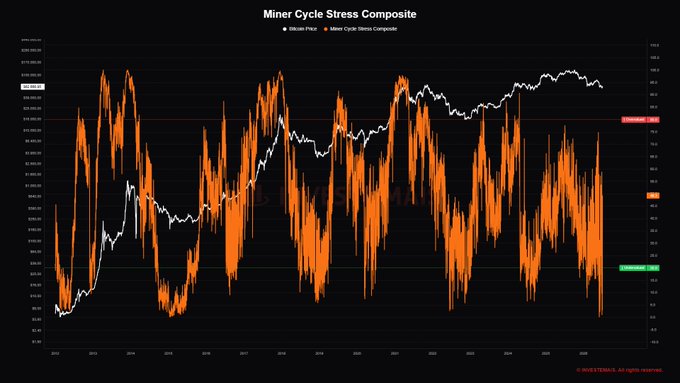

The comparison between the Bitcoin miner cycle comprehensive stress indicator and the Bitcoin price shows a temporal correlation between mining profitability pressure and major turning points in the market cycle. Source: Investemais


This composite indicator is an observation tool for miner stress built by the analyst. Its core underlying indicators remain hash price, network difficulty, total network hash rate, and mining company balance sheets. It can only reflect the degree of industry pressure and cannot alone determine if the market has bottomed out. What truly determines the industry's direction is the profit pressure that forces miners into actions like shutdowns and coin sales.


Hash Price: The Core Yardstick for Mining Profitability


The Puell Multiple is used to calculate the ratio of miners' block reward income to the annual average price of newly issued Bitcoin, intuitively reflecting the current cash flow status of mining.


This perspective is very applicable for miners because they run cash-based businesses. Electricity, server hosting, debt repayments, machine maintenance, repairs, and personnel costs all compete for market share with block reward income. When the dollar value of rewards declines, weaker miners are often the first to be eliminated.


However, hash price is a more intuitive measure of profitability. According to Luxor's Hashrate Index definition, hash price refers to the daily USD revenue that 1 PH/s of hash rate can generate, comprehensively including four variables: block subsidy, transaction fees, network difficulty, and the current BTC price. Even if the Bitcoin price hasn't broken below previous lows, unit hash rate revenue can still continuously shrink as long as difficulty increases, transaction fees remain low, and machine energy consumption is high.


Mining profitability has been tightening recently. The June 1st Hashrate Index weekly report showed hash price fell 9% weekly to $32.56 / PH/s/day, with the six-month forward average price only $31.71. Two weeks later on June 15th, data showed a slight rebound to $33.74, but the forward average remained at $32.13.


This slight rebound did not erase industry differentiation. Hashrate Index calculations show that new-generation low-power miners with unit energy consumption below 19 J/TH earn about $81 per megawatt of hash rate, while older, high-power models (25–38 J/TH) earn only $43 per megawatt. Under the same Bitcoin price environment, low-cost new mining farms can operate stably, while older, high-energy-consumption farms approach shutdown thresholds.


This huge profit gap transforms paper bottom indicators into real survival tests for companies. Mining companies holding new-generation miners, enjoying low electricity costs, having flexible curtailment agreements, and possessing sufficient cash flow can withstand the cycle and wait for difficulty adjustments. Companies relying on old equipment, facing high hosting costs, and operating with high debt have almost no buffer; once hash price remains low, they can only passively reduce production.


Who Will Be Eliminated?


Miner pressure has a self-adjusting mechanism, but the process accompanies industry pains. After a large number of miners shut down, the total network hash rate declines. If the hash rate contraction continues until the difficulty adjustment window, Bitcoin's network mining difficulty automatically decreases, and the unit block reward for surviving miners increases accordingly.


This is also the underlying logic behind the miner capitulation wave often seen at bear market bottoms: inefficient players exit first, and surviving mining companies share more block rewards after difficulty decreases. As long as the Bitcoin price and transaction fees don't keep falling, industry profit margins can gradually stabilize.


Second-quarter 2026 data has confirmed the effectiveness of this adjustment mechanism. The Hashrate Index's Q2 heatmap shows this round of hash rate decline stems primarily from profit pressure at the economic level. The network's 30-day moving average hash rate fell from 1066 EH/s in Q1 to 1004 EH/s in Q2, a quarterly decline of 5.8%. The report estimates that many old miners above 25 J/TH have turned gross profit negative, with approximately 252 EH/s of marginal inefficient hash rate in a shutdown state.


The Bitcoin price itself remains the cornerstone of the economic system. CryptoSlate market data shows that as of July 6, 2026, Bitcoin traded at $63,007, with a market capitalization of $1.26 trillion and a market share of 58.0%. However, miner profitability depends on a specific combination of factors: price, transaction fees, mining difficulty, electricity costs, and machine efficiency.


If the hash price remains at low levels around $30, the primary source of pressure is miner curtailment. Miners with high electricity costs or old machines may shut down hash power during unprofitable periods, especially if electricity can be resold or redirected. The second is miner cash flow. Miners holding Bitcoin can sell it or use it as collateral for loans, further increasing pressure during periods of already tight liquidity.


The third point is consolidation. Low-cost miners, better-capitalized public companies, and operators with newer machines can hold out longer than weaker competitors and potentially acquire mining farms, power contracts, or market share after difficulty decreases and reward distribution becomes fairer.


The fourth trend is the transition to AI and high-performance computing. Many mining companies are no longer solely reliant on Bitcoin mining for profits, using bear markets to host AI servers and open a second growth curve. However, only mining companies possessing land, power, cooling facilities, stable clients, and sufficient funds have practical value in implementing this transition; persistently low hash prices significantly increase the strategic value of this transition path. Wall Street capital has already positioned itself in mining company targets with AI computing businesses, even if the related data centers haven't been built yet.


Signals to Watch


The mining industry stress composite indicator is more suitable as an early warning signal; it cannot precisely predict the timing of the bottom. It indicates that mining industry revenue pressure has reached levels seen in previous stress cycles. But it does not indicate whether the market has fully repriced this pressure.


The subsequent signals are more specific: whether the hash price can recover to levels just above $30, whether mining difficulty will continue to decrease, whether the hash rate will stabilize, whether miners will sell more Bitcoin, and whether mining companies' AI computing deployments are genuine growth narratives or mere fundraising tools.


If the above indicators improve simultaneously, looking back, this round of miner pressure will have been just a bottoming phase. If the data continues to deteriorate, the industry will undergo a deeper round of reshuffling, with inefficient hash rate share continuously shrinking, benefiting surviving players after network-wide difficulty decreases.


Therefore, this bottom signal can also serve as a solvency test. Although the chart may be eye-catching due to its similarity to past cycle lows, if the recovery takes longer than expected, the hash price will determine which miners can continue to survive.


Связанные с этим вопросы

QWhat is the core factor that determines which mining enterprises can survive a bear market according to the article?

AAccording to the article, the core factor determining survival is hash price. Enterprises with new, low-power mining machines, low electricity costs, flexible power curtailment agreements, and sufficient cash flow can endure cycles and wait for difficulty adjustments. Conversely, those relying on old equipment, high hosting costs, and high debt have little buffer and may be forced to shut down if hash prices remain low.

QWhat self-regulation mechanism exists for miner pressure, and what is its consequence?

AThe self-regulation mechanism is that when a large number of inefficient mining machines shut down, the overall network hashrate drops. If this decline continues until the next difficulty adjustment window, the Bitcoin mining difficulty automatically decreases. This increases the per-block rewards for the remaining miners. The consequence is industry consolidation, where inefficient players are eliminated first, allowing surviving miners to share a larger portion of the rewards.

QBesides hash price, what other key metric is mentioned as a direct measure of mining profitability?

AThe article mentions the Puell Multiple as another key metric. It measures the ratio of miners' block reward income (in USD) to the 365-day moving average of newly issued Bitcoin's price, providing an intuitive reflection of current mining cash flow health.

QWhat are the four main trends or pressures that miners face if hash prices remain around $30?

AThe four main trends or pressures are: 1) Curtailment: Miners with high electricity costs or old machines may shut off hashrate during unprofitable times. 2) Capital flows: Miners may sell Bitcoin or use it as collateral for loans, adding pressure in tight liquidity periods. 3) Consolidation: Low-cost, well-capitalized miners with newer machines can outlast weaker competitors and potentially acquire assets post-difficulty adjustment. 4) Diversification into AI/HPC: Some miners are pivoting to host AI servers, but this requires significant existing infrastructure and capital.

QWhat specific signals should be monitored to assess whether the mining industry is recovering from its stressed state?

AThe signals to monitor are: whether the hash price can recover to levels above $30, whether the mining difficulty continues to decrease, whether the network hashrate stabilizes, whether miners sell more Bitcoin, and whether the AI computing power布局 of mining companies represents genuine growth or is merely a fundraising narrative.

Похожее

‘Поощрять демократию’ ценой безопасности? Внутри эксплойта Bonk на $20 млн

Мемкоин-проект BonkDAO стал жертвой взлома, в результате которого было похищено 20 миллионов долларов. Инцидент произошел из-за вредоносного предложения по управлению (governance proposal). Злоумышленник, приобретя достаточно токенов BONK, создал предложение, которое с минимальным порогом одобрения в 1% позволило вывести средства из казны проекта. Аналитики безопасности раскритиковали слабые настройки управления BonkDAO, указав на отсутствие необходимых мер защиты, таких как период блокировки или требование множественных подтверждений для транзакций казны. Исследователь Тейлор Монахан отметила, что данный случай демонстрирует проблему приоритета «демократизации» через DAO в ущерб безопасности. После новости о взломе цена токена BONK упала на 10%. Несмотря на это, данные on-chain-аналитики показывают, что крупные держатели (киты) продолжают накопление токена с середины июня, что может поддержать цену. Однако если рыночные условия ухудшатся, мемкоин может обновить годовой минимум. Проект сотрудничает с правоохранительными органами и биржами для расследования инцидента.

ambcrypto40 мин. назад

‘Поощрять демократию’ ценой безопасности? Внутри эксплойта Bonk на $20 млн

ambcrypto40 мин. назад

Zoomex X Space: Итоги встречи с Дэвидом Джеймсом и Панелью трейдеров Чемпионата мира

Zoomex провел третий эпизод X Space в рамках своей благотворительной инициативы «World Cup Impact Pledge», собрав на одной виртуальной сцене голкипера сборной Англии Дэвида Джеймса и панель трейдеров. Обсуждались плей-офф, психология пенальти, философия вратарского искусства и шансы Англии на победу, в которую Джеймс верит безоговорочно. Ключевой темой стала параллель между подготовкой вратаря и трейдера. Джеймс объяснил, что давление возникает не от частых ударов, а от необходимости сделать ключевой сейв после долгого бездействия, когда концентрация должна быть на пике. Подобно трейдеру, который не боится следующего движения рынка благодаря своей стратегии, подготовленный вратарь не боится удара — он к нему готов. Особое внимание уделили пенальти. Джеймс описал два режима: чистую подготовку (анализ данных, привычек бьющего) и чистый инстинкт, который может подвести. Он подчеркнул, что ритуалы и мысленные репетиции — это всегда результат практики, а не спонтанность. Эта идея напрямую соотносится с трейдингом, где глубокий анализ данных оттачивает интуицию для прогнозирования рынков. Джеймс также затронул эволюцию вратарской позиции, отметив, что изменения в правилах (например, ввод мяча в игру от ворот) превратили качественный первый пас из опции в обязательное требование, в то время как физические аспекты игры остались прежними. В завершение Джеймс подтвердил свой прогноз на победу Англии, выбранную им благотворительной организацией стала UEFA Foundation, в пользу которой Zoomex выделит 1000 USDT, а в случае верного прогноза — дополнительно 5000 USDT.

TheNewsCrypto51 мин. назад

Zoomex X Space: Итоги встречи с Дэвидом Джеймсом и Панелью трейдеров Чемпионата мира

TheNewsCrypto51 мин. назад

Глубокое изучение списка партнеров Open USD: посмотрите, кто вошел, и вы поймете, куда направляются деньги

**Open USD: Анализ альянса партнеров и направления финансовых потоков** Стабильная монета Open USD дебютировала с беспрецедентной коалицией из более чем 150 партнеров, включая BlackRock, Visa, Mastercard, Stripe, Coinbase, крупные банки (BNY Mellon, Bank of America), технологических гигантов (Google, IBM), торговые платформы (Shopify) и криптокомпании (Ripple, Aave, MetaMask). Этот список раскрывает, кто видит в стейблкоинах будущее критической финансовой инфраструктуры и стремится не остаться в стороне. **Мотивы ключевых игроков:** * **Управляющие активами (BlackRock):** Стремятся управлять огромными резервами стейблкоина, получая комиссию. * **Торговцы и банки (Shopify, банки):** Для торговцев — снижение комиссий за прием платежей и доход с остатков. Для банков — защитная стратегия: вместо того чтобы терять депозиты, они присоединяются к альянсу, чтобы сохранить роль в расчетах и получить долю дохода от резервов. * **Технологические компании (Google, IBM):** Видят в открыто управляемом стейблкоине идеальный инструмент для программируемых платежей между машинами в будущем. * **Криптосектор:** Получает доступ к мейнстрим-партнерам и ликвидности, обеспечивая новой монете реальную полезность с первого дня. **Парадокс и проблема:** В альянс вступили прямые конкуренты (Visa/Mastercard, Coinbase/Ripple). Их объединяет страх остаться вне новой инфраструктуры, даже если она угрожает их текущему бизнесу (как в случае с карточными сетями). Однако общее управление может замедлить принятие решений. **Вывод:** Список партнеров Open USD показывает сдвиг парадигмы: стейблкоин больше не продукт одной компании (как у Circle или Tether), а общая инфраструктура, которой индустрия предпочитает коллективно владеть. Главная угроза для существующих игроков — не технология, а то, что их потенциальные клиенты объединились, чтобы создать альтернативу.

Foresight News1 ч. назад

Глубокое изучение списка партнеров Open USD: посмотрите, кто вошел, и вы поймете, куда направляются деньги

Foresight News1 ч. назад

IOSG: Обратный отсчет до Q‑Day — Положит ли квантовый вычисления конец криптовалюте?

Квантовые вычисления представляют долгосрочную системную угрозу для криптографии, лежащей в основе блокчейнов и активов Web3, а не мгновенный "конец". Ключевой риск заключается в том, что будущие устойчивые к ошибкам квантовые компьютеры (CRQC) смогут взломать текущие алгоритмы с открытым ключом (например, ECDSA, BLS) с помощью алгоритма Шора, позволяя восстановить закрытые ключи из публичных, обнародованных в блокчейне (например, в старых биткойн-транзакциях). В ответ разрабатывается постквантовая криптография (PQC). NIST уже стандартизировал алгоритмы на основе решёток (ML-KEM, ML-DSA) и хэшей (SLH-DSA). Однако переход для блокчейнов — это сложнейшая задача скоординированного обновления всей экосистемы (протоколы, кошельки, биржи), осложнённая такими проблемами, как увеличение размера подписей PQC. Основные испытания для ведущих сетей: * **Биткойн**: Главный вызов — социальный консенсус и управление. Необходимо решить, как безопасно перенести активы, особенно "спящие" монеты с обнародованными ключами, не нарушая принцип "код — закон". * **Эфириум**: Основная сложность — техническая: необходимо согласованно обновить криптографию на нескольких уровнях (учётные записи, консенсус, данные) с помощью стратегий вроде абстракции счетов и повышения "криптографической гибкости". Отрасль имеет "окно комфорта" в 5-8 лет для подготовки. Хотя квантовый апокалипсис маловероятен, рынок может переоценить активы раньше срока, если прогнозы появления CRQC сдвинутся или крупные игроки начнут активный переход на PQC.

marsbit2 ч. назад

IOSG: Обратный отсчет до Q‑Day — Положит ли квантовый вычисления конец криптовалюте?

marsbit2 ч. назад

Торговля

Спот
活动图片