Can SK Hynix's Stock Double Again in This Rally?

marsbitОпубликовано 2026-06-16Обновлено 2026-06-16

Введение

The article discusses the highly optimistic price target of approximately $3,500 for SK Hynix stock, set by Aletheia Capital. This target is significantly above the consensus range of $2,000-$2,520 from major brokerages. The core debate is whether SK Hynix deserves a fundamental re-rating beyond its traditional cyclical discount, based on the long-term impact of AI-driven demand. The $3,500 target hinges on three key assumptions holding simultaneously until at least 2027: 1) Continued shortage and high pricing for HBM (High Bandwidth Memory), a critical component for AI chips; 2) Sustained high prices for standard DRAM, as HBM production consumes capacity and constrains general supply; and 3) Strong AI server demand generating substantial, above-expectation free cash flow. SK Hynix's leading ~58% market share in HBM and its early certification with key clients like Nvidia provide a competitive advantage, allowing it to capture significant supply chain premiums. The HBM shortage is seen not just as a niche growth driver but as a catalyst that amplifies profitability across the entire memory business by tightening overall DRAM supply. However, the article cautions that this target represents an optimistic "tail scenario." Key risks include potential supply increases from competitors (Samsung, Micron) by 2027, a possible slowdown in HBM price growth, and high capital expenditures that could erode the projected free cash flow. The divergence in analyst targets reflects the mar...

TL;DR

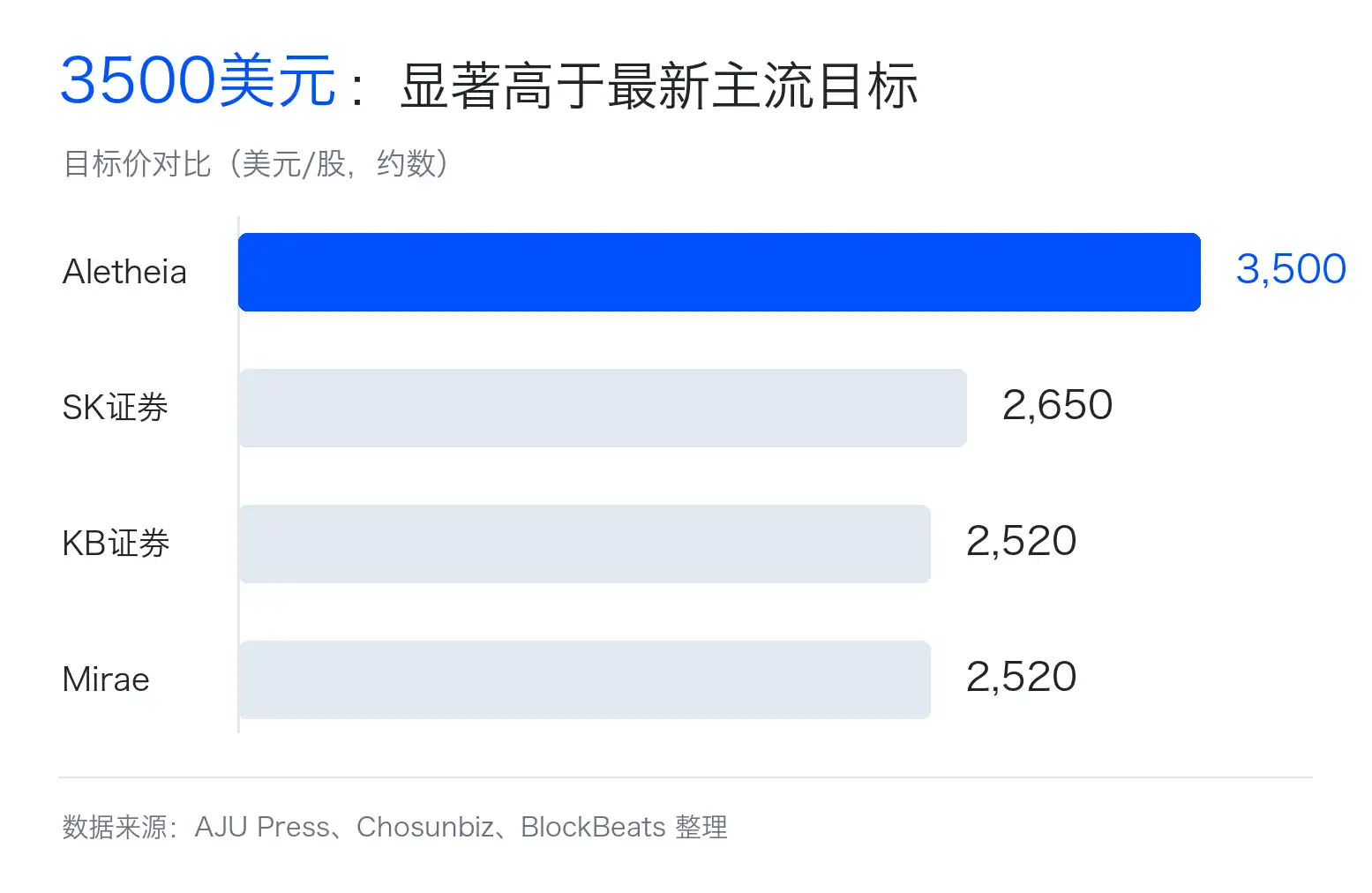
Aletheia Capital raised its target price for SK Hynix to approximately $3,500 in a report released today, pushing it far above the target range of mainstream institutions.

Aletheia Capital is an independent research and investment advisory firm headquartered in Hong Kong, serving institutional investors and covering sectors such as Asian tech hardware. In contrast, publicly reported target prices from SK Securities are around $2,000, while Mirae Asset and KB Securities target around $2,520.

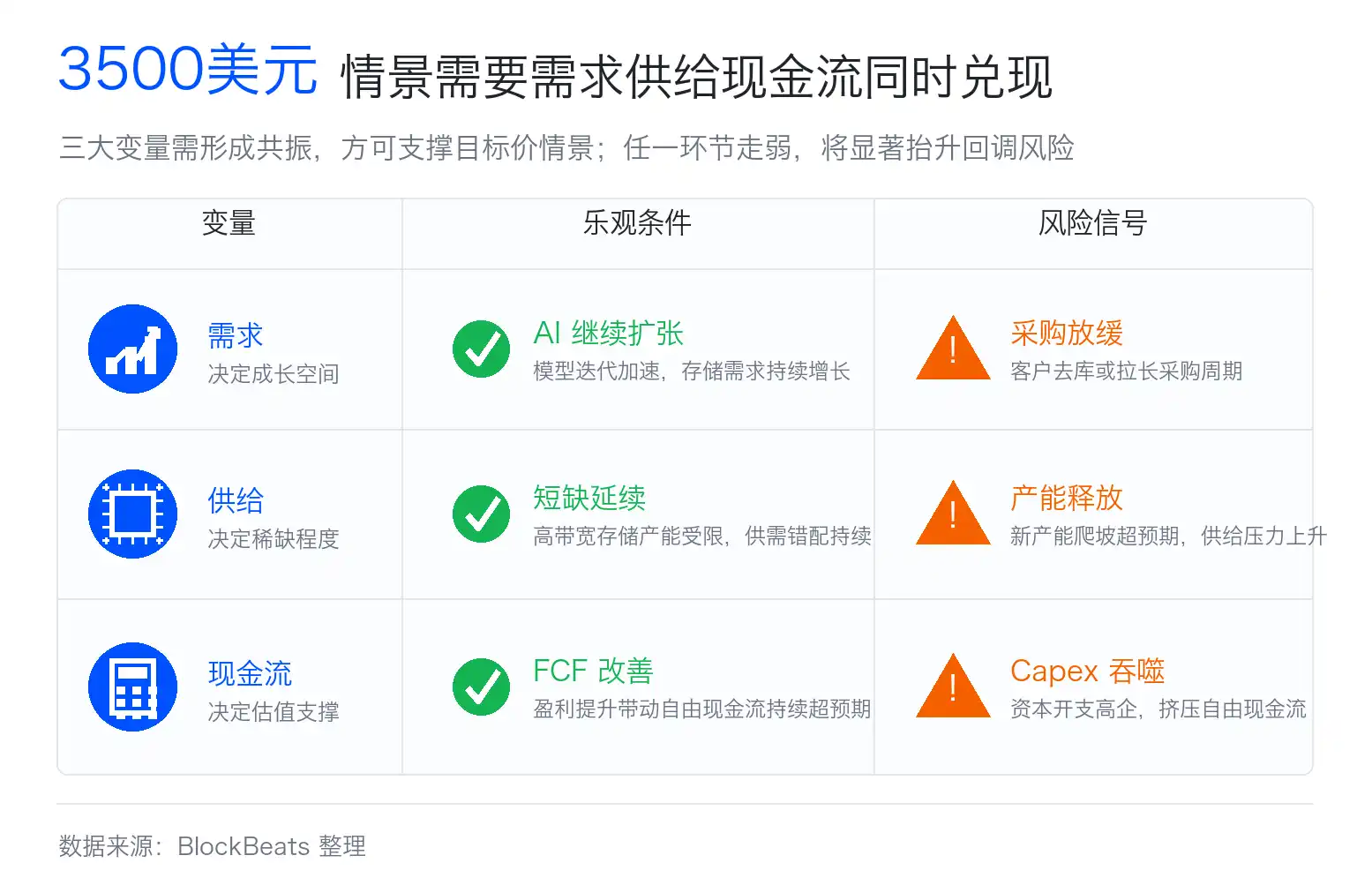
The truly aggressive aspect of the $3,500 target price is not just being more optimistic than mainstream institutions. It requires the market to believe three things will happen simultaneously: continued shortages of HBM (high-bandwidth memory for AI chips), continued price increases for standard DRAM, and AI server demand sustaining both the memory upcycle and free cash flow until 2027.

The market has already acknowledged that SK Hynix deserves a re-rating; the divergence lies in how far this re-rating can go. Most mainstream institutions still apply a cyclical industry discount, while the $3,500 price implies pulling out an optimistic tail scenario even after the re-rating.
The Divergence Lies in the 2027 Profit Base

The $3,500 figure is most easily misread as a simple valuation question: if you just apply a 10x multiple to SK Hynix's 2027 profits or free cash flow, the stock price can continue rising. The difficulty lies not in the multiple itself, but in how much money the company will actually earn and how much cash it will retain in 2027.

Memory company profits are highly volatile. During an upturn, prices rise, inventory clears, and margins expand rapidly. During a downturn, new capacity comes online, customers cancel orders, prices fall, and profits can quickly reverse. This is why the market has long assigned lower valuation multiples to memory companies.

Even with SK Hynix's current strong profitability, its 12-month forward P/E ratio, as mentioned in public reports, remains in the single digits. The market isn't blind to AI; it's concerned that this rally will ultimately still be priced as a cyclical peak.

The aggressive target price circulating from Aletheia challenges this cyclical discount. Based on public descriptions, it bets that sustained AI hardware demand will keep pushing HBM and DRAM prices higher, and SK Hynix's 2027 free cash flow will significantly exceed most current expectations, thus allowing for repricing based on this higher base.

The issue is that $3,500 requires multiple variables to align favorably simultaneously: HBM prices remaining strong, standard DRAM prices not being undercut by new capacity, SK Hynix maintaining its leading market share, capital expenditures not consuming too much cash, and the market still willing to assign a non-low multiple to a cyclical stock. If any link underperforms expectations, the target price would shift from a structural re-rating to a high-cycle extrapolation.

HBM Shortages Spill Over to Standard Memory

HBM can change SK Hynix's pricing logic because it's not a minor upgrade to standard memory; it's a core component next to AI accelerator cards. No matter how fast an AI chip computes, its overall performance can be bottlenecked if data can't be fed in fast enough. HBM's role is to provide a higher-bandwidth data channel for GPUs or AI accelerators.

General investors can think of it this way: the GPU is the engine, and HBM is the high-speed fuel delivery system. The stronger the engine, the higher the demand on the fuel system. In the past, when trading AI hardware, the market looked first at NVIDIA GPUs. Now, the market is increasingly realizing that GPU shipments and the ability to build up AI servers also depend on HBM supply.

Increasing HBM supply isn't as simple as slightly tweaking a standard DRAM production line for immediate volume. It requires more complex stacking, packaging, customer qualification, and consumes more wafer area and advanced packaging resources. Producing an equivalent capacity of HBM typically occupies more production capacity resources than standard DRAM.

This spreads the impact to standard memory. As manufacturers shift more resources to HBM, supply of DRAM for standard servers, PCs, and mobile devices tightens, potentially pushing up the average selling price of DRAM.

This is precisely the core mechanism that makes the ~$3,500 target price plausible. If HBM were just a fast-growing niche product, it could only boost part of SK Hynix's revenue. If HBM simultaneously constrains standard DRAM supply and lifts the entire memory price curve, it becomes an amplifier for the entire company's margins and cash flow.
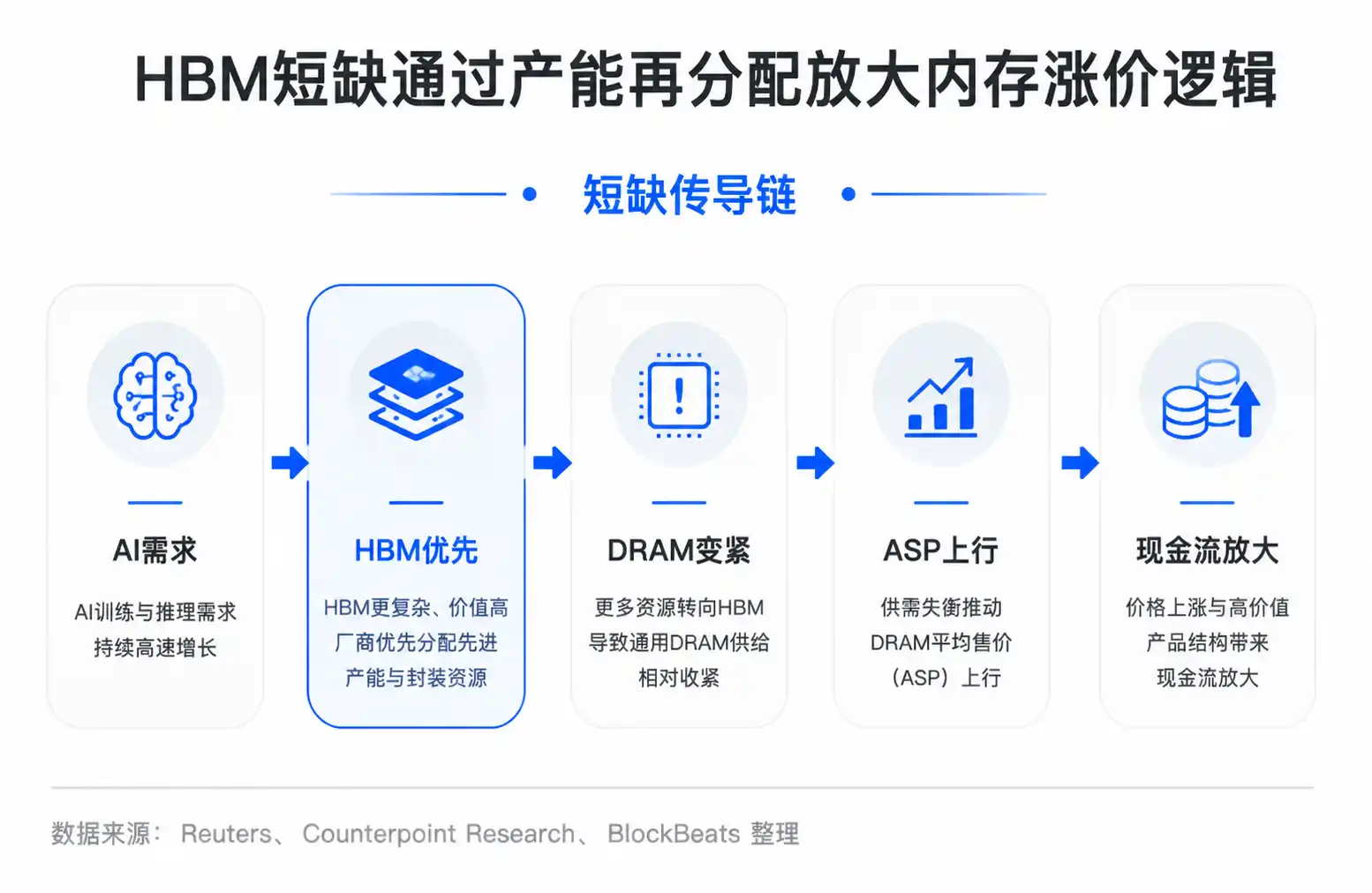
However, HBM shortages can only extend the cycle, not eliminate it. Samsung and Micron are catching up, SK Hynix itself will also expand production, and new wafer fabs and packaging capabilities will eventually be reflected in the supply side. The core of the debate is not whether shortages exist, but how long they will last and how long prices can remain strong.

SK Hynix Reaps the Most Direct Supply Chain Premium

SK Hynix is at the center of this re-rating not just because it's a memory company, but because it's the fastest runner in HBM. According to Reuters citing Counterpoint data, SK Hynix held about 58% of the global HBM market share in Q1 2026, with Samsung and Micron each around 21%. Reuters has also referred to it as a key supplier in NVIDIA's HBM supply chain.
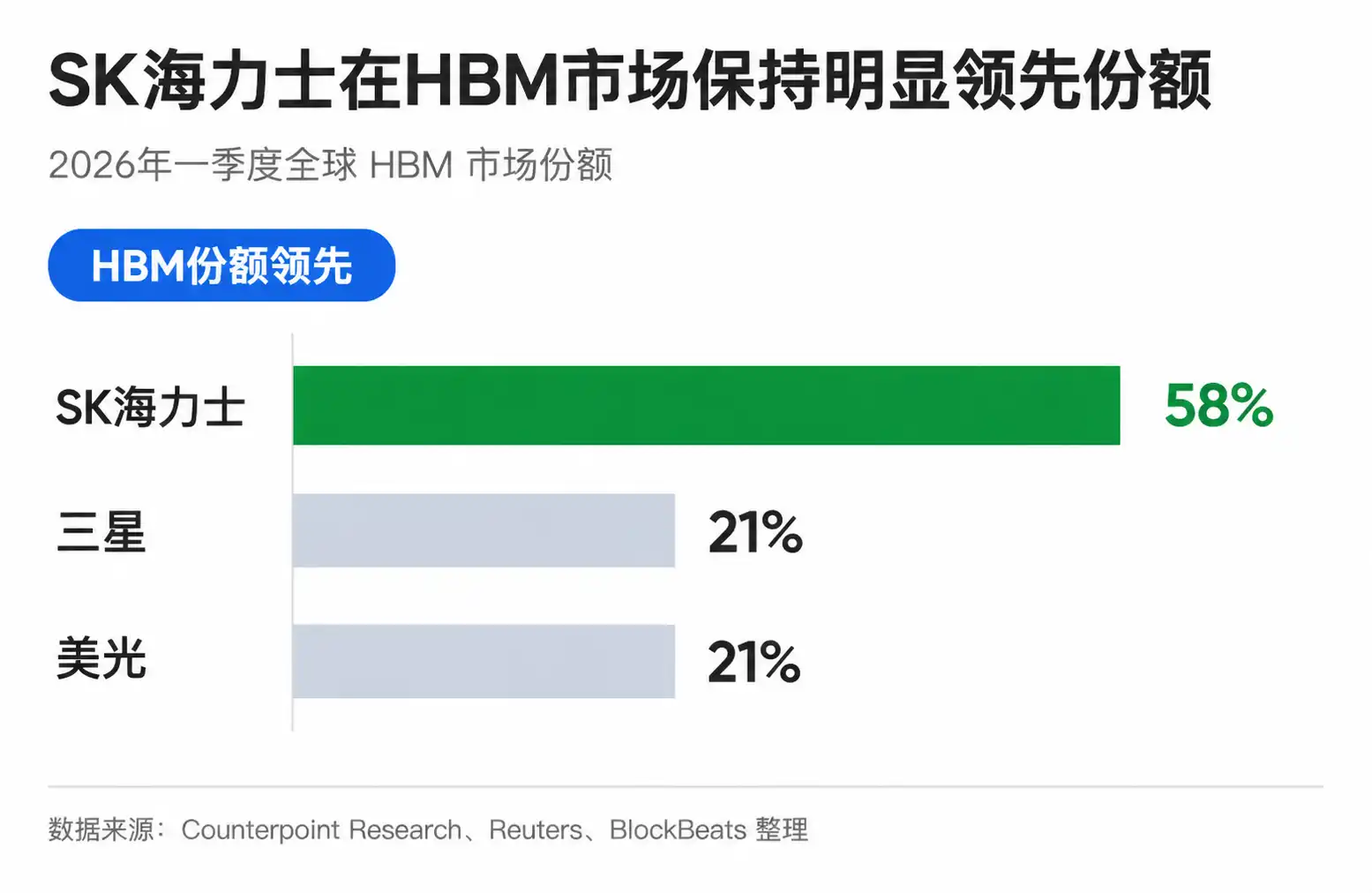
Such a lead is valuable in the semiconductor supply chain. AI chipmakers selecting HBM suppliers consider not just price, but also performance, yield, stability, and qualification progress. Being first to pass customer qualification makes it easier to enter the collaboration window for the next-generation products. Locking in orders earlier provides more initiative in capacity planning and price negotiations.

This is also why 2026 supply-demand visibility is drawing attention. According to a 2025 Reuters report, SK Hynix had completed 2026 HBM supply discussions with key customers. Multiple industry reports also suggest HBM shortages may extend into 2027. For investors, 2026 performance is at least not entirely story-driven.

SK Hynix's benefits aren't limited to HBM revenue itself. Because HBM occupies more capacity, squeezing standard DRAM supply, the traditional memory business may also benefit from price increases. AI demand first enters the financials through HBM, then influences the entire DRAM price through capacity reallocation.

This explains why institutional target prices keep being revised upward. Even without accepting an extreme scenario like $3,500, target prices in the ~$2,000 to $2,520 range indicate that mainstream institutions are already recalculating SK Hynix's profit elasticity for 2026-2027. The difference is that most still retain the discount appropriate for a cyclical industry, not extrapolating post-2027 tightness directly into a new normal.

Doubling the Stock Price Awaits Three Conditions

The $3,500 target price circulating from Aletheia essentially bets on continued strong demand, continued tight supply, and continued cash flow exceeding expectations. Over the past two years, massive GPU purchases by cloud providers and AI companies drove the HBM demand explosion. Next, the market needs to see if inference, enterprise AI, and custom ASICs can continue expanding memory consumption, ensuring demand isn't confined to training clusters.

The supply side also can't loosen too quickly. 2026 tightness is relatively easier to understand due to lags in capacity, packaging, and qualification; by 2027, new capacity and products from Samsung, SK Hynix, and Micron will gradually enter the market. If new supply arrives faster than expected, HBM price increases may narrow, and standard DRAM will face renewed pressure.

Ultimately, it comes down to cash flow. During an upturn, memory companies often increase capital expenditures for expansion, process upgrades, and advanced packaging. Profit growth doesn't necessarily all stay on the balance sheet. If SK Hynix needs significant investment to maintain its lead, the free cash flow base underpinning the $3,500 target price would be eroded.

Therefore, this target price is better viewed as an optimistic scenario, not a validated market consensus. 2027 is the real observation window: if HBM prices, DRAM ASPs, supply timing, and free cash flow continue to align favorably, the market will believe AI is raising the memory industry's profit center. If prices soften first, supply arrives first, or cash flow is consumed by capex, then ~$3,500 would shift from a re-rating anchor to an emotional peak.
Связанные с этим вопросы

QWhat are the three key conditions that Aletheia Capital's highly optimistic $3,500 price target for SK Hynix relies on?

AAletheia Capital's $3,500 price target for SK Hynix relies on three key conditions simultaneously occurring: 1) Sustained shortage and high prices for HBM (High Bandwidth Memory). 2) Continued price increases for regular DRAM. 3) AI server demand supporting strong market conditions and high free cash flow for the company through 2027.

QAccording to the article, what is the primary challenge in achieving the $3,500 target price, aside from the valuation multiple?

AThe primary challenge is not the valuation multiple itself, but accurately forecasting how much profit (or free cash flow) SK Hynix will actually generate in 2027. This requires multiple favorable variables to align, including HBM and DRAM pricing, market share, manageable capital expenditures, and market willingness to apply a higher multiple to a traditionally cyclical stock.

QHow does HBM shortage theoretically benefit SK Hynix's overall memory business beyond just HBM sales?

AHBM production is more complex and consumes more manufacturing resources (like wafer area and advanced packaging capacity) than regular DRAM. As manufacturers allocate more resources to produce HBM, the supply of regular DRAM for servers, PCs, and phones becomes tighter. This supply constraint can drive up the average selling price (ASP) of all DRAM, thereby boosting the profitability and cash flow of SK Hynix's entire memory division, not just the HBM segment.

QWhy is SK Hynix considered a core beneficiary in the current AI-driven memory revaluation?

ASK Hynix is a core beneficiary not just because it is a memory company, but because it holds a significant technological and supply chain lead in HBM. With reported market share around 58% in Q1 2026 and status as a key HBM supplier to NVIDIA, its early mover advantage in performance, yield, and customer certification allows it to secure orders, plan capacity proactively, and command pricing power more effectively than its competitors.

QWhat does the article suggest the $3,500 price target should be viewed as, rather than a market consensus?

AThe article suggests that the $3,500 price target should be viewed as an optimistic scenario or tail-end outcome, not an established market consensus. It represents a bet on a highly favorable alignment of demand, supply, and cash flow conditions extending through 2027. If any of these factors underperform, the target price would revert from being a structural revaluation anchor to merely reflecting peak-cycle optimism.

Похожее

Арендованная вера: сколько реальных денег скрывается в потоках средств биткоин-ETF

**Краткое содержание** Еженедельные притоки средств в биткоин-ETF часто интерпретируются как показатель веры институциональных инвесторов. Однако анализ показывает, что краткосрочные колебания притоков в значительной степени обусловлены не фундаментальной верой в рост цены, а арбитражной сделкой, известной как "керри-трейд" (cash-and-carry). * **Динамика притоков определяется арбитражем.** Трейдеры покупают ETF-акции (это отражается как приток средств) и одновременно открывают короткие позиции по фьючерсам на биткоин на CME, хеджируя рыночный риск. Их цель — заработать на разнице между фьючерсной и спотовой ценой (базис), а не на движении цены биткоина. Корреляция между еженедельными притоками в ETF и новыми короткими позициями хедж-фондов на CME очень высока (0.70). * **"Настоящий" спрос стабилен.** В общей сложности в ETF поступило около $55 млрд. Чистая позиция арбитражных трейдеров составляет лишь около $1 млрд. Основная часть — это устойчивые, направленные (лонг) покупки на уровне примерно $400 млн в неделю, которые и сформировали основной объем активов за два года. * **Арбитраж уходит.** Максимальный объем коротких позиций хедж-фондов под эту сделку достиг около $14 млрд в конце 2024 года, но с тех пор неуклонно снижается примерно до $4.5 млрд. По мере сжатия базиса до уровня, близкого к доходности гособлигаций США, эта сделка становится невыгодной, и капитал уходит, что вызывает отток из ETF. * **Вывод для интерпретации:** Не следует путать краткосрочные колебания притоков/оттоков, вызванные включением или выключением арбитражной сделки, с изменением долгосрочного доверия к биткоину. Для правильной оценки нужно отслеживать уровень базиса относительно безрисковой ставки и данные по коротким позициям на CME. Реальный, направленный интерес к биткоину через ETF остается значительным и устойчивым.

marsbit25 мин. назад

Арендованная вера: сколько реальных денег скрывается в потоках средств биткоин-ETF

marsbit25 мин. назад

Смерть Гринспена: рыночные правила, написанные им, Уорш переписывает

22 июня 2026 года скончался бывший председатель Федеральной резервной системы Алан Гринспен, архитектор современной финансовой системы. Его наследие — «пут Гринспена» — сформировало у рынков ожидание, что ФРС будет всегда страховать их от глубоких падений, как это было в 1987 и 1998 годах. Гринспен мастерски использовал силу слова и двусмысленные формулировки для управления ожиданиями, однако его низкие ставки после 2001 года многие считают причиной последующего кризиса 2008 года. Почти одновременно с его смертью нынешний глава ФРС Кевин Уорш инициировал полный пересмотр работы регулятора, создав пять целевых групп. Цель — подвергнуть ревизии устоявшиеся практики, включая политику «прямого информирования» о будущих шагах, которая стала основным каналом формирования рыночных ожиданий за последние 15 лет. Уорш, критик чрезмерного вмешательства ФРС, считает, что это исказило ценообразование активов. Его реформы, направленные на возвращение к более непредсказуемой и ориентированной на базовые принципы политике, могут положить конец эпохе «путов» и формуле «не идите против Федрезерва». Это символизирует конец финансовой парадигмы Гринспена в момент, когда ФРС сталкивается с миром, гораздо более сложным, чем в 1987 году.

marsbit42 мин. назад

Смерть Гринспена: рыночные правила, написанные им, Уорш переписывает

marsbit42 мин. назад

Снова привлекли 75 миллионов долларов: почему fomo снова заставляет ведущих венчурных капиталистов вступать в игру?

Социальное крипто-торговое приложение fomo привлекло 75 млн долларов в раунде финансирования серии B, возглавляемый Index Ventures, при участии Union Square Ventures (USV) и Benchmark. Пост-денежная оценка составляет 550 млн долларов. С момента запуска год назад, на платформе зарегистрировалось более 625 000 пользователей, совокупный объём торгов превысил 4 млрд долларов. Продукт fomo, основанный командой с опытом работы в dYdX и других ведущих компаниях, фокусируется на устранении технических барьеров для массового пользователя. Он предлагает упрощённую торговлю без комиссий за газ (Gas), поддержку нескольких блокчейнов (Bitcoin, Ethereum, Solana и др.), возможность покупки криптовалюты через Apple Pay и встроенные социальные функции для отслеживания сделок других трейдеров. Недавно была добавлена торговля бессрочными контрактами (перпетуалами). Ранее, в 2025 году, fomo привлёк 17 млн долларов в раунде A от Benchmark, известного своими инвестициями в потребительские приложения, что подчёркивает растущий интерес институционального капитала к упрощённым крипто-решениям. Инвестиции и рост пользовательской базы указывают на признание стратегии fomo по преодолению последних препятствий для массового внедрения криптовалют.

Foresight News1 ч. назад

Снова привлекли 75 миллионов долларов: почему fomo снова заставляет ведущих венчурных капиталистов вступать в игру?

Foresight News1 ч. назад

Более чем десятикратный рост за год: безумный продукт с плечом от SK Hynix

Внутригодовой рост более чем в десять раз: безумный продукт с кредитным плечом SK Hynix Акции SK Hynix демонстрируют стремительный рост на фоне ажиотажного спроса на полупроводники памяти, связанного с развитием ИИ. ETF с двойным кредитным плечом на акции SK Hynix, котирующийся в Гонконге, с начала года вырос более чем на 1000%, а его активы увеличились в 21,7 раза по сравнению с концом прошлого года. Основными инвесторами этого высокорискового продукта являются частные лица, в то время как институциональные инвесторы практически не участвуют. Однако эксперты предупреждают о значительных рисках, присущих leveraged ETF. Эти инструменты не только удваивают прибыль, но и пропорционально увеличивают убытки. В периоды высокой волатильности возможно возникновение "срока износа", что может привести к необратимым потерям даже при восстановлении цены базового актива. Кроме того, наблюдались аномальные движения цены ETF, полностью оторванные от динамики акций, из-за недостатка ликвидности. При текущих исторически высоких оценках сектора полупроводников и усилении разногласий между "быками" и "медведями", риски, связанные с продуктами с кредитным плечом, резко возрастают. Любые негативные факторы, такие как корректировка отраслевой политики или неожиданно слабые квартальные результаты компаний, могут спровоцировать резкие колебания на рынке, которые leveraged ETF значительно усилят.

marsbit1 ч. назад

Более чем десятикратный рост за год: безумный продукт с плечом от SK Hynix

marsbit1 ч. назад

Сверх 50-кратного взлёта за 18 месяцев: эпическое возрождение KIOXIA

Корпорация Kioxia, ранее переживавшая трудные времена из-за упущенных возможностей в сфере HBM и отложенного IPO, совершила впечатляющий рывок благодаря буму в области искусственного интеллекта. Спустя 18 месяцев после выхода на Токийскую фондовую биржу в конце 2024 года ее акции выросли более чем в 50 раз, а рыночная капитализация превысила 51 триллион иен, неоднократно опережая Toyota и занимая первое место в Японии. Ожидается, что операционная прибыль компании в первом квартале 2026 финансового года достигнет 1,3 триллиона иен, что в 30 раз больше, чем годом ранее, а вся производственная мощность NAND на 2026 год уже распродана. Основой успеха Kioxia является ее передовая технология 3D NAND, в частности платформа BiCS FLASH. Сейчас компания разрабатывает уже 10-е поколение, достигая 332 слоев и повышая плотность хранения данных за счет таких ключевых инноваций, как CBA (непосредственное соединение массива с КМОП) и OPS (выбор затвора с шагом). Помимо этого, Kioxia исследует будущее технологии памяти, разрабатывая 3D DRAM под названием OCTRAM. Эта технология, основанная на транзисторах с каналом из оксидного полупроводника (InGaZnO), направлена на решение проблем утечки тока и энергопотребления при обновлении, характерных для традиционной DRAM, открывая путь к созданию памяти большой емкости с низким энергопотреблением для эпохи ИИ. Превратившись из «неудачника» в лидера рынка, история Kioxia демонстрирует, как технологический актив в сочетании с изменяющимся рыночным спросом может кардинально изменить судьбу компании в циклической полупроводниковой отрасли.

marsbit1 ч. назад

Сверх 50-кратного взлёта за 18 месяцев: эпическое возрождение KIOXIA

marsbit1 ч. назад

Торговля

Спот
Фьючерсы
活动图片