The price of Polygon (MATIC) has shown great strength in the past few weeks against Tether as it maintained its bullish sentiment. Despite the retracement across the crypto market, Polygon has shown great strength holding above $0.75 compared to other crypto assets that have lost their key support.
Polygon (MATIC) Price Analysis On The Weekly Chart
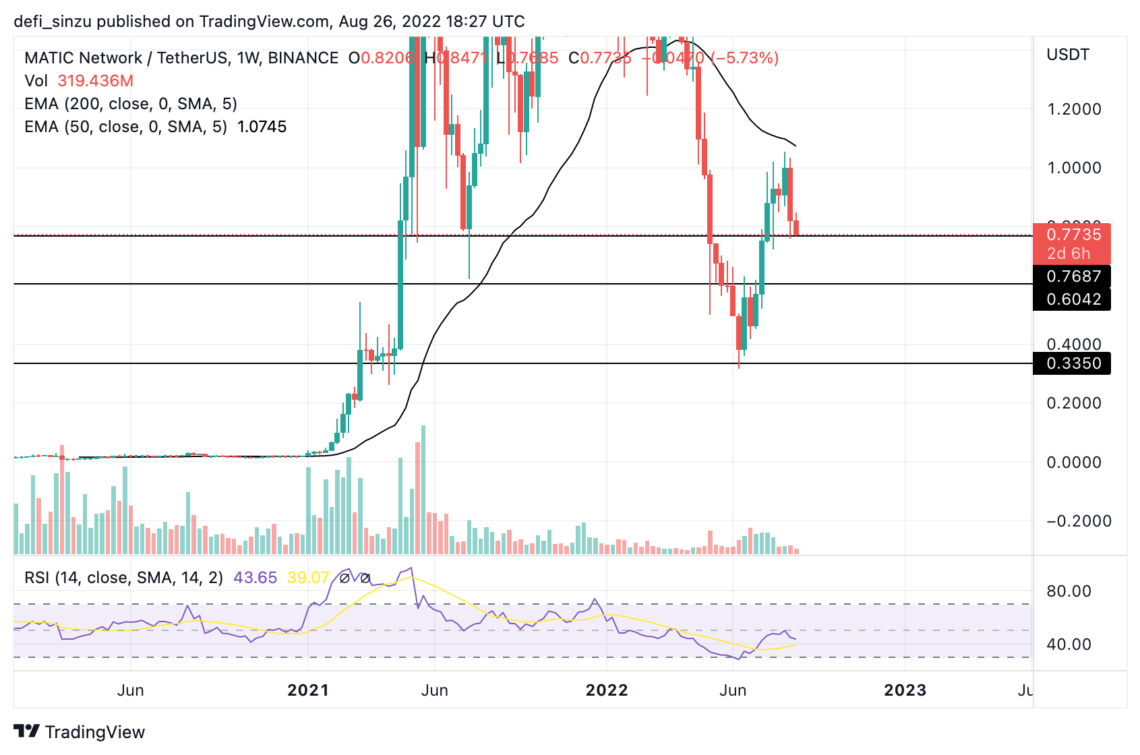
From the chart, the price of MATIC saw its weekly low at $0.75; the price of MATIC bounced from that region to a price of $1 on the weekly chart as the price is unable to show much strength to trend higher after being rejected.
MATIC’s weekly candle closed with a bearish sentiment, with the new week’s candle looking more bearish.
The price has continued to show little or no traction; If the price of MATIC on the weekly chart maintains this structure, it could retest its low of $0.6 as the support region on the weekly chart.
For the price of MATIC to trend higher, it needs to hold above the resistance at $0.6 to enable the price to trend higher.
Weekly resistance for the price of MATIC – $1.
Weekly support for the price of MATIC – $0.6.
Price Analysis Of MATIC On The Daily (1D) Chart
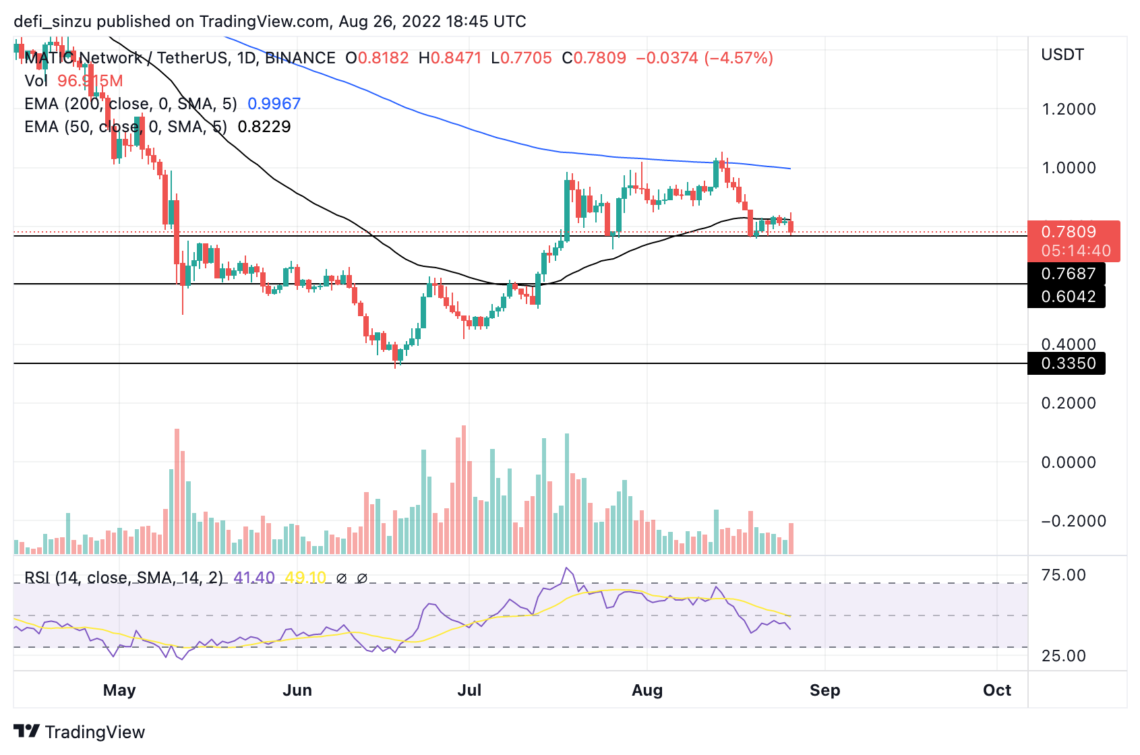
The price of MATIC has found itself ranging in a channel after being rejected from the $1 mark despite showing bullish strength in weeks, rallying from $0.3 to the $1 mark.
MATIC has found its price between $0.75 acting as support and $1 acting as the resistance for the price of MATIC. The price of MATIC needs to reclaim the region of $0.8 for the price to have the chance of trending higher.
If the price of MATIC fails to reclaim $0.8, the support at $0.75 and $0.6 would be a good region for bulls to build more strength and hold the price sell-off.
MATIC is currently trading at $0.77, just below the 50 and 200 Exponential Moving Average (EMA), which corresponds to prices of $0.82 and $1, acting as resistances for MATIC price.
MATIC is holding up well despite the retracement; if the price holds above $0.6-$0.77 price could have a good chance to trend higher.
On the daily chart, the Relative Strength Index (RSI) for the price of MATIC is at 40, indicating sell orders.
Daily (1D) resistance for MATIC price – $0.82-$1.
Daily (1D) support for MATIC price – $0.75-$0.6.
Price Analysis Of MATIC On The Four-Hourly (4H) Chart
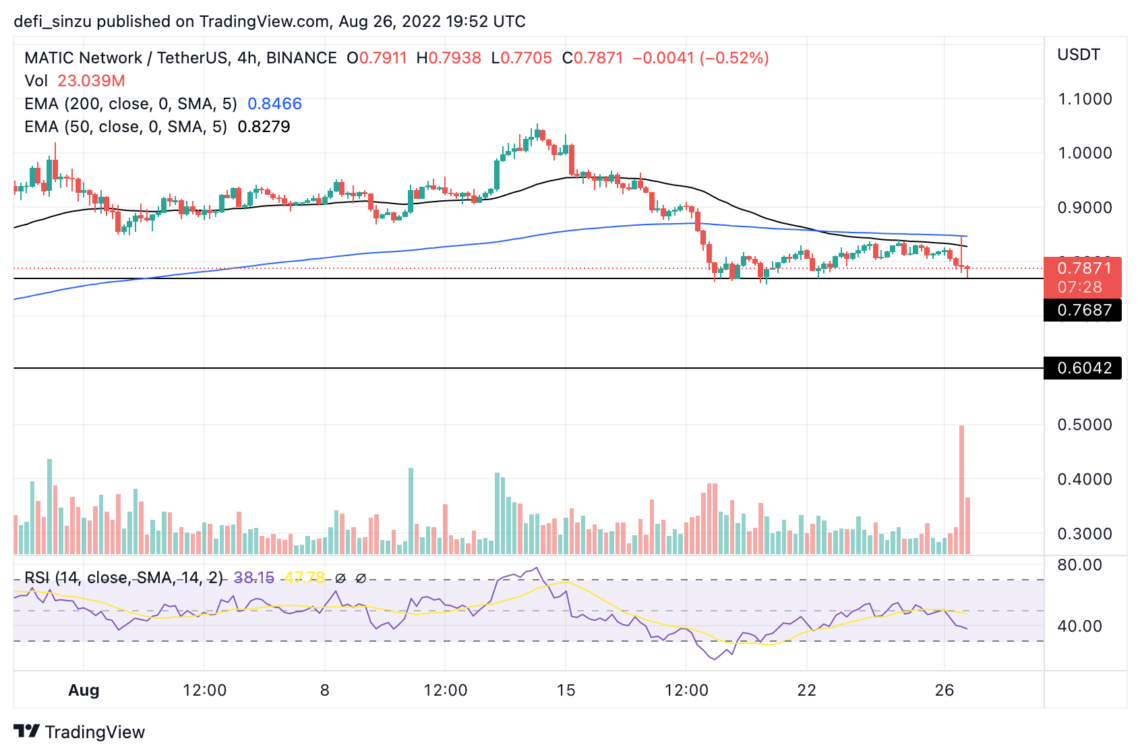
The price of MATIC has shown great strength holding up after the rejection from $0.82, acting as resistance. MATIC price is trading just below the 50 and 200 EMA price, corresponding to $0.85, acting as resistance to the MATIC price.
Polygon price needs to break and hold above the 50 and 200 EMA to assume its bullish sentiment; if MATIC fails to break and hold above, we could see the price retesting its support levels at $0.75-$0.6.
Four-Hourly (4H) resistance for MATIC price – $0.82.
Four-Hourly (4H) support for MATIC price – $0.75-$0.6