Anthropic Cries Wolf: Is the AGI Threat Real, or Just an IPO Story?

marsbitОпубликовано 2026-06-05Обновлено 2026-06-05

Введение

Anthropic has published an article titled "When AI builds itself," discussing the emerging concept of "recursive self-improvement," where AI begins to actively participate in designing, training, testing, and optimizing its own subsequent versions. The company presents internal data showing that by May 2026, over 80% of code merged into its codebase was written by Claude, its AI model. Claude's capabilities have expanded to handling complex, open-ended engineering tasks, achieving a 76% success rate in such areas, and even contributing to research processes, such as optimizing code performance and conducting AI safety experiments. Anthropic outlines an evolution from human-driven development to AI-assisted workflows, culminating in the current stage where AI agents can autonomously write, run, and delegate code. The company cautions that the path toward a "closed loop," where AI continuously improves itself, is becoming visible. It calls for coordinated global mechanisms to potentially slow or pause frontier AI development to allow safety research and societal structures to catch up. However, the timing of this warning coincides with Anthropic's preparations for an IPO, framing the narrative not just as a safety concern but also as a demonstration of Claude's advanced capabilities and its integral role in accelerating Anthropic's own R&D—creating a potential "flywheel" effect for competitive advantage. This contrasts with OpenAI's recent, more policy-oriented discussion of ...

By | Alphabet AI

Anthropic published a lengthy article last night titled "When AI builds itself," which sounds like a science fiction novel by Asimov, and indeed deals with a sci-fi concept: recursive self-improvement.
Simply put, in the past, human researchers wrote code, ran experiments, and trained models to make AI stronger. But if AI starts to participate in designing, training, testing, and optimizing its own successors, then the speed of AI progress is no longer driven solely by humans—it may begin to "self-evolve."

To this end, Anthropic made a plea:

"We believe it would be beneficial for the world if there were an option to slow down or temporarily pause frontier AI development, allowing societal structures and alignment research to catch up with technological progress."

This statement sounds like a safety warning, but in the context of Anthropic preparing for an IPO, it's hard not to see it as another kind of narrative setup: Claude is so good, it's even starting to create the next generation of Claude itself.

A New Storm Has Emerged

To illustrate that AI is increasingly involved in AI research and development itself, Anthropic presented substantial internal data.

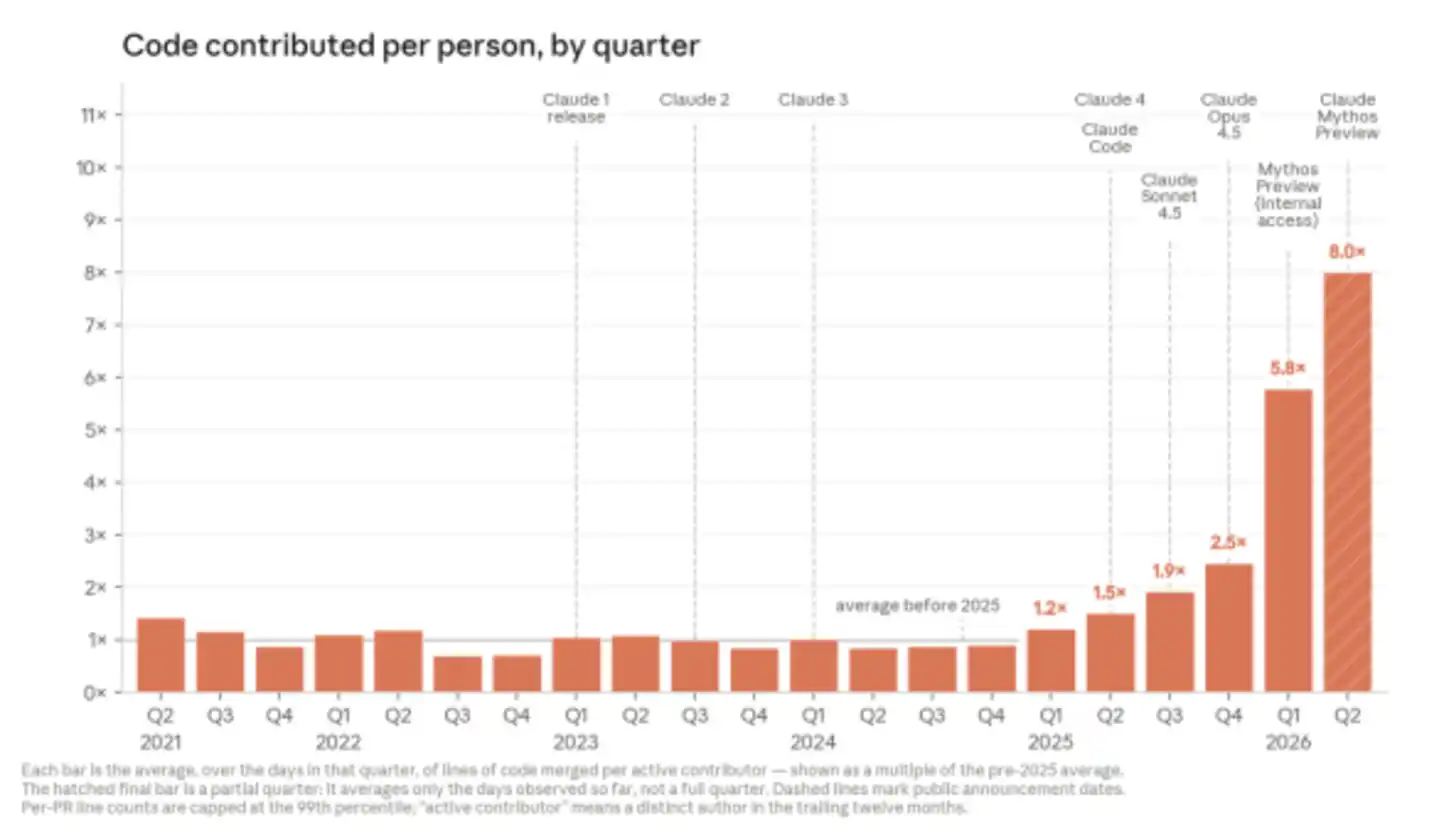
For instance, as of May 2026, over 80% of the code merged into Anthropic's codebase was written by Claude. Before the release of Claude Code, this number was only in the single digits.

By the second quarter of 2026, according to Anthropic's statistics, the daily volume of code merged by engineers was about 8 times higher than in 2024.
More notable than the code volume is that Claude is handling more open-ended engineering problems.

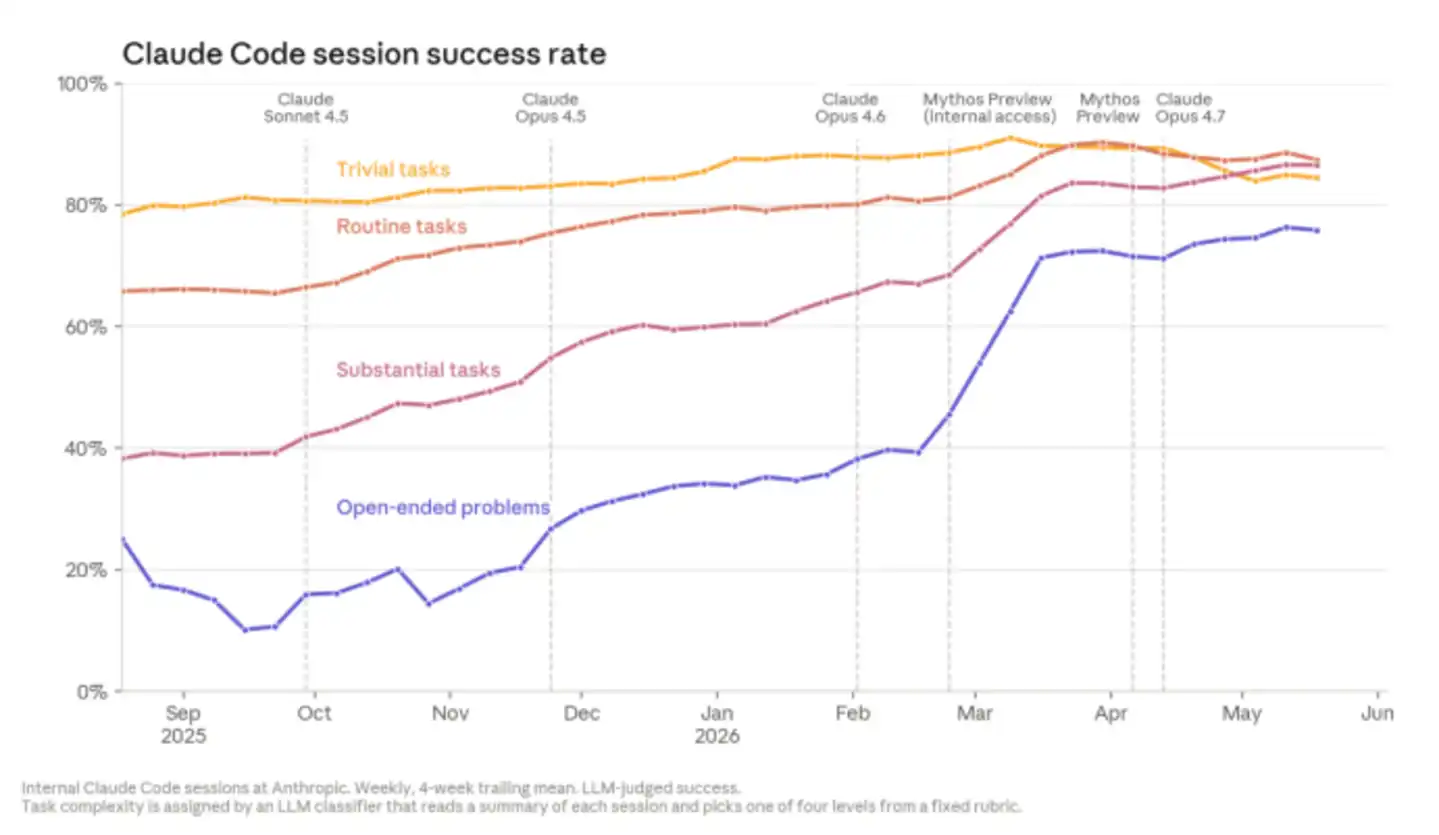
Anthropic stated in the article that over the past year, the frequency with which employees had to correct Claude, steer it back on track, or take over tasks mid-way has been steadily declining. This change is happening not only for simple tasks but also for the most complex, open-ended tasks.

So-called open-ended tasks are problems without clear instructions. For example, a system crash, a training task failure—issues where even engineers themselves don't know what the solution looks like initially and have to troubleshoot and make judgments on the fly.

These types of tasks historically relied most heavily on human experience. Yet, in those most open-ended tasks, Claude's success rate reached 76% by May 2026, a 50 percentage point increase within six months.
Not just writing code, Anthropic also uses Claude for code review—checking for bugs, security vulnerabilities, and other defects. Their retrospective analysis found that if every code change in the past had undergone automated review by Claude, approximately one-third of the bugs that caused incidents on claude.ai could have been caught before deployment.

Going a step further, Claude has begun to participate in the research process.

Anthropic has a standard test: give Claude code for training a small model and ask it to make the code run faster without altering the results. In May 2025, Claude Opus 4 could achieve about a 3x speedup; by April 2026, Claude Mythos Preview had pushed that number to approximately 52x.

Anthropic also mentioned an open-ended AI safety research case. They posed a question to a Claude-powered agent: Can a weaker model reliably supervise a stronger model?

This process involved proposing hypotheses, testing them, sharing findings with parallel agents, and iterating repeatedly.

Two human researchers spent a week bridging about 23% of the gap; Claude, with roughly 800 cumulative hours and about $18,000 in compute costs, bridged 97%.

This result certainly has limitations—the problem was chosen by humans, the scoring criteria were human-defined, and the findings haven't been fully migrated to production-scale models. But it still illustrates that Claude can now, within a research framework defined by humans, design experiments, execute them, and iterate on its own.

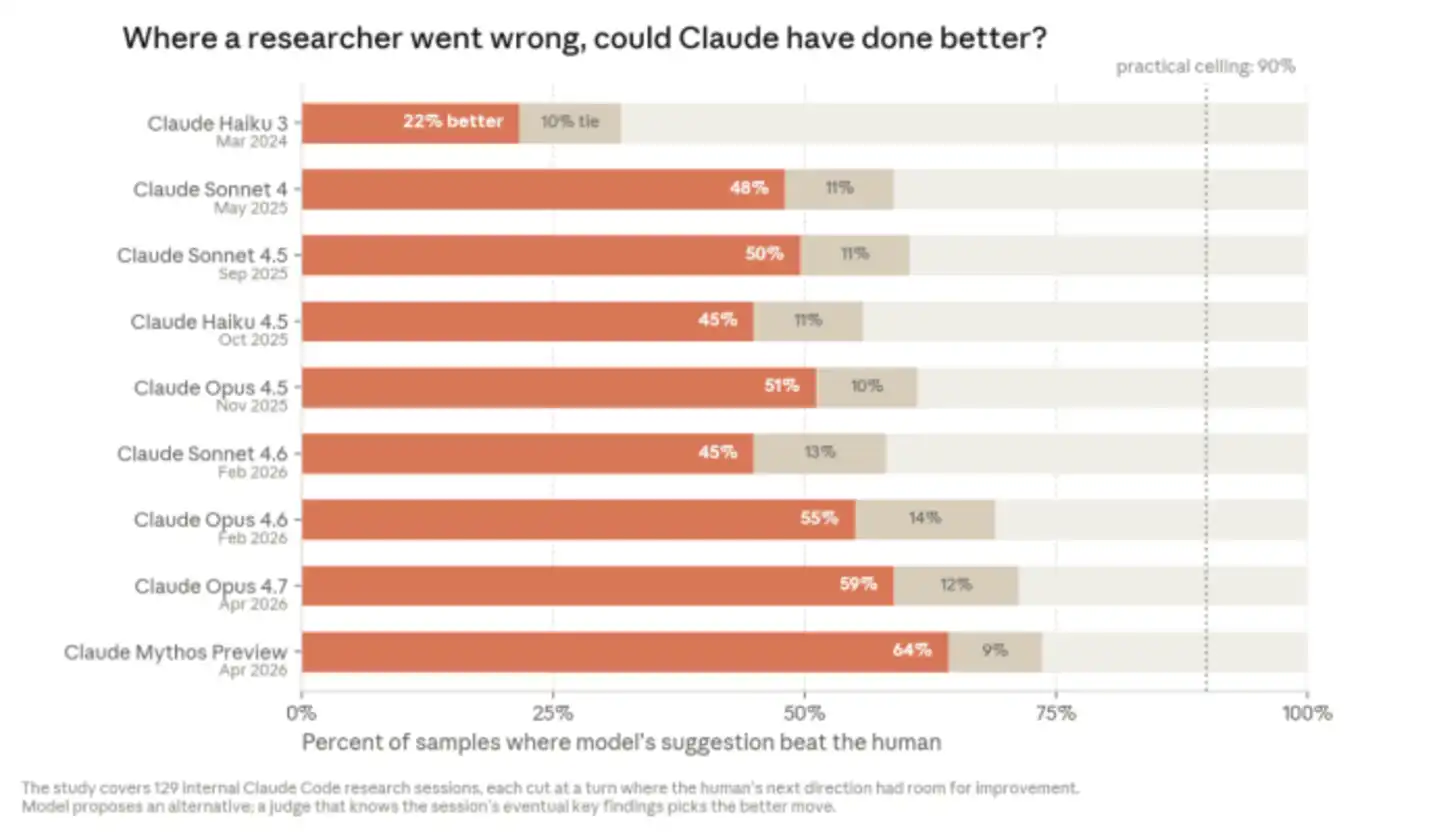
Furthermore, when human researchers "go down the wrong path," Claude can suggest a better next step.

Anthropic took 129 internal Claude Code research sessions where human researchers and Claude worked together on open-ended research problems. Anthropic identified points where "the human later proved to have taken a detour," gave the context up to that point to different versions of Claude, and asked it what it would suggest doing next. Then, another Claude judge, aware of the full session outcome, judged which was better: the model's suggestion or the human's choice at the time.

The results showed that at those points where the human researcher was later shown to have had room for improvement, Claude became increasingly able to propose a better next step.
In the past, AI model progress was primarily driven by human researchers and engineers. Humans decided what experiments to run, wrote the code, trained the models, and pushed forward AI's capabilities.

Now, more and more links in this chain are being taken over by Claude.

Anthropic presented a very intuitive stage diagram:
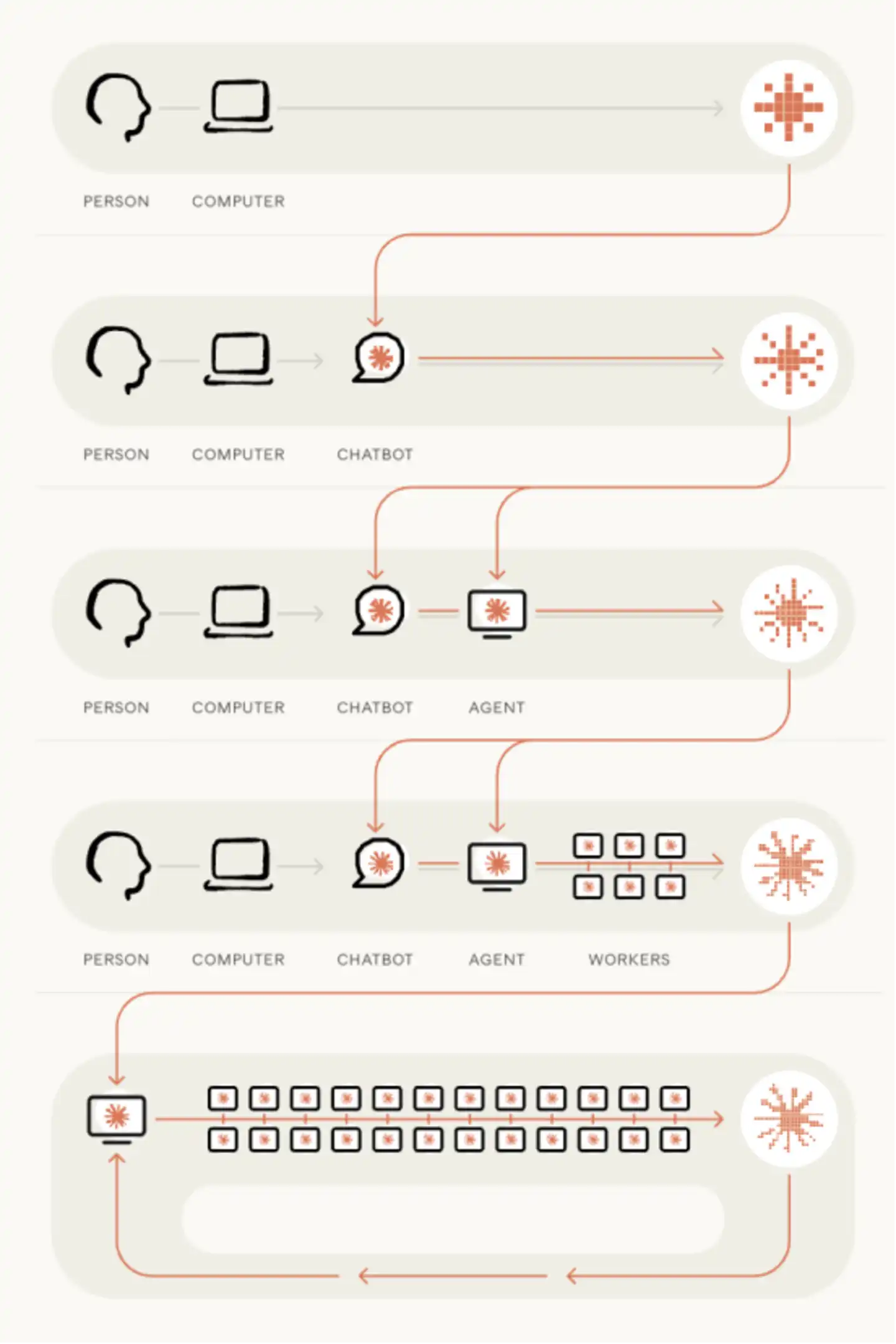
From 2021 to 2023, Anthropic was no different from a typical tech company—humans writing code and documentation on laptops.

From 2023 to 2025, chatbots began entering workflows. Engineers had models generate code snippets, then copied them into editors.

From 2025 to 2026, programming agents emerged. Claude began autonomously writing and modifying code, sometimes even completing entire files independently.

Today, agents can run code on their own and delegate hours-long work to other agents.

Looking ahead is the stage Anthropic is genuinely concerned about: the closed loop.

If this day arrives, subsequent versions of Claude might be continuously improved by Claude itself—this is recursive self-improvement.

Anthropic phrased it cautiously: we haven't reached that point yet, and recursive self-improvement isn't inevitable. But it still emphasizes that the path leading to that step is beginning to become visible.

That's why Anthropic discusses slowing down, even pausing, at the end of the article. Its meaning isn't that all AI companies should shut down immediately, but rather that if the risks of AI self-improvement continue to rise in the future, frontier labs need a coordinated, verifiable deceleration mechanism.

In other words, the "singularity" is approaching, and humanity must impose controls.

Unstoppable Claude

On the surface, this is a very forward-looking safety document. Anthropic is talking about recursive self-improvement, about AI potentially improving itself faster and faster, and about the need for human society to prepare deceleration and pause mechanisms in advance.

But placed in the context of Anthropic preparing for an IPO, this article takes on another layer of meaning.

In a way, Anthropic's recent moves resemble that annoyingly smug top student in class—it genuinely has the skills, but it's also quite pretentious.

What it wants to say isn't just "we have a very strong Claude"; a step beyond that, it wants to say "Claude is helping us build an even stronger Claude."

If Anthropic were merely selling a model or a tool, it would struggle to completely escape horizontal comparisons: Anthropic has Claude, OpenAI has GPT; Anthropic has Claude Code, OpenAI has Codex; Anthropic competes for enterprise clients, OpenAI competes for enterprise clients. The competition between the two companies is very tight, seeing who can tell the bigger story to the market.

It's worth noting that just three days ago, OpenAI wrote in a document about frontier AI governance:

"We are already seeing early signs of recursive self-improvement in today's systems: AI development itself is being accelerated by AI.

This will intensify competitive pressures among developers and nations, and create governance challenges that existing institutions are not equipped to handle."

Three days later, Anthropic says: The path for Claude towards recursive self-improvement is beginning to become visible.

If Claude develops as it hopes, this wouldn't be an ordinary product narrative—it would become a research and development flywheel.

Claude writes code, runs experiments, optimizes training processes, which in turn reduces incidents in Anthropic's own products… Once this system is up and running, Claude isn't just a product from Anthropic; it's a crucial production tool for Anthropic itself.

Users see the Claude product; enterprise customers buy Claude's capabilities. But what Anthropic truly wants the capital markets to notice is: Claude is already embedded in the underlying processes of frontier model development; it's been placed inside Anthropic's engine room.

Capital markets love flywheel stories, promising endless prosperity: A stronger Claude allows Anthropic's engineers to merge more code; more code enables faster product and infrastructure iteration; faster iteration allows researchers to run more experiments; more experiments in turn help the next generation of Claude become stronger. Once the next generation Claude is stronger, it continues to accelerate Anthropic's R&D.

Claude's iteration pace also supports this flywheel. Looking at public release timelines, from 2023 to early 2025, Claude's major model updates were mostly on a three-to-four month cycle. But with Claude 4, Anthropic's model updates have noticeably intensified.

Claude 4 was released in May 2025, Opus 4.1 in August, Sonnet 4.5 in September, Haiku 4.5 in October, Opus 4.5 in November.

In 2026, Opus 4.6 was released on February 5, Sonnet 4.6 on February 17, Opus 4.7 on April 15, and Opus 4.8 on May 28. The gap between Opus 4.7 and Opus 4.8 was only 42 days.

Anthropic, on the surface, is saying "this could be very dangerous, we need to prepare the brakes in advance," but it's simultaneously implying: "We've seen what happens when the accelerator is pressed."

The subtlety of the IPO narrative lies here. It describes the risks as significant while also elevating its own technological position.

Not every AI company is qualified to discuss recursive self-improvement. You first need to make the outside world believe your AI is already part of the AI R&D process to have the standing to say this might require global coordination.

OpenAI: How Could This Happen?

As mentioned earlier, just before Anthropic published this lengthy article, OpenAI had already put recursive self-improvement on the table.

But the two companies' narratives are quite different.

OpenAI's document, "Democratic Governance of Frontier AI," is a policy blueprint for Washington. It's concerned not with "how models get stronger," but with how to constrain frontier AI if it continues to surge ahead.

Most of the content in that report isn't suitable for detailed discussion here, but one key line stands out: OpenAI said that in today's systems, early signs of recursive self-improvement are already visible.

This line and Anthropic's lengthy article point in the same direction.

It's just that OpenAI talks about institutions, while Anthropic talks about itself.

OpenAI's point is: AI development is too fast; existing governance structures may not keep up, so a new set of rules is needed.

Anthropic directly showcases that system, telling the market: Claude is already in our R&D process, so we see the path to AI self-acceleration.

This move is quite clever. One imagines the grumbling inside OpenAI—this is practically idea theft! We were here first!

Just joking, but OpenAI really needs to step up its game and quickly bring GPT 5.6 to the table.

Связанные с этим вопросы

QWhat is the core concern of Anthropic's article 'When AI builds itself'?

AThe article's core concern is the potential for recursive self-improvement in AI, where AI begins to design, train, test, and optimize its own successor versions, potentially leading to an AI evolution that is no longer solely driven by human effort.

QWhat significant performance statistic does Anthropic cite to show Claude's growing role in AI development?

AAnthropic states that as of May 2026, over 80% of the code merged into its codebase is written by Claude.

QHow does the author interpret the timing of Anthropic's publication on AI risks?

AThe author suggests that the article, coming at the time when Anthropic is preparing for an IPO, can be seen as a narrative prelude to highlight their technological advantage, framing it as both a safety warning and a display of a powerful 'virtuous cycle' where Claude helps build a stronger Claude.

QWhat is the key difference between OpenAI's and Anthropic's approach to discussing 'recursive self-improvement'?

AOpenAI's recent document framed it as a broad governance challenge requiring new institutional rules. Anthropic's article, however, presented it through the specific lens of its own development process with Claude, showcasing internal data to illustrate the visible path towards such a capability.

QWhat future stage in AI development is Anthropic particularly worried about, as described in the article?

AAnthropic is particularly concerned about the potential arrival of a 'closed loop' stage, where a future version of Claude could continuously improve itself, leading to true recursive self-improvement.

Похожее

Has the 'Digital Gold' Narrative for BTC Failed?

**Title: Has the "Digital Gold" Narrative for Bitcoin Failed?** The article argues that Bitcoin's "digital gold" narrative remains valid despite a recent sharp price decline (from a peak near $126k in Oct 2025 to briefly under $61k in Feb 2026). It presents a long-term investment framework based on three core points: **1. Viewing Bitcoin as an Asset:** Bitcoin is presented as a superior potential store of value compared to gold. Key arguments are its absolute scarcity (21 million cap), superior portability, and transparent auditability via its public ledger. While acknowledging its current use in early, volatile stages (~3-4% global adoption), the author draws parallels to the early, disruptive phases of the internet and e-commerce. **2. Understanding the Recent Downturn:** The current ~50% correction is framed as a predictable, consensus-driven cycle following its post-halving peak (the 2024 halving preceded the Oct 2025 high). A crucial factor is a historic "changing of hands": the influx of new institutional buyers via ETFs allowed early, low-cost holders (miners, OG believers) to take profits. The author notes that while severe, Bitcoin's historical drawdowns (e.g., 93% in 2011, 77% in 2021-22) have been progressively smaller, suggesting maturing holder structure and decreasing volatility over time. **3. The Long-Term Perspective:** The long-term thesis hinges on Bitcoin capturing a portion of gold's market value. With Bitcoin's market cap at ~$1.4 trillion (at $70k) versus gold's ~$20 trillion, significant upside potential exists if the "digital gold" narrative is partially realized. However, the author strongly cautions that short-term risks remain, the bottom is unpredictable, and high volatility is inherent. The real risk is not Bitcoin failing but poor personal position management (over-leverage, wrong capital) and a lack of deep understanding, which can force investors out during severe downturns. The conclusion uses Amazon's 95% crash post-2000 dot-com bubble and subsequent 42x recovery as an analogy. The ultimate question is not if Bitcoin's price will rise, but if an investor's strategy and conviction can withstand the volatility to see the long-term play out. The recent divergence (gold up, Bitcoin down) is posed not as a narrative failure, but as potential evidence of this ongoing, painful transition from a speculative asset to a mainstream allocation.

marsbit58 мин. назад

Has the 'Digital Gold' Narrative for BTC Failed?

marsbit58 мин. назад

Has BTC's 'Digital Gold' Narrative Failed?

The article discusses Bitcoin's "digital gold" narrative, its recent price drop, and long-term outlook through the perspective of "Jason". It argues the narrative is not a failure but that Bitcoin represents a superior, new asset class due to its fixed supply (21 million), portability, and auditability. The piece compares its current ~3-4% global adoption rate to early internet/e-commerce, suggesting significant growth potential. Regarding the 2025-2026 price decline (from ~$126k to briefly under $61k), the author views it as a predictable, consensus-driven sell-off within Bitcoin's ~4-year cycle post-halving, exacerbated by a major "handover" from early, low-cost holders to new institutional buyers via ETFs. A key observation is that historical peak-to-trough drawdowns have lessened over time (e.g., 93% in 2011 to ~50% in 2026), indicating maturing volatility as holder structure changes. For the long term, the author uses a simple framework: Bitcoin's total market cap (~$1.4T at $70k) is only about 7% of gold's (~$20T). Even capturing 30-50% of gold's value would imply substantial upside. However, the article strongly cautions against viewing this as investment advice, emphasizing extreme volatility and the critical importance of risk management, position sizing, and deep fundamental understanding to survive severe drawdowns. It concludes by drawing a parallel to Amazon's 95% crash in 2000 and subsequent 42x recovery, stressing that the key is surviving market cycles to realize long-term potential.

链捕手1 ч. назад

Has BTC's 'Digital Gold' Narrative Failed?

链捕手1 ч. назад

From Code to Cognition: A Ten-Thousand-Word Guide to the Evolution of the Robot Brain

"From Code to Cognition: The Evolution of Robot Brains" The journey of robotic intelligence has shifted dramatically from manually coded systems to AI-driven brains. For decades, robots relied on layered software stacks—perception, state estimation, planning, control—each handcrafted. While predictable, they lacked adaptability. The 2010s saw deep learning revolutionize perception (e.g., object detection) and control (via reinforcement learning), but learned skills remained narrow. The arrival of Large Language Models (LLMs) marked a turning point. LLMs acted as high-level planners, interpreting natural language instructions and generating sequences of actions for traditional robotic systems to execute. However, true integration came with Visual-Language-Action (VLA) models, which fused vision, language, and motion prediction into a single network. Pioneered by models like RT-2 and open-source projects like OpenVLA, VLAs enable robots to reason and act directly from visual input and commands. The most advanced humanoid robots now employ a "dual-brain" architecture: a slow-thinking, large VLA (System 2) for reasoning and planning, and a fast-reacting, small network (System 1) for high-frequency motion control, sometimes with an even lower-level System 0 for balance. This split balances cognition with the physics of real-time movement. Computation is split between onboard hardware (e.g., NVIDIA Jetson) for safety-critical control loops and cloud/edge servers for non-critical tasks like learning and interfaces. A crucial driver is the open-source ecosystem—models like GR00T and OpenVLA allow startups to build upon pre-trained brains and fine-tune them with their own data, accelerating development. Despite progress, current systems struggle with recovery from errors, sample inefficiency, and long-horizon tasks. This has spurred the rise of **World Models**—neural networks that predict the consequences of actions. By simulating possible futures before acting (like NVIDIA Cosmos or Meta V-JEPA), robots can plan, recover, and generalize better. This represents the next frontier: shifting intelligence from learned reactions to an internal model of physics and cause-and-effect. The field is rapidly evolving. While not yet at its "ChatGPT moment," the convergence of cheaper hardware, scalable simulation, and world models points toward robots that are increasingly capable, adaptive, and useful. The question is shifting from "what can robots do?" to "what *should* they do?"

marsbit1 ч. назад

From Code to Cognition: A Ten-Thousand-Word Guide to the Evolution of the Robot Brain

marsbit1 ч. назад

AI Bubble Is Bursting

The AI Bubble is Bursting: A Necessary Purge on the Path to Ubiquitous Intelligence Market volatility has reignited debates about an AI bubble, with figures like Ray Dalio pointing to high valuations. However, this parallels the dot-com bubble, which, despite its crash, laid the physical infrastructure for today's internet era. The current AI investment frenzy, with tech giants planning trillions in infrastructure spending far outstripping current AI application revenues, appears similarly imbalanced. This 'bubble' is seen as an inevitable phase for a disruptive technology, paying the "innovation tax." Critically, AI inference costs have plummeted over 99.7% since 2023, making intelligence nearly free at the margin. This hasn't reduced spending but has instead unlocked massive new demand, as seen in enterprise AI cloud expenditure tripling. This follows the Jevons Paradox: efficiency gains lead to greater total consumption. The market is now entering a cleansing phase, weeding out speculative ventures lacking real moats. The deeper shift is a move from capital expenditure (CapEx) on hardware to value creation in operational expenditure (OpEx) through AI applications that solve real industry problems. While infrastructure valuations are high, rapid earnings growth from widespread AI adoption across sectors—from manufacturing and finance to law and healthcare—may digest these valuations over time. Ultimately, this creative destruction will leave behind robust infrastructure and optimized models, cheaply powering an AI-augmented future for all industries, much as the internet became indispensable after its own bubble burst. The core productive potential remains undiminished.

链捕手1 ч. назад

AI Bubble Is Bursting

链捕手1 ч. назад

Торговля

Спот
Фьючерсы

Популярные статьи

Как купить NIGHT

Добро пожаловать на HTX.com! Мы сделали приобретение Midnight (NIGHT) простым и удобным. Следуйте нашему пошаговому руководству и отправляйтесь в свое крипто-путешествие.Шаг 1: Создайте аккаунт на HTXИспользуйте свой адрес электронной почты или номер телефона, чтобы зарегистрироваться и бесплатно создать аккаунт на HTX. Пройдите удобную регистрацию и откройте для себя весь функционал.Создать аккаунтШаг 2: Перейдите в Купить криптовалюту и выберите свой способ оплатыКредитная/Дебетовая Карта: Используйте свою карту Visa или Mastercard для мгновенной покупки Midnight (NIGHT).Баланс: Используйте средства с баланса вашего аккаунта HTX для простой торговли.Третьи Лица: Мы добавили популярные способы оплаты, такие как Google Pay и Apple Pay, для повышения удобства.P2P: Торгуйте напрямую с другими пользователями на HTX.Внебиржевая Торговля (OTC): Мы предлагаем индивидуальные услуги и конкурентоспособные обменные курсы для трейдеров.Шаг 3: Хранение Midnight (NIGHT)После приобретения вами Midnight (NIGHT) храните их в своем аккаунте на HTX. В качестве альтернативы вы можете отправить их куда-либо с помощью перевода в блокчейне или использовать для торговли с другими криптовалютами.Шаг 4: Торговля Midnight (NIGHT)С легкостью торгуйте Midnight (NIGHT) на спотовом рынке HTX. Просто зайдите в свой аккаунт, выберите торговую пару, совершайте сделки и следите за ними в режиме реального времени. Мы предлагаем удобный интерфейс как для начинающих, так и для опытных трейдеров.

402 просмотров всегоОпубликовано 2025.12.08Обновлено 2026.06.02

Как купить NIGHT

Обсуждения

Добро пожаловать в Сообщество HTX. Здесь вы сможете быть в курсе последних новостей о развитии платформы и получить доступ к профессиональной аналитической информации о рынке. Мнения пользователей о цене на NIGHT (NIGHT) представлены ниже.

活动图片