5 in a row! Here’s why monthly perp volumes have been falling since October

ambcryptoОпубликовано 2026-04-07Обновлено 2026-04-07

Введение

Perpetual trading volumes on decentralized exchanges have declined for five consecutive months, falling nearly 50% from a peak of $1.36 trillion in October 2025 to $699 billion by March 2026. This drop reflects ongoing bear market conditions and cautious trader sentiment following last year's market crash, which erased nearly $1 trillion in value. Open interest also declined by 50% from pre-October levels, indicating reduced speculative activity. While the decline highlights persistent bearish pressure, it also suggests traders are recalibrating risk more strategically. This measured behavior helps stabilize markets, reduce volatility, and may lay a stronger foundation for crypto's next rally.

In crypto trading, market crashes leave marks that investors don’t forget.

Looking back at Q4 last year, things were rough across the board; spot trading and even long-term HODLing all took a hit. Crypto markets lost nearly $1 trillion, triggering massive liquidity sweeps, forcing deleveraging, and sending shocks across the market, which left investors cautious and their sentiment fragile for months.

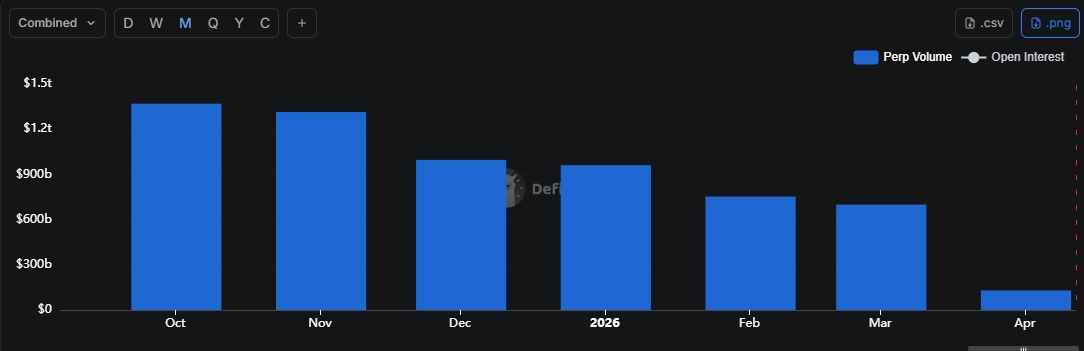
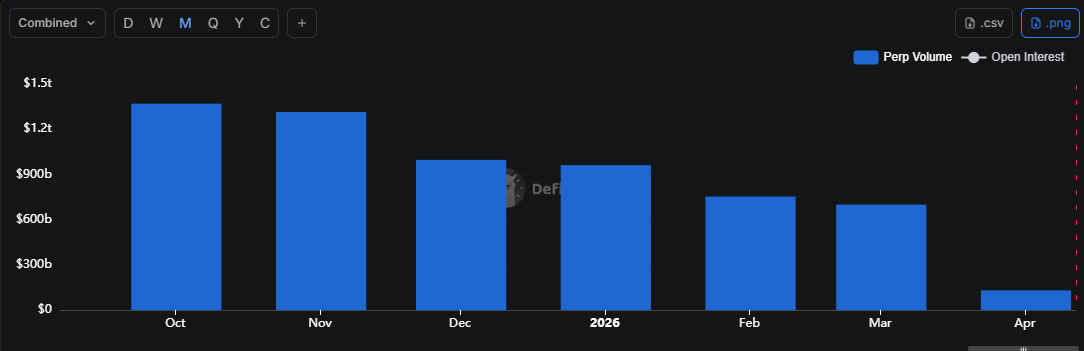
Fast forward to now, that wave of volatility hasn’t fully disappeared. Data from DeFiLlama shows that perpetual volumes across major DEX chains have been on a steady decline for five consecutive months. From a peak of $1.36 trillion in October 2025, volumes slid all the way down to $699 billion by March 2026.
Source: DeFiLlama

Technically speaking, traders wiped out nearly half of last quarter’s perp volume. For context, perp volume measures the total value of all perpetual contract trades happening on decentralized exchanges. It’s basically a snapshot of how actively traders are betting on short- and long-term price moves in crypto.

And let’s be real, anything involving “bets” is pure speculation. In a bull market, that speculative capital acts like rocket fuel, pushing rallies higher and giving momentum to the market. But since the October crash, crypto still sits about 40% below pre-crash levels, showing how much ground the market has yet to cover.

So what do we make of falling perp volume in a bear market? Could it be a healthy sign that traders are stepping back and markets are consolidating, or is it a warning that liquidity is drying up?

Falling perp volumes highlight lingering bear market pressure in crypto

Unlike spot trading, speculative trading is highly sensitive to macro conditions.

In other words, traders in perpetual markets don’t just react to crypto-specific news. Instead, they watch the broader financial landscape closely. Global market shifts, interest rate changes, and even geopolitical events can quickly influence their positions. In this context, that nearly 50% wipeout of perp volume really highlights the bearish setup the market is facing right now.

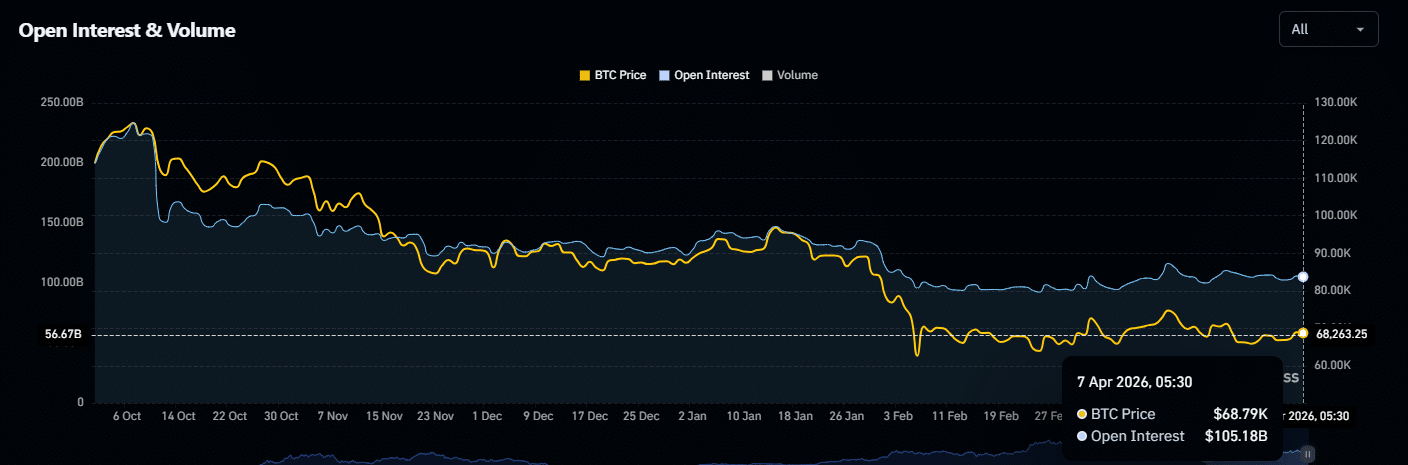
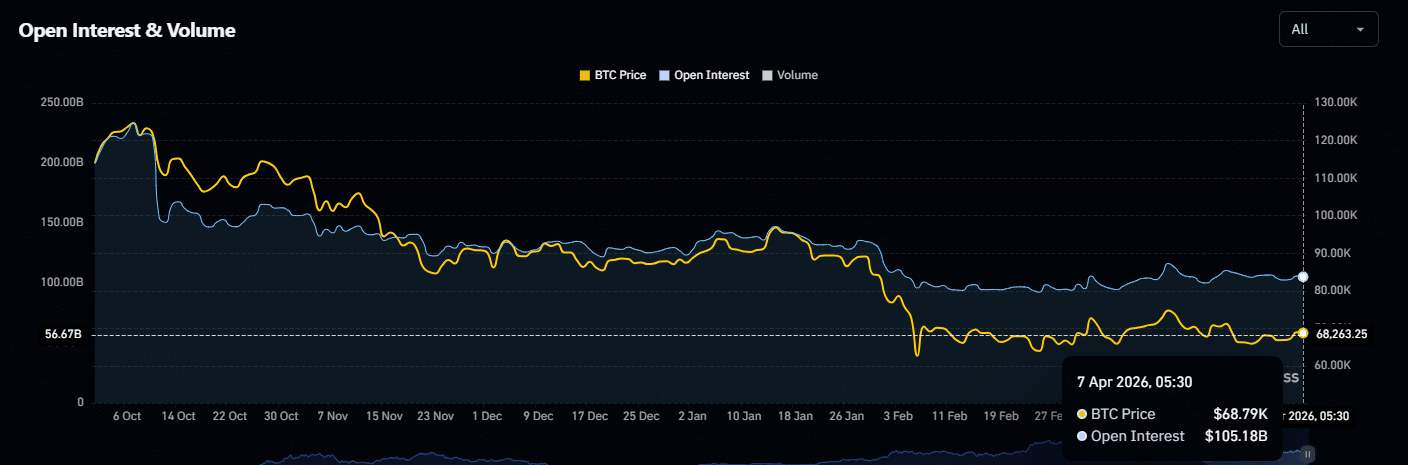
Adding to that, Coinglass data shows that open interest (OI) across all crypto assets combined has also dropped 50% from the $200 billion pre-October levels. For context, open interest is basically the total value of all “outstanding” contracts that haven’t been settled yet, showing how much capital traders have at risk.
Source: Coinglass

Taken together, the drop in perp volume and open interest tells a clear story: crypto traders are actively recalibrating risk and waiting for clearer signals before jumping back in. In a bear market, that’s actually a bullish sign. It indicates that traders aren’t blindly chasing moves. Instead, they’re letting the market settle, which helps reduce the risk of sudden swings and wild volatility.

At the same time, the scars from the October crash haven’t fully healed.

Still, traders are taking notes from past shocks, pulling back when risk is high, and redeploying capital more strategically. As a result, the market may look quiet on the surface, yet behind the scenes, this cautious behavior is quietly building a stronger foundation for crypto’s next move.


Final Summary

  • Perp volume and open interest are down nearly 50%, reflecting traders’ caution and a still-bearish market setup.
  • Measured trading behavior in a bear market helps stabilize liquidity, limit volatility, and lay the groundwork for the next crypto rally.


Связанные с этим вопросы

QWhat has been the trend in monthly perpetual trading volumes on major DEX chains since October 2025, according to DeFiLlama data?

APerpetual trading volumes have been on a steady decline for five consecutive months, falling from a peak of $1.36 trillion in October 2025 to $699 billion by March 2026.

QWhat does the combined drop in perp volume and open interest indicate about current trader behavior?

AThe drop indicates that crypto traders are actively recalibrating risk and waiting for clearer signals before jumping back in, showing caution and a more strategic deployment of capital.

QHow does speculative trading in perpetual markets differ from spot trading in terms of market sensitivity?

ASpeculative trading is highly sensitive to macro conditions, meaning traders react to global market shifts, interest rate changes, and geopolitical events, not just crypto-specific news.

QWhat is the significance of falling perp volume in a bear market, according to the article?

AIn a bear market, falling perp volume can be a bullish sign as it indicates traders are not blindly chasing moves, which helps reduce the risk of sudden swings and builds a stronger foundation for the next market move.

QBy what percentage did the crypto market drop from its pre-crash levels following the October crash?

AThe crypto market still sits about 40% below pre-crash levels.

Похожее

FlyEdge запустила тестовую платформу для токенизации авиабонусов

FlyEdge, B2B-платформа для токенизации программ лояльности авиакомпаний, открыла публичный доступ к тестовой версии своей блокчейн-инфраструктуры. Система работает на базе блокчейна StreamChain (совместимого с EVM) и позволяет авиакомпаниям и пассажирам отслеживать все операции с токенами — от выпуска до погашения. Авиакомпании сохраняют полный контроль над своими токенами, используя инструменты FlyEdge для их выпуска, перевода и изъятия, при этом все действия фиксируются в блокчейне. Для пассажиров блокчейн-технология будет незаметна: они получают некастодиальные смарт-кошельки с защитой passkey, сетевые комиссии оплачивает платформа, а необходимость в сид-фразах или криптокошельках отсутствует. Тестовая версия платформы, запущенная 20 августа на 12 языках, предназначена для ознакомления и проверки функционала авиакомпаниями, пассажирами и СМИ, но не является началом коммерческой работы с реальными клиентами. В рамках теста уже были проверены операции со 100 тестовыми активами.

cryptonews.ru45 мин. назад

FlyEdge запустила тестовую платформу для токенизации авиабонусов

cryptonews.ru45 мин. назад

«Уголовно наказуемое деяние»: депутат объявила охоту на «Человек-паука»

Заместитель председателя комитета Госдумы по культуре Елена Драпеко призвала МВД вмешаться в ситуацию с незаконными показами зарубежных фильмов, таких как «Человек-паук: Новый день», в российских кинотеатрах. По её словам, это является уголовно наказуемым деянием (незаконное предпринимательство). Фильмы демонстрируются без прокатного удостоверения и согласия правообладателей по схеме: билеты продаются на официальные короткометражки, а перед ними показывают нелегальную новинку. Данные о таких показах не передаются в Единую автоматизированную информационную систему (ЕАИС) учёта продажи билетов. О масштабах теневого проката судят по разнице между общими кассовыми сборами кинотеатров и данными ЕАИС. По некоторым оценкам, только за первые выходные «Человек-паук» собрал таким образом около 900 млн рублей. Нарушителям грозит уголовная (при ущербе свыше 500 тыс. рублей), административная и гражданско-правовая ответственность. Драпеко считает, что Минкультуры может отслеживать такие показы и передавать информацию силовикам. Правительство уже больше года обсуждает меры против теневого проката, что указывает на системный характер проблемы, связанной с экономической выгодой кинотеатров на фоне высоких цен на билеты и отсутствия голливудских премьер.

cryptonews.ru55 мин. назад

«Уголовно наказуемое деяние»: депутат объявила охоту на «Человек-паука»

cryptonews.ru55 мин. назад

Отчет: Успех Bitcoin-машины Strategy стоимостью $66 млрд зависит от рынков капитала, а не от цены BTC

Согласно отчету Regime Intelligence, основная уязвимость корпоративной казначейской стратегии MicroStrategy (MSTR), владеющей 840 447 BTC на сумму около $66,7 млрд, заключается не в падении цены биткоина, а в потере доступа к рынкам капитала. Несмотря на долг в $22 млрд, компания не столкнется с маржин-коллом при обвале BTC — стресс-тест показывает, что криптовалюта должна упасть на 96%, чтобы активы не покрыли конвертируемые облигации. Однако MSTR необходимо ежегодно обслуживать обязательства на $1,76 млрд (дивиденды по привилегированным акциям и проценты). Для этого требуется постоянный приток свежего капитала. Если условия финансирования ухудшатся, стратегия накопления BTC может смениться продажами для покрытия расходов. В 2024 году компания уже несколько раз продавала биткоин (всего — 1 690 BTC) для выполнения обязательств, но, по словам CEO Фонга Ле, объем накопленного BTC более чем в 25 раз превышает проданный. Планируется возобновить покупки позже в этом году.

cointelegraph1 ч. назад

Отчет: Успех Bitcoin-машины Strategy стоимостью $66 млрд зависит от рынков капитала, а не от цены BTC

cointelegraph1 ч. назад

Торговля

Спот
活动图片