4 Years After Terra’s Collapse, Hodlnaut’s Former CEO Faces Fraud Charges In Singapore Court

bitcoinistОпубликовано 2026-05-26Обновлено 2026-05-26

Введение

Zhu Juntao, co-founder and former CEO of the defunct Singapore crypto lender Hodlnaut, has been charged with fraud by false representation in a Singapore court. The charges relate to alleged misleading statements made to users in mid-2022, claiming the platform had no exposure or losses from the Terra (UST) collapse. Investigations later revealed Hodlnaut lost nearly $190 million from Terra, contributing to a $193 million shortfall that led to its liquidation. Zhu pleaded not guilty to all six charges, which carry potential imprisonment of up to 20 years. His case highlights ongoing legal accountability efforts stemming from the 2022 crypto market contagion.

Zhu Juntao, co-founder and former Chief Executive Officer of the now-defunct Singapore-based crypto lending platform Hodlnaut, was charged in a Singapore court on May 26, 2026 with fraud by false representation — nearly four years after the Terra/LUNA ecosystem implosion triggered a $193 million financial shortfall that ultimately ended the platform and stranded more than 30,000 users worldwide.

The charges were announced by the Commercial Affairs Department of the Singapore Police Force, which has been investigating Hodlnaut and its directors since November 2022. Zhu, 36, faces six counts in total — three under Section 424A(1)(a) read with Section 424A(3) of Singapore’s Penal Code 1871, and three under the same provision read together with Section 109 of the same code, which covers abetment. If convicted on each charge, he faces imprisonment of up to 20 years, a fine, or both, per the police statement.
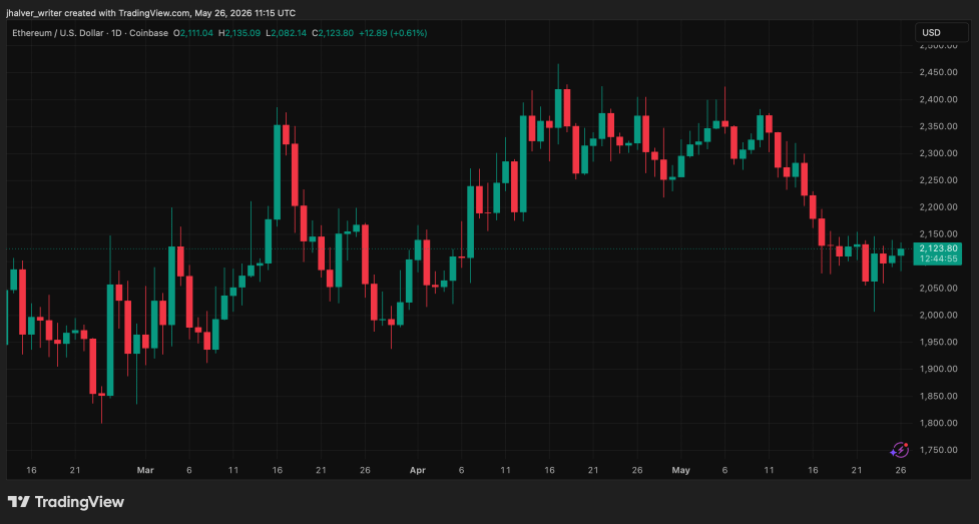
ETH's price moving sideways, per the daily chart. Source: ETHUSD on Tradingview

What The Charges Allege

The fraud charges center on a specific window: May to July 2022, the weeks immediately following TerraUSD’s catastrophic de-pegging in early May of that year. According to the Singapore Police Force’s official statement, Zhu allegedly directed Hodlnaut employees to make misleading statements on the company’s official Telegram group and in emails sent directly to users — assertions that Hodlnaut had no direct exposure to UST and had not suffered losses from the collapse.

The statements, as documented in Mothership SG’s reporting of court filings, included a post in which Hodlnaut wrote that it had “not taken any losses as a firm” and that only users who personally held UST were affected. Zhu also allegedly directed a separate employee to email 30 recipients stating the company had assumed no losses. Those statements, prosecutors now allege, were false and intended to deceive users during the most critical period of the platform’s deterioration.

What Actually Happened With Terra

The judicial record that emerged after Hodlnaut suspended withdrawals in August 2022 told a starkly different story. An interim judicial managers’ report seen by Bloomberg found that Hodlnaut had lost nearly $190 million through its exposure to the collapsed Terra ecosystem — a figure the platform had actively downplayed to users while the losses accumulated. On-chain analytics firms subsequently confirmed material exposure to UST and TerraForm Labs-linked activity that Hodlnaut had not previously acknowledged.

Court documents filed in Singapore in August 2022, when the platform sought creditor protection, disclosed a $193 million financial shortfall. Court-appointed managers later confirmed an additional $13.1 million in user assets were stranded on the collapsed FTX exchange.

Hodlnaut was subsequently ordered to liquidate by Singapore’s High Court, with EY partners appointed as joint liquidators. Zhu indicated he was not guilty and disputed all charges at his May 26 hearing — a pre-trial conference has been scheduled for June 2026, per Channel News Asia.

This development marks a significant moment for the nascent sector’s long-running accountability reckoning following the 2022 crypto contagion. The Terra collapse set off a chain of platform failures — Celsius, Voyager, Three Arrows Capital, and eventually FTX among them — that collectively cost retail users hundreds of billions of dollars.

That four years have elapsed between Hodlnaut’s collapse and its former CEO’s first day in court is itself a reflection of how slowly the legal system processes crypto’s most consequential failures — and a reminder that the cases are far from closed.

Cover image from Grok, ETHUSD chart from Tradingview

Связанные с этим вопросы

QWhat specific charges does Zhu Juntao face in the Singapore court, and under which laws?

AZhu Juntao faces six counts of fraud by false representation. Three counts are under Section 424A(1)(a) read with Section 424A(3) of Singapore's Penal Code 1871, and three counts are under the same provision read together with Section 109 of the same code, which covers abetment.

QWhat was the alleged falsehood communicated by Hodlnaut during the May-July 2022 period, according to the charges?

AAccording to the charges, Zhu Juntao allegedly directed employees to make misleading statements on Telegram and via email, asserting that Hodlnaut had no direct exposure to UST and had not suffered any losses from the Terra collapse. In reality, the platform had lost nearly $190 million from its exposure.

QWhat was the total financial shortfall and additional user asset loss reported for Hodlnaut following the Terra collapse?

ACourt documents disclosed a $193 million financial shortfall. Additionally, court-appointed managers later confirmed that an extra $13.1 million in user assets were stranded on the collapsed FTX exchange.

QWhat was the final outcome for the Hodlnaut platform as ordered by the Singapore High Court?

AHodlnaut was ordered to be liquidated by Singapore's High Court, with EY partners appointed as joint liquidators.

QHow did Zhu Juntao plead to the charges during his court hearing on May 26, 2026?

ADuring his hearing on May 26, 2026, Zhu Juntao indicated he was not guilty and disputed all charges.

Похожее

The Value Distribution of Stablecoins

**Summary: The Value Distribution of Stablecoins** The article argues that stablecoins are evolving from mere trading tools into broader channels for dollar access. It divides the stablecoin ecosystem into four layers to analyze how value is distributed: 1. **Issuance Layer:** Mints stablecoins, holds reserve assets, and captures the spread between reserve yield and user costs (e.g., Tether, Circle). This layer currently earns the largest profit margin. 2. **Infrastructure Layer:** Connects stablecoins to the traditional financial system, handling fiat on/off-ramps, banking integration, compliance (KYC/AML), and asset management (e.g., Bridge, BVNK). This is the "unglamorous" but critical work, building the essential bridges between crypto and real-world finance. 3. **Acquiring/Distribution Layer:** Integrates stablecoins into merchant systems, manages payment flows, and provides enterprise financial software (e.g., Stripe, Coinbase). They act as the access point for businesses. 4. **Application Layer:** The end-users and businesses that ultimately use stablecoins for payments, settlements, or as a store of value. They benefit from convenience but have little pricing power. The core thesis is that while the issuance layer currently dominates profits, the often-overlooked **infrastructure layer holds significant long-term potential**. The real challenge and barrier to mass adoption is not the on-chain transfer of stablecoins (which is simple), but the complex "last mile" integration into existing business workflows, banking systems, and regulatory frameworks across different countries. Companies in this layer are currently in a "land grab" phase, investing heavily to build networks, secure bank partnerships, and establish compliance pathways. While their position is currently pressured by the profitable issuers above and distribution platforms below, the article suggests that if stablecoins become a default financial rail for businesses, the infrastructure providers who have done the hard work of integration will ultimately gain strong pricing power and become entrenched, essential players.

marsbit5 ч. назад

The Value Distribution of Stablecoins

marsbit5 ч. назад

The Value Distribution of Stablecoins

The Value Distribution of Stablecoins The article argues that stablecoins are evolving from a mere trading tool into a broad "dollar channel." It analyzes the industry's value chain through four layers: 1. **Issuance Layer (e.g., Tether, Circle):** The top layer that mints stablecoins, holds reserve assets, and captures the thickest interest rate spread. 2. **Infrastructure Layer (e.g., Bridge, BVNK):** Connects stablecoins to the traditional financial system, handling critical but complex "dirty work" like fiat on/off-ramps, banking integration, compliance (KYC/AML), and cross-border settlement. 3. **Acquiring/Distribution Layer (e.g., Stripe, Coinbase):** Embeds stablecoins into merchant systems, manages payment flows, and integrates with enterprise software. 4. **Application Layer:** End-users and businesses that ultimately use stablecoins for payments, settlement, or storing value. The author posits that while the issuance layer currently captures the most profit, the most overlooked and potentially critical layer is infrastructure. The core challenge for stablecoin adoption isn't the on-chain transfer (which is simple), but bridging the gap between blockchain and the real-world financial system. This involves solving practical problems for businesses: fiat conversion, reconciliation, tax handling, and user onboarding. Infrastructure companies are currently in a difficult "land-grab" phase—building networks, securing banking relationships, and achieving compliance country-by-country. They face pressure from both the profitable issuance layer above and distribution platforms below. However, the author suggests this layer is building a crucial moat. Once stablecoins become a default business rail, the infrastructure players who have done the hard work of integration may gain significant, durable value and pricing power.

链捕手5 ч. назад

The Value Distribution of Stablecoins

链捕手5 ч. назад

Торговля

Спот
Фьючерсы

Популярные статьи

Как купить S

Добро пожаловать на HTX.com! Мы сделали приобретение Sonic (S) простым и удобным. Следуйте нашему пошаговому руководству и отправляйтесь в свое крипто-путешествие.Шаг 1: Создайте аккаунт на HTXИспользуйте свой адрес электронной почты или номер телефона, чтобы зарегистрироваться и бесплатно создать аккаунт на HTX. Пройдите удобную регистрацию и откройте для себя весь функционал.Создать аккаунтШаг 2: Перейдите в Купить криптовалюту и выберите свой способ оплатыКредитная/Дебетовая Карта: Используйте свою карту Visa или Mastercard для мгновенной покупки Sonic (S).Баланс: Используйте средства с баланса вашего аккаунта HTX для простой торговли.Третьи Лица: Мы добавили популярные способы оплаты, такие как Google Pay и Apple Pay, для повышения удобства.P2P: Торгуйте напрямую с другими пользователями на HTX.Внебиржевая Торговля (OTC): Мы предлагаем индивидуальные услуги и конкурентоспособные обменные курсы для трейдеров.Шаг 3: Хранение Sonic (S)После приобретения вами Sonic (S) храните их в своем аккаунте на HTX. В качестве альтернативы вы можете отправить их куда-либо с помощью перевода в блокчейне или использовать для торговли с другими криптовалютами.Шаг 4: Торговля Sonic (S)С легкостью торгуйте Sonic (S) на спотовом рынке HTX. Просто зайдите в свой аккаунт, выберите торговую пару, совершайте сделки и следите за ними в режиме реального времени. Мы предлагаем удобный интерфейс как для начинающих, так и для опытных трейдеров.

1.5k просмотров всегоОпубликовано 2025.01.15Обновлено 2026.06.02

Как купить S

Sonic: Обновления под руководством Андре Кронье – новая звезда Layer-1 на фоне спада рынка

Он решает проблемы масштабируемости, совместимости между блокчейнами и стимулов для разработчиков с помощью технологических инноваций.

2.3k просмотров всегоОпубликовано 2025.04.09Обновлено 2025.04.09

Sonic: Обновления под руководством Андре Кронье – новая звезда Layer-1 на фоне спада рынка

HTX Learn: Пройдите обучение по "Sonic" и разделите 1000 USDT

HTX Learn — ваш проводник в мир перспективных проектов, и мы запускаем специальное мероприятие "Учитесь и Зарабатывайте", посвящённое этим проектам. Наше новое направление .

1.8k просмотров всегоОпубликовано 2025.04.10Обновлено 2025.04.10

HTX Learn: Пройдите обучение по "Sonic" и разделите 1000 USDT

Обсуждения

Добро пожаловать в Сообщество HTX. Здесь вы сможете быть в курсе последних новостей о развитии платформы и получить доступ к профессиональной аналитической информации о рынке. Мнения пользователей о цене на S (S) представлены ниже.

活动图片