· Celsius had a range of internal failures during the years leading up to its recent liquidity issues, according to former employees and internal documents reviewed by CNBC.
· Employees who spoke with CNBC painted a picture of risk-taking, disorganization and alleged market manipulation.
· “The biggest issue was a failure of risk management,” said one former employee.
Problems at Celsius appear to have been simmering for years before the crypto lender filed for bankruptcy.
The crypto company saw a range of internal missteps leading up to its recent turmoil, according to former employees and internal documents CNBC reviewed. Multiple employees painted a picture of risk-taking, disorganization and alleged market manipulation.
“The biggest issue was a failure of risk management,” Timothy Cradle, Celsius’ former director of financial crimes compliance, told CNBC in an interview. “I think Celsius had a good idea, they were providing a service that people really needed, but they weren’t managing risk very well.”
The Hoboken, New Jersey-based company made headlines a month ago after it froze customer accounts, blaming “extreme market conditions.” It had attracted 1.7 million customers and $11.8 billion in deposits as of June. Celsius customers have told CNBC they were drawn in by a 17% yield the company was offering on crypto deposits.
Behind the scenes, Celsius would lend that money out to hedge funds and others willing to pay an even higher yield. It would also invest in other high-risk cryptocurrency projects, according to internal documents. Celsius would later split those profits with the customer. The model came crashing down along with the price of cryptocurrencies, which caused multiple companies to freeze assets and at least three to file for bankruptcy.
Cradle said he was part of a three-person compliance team between 2019 and 2021. The role required him to apply international finance laws to Celsius’ business. But resources were limited, he said.
“The compliance team was too small,” Cradle said. “Compliance was a cost center — basically we were sucking out money and not bringing any back in. They didn’t want to spend on compliance.”
One of the internal company documents CNBC obtained echoed this claim. It said when it came to assessing fraudulent cryptocurrency platforms, “there is not adequate compliance staff for the amount of users on Celsius’s platform as there are only 3 full-time individuals.”
‘Banks are not your friends’
Cradle said he was especially alarmed by conversations at a Celsius Christmas party in 2019 about a cryptocurrency created and used by Celsius, called the “cel” token. Executives said they were “pumping up the cel token” and “actively trading and increasing the price of the token,” Cradle said.
“They weren’t shy about it. They were absolutely trading the token to manipulate the price,” Cradle said. “It came up in two completely different conversations for two completely different reasons.”
Celsius, CEO Alex Mashinsky and company lawyers did not respond to multiple requests for comment.
Celsius was by far the largest holder of cel tokens. But it was also a buyer, according to blockchain data firm Arkham. The firm estimated that Celsius spent $350 million acquiring tokens on exchanges over the past three years, despite already having billions worth in its own treasury. At the same time, top executives were selling. Accounts associated with Alex Mashinsky appear to have sold or “swapped” roughly $40 million, according to Arkham.
Cradle and other employees received part of their salary in cel tokens. A former human resources employee said it was a way to attract and retain talent. It also let them share in the company’s financial upside — similar to the appeal of equity in a fast-growing start-up. The token started to spike in early 2020 and the following year hit a high of almost $8. It was trading under $1 as of July.
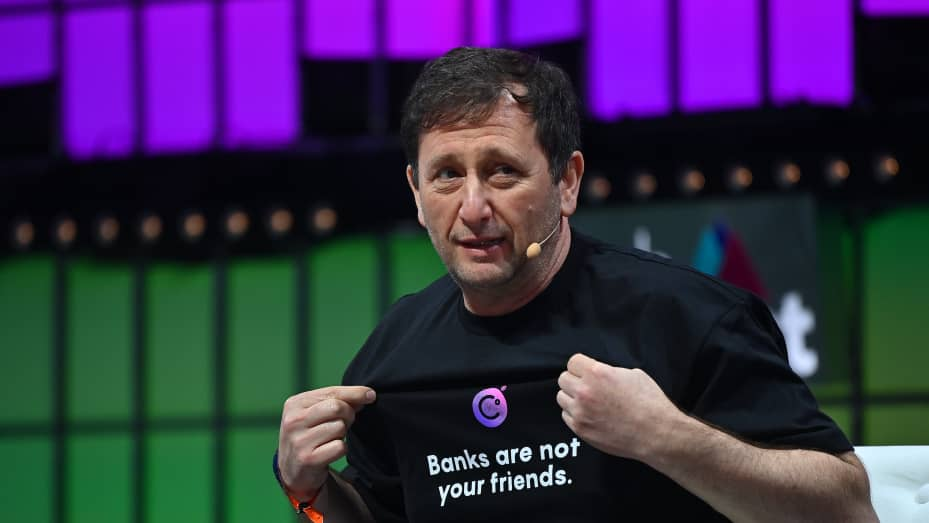
Celsius’ CEO was an outspoken booster of the token. He gave weekly YouTube updates often touting the benefits or “tokenomics” of the project. Mashinsky was also known to criticize Wall Street banks. He frequently wore a black T-shirt during public appearances that said: “Banks are not your friends.”
Another former Celsius employee, who asked not to be named, said while Mashinsky was inducing average investors to buy the cryptocurrency, he was selling behind the scenes.
It wouldn’t take much to move the price of the token because the volume was relatively small, the former employee said. Mashinsky was selling millions behind closed doors without any public disclosures, according to the former employee.
“It’s easy to manipulate the price of cel due to the low trading volumes in cel. I’m sure [Mashinsky] knows that,” the former employee said. “That’s just an example of what he will do to publicly manipulate the price for his own benefit.”
The former employee’s allegations echo a recent lawsuit brought by a former investment manager, Jason Stone. Stone alleges that Celsius artificially inflated the price of its own token and was “actively using customer funds to manipulate crypto-asset markets to their benefit.” The suit also claimed Celsius failed to hedge risk and engaged in activities that amounted to fraud.
Details within internal documents
Other internal documents shine light on some of the risk Celsius appeared to be taking with customer funds. Lenders such as Celsius and hedge funds were able to achieve high returns by investing in “decentralized finance,” or DeFi, projects. Celsius has its own cryptocurrency and relied on high yields to attract more borrowers. According to internal documents, Celsius was investing customer funds in multiple DeFi projects. All were labeled medium to high risk.
On Wednesday, Vermont became the sixth state regulator to launch an investigation into Celsius and pointed to that investment strategy. The state’s Department of Financial Regulation said Celsius “deployed customer assets in a variety of risky and illiquid investments, trading, and lending activities.”
“Celsius customers did not receive critical disclosures about its financial condition, investing activities, risk factors, and ability to repay its obligations to depositors and other creditors,” the Vermont regulator said in a statement.
Cradle also said that many Celsius users likely didn’t have a good grasp of the company’s terms of use, which contradicted the messaging that Celsius communicated through its marketing.
But the risks associating with depositing funds with Celsius were “hiding in plain sight,” Cradle said. Section 13 of the company’s terms of use says that once a customer deposits funds, the funds belong to Celsius.
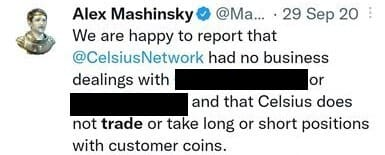
Cradle also said he saw evidence of the company trading customer funds without disclosing that it was doing so. Celsius’ CEO has said explicitly on Twitter that the company did not trade customer funds.
Cradle said that based on his firsthand experience with the company’s risk appetite he wouldn’t keep his own money with Celsius.
“I didn’t feel comfortable leaving them on the platform,” Cradle said, referring to his own crypto funds. “I frequently read the terms of use — once you deposit your assets with Celsius, they belong to Celsius, and Celsius can keep them if they need to or want to.”
Internal documents also show evidence of disorganization across multiple teams. One document shows policies written by a team without the head of that team knowing. In one instance, a top risk officer writes that he was “surprised” by a document written by another team overseas.
“He was probably surprised that the document even existed — that’s just the way things were at Celsius. It’s left hand not knowing what the right hand is doing,” Cradle said. “It’s just another example of mismanagement or sort of sloppy management on Celsius’ part.”
Lacking transparency
One area in which Cradle said Celsius lacked transparency was its number of accounts. While Celsius reported 1.7 million users, Cradle said that number is inflated.
“It’s probably closer to 300,000, because the amount of fake accounts was so vast and there was nothing the management team was willing to do to really stop people from doing that,” he said.
In addition to this alleged discrepancy, Mashinsky’s own Twitter posts show a contrast between the messages he conveyed to customers and what was transpiring behind the scenes.
The day before the withdrawal freeze, in response to a tweet that questioned the company’s financial health, Mashinsky wrote: “do you even know one person who has a problem withdrawing from Celsius? why spread FUD and misinformation,” referring to fear, uncertainty and doubt. The following day, June 12, customers were no longer permitted to withdraw funds from their accounts.
Public records indicate Celsius may have had financial problems long before this.
Data from the federal government shows Celsius received a Paycheck Protection Program loan worth $281,502 in April 2020. The federal government awarded these loans to businesses negatively affected by the Covid pandemic.
“That raised my eyebrows a bit, and I was curious if we were profitable,” Cradle said.
The loan was forgiven by the federal government, meaning that Celsius met the requirements needed to avoid repayment.
Background checks
Risk-taking also showed up in the Celsius hiring process. Nikki Goodstein, a former senior member of the human resources team, said she was not aware of any background checks at the company when she joined in May 2021.
She told CNBC that executives specifically told the chief human resources officer not to run a background check on Yaron Shalem, the incoming chief financial officer. In November 2021, Shalem was arrested in Israel and charged with money laundering in connection with his previous company. Shalem did not respond to requests for comment.
CNBC also made an attempt to find out the status of the case, but it does not appear to be publicly available in the Israeli court system. The chief human resources officer who Goodstein said was told not to run a background check did not respond to CNBC’s request for comment.
Goodstein, who worked at publicly traded Fortune 500 companies before Celsius, said she was “surprised” someone in an executive role wouldn’t face a background check.
“It was definitely a gap in process at that time,” she said. “Everyone was [upset] that he wasn’t background checked, because then it wouldn’t have brought such embarrassment to the company if that was a process that we had in place — we all were kind of like, what the heck just happened?”
Cradle said he’s not planning to go back to the cryptocurrency industry after Celsius and a stint at another start-up. Celsius set out to make a good product at a time when banks paid near zero interest on savings, he said.
“I think it was good people with poor planning — they didn’t hire at the right times, they didn’t staff up at the right times, they didn’t scale with the growth of the company,” he said. “It was just a bunch of mistakes that are ending up very tragically.”