The crypto community is looking into three key dates this month that could profoundly impact the trajectory of the crypto market and the wider United States macroeconomic environment this year.
On July 13, the monthly Consumer Price Index (CPI) and data relating to inflation will be released to the public. On July 26-27, a decision will be made as to whether to hike interest rates further, while on July 28, the United States Q2 2022 Gross Domestic Product (GDP) estimates will tell us whether the country is in a technical recession.
July 13: Inflation marker, CPI
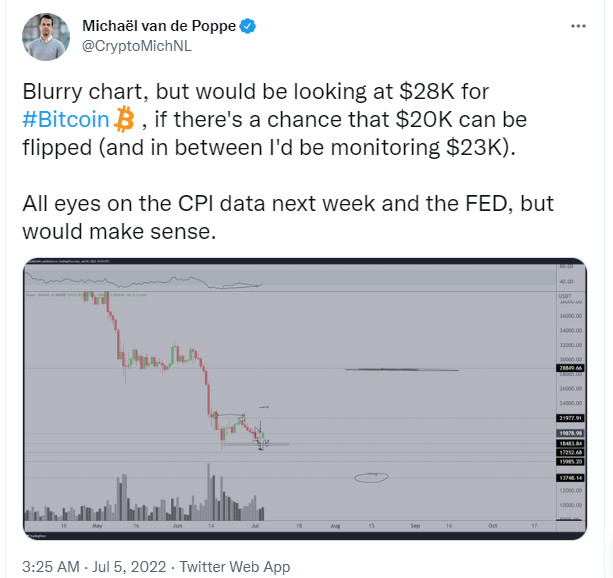
Micahel van de Poppe, CEO and founder of crypto consultancy and educational platform EightGlobal, told his 614,300 Twitter followers on July 4 that it’s “all eyes on the CPI data next week,” adding bullish forecasts for Bitcoin should it flip above its $20,000 price point.
Co-founder of The Crypto Academy, known on Twitter as 'Wolves of Crypto', told his followers to keep an eye out for the date, adding that CPI going lower than expected “could be the catalyst for a dead cat bounce” for Bitcoin.
“All eyes on CPI numbers on July 13th. If CPI comes in lower, that will be the catalyst for a dead cat bounce.”
CPI is one of the benchmarks for gauging how inflation progresses by measuring the average change in consumer prices based on a representative basket of household goods and services.
Continued rising inflation could impact demand for cryptocurrencies, with consumers needing to spend more to get by than before.
Interestingly, while Bitcoin was created amid high inflation following the 2008 Global Financial Crisis, and touted as an inflation hedge due to its fixed supply and scarcity, recent years have seen the cryptocurrency perform in line with traditional tech stocks, being less than inflation-proof.
The next scheduled release of the CPI is expected on July 13, 2022, by the U.S. Bureau of Labor Statistics.
According to Trading Economics, the current consensus on the June inflation rate, or CPI, is 8.7%, slightly higher than May’s 8.6%.
July 26-27: Fed interest rate hike
After raising interest rates by 75 basis points in June, one of the most significant monthly increases in 28 years, interest rates are expected to increase further following the Federal Open Market Committee (FOMC) meeting later this month.
Interest rate hikes are one of the primary tools used by the Federal Reserve and the U.S. Central Bank to manage inflation by slowing down the economy. Increased interest rates lead to increases in borrowing costs, which can discourage consumer and business spending, and lending.
It can also place downward pressure on higher-risk asset prices, such as crypto, as investors can start to earn decent returns just by parking their money in interest-bearing accounts or low-risk assets.
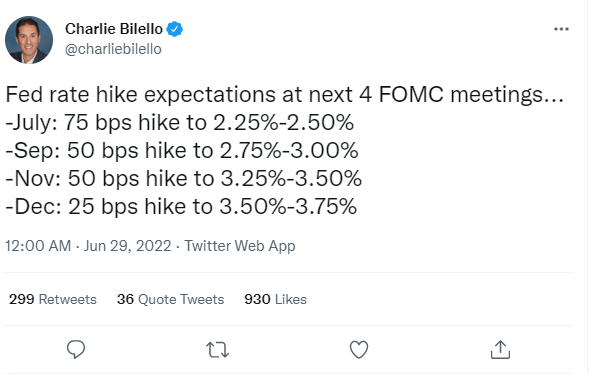
This month, the FOMC is expected to decide whether to impose a 50 or 75 basis point hike. Charlie Bilello, founder and CEO of Compound Capital Advisors, placed his bets on the higher amount.
July 28: Are we in a recession?
On July 28, the U.S. Bureau of Economic Analysis (BEA) will release an advance estimate of the United States’ GDP for the second quarter of 2022.
After registering a -1.6% GDP decline in Q1 2022, Atlanta Federal Reserve’s GDPNow tracker is now expecting a -2.1% decline in GDP growth for Q2 2022.
A second consecutive quarter of GDP decline would place the United States into a “technical recession.”
Should the United States economy be officially labeled as a recession, which is expected to begin in 2023, Bitcoin will be facing its first-ever full-blown recession and is likely to see a continued decline alongside tech stocks.
Silver lining?
Despite the gloomy macro forecasts, some of crypto’s leading pundits view the recent macro-catalyzed crypto market crash as an overall positive sign for the industry.
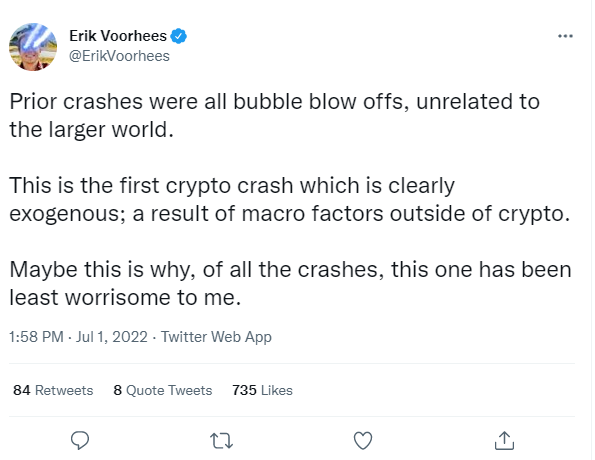
Crypto expert Erik Voorhees, the co-founder of Coinapult and CEO and Founder of ShapeShift, said the current crypto crash is “least worrisome” to him, as it is the first crypto crash to result from macro factors outside of crypto.
Alliance DAO core contributor Qiao Wang made similar comments to his 131,200 followers, noting that this is the first cycle where the main bear case was an “exogenous factor.”
“People who are worried about crypto because of macro realize how bullish this is right?”
“This is the first cycle where the main bear case is an exogenous factor. In previous cycles, it was endogenous, e.g., Mt.Gox (2014) and ICOs (2018),” he explained.