40 Days Of Deadlock: US Shutdown Risks ETF Delay Amid Soaring Demand

bitcoinistОпубликовано 2025-10-19Обновлено 2025-10-19

Введение

The US federal funding lapse has stretched on, creating new delays for regulatory decisions tied to crypto products. According to...

Trusted Editorial content, reviewed by leading industry experts and seasoned editors. Ad Disclosure

The US federal funding lapse has stretched on, creating new delays for regulatory decisions tied to crypto products. According to reports, the shutdown has lasted beyond 40 days in some scenarios used by market forecasters, and reduced staffing at federal agencies is slowing routine approvals.

Shutdown Stretches Past 40 Days

Reports have disclosed a market estimate putting the chance of a prolonged shutdown at about 55% for certain stretches, which traders say complicates timing for filings and reviews.

The Securities and Exchange Commission is operating with fewer staff, and that has forced some rulemakings and approval windows to be pushed back. For applicants hoping for quick sign-offs, this means waiting longer than planned.
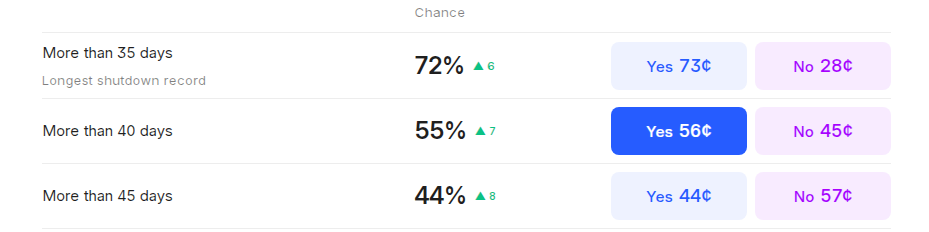
Source: Kalshi

Investor Interest Remains High

Despite the holdup, investor appetite for regulated crypto products appears strong. According to filings and traffic data cited in market reports, clients of Charles Schwab hold roughly 20% of the US crypto ETF market by assets under custody, and web visits to crypto information pages have jumped about 90% on an annualized basis. That shows demand is not evaporating while regulators are idle.

What That Means For Markets

When reviews resume in force, some strategists expect pent-up demand to move into newly approved products. Based on reports, the delay has simply shifted the calendar rather than killed the approvals.

Yet market reaction is not guaranteed to be large; some money may already be waiting on the sidelines, while other investors have moved on.

Bitcoin is currently trading at $107,147. Chart: TradingView

Backlog Could Trigger A Fast Response

Regulatory staff will face a backlog when full operations return. Papers awaiting attention may be prioritized, and several issuers will press to get decisions cleared.

Sources tracking the space warn that a sudden cluster of approvals could follow the end of the funding gap, creating rapid inflows into the newly cleared funds.

Risks Beyond Timing

The shutdown is one of several risks. Reports point to the fact that approvals depend on legal arguments, compliance steps, and the agency’s view on market structure.

A temporary staffing shortfall delays work, but it does not change the substantive questions the regulator must answer before signing off. That means some applications could still be rejected or heavily conditioned.

Featured image from Unsplash, chart from TradingView

Editorial Process for bitcoinist is centered on delivering thoroughly researched, accurate, and unbiased content. We uphold strict sourcing standards, and each page undergoes diligent review by our team of top technology experts and seasoned editors. This process ensures the integrity, relevance, and value of our content for our readers.

Christian, a journalist and editor with leadership roles in Philippine and Canadian media, is fueled by his love for writing and cryptocurrency. Off-screen, he's a cook and cinephile who's constantly intrigued by the size of the universe.

Похожее

Pope Issues First AI Encyclical: 40,000 Words, 10 Key Points, Clarifying AI Anxiety

Pope Leo XIV's historic encyclical "Magnifica Humanitas," released in May 2026, marks the Catholic Church's first major document addressing artificial intelligence. The 40,000-word text moves beyond theological abstraction to confront practical AI anxieties affecting society. It argues that AI is no longer a mere tool but an embedded environment influencing daily decisions in areas like employment, healthcare, justice, and information, often without users' awareness. The encyclical presents ten core concerns. It highlights that the central issue isn't just regulation, but who holds the underlying *power*—control over data, compute, and platforms—often concentrated in private entities. It warns that even developers cannot fully explain AI systems, creating accountability gaps. While AI can simulate human interaction and creativity, it cautions against treating it as a moral agent capable of bearing true responsibility or forming genuine relationships. Key risks identified include AI's role in opaque decision-making for jobs or welfare, the amplification of persuasive disinformation, and the potential for education to focus on tool use over critical thinking. The document stresses that work has value beyond efficiency, and AI should enhance human capabilities, not merely replace roles. It firmly states that irreversible decisions, especially involving life and death, must remain under human judgment. Ultimately, the encyclical frames AI's challenge as anthropological, not just technological. As AI simulates uniquely human capacities like judgment and creation, it forces a re-examination of what makes human action meaningful: our capacity for responsibility, vulnerability, and bearing real consequences. The Pope concludes that technology is never neutral; its development and deployment are shaped by human values and choices, making an inclusive, ethically grounded dialogue essential for its future.

marsbit6 мин. назад

Pope Issues First AI Encyclical: 40,000 Words, 10 Key Points, Clarifying AI Anxiety

marsbit6 мин. назад

Retail Investors' 'Lead Brother' Serenity vs. Newly Minted Stock God Leopold: How Are the Two Top Hunters Mining AI's 'Physical Limits'?

The article profiles two prominent figures, Serenity and Leopold Aschenbrenner, who are gaining attention for their unconventional investment strategies focused on the physical constraints of the AI boom, moving beyond mainstream software narratives. Serenity, an anonymous online trader, advocates a "shiso leaf" theory. He targets small-cap companies with monopolies on critical, overlooked components in the AI hardware supply chain, such as specific semiconductor materials. His deep, technical analysis of bottlenecks in areas like co-packaged optics (CPO) has reportedly yielded massive returns, though his anonymity and focus on illiquid micro-cap stocks pose significant risks for followers. Leopold Aschenbrenner, a former OpenAI researcher, founded a multi-billion dollar hedge fund. His macro thesis argues that physical infrastructure—power grids, land, data centers—is the true bottleneck for AI growth, lagging far behind chip production. Consequently, his fund employs an infrastructure arbitrage strategy: heavily investing in storage and compute infrastructure companies while placing massive bearish bets (put options) against major semiconductor stocks, betting their valuations will correct as physical constraints become apparent. While their methods differ—Serenity drills into microscopic supply chain details, while Leopold takes a macroscopic, infrastructure-focused view—both share a core belief: the real power and investment alpha in the AI era lie in controlling scarce physical resources, not just software. The article concludes by noting the inherent risks in both approaches, such as liquidity issues for micro-caps and timing risks for macro bets, but suggests they signal a broader market re-evaluation of AI's foundational assets.

marsbit9 ч. назад

Retail Investors' 'Lead Brother' Serenity vs. Newly Minted Stock God Leopold: How Are the Two Top Hunters Mining AI's 'Physical Limits'?

marsbit9 ч. назад

Торговля

Спот
Фьючерсы
活动图片