Shiba Inu Reopens Shibarium Bridge After 1-Month Freeze

bitcoinistОпубликовано 2025-10-16Обновлено 2025-10-16

Введение

Shiba Inu has restored BONE transfers on Shibarium’s Plasma bridge, re-enabling deposits and withdrawals between Ethereum and the layer-2 network...

Trusted Editorial content, reviewed by leading industry experts and seasoned editors. Ad Disclosure

Shiba Inu has restored BONE transfers on Shibarium’s Plasma bridge, re-enabling deposits and withdrawals between Ethereum and the layer-2 network following a security incident that forced a month-long pause. In an October 14 post, core contributor Kaal Dhairya wrote that the “Plasma Bridge is back online for BONE, following a comprehensive review and a series of security enhancements,” adding that users can now bridge BONE “with a safer, stronger, and more resilient experience.”

Shiba Inu Relaunches The Shibarium Bridge

The relaunch comes after Shibarium’s bridge was restricted in mid-September following a validator-key compromise that enabled a malicious exit on the PoS bridge. In a September 21 incident report, Dhairya stated that “on September 12, 2025 at 18:44 UTC, unauthorized validator signing power was used to push a malicious state/exit through the PoS bridge, withdrawing multiple assets,” prompting immediate containment measures and a broader hardening program. The team said at the time it would publish full technical details once it was safe to do so and that “bridging remains restricted during containment/hardening.”

Shibarium’s team is positioning the re-opened BONE bridge as the first step in a phased restoration of services, backed by new policy-level and operational controls. The most visible change for users is a mandatory delay before withdrawals finalize: “All BONE Plasma withdrawals now include a 7-day finalization delay. This buffer gives operators and security teams time to monitor and respond to unusual activity before funds finalize—significantly improving defense without removing user access.” The post frames the delay as reinforcing Plasma’s fraud-resistance guarantees.

Another control introduced at the bridge layer is proactive address blacklisting. According to the team, the new mechanism “lets us flag and block suspicious addresses at the bridge layer,” with the intent of preventing repeat abuse across the ecosystem. The Shiba Inu team also emphasized that critical code changes underwent an external review: “All critical changes were reviewed by Hexens, adding an independent layer of expert scrutiny.” The relaunch followed a validation sequence that included unit tests, end-to-end simulations, deployment on the public testnet (“Puppynet”), and “multi-timeframe” monitoring before production activation.

The October 14 update also addresses a separate strand of the September incident involving KNINE and minor OSCAR token flows. The Shiba Inu team disclosed that the attacker “drained and sold roughly $600 worth of OSCAR tokens from the bridge but ignored the 5 ETH recovery offer for KNINE tokens,” which now remain blacklisted and unusable to the attacker. The previously announced KNINE bounty “has expired,” the team said, but it plans “one final, conditional bounty (amount TBD) for complete return of all KNINE held by attacker-controlled addresses,” stressing that partial returns will not qualify and that terms will appear only on verified channels.

While only BONE is live on the Plasma bridge today, Shibarium signaled a broader roadmap. The team plans “gradual re-enablement for other tokens” and is “finalizing a fair and transparent repayment framework for affected users,” with specifics to be published once doing so would not increase risk. The post underscores a measured posture after the September compromise: “Safety first: We won’t publish specifics that could be gamed while security work is ongoing. Expect measured, verifiable updates.”

Context around the month-long outage highlights the extent of remediation behind the scenes. In late September, Shibarium detailed rotations of validator signers, migrations of contract control to multi-party hardware custody, targeted contract-level protections, live monitoring and exchange coordination, and the engagement of independent security and incident-response specialists. The September 21 update also acknowledged decentralization shortcomings in validator operations and outlined a hardening plan “in progress collaboration with Hexens,” with restoration gated on third-party sign-offs and successful drills on test environments.

For now, the reopening restores a critical path for validators, liquidity providers and users who rely on BONE mobility between Ethereum and Shibarium. As the post concludes, the new safeguards—including blacklisting and the 7-day challenge window—are intended to align the bridge’s user experience with the practical realities of operating a Plasma-style system under adversarial conditions: “Every new safeguard, every extra check, and yes—even the 7-day delay—reflects one core principle: protecting the community.”

At press time, the Shiba Inu (SHIB) token traded at $0.00001060.
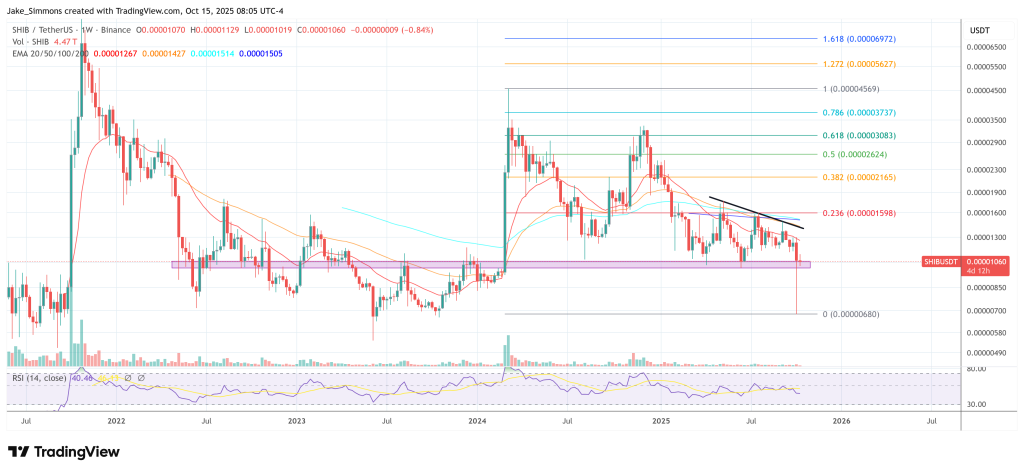
Shiba Inu price
Shiba Inu trades at key support zone, 1-week chart | Source: SHIBUSDT on TradingView.com
Featured image created with DALL.E, chart from TradingView.com
Editorial Process for bitcoinist is centered on delivering thoroughly researched, accurate, and unbiased content. We uphold strict sourcing standards, and each page undergoes diligent review by our team of top technology experts and seasoned editors. This process ensures the integrity, relevance, and value of our content for our readers.

Jake Simmons has been a Bitcoin enthusiast since 2016. Ever since he heard about Bitcoin, he has been studying the topic every day and trying to share his knowledge with others. His goal is to contribute to Bitcoin's financial revolution, which will replace the fiat money system. Besides BTC and crypto, Jake studied Business Informatics at a university. After graduation in 2017, he has been working in the blockchain and crypto sector. You can follow Jake on Twitter at @realJakeSimmons.

Похожее

Six Complaints from an Ethereum Developer

A disgruntled early Ethereum developer and token holder presents six core criticisms of the project's trajectory, contrasting it with Solana's rise. 1. **Premature Complacency**: The Ethereum Foundation shifted from a "building" to an "infrastructure" mindset too soon, adopting a passive, "retired chairman" posture before securing market dominance, reflected in ETH's ~65% decline against BTC post-Merge. 2. **Misguided Messaging**: The Merge was marketed primarily on ESG (99.95% energy reduction) rather than user benefits like speed or yield, appealing to internal ideals instead of market demands. 3. **Delayed Execution**: Proof-of-Stake, on the roadmap since 2015, took seven years to launch, ceding critical narrative and development windows. Competitors like Solana built entire ecosystems in that time. 4. **Poor Native Staking UX**: Years after the Merge, there is still no first-party, user-friendly staking application, forcing reliance on centralized services like Lido and undermining ETH's "sound money" narrative. 5. **Managed Decline**: The rollup-centric roadmap deliberately weakens the base layer's fee capture, outsourcing value and profitability to L2s like Arbitrum and Base, which issue their own tokens and fragment capital. 6. **Ideology Over Product**: Ethereum culture prioritizes philosophical purity ("credible neutrality," "public goods") over competitive product delivery that meets user demands (e.g., financialization), while Solana's ecosystem focuses on coordinated execution. The diagnosis is accumulated execution debt, not a coordination failure. Ethereum possessed a structural advantage in 2021 but spent years in governance debates, while Solana efficiently executed. The current market cap reflects these specific strategic failures, not abstract theory.

marsbit12 мин. назад

Six Complaints from an Ethereum Developer

marsbit12 мин. назад

Six Complaints from an Ethereum Developer

Six Grievances from an Ethereum Developer The author, an early investor and developer still building on Ethereum, expresses deep frustration with its trajectory and declining ETH/BTC price since the merge. The core argument is that Ethereum's current market position stems from concrete failures in execution and strategy, not abstract coordination problems. The first grievance targets a shift in the Ethereum Foundation's mentality from builders to "infrastructure," adopting a premature posture of a retired victor. Second, marketing the Merge around ESG (99.95% energy reduction) is seen as talking to its own conscience rather than the market, which prioritizes user experience and yield. Third, the seven-year delay in delivering Proof-of-Stake (PoS) ceded critical narrative and development time to competitors like Solana. Fourth, three years post-merge, there is still no user-friendly first-party staking application, forcing reliance on centralized services like Lido and undermining ETH's monetary narrative. Fifth, the rollup-centric roadmap has strategically surrendered base-layer fee capture to L2s, fragmenting value within the ecosystem while Solana demonstrates an integrated L1's value accrual. Finally, the author criticizes an institutional culture that prioritizes philosophical ideals (credible neutrality, pluralism) over competitive product delivery focused on what users actually want. The diagnosis is "accumulated execution debt." Ethereum possessed a structural advantage in 2021 but spent years in governance debates, while Solana's ecosystem coordinated efficiently to deliver and capture the next wave of value. The conclusion is that Ethereum's market cap reflects its abandonment of the fight for asset appreciation.

链捕手22 мин. назад

Six Complaints from an Ethereum Developer

链捕手22 мин. назад

Token Budget Wars: Enterprise AI Enters the 'Accounting Era'

Token Budget Wars: Enterprise AI Enters the "Accounting Era" Enterprise AI is shifting from the question of "whether to adopt" to "how to account for it." As AI inference costs evolve from experimental budgets into ongoing operational expenses, CEOs and CFOs are demanding proof of value: what tangible results does each dollar spent on tokens deliver? The core of "Token Budget Wars" is not simply about reducing AI bills, but about intelligently allocating compute resources. It involves determining which business processes warrant more computational power, which tasks can use cheaper models, which can be outsourced or handled manually, and which are merely inefficient consumption. A key insight is that AI usage (token consumption) does not equal value. While SaaS usage indicated software adoption, AI token usage only indicates the "meter is running." The same workflow can cost vastly different amounts due to factors like prompt quality, context, model choice, and retries. The critical metric for scaling is "marginal token utility"—the business value created per additional dollar of inference cost. However, this is difficult to measure due to challenges like the long tail of retries, context inflation (where costs can scale quadratically with context length), and inefficient model routing (defaulting to the most powerful model for all tasks). The competition for token allocation is intensifying because, in the AI era, influence is tied to how much intelligence one can command, not just team size. AI spending is essentially competing with labor costs, whether for replacing external BPOs, internal staff, or generating new revenue. BPO contracts provide a clearer benchmark as they are priced per completed unit. The missing layer is attribution from tokens to business outcomes. Companies need a system that connects inference spending to completed work and results, capturing the agent's decision trajectory—what it saw, retrieved, tried, and why it succeeded or failed. This recorded rationale becomes a valuable asset. Ultimately, those who master token-to-outcome attribution will control the allocation of AI resources within enterprises, deciding which workflows get more compute, which are capped, or which revert to humans. The first phase of enterprise AI proved models could do the work. The next phase will determine how much of that work is worth paying for.

marsbit48 мин. назад

Token Budget Wars: Enterprise AI Enters the 'Accounting Era'

marsbit48 мин. назад

US Debt Exceeds $39 Trillion, Surpassing GDP for First Time: The 'Gray Rhino' Every Investor Must Face by 2026

The U.S. national debt has exceeded $39 trillion, with the debt-to-GDP ratio surpassing 100% in 2026 for the first time since WWII. The annual interest payment is projected to reach $1.039 trillion. Driven by structural factors like tax cuts, rising entitlement spending (Social Security, Medicare), and compounding interest, the deficit persists. The Congressional Budget Office warns the current fiscal path is unsustainable, projecting debt could reach 175% of GDP by 2056. While the U.S. is unlikely to default as it issues its own currency, the consequences include persistent inflation pressure, higher long-term interest rates (e.g., 30-year Treasury yields at 5.2%), and potential crowding out of private investment. A fiscal crisis could manifest as a sudden, sharp spike in borrowing costs if market confidence erodes. Major credit rating agencies have downgraded U.S. debt, reflecting these concerns. For investors, this signals the end of the era of permanently low interest rates. Equity investors should favor companies with strong current earnings over high-growth stocks reliant on low discount rates. Bond investors face headwinds for long-term Treasuries due to increased supply, making shorter-duration bonds and investment-grade corporates relatively attractive. Gold and real assets can provide a hedge against currency debasement risks. Three broad scenarios are possible: gradual stabilization through fiscal reform (unlikely given political gridlock), a slow-burn of high debt and interest rates dragging on growth (the most probable baseline), or a sudden loss of market confidence triggering a crisis. Key indicators to watch include CBO report updates, Treasury auction demand, and the 30-year Treasury yield. The core takeaway for investors is the need to adjust portfolios for a world of sustained higher government borrowing costs and interest rates.

marsbit1 ч. назад

US Debt Exceeds $39 Trillion, Surpassing GDP for First Time: The 'Gray Rhino' Every Investor Must Face by 2026

marsbit1 ч. назад

Торговля

Спот
Фьючерсы
活动图片