[Key interpretation] The possibility of BTC's price hitting a new low has declined, and the ETH price has been recognized by investors

Huobi ResearchОпубликовано 2022-07-04Обновлено 2022-07-05

Введение

BTC price volatility narrowed and the bottom building potential of mainstream currencies increased.

1、 BTC reduction horizontal plate

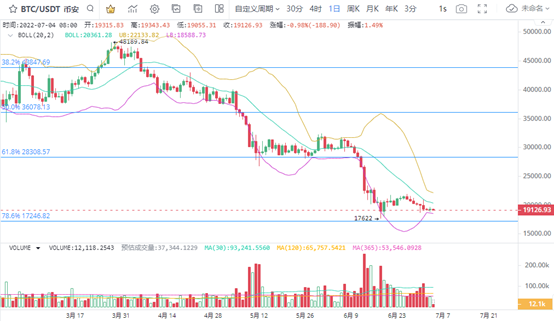
In the daily K-line chart of BTC, there were horizontal adjustments for several consecutive trading days, and finally there was a contraction signal in the daily level trading volume. The trading volume is lower than the equivalence line, which means that the trading characteristics with high activity in recent years have continued to change significantly. At the point, BTC was trading sideways around $19000, similar to the recent low closing price. This shows that long and short will compete around $19000, and the market is still in the expectation of volume reduction and correction.
2. The number of BTC coin holding addresses increased against the trend

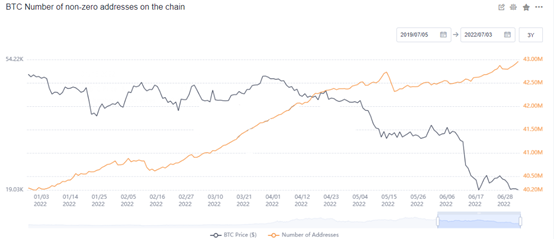
The data shows that although the BTC price has continued to retreat significantly, falling below $20000 from $40000 in April, the number of currency holding addresses is not stagnant. The latest number of coin holding addresses on July 3 has reached 42.96 million, an increase of more than 9.6 million or 2.2% compared with 42million in April. Since 2022, the number of BTC coin holding addresses has increased from 40.2 million to 42.96 million, an increase of 2.76 million or 6.8%. On the whole, during the BTC price retreat, more investors hold BTC after the chips change hands. At present, the growth trend of the number of BTC coin holding addresses is similar to that in the second half of 2021, and the growth rate is weaker than that in the first half of 2021. According to this judgment, the bulls are in the stage of chip accumulation, and the price reversal of BTC needs time to test.
3. BTC price is close to the cost price of investors

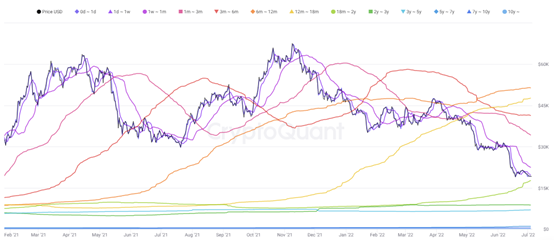
During the low-level and high-volume operation of BTC price, its cost price is rapidly approaching the cost price of investors. From the perspective of holding time, the cost price of investors holding money for 18 to 24 months has risen to $17643, that is to say, this point has been higher than the recent BTC lowest price of $17622. In other words, if BTC is close to US $17643 in the short term, the possibility of further breaking and falling has been significantly reduced. The cost price of investors holding money for 18 to 24 months is the main price for holding money for a long time. Its currency holding cycle starts from the middle of 2020. If the main cost price is lower than this cost price, the cost may be an important buying signal.
4. Eth main force lures more and pulls up

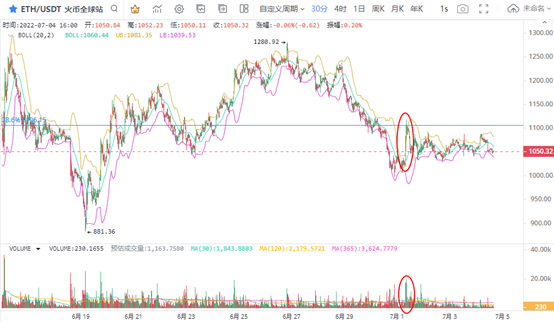
In the 30 minute K-line chart, the main investors' short-term rise in BTC prices lasted for a short time, but the trading volume continued to rise significantly. The corresponding eth price rise continued on July 1. Although the main short-term trading rhythm accelerates, this trading heat does not last long, so the impact on the market is not significant. Near the key $1000, the ETH price trend still shows a contraction sideways, indicating that there is a greater possibility of further breaking. From the perspective of fluctuation space, the current US $1050 is very close to the integer price of US $1000. Therefore, ETH will also test the support effect of $1000 in the short term, so as to confirm whether it can rebound again.
5. The number of eth active addresses rebounded

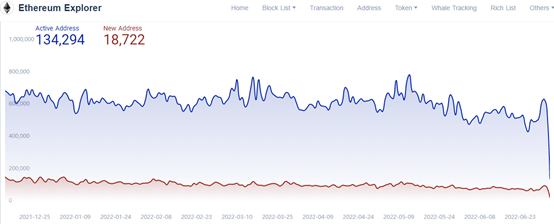
Recently, the number of active addresses of eth has continued to rebound significantly, increasing from 430000 on June 26 to 629000 on July 2, with an increase of 46%. During this period of time, the price of eth has continued to fall significantly, falling from $1242 to $1059, which shows that investors bought eth at a low price in the price decline stage. Judging from this, the early decline of eth has boosted investors' trading enthusiasm. During the same period, the number of new addresses also showed a similar increase.

At the point, ETH is closer to the integer level of $1000. Considering that there are many eth investors in short-term trading, more investors in new trading will continue to suffer losses after falling below $1000. Therefore, at present, the support of eth of $1000 is very important.

Похожее

Unveiling the Whales of the World Cup Prediction Market: Smart Money Stumbles on the Pitch, 'Buy No' Outperforms 'Buy Yes'

**Title: Unveiling the Whales of the World Cup Prediction Market: "Smart Money" Stumbles on the Pitch as "Buying No" Outperforms "Buying Yes"** An analysis of pre-match trades over $5,000 on Polymarket for 20 completed group stage matches reveals a counterintuitive finding: large "smart money" bets were not consistently accurate. Aggregated pre-match buying volume was $89.55 million, with a weighted hit rate of only 48.5%. Holding these positions would have resulted in an estimated net loss of about $1.76 million (ROI -2.0%), challenging the notion that big money reliably predicts outcomes. The data highlights several key dynamics. Draws proved to be a major risk, significantly impacting bets on favored teams, as seen in Belgium-Egypt and Spain-Cape Verde. Markets were more efficient for clear mismatches (e.g., Germany's big win) but became prone to bias when favorites were overvalued. Notably, buying "No" shares (betting against a specific outcome) significantly outperformed buying "Yes," with hit rates of 62.4% vs. 37.5%. This suggests the market often overprices popular narratives, creating value in contrarian positions. Individual trades showed extreme volatility. One wallet (mintblade) earned an estimated $6.77 million by betting against Iran, while another (LEEEROYJENKINS) lost roughly $8.39 million on a Belgium win. The market favors high-risk, high-reward information trading rather than steady arbitrage. For sustained insight, wallets with consistent performance across multiple matches (e.g., swisstony) are more telling than one-off big bets. Ultimately, the Polymarket acts less as a crystal ball and more as a mirror, reflecting crowd bias and the inherent unpredictability of football. True "smart money" may lie not in predicting the future, but in identifying and exploiting market mispricings while respecting risk.

marsbit17 мин. назад

Unveiling the Whales of the World Cup Prediction Market: Smart Money Stumbles on the Pitch, 'Buy No' Outperforms 'Buy Yes'

marsbit17 мин. назад

Bezos' Third Startup Still Can't Avoid Musk

Jeff Bezos Returns as CEO for Third Venture, Still Can't Avoid Musk After stepping down as Amazon CEO in 2021, Jeff Bezos has returned to the front lines as co-CEO of Prometheus, an AI startup he founded. In a recent CNBC interview, Bezos described the experience as "Type 2 fun"—exhausting but ultimately rewarding. Founded less than a year ago, Prometheus has already raised over $18 billion in two funding rounds, achieving a staggering $41 billion valuation. Prometheus aims to develop a "General Engineer AI" to accelerate the entire "invention loop"—design, simulation, testing, and manufacturing—for complex physical products like jet engines, spacecraft, and medical devices. This positions the company at the intersection of Bezos's past experiences: Amazon's platform-building scale and Blue Origin's rigorous physical engineering. This marks Bezos's third major venture, following Amazon and Blue Origin. His co-CEO is Vik Bajaj, bringing expertise from life sciences and hard tech. Bezos now dedicates most of his time to Prometheus, signaling his belief in its transformative potential. The move also comes as Bezos's space company, Blue Origin, faces challenges, including a recent test explosion delaying its New Glenn rocket. Meanwhile, Elon Musk's SpaceX achieved a record-breaking IPO, surpassing Amazon's market cap. While Musk focuses on AI for executing physical tasks (like Tesla's robots and SpaceX's engineering), Bezos is betting on AI to *invent* in the physical world. Prometheus enters a crowded industrial AI field with players like OpenAI, NVIDIA, and Tesla's Optimus. Its lofty valuation bets on the unproven but massive opportunity to become the foundational platform for engineering in the AI era—a "blue ocean" Bezos hopes to define before Musk does.

marsbit20 мин. назад

Bezos' Third Startup Still Can't Avoid Musk

marsbit20 мин. назад

Won't US Stocks Ever Fall Again? The 'Great Melt-up' Trap in the Era of High Debt

The article analyzes a popular theory circulating online that the U.S. stock market may be mathematically incapable of a true, sustained decline due to the country's massive and growing national debt. The argument suggests that the government's only path to managing this debt is through inflation and money printing, which would nominally lift asset prices like stocks, creating a perpetual "melt-up." The author places this idea within the historical context of market melt-ups, such as the dot-com bubble and Japan's asset bubble, where prices detach from fundamentals driven by momentum and FOMO. While acknowledging that a high-debt environment creates incentives for inflation, which is generally favorable for assets over cash, the article refutes key claims of the online theory. It clarifies that interest payments are not about to exceed GDP, that printing money is not the only option for the government, and that stocks do not reliably rise in lockstep with hyperinflation, citing historical examples from Germany, Zimbabwe, and Venezuela. The more probable outcome, according to the author, is a prolonged period of financial repression—moderate inflation above interest rates that slowly erodes debt and cash purchasing power, leading to nominally higher asset prices but potentially lower real returns. The core warning is that while long-term market trends may be upward, this does not eliminate the risk of significant interim crashes (30%, 40%, or more) or guarantee real wealth creation during inflationary times. The conclusion advises against betting one's entire financial future on a smooth, perpetually rising market narrative. Instead, it recommends a disciplined, diversified strategy involving productive assets (stocks, real estate, some gold, short-term bonds) and an adequate cash buffer to avoid forced selling during downturns. The key takeaway is to avoid extreme concentration in expensive assets and leverage, and not to base investment decisions on the hope that every market dip will inevitably be rescued.

marsbit40 мин. назад

Won't US Stocks Ever Fall Again? The 'Great Melt-up' Trap in the Era of High Debt

marsbit40 мин. назад

Торговля

Спот
Фьючерсы
活动图片