Cardano Enters New Scalability Era With Hydra Node V1.0 Release

bitcoinistОпубликовано 2025-10-10Обновлено 2025-10-10

Введение

Cardano’s scaling roadmap hit a visible milestone yesterday as the Hydra team tagged hydra-node v1.0.0 on GitHub—positioning the isomorphic state-channels...

Trusted Editorial content, reviewed by leading industry experts and seasoned editors. Ad Disclosure

Cardano’s scaling roadmap hit a visible milestone yesterday as the Hydra team tagged hydra-node v1.0.0 on GitHub—positioning the isomorphic state-channels protocol for production use while still flagging remaining limitations. In a brief comment on X, Cardano founder Charles Hoskinson struck an upbeat tone about the near-term trajectory: “Hydra is going to have an awesome 2026,” he wrote, amplifying a community post that framed the upgrade as a step-change for throughput-sensitive use cases.

Cardano’s Hydra Node V1.0 Is Live

The release notes, published under the “A big release of hydra-node! It’s official. We’re at version 1.0.0!” banner, emphasize that the team intends to “continue to support [the] Hydra Head protocol implementation into production environments,” even as they continue work on the “largest outstanding known problem,” partial fanout. Crucially, the tag itself is marked “Pre-release” on GitHub—an important nuance for developers and integrators who follow semantic signals from the repository.

At a technical level, v1.0.0 consolidates months of incremental changes into a package that’s been tested with cardano-node 10.1.2 and cardano-cli 10.1.1.0. The build introduces a beta of incremental commits, allowing funds to be committed to a running Head; adds a –deposit-deadline parameter so operators can define how long a node should watch for deposits before enabling safe recovery; and rewrites the commit and initial scripts in Aiken, moving the initial script to Plutus V3 and shrinking it by 1,337 bytes.

One consequential trade-off appears in the commit-path rewrite: the documented maximum number of Head participants is now eight. The release also notes API refinements (for example, a POST /transaction endpoint) and persistence format changes tied to more efficient snapshot handling.

For builders, these specifics matter because Hydra’s promise has always been pragmatic rather than purely theoretical: execute fast, low-cost transactions off-chain inside a Head while preserving Cardano’s extended-UTXO semantics, then fan the final state back to L1.

The Hydra Head protocol has been mainnet-compatible since v0.10.0, but the v1.0.0 tag signals a harder push toward real-world deployment across DeFi, gaming, and latency-sensitive apps—precisely the domains community voices highlighted in today’s discourse. As one KOL put it in a widely shared post, “Cardano just entered a new era of speed and scalability. Hydra Node v1.0.0 is here — DeFi, gaming, and real-time apps are about to level up.”

While the release notes are measured, the throughput optics behind Hydra are anything but. In prior public stress tests tied to the community’s Hydra Doom project and its CPLAY summit finale, Input Output recorded Hydra hitting 1 million transactions per second.

That figure was presented as a demonstration of how off-chain Hydra Heads can absorb extreme, frame-by-frame game state updates without interrupting service—useful for real-time interactive apps and high-fan-out venues. “We proved that Hydra can scale to 1 million TPS,” Hoskinson said in the company’s recap of the event.

Beneath the headline peak, telemetry circulating during the qualifier rounds showed sustained readings in the hundreds of thousands of TPS, with community dashboards and posts commonly citing plateaus around ~650,000 TPS before the Las Vegas finale pushed beyond the seven-figure mark.

At press time, ADA traded at $0.816.
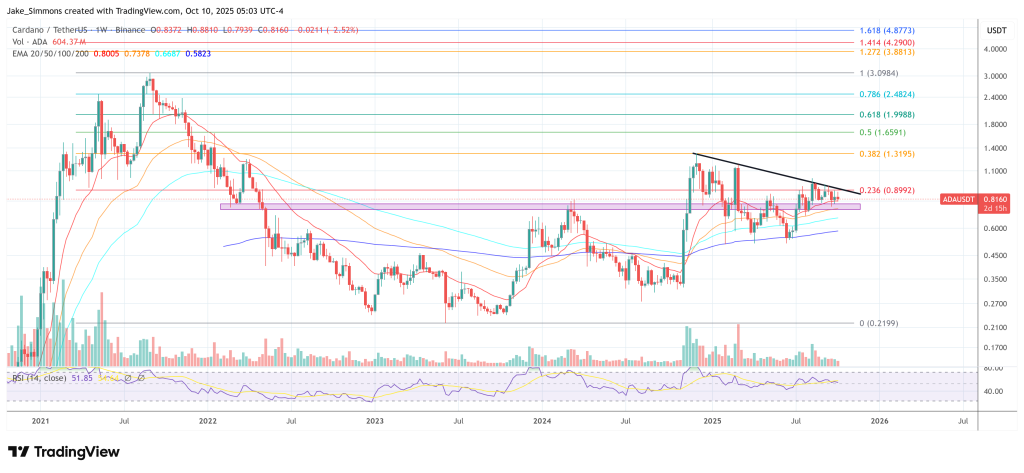
Cardano price
Cardano price, 1-day chart | Source: ADAUSDT on TradingView.com
Featured image created with DALL.E, chart from TradingView.com
Editorial Process for bitcoinist is centered on delivering thoroughly researched, accurate, and unbiased content. We uphold strict sourcing standards, and each page undergoes diligent review by our team of top technology experts and seasoned editors. This process ensures the integrity, relevance, and value of our content for our readers.

Jake Simmons has been a Bitcoin enthusiast since 2016. Ever since he heard about Bitcoin, he has been studying the topic every day and trying to share his knowledge with others. His goal is to contribute to Bitcoin's financial revolution, which will replace the fiat money system. Besides BTC and crypto, Jake studied Business Informatics at a university. After graduation in 2017, he has been working in the blockchain and crypto sector. You can follow Jake on Twitter at @realJakeSimmons.

Похожее

US Government Lifts Ban on Crypto Perpetual Contracts for the First Time: What Does It Mean for the Market?

The U.S. Commodity Futures Trading Commission (CFTC) has issued guidance permitting 24/7 trading and clearing for crypto asset derivatives, effectively opening the U.S. market to crypto perpetual contracts for the first time. This move ends the previous ban and allows American individuals and institutions to trade these instruments around the clock. Direct beneficiaries include Kalshi, which received approval to list a Bitcoin perpetual contract; Coinbase, now the first CFTC-regulated futures commission merchant for U.S. clients to access global crypto derivatives; and CME, which will transition its Bitcoin futures and options to 24/7 trading. The CFTC emphasized this is a specific allowance for crypto assets, noting that traditional commodities like agriculture may not be suitable for non-stop trading. It also requires platforms to undergo case-by-case reviews for compliance and risk management. Industry leaders like Michael Saylor and Brian Armstrong praised the decision for integrating Bitcoin into capital markets and granting U.S. users access to a major global market segment. However, consumer advocacy group Better Markets criticized the CFTC for allegedly neglecting investor protection and favoring the industry it regulates. Other platforms like Kraken have announced plans to launch regulated perpetual futures for the U.S. market. The policy shift is expected to redirect significant liquidity and institutional participation to the newly accessible U.S. crypto derivatives landscape.

Odaily星球日报41 мин. назад

US Government Lifts Ban on Crypto Perpetual Contracts for the First Time: What Does It Mean for the Market?

Odaily星球日报41 мин. назад

How the CLARITY Act Reshapes the Stablecoin Yield Economy

The CLARITY Act, recently advanced by the U.S. Senate Banking Committee, fundamentally reshapes the stablecoin yield economy by closing loopholes left by the earlier GENIUS Act. Its Section 404 expands the ban on "hold-to-earn" rewards to all Digital Asset Service Providers (DASPs) and their affiliates, prohibiting any passive, interest-like yield. Crucially, it introduces a legal distinction, permitting "use-to-earn" rewards based on actual activities like spending, trading, or staking. In anticipation of this regulatory shift, major Wall Street asset managers—Morgan Stanley, BlackRock, and JPMorgan—have launched a series of tokenized money market funds (e.g., BlackRock's BRSRV, JPMorgan's JLTXX) designed explicitly for stablecoin reserve assets. These products represent a new, compliant yield layer: the stablecoin issuer earns interest from the underlying tokenized fund, which can then be passed to users through redesigned activity-based rewards. This marks a paradigm shift from a "hold-to-earn" to a "use-to-earn" market. While pathways remain for exchanges to redesign rewards (Path A) and for DeFi protocols to offer yield (Path B), the tokenized reserve asset layer (Path C) emerges as the most robust and strategically positioned infrastructure. However, this concentration—exemplified by BlackRock's BUIDL fund backing over 90% of USDtb's reserves—introduces new systemic risks. The final outcome hinges on regulatory decisions, particularly the OCC's proposed 20% cap on tokenized assets in reserves, which will determine the scalability of this new financial infrastructure layer.

marsbit2 ч. назад

How the CLARITY Act Reshapes the Stablecoin Yield Economy

marsbit2 ч. назад

Kalshi and Coinbase Receive CFTC Approval, Ushering in the Most Regulation-Friendly Era for the Crypto Industry?

The U.S. Commodity Futures Trading Commission (CFTC) took two landmark actions on May 29. It approved Kalshi's application to list a Bitcoin perpetual futures contract and issued a no-action letter to Coinbase Financial Markets. This allows Coinbase to offer certain perpetual futures products to U.S. customers through a subsidiary, with digital assets permitted as collateral. These moves, coupled with a new CFTC policy statement, provide a clearer regulatory pathway for perpetual contracts in the U.S., moving them from a regulatory gray area. CFTC Chair Mike Selig stated this is a key step for U.S. crypto leadership but noted the policy is not yet permanent. The article explains that CFTC's previous reluctance stemmed from legal ambiguities, as perpetual contracts lack an expiration date. However, such contracts dominate global crypto derivatives, accounting for ~78% of centralized exchange volume in 2025, forcing U.S. regulators to adapt to competition from offshore platforms like Hyperliquid. The approvals offer two compliance paths: Kalshi's direct listing and Coinbase's model using foreign futures. This is expected to attract institutional capital back to regulated U.S. venues, stimulate the launch of more products like ETH perpetuals, and enhance U.S. competitiveness in the global crypto derivatives market. The author suggests this may signal a "regulatorily friendly" era for crypto.

marsbit6 ч. назад

Kalshi and Coinbase Receive CFTC Approval, Ushering in the Most Regulation-Friendly Era for the Crypto Industry?

marsbit6 ч. назад

Торговля

Спот
Фьючерсы

Популярные статьи

Как купить ADA

Добро пожаловать на HTX.com! Мы сделали приобретение Cardano (ADA) простым и удобным. Следуйте нашему пошаговому руководству и отправляйтесь в свое крипто-путешествие.Шаг 1: Создайте аккаунт на HTXИспользуйте свой адрес электронной почты или номер телефона, чтобы зарегистрироваться и бесплатно создать аккаунт на HTX. Пройдите удобную регистрацию и откройте для себя весь функционал.Создать аккаунтШаг 2: Перейдите в Купить криптовалюту и выберите свой способ оплатыКредитная/Дебетовая Карта: Используйте свою карту Visa или Mastercard для мгновенной покупки Cardano (ADA).Баланс: Используйте средства с баланса вашего аккаунта HTX для простой торговли.Третьи Лица: Мы добавили популярные способы оплаты, такие как Google Pay и Apple Pay, для повышения удобства.P2P: Торгуйте напрямую с другими пользователями на HTX.Внебиржевая Торговля (OTC): Мы предлагаем индивидуальные услуги и конкурентоспособные обменные курсы для трейдеров.Шаг 3: Хранение Cardano (ADA)После приобретения вами Cardano (ADA) храните их в своем аккаунте на HTX. В качестве альтернативы вы можете отправить их куда-либо с помощью перевода в блокчейне или использовать для торговли с другими криптовалютами.Шаг 4: Торговля Cardano (ADA)С легкостью торгуйте Cardano (ADA) на спотовом рынке HTX. Просто зайдите в свой аккаунт, выберите торговую пару, совершайте сделки и следите за ними в режиме реального времени. Мы предлагаем удобный интерфейс как для начинающих, так и для опытных трейдеров.

2.2k просмотров всегоОпубликовано 2024.03.29Обновлено 2025.07.02

Как купить ADA

SNEK: ведущий мемкоин на блокчейне Cardano, открывающий новую эпоху для экосистемы Cardano

SNEK - это дефляционный мемкоин, выпущенный на блокчейне Cardano. Он создаёт децентрализованную культурную и развлекательную ценность за счёт участия глобального сообщества.

2.1k просмотров всегоОпубликовано 2025.10.15Обновлено 2025.10.15

SNEK: ведущий мемкоин на блокчейне Cardano, открывающий новую эпоху для экосистемы Cardano

Неделя обучения по популярным токенам 8: запуск основной сети Ouroboros Leios для ADA ожидается в 2026 году

Основная сеть Ouroboros Leios для ADA, как ожидается, будет запущена в 2026 году, а хардфорк до версии протокола 11 запланирован на I квартал 2026 года.

2.0k просмотров всегоОпубликовано 2026.02.10Обновлено 2026.02.12

Неделя обучения по популярным токенам 8: запуск основной сети Ouroboros Leios для ADA ожидается в 2026 году

Обсуждения

Добро пожаловать в Сообщество HTX. Здесь вы сможете быть в курсе последних новостей о развитии платформы и получить доступ к профессиональной аналитической информации о рынке. Мнения пользователей о цене на ADA (ADA) представлены ниже.

活动图片