Tether And Circle Inject $12.75B To The Market In 30 Days – Details

bitcoinistОпубликовано 2025-09-12Обновлено 2025-09-13

Введение

The stablecoin market is once again in the spotlight after Tether minted another $1 billion USDT just a few hours...

Trusted Editorial content, reviewed by leading industry experts and seasoned editors. Ad Disclosure

The stablecoin market is once again in the spotlight after Tether minted another $1 billion USDT just a few hours ago. This fresh injection of liquidity comes at a time when the crypto market is entering a volatile phase, with uncertainty surrounding both macroeconomic conditions and investor sentiment. Bitcoin and altcoins are beginning to show shifting dynamics, and stablecoin issuers like Tether and Circle are emerging as critical players in shaping these movements.

Large mints from Tether have historically coincided with aggressive price swings across the crypto market, as the arrival of new liquidity often fuels increased trading activity. Whether this supply is immediately deployed or gradually filters into exchanges, the effect on market psychology is significant. Traders and investors frequently view such events as early signals of potential inflows into risk assets.

With Bitcoin consolidating near key levels and altcoins attempting to recover from recent corrections, the timing of this mint underscores the importance of stablecoins in the broader ecosystem. As liquidity expands, the coming days could see heightened volatility, with the possibility of strong directional moves. For now, all eyes are on how this $1 billion issuance will ripple across the crypto landscape.

Tether and Circle Add Liquidity Into The Market

According to data from Lookonchain, Tether and Circle have minted a combined $12.75 billion in stablecoins over the past month, marking one of the most significant liquidity injections in recent cycles. This expansion underscores the crucial role stablecoins play in the crypto ecosystem, acting as the backbone of trading activity and serving as a bridge for capital flowing into risk assets.
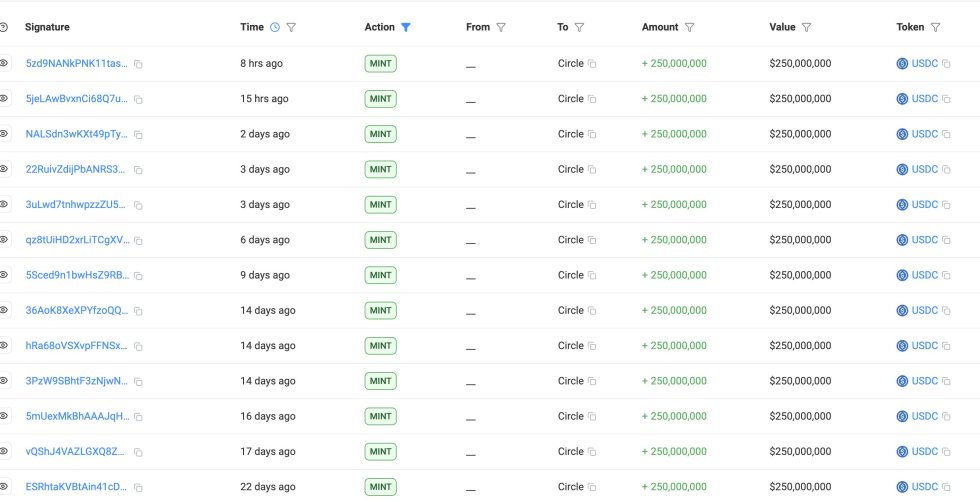
Tether and Circle Stablecoin Mints | Source: Lookonchain

The timing of this surge is notable. Bitcoin and Ethereum are consolidating near critical levels, and altcoins are beginning to show signs of renewed momentum. Historically, large stablecoin mints have preceded uptrends in crypto markets, as fresh liquidity provides the fuel for traders and institutions to deploy capital more aggressively. The $12.75B increase, therefore, reflects more than just stablecoin supply growth—it signals a market preparing for potential expansion.

Still, risks remain elevated. Some analysts caution that the broader economic environment is highly unpredictable, with lingering concerns over global growth, inflationary pressures, and liquidity conditions. The volatility of traditional markets often bleeds into crypto, making sudden swings a persistent threat.

All eyes are now on the US Federal Reserve, with investors widely anticipating a rate cut at next week’s meeting. Such a move would reinforce the bullish implications of the stablecoin surge, further boosting liquidity and supporting higher valuations across digital assets. Conversely, any hesitation or unexpected policy shift could magnify uncertainty, creating sharp volatility.

USDT Dominance Suggests Risk Appetite

Tether (USDT) dominance currently stands at 4.29%, showing a modest decline after testing resistance near 4.5%. The weekly chart reveals that USDT’s market share has been in a gradual downtrend since peaking above 9% in mid-2022. This decline reflects a healthier appetite for risk assets, as capital shifts out of stablecoins and into Bitcoin, Ethereum, and altcoins.
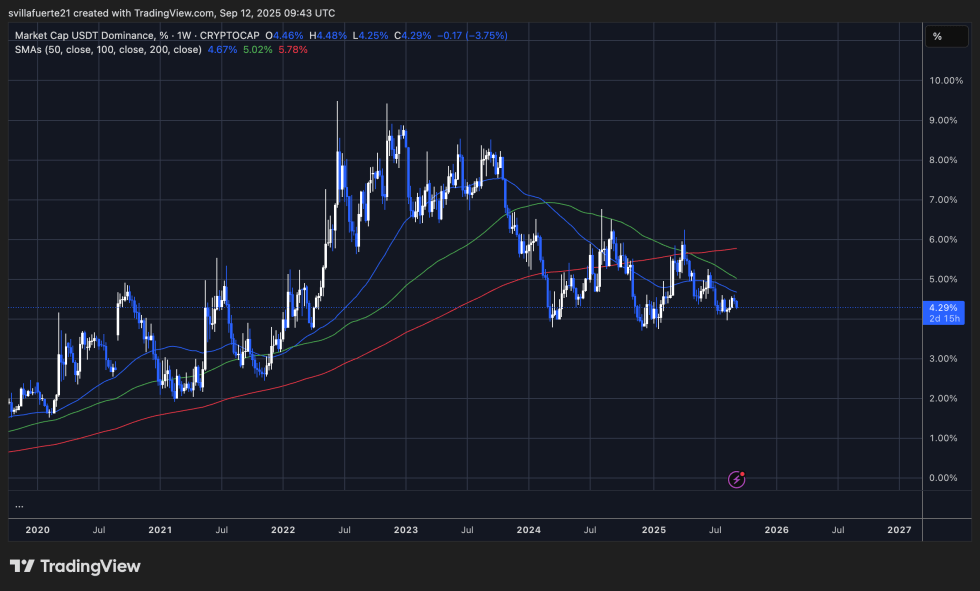
USDT Market Cap Dominance | Source: USDT.D chart on TradingView

The 50-week SMA at 4.67% and the 100-week SMA at 5.02% are both trending lower, confirming persistent weakness in dominance. Meanwhile, the 200-week SMA at 5.78% sits well above current levels, acting as a ceiling that reinforces the longer-term bearish structure for USDT’s market share. As long as USDT dominance remains below the 5% threshold, the market backdrop favors capital rotation into risk assets.

However, short-term support has emerged around the 4.2%–4.3% zone, where dominance has stabilized multiple times this year. A breakdown below this range would likely signal further risk-taking by investors, potentially fueling stronger rallies in crypto. Conversely, a bounce back toward 5% would indicate rising caution and renewed demand for stablecoins.

Featured image from Dall-E, chart from TradingView

Editorial Process for bitcoinist is centered on delivering thoroughly researched, accurate, and unbiased content. We uphold strict sourcing standards, and each page undergoes diligent review by our team of top technology experts and seasoned editors. This process ensures the integrity, relevance, and value of our content for our readers.

Sebastian's journey into the world of crypto began four years ago, driven by a fascination with the potential of blockchain technology to revolutionize financial systems. His initial exploration focused on understanding the intricacies of various crypto projects, particularly those focused on building innovative financial solutions. Through countless hours of research and learning, Sebastian developed a deep understanding of the underlying technologies, market dynamics, and potential applications of cryptocurrencies. As his knowledge grew, Sebastian felt compelled to share his insights with others. He began actively contributing to online discussions on platforms like X and LinkedIn, focusing on fintech and crypto-related content. His goal was to expose valuable trends and insights to a wider audience, fostering a deeper understanding of the rapidly evolving crypto landscape. Sebastian's contributions quickly gained recognition, and he became a trusted voice in the online crypto community. To further enhance his expertise, Sebastian pursued a UC Berkeley Fintech: Frameworks, Applications, and Strategies certification. This rigorous program equipped him with valuable skills and knowledge regarding Financial Technology, bridging the gap between traditional finance (TradFi) and decentralized finance (DeFi). The certification deepened his understanding of the broader financial landscape and its intersection with blockchain technology. Sebastian's passion for finance and writing is evident in his work. He enjoys delving into financial research, analyzing market trends, and exploring the latest developments in the crypto space. In his spare time, Sebastian can often be found immersed in charts, studying 10-K forms, or engaging in thought-provoking discussions about the future of finance. Sebastian's journey as a crypto analyst and investor has been marked by a relentless pursuit of knowledge and a dedication to sharing his insights. His ability to navigate the complex world of crypto, combined with his passion for financial research and communication, makes him a valuable asset to the industry. As the crypto landscape continues to evolve, Sebastian remains at the forefront, providing valuable insights and contributing to the growth of this revolutionary technology.

Похожее

Представлен 0,7-нм чип: Закон Мура снова в действии

Закон Мура снова в силе: IBM представила первый в мире процесс с технологией 0,7 нм. На чипе размером с ноготь можно разместить почти 100 миллиардов транзисторов, что вдвое превышает плотность 2-нм чипов. Ключевым прорывом стала архитектура NanoStack — первая в отрасли трехмерная вертикальная компоновка транзисторов на основе нанолистов. По сравнению с 2 нм, это дает прирост производительности на 50% или повышение энергоэффективности на 70%. Технология уже успешно протестирована в лаборатории, включая работу КМОП-инверторов и сокращение площади SRAM на 40%. IBM, которая больше не производит чипы, разрабатывает процесс для лицензирования производителям. Ожидается, что NanoStack может обеспечить дальнейшую миниатюризацию чипов как минимум на десять лет, а коммерческое производство может начаться в ближайшие пять лет.

marsbit11 мин. назад

Представлен 0,7-нм чип: Закон Мура снова в действии

marsbit11 мин. назад

Создатели ChatGPT уже не используют ChatGPT для работы

Разработчики ChatGPT уже практически не используют его для работы. В OpenAI основным инструментом стал AI-агент Codex. К июню 2026 года на него приходится 99,8% всех выходных токенов компании, тогда как менее года назад этот показатель не достигал 10%. Перелом наступил в сентябре, когда Codex, получив более мощную модель и новые функции, начал выполнять все более сложные задачи. Сотрудники предпочитают поручать ему целые рабочие процессы, а не вести диалог в чате. Это касается всех отделов — от инженерного до юридического и финансового. Ключевой сигнал — активный рост пользователей, не являющихся разработчиками. Они используют Codex для автоматизации рутинных задач, анализа документов и даже программирования. Более 25% задач от бизнес-пользователей связаны с написанием кода, что стирает границы между профессиями. Codex эволюционировал из инструмента для генерации кода в автономного агента, способного самостоятельно выполнять длительные многоэтапные задачи — от реализации и тестирования до отладки. Наиболее активные пользователи поручают ему объем работы, эквивалентный 60+ человеко-часам в день. Это знаменует смену парадигмы: вместо пошагового взаимодействия с чат-ботом пользователи все чаще делегируют AI-агентам выполнение целых комплексных задач, сохраняя за собой контроль и ответственность.

marsbit17 мин. назад

Создатели ChatGPT уже не используют ChatGPT для работы

marsbit17 мин. назад

Grayscale снижает комиссии перед запуском MSOL — Зададут ли институциональные инвесторы следующий рост Solana?

Институциональные действия на волатильном рынке редко являются случайностью. На фоне общего оттока средств с крипторынка (свыше $100 млрд на прошлой неделе) и падения общей капитализации до $1,99 трлн, Solana (SOL) демонстрирует признаки возможного расхождения с общей тенденцией. Ключевым событием стало решение Grayscale снизить годовую комиссию за свой спотовый ETF на Solana с 0,35% до 0,19%. Этот шаг, вероятно, является реакцией на усиление конкуренции, в частности на планы Morgan Stanley запустить ETF (MSOL) с комиссией всего 0,14%. Эти действия указывают на сохраняющийся институциональный интерес к SOL, несмотря на слабую общую рыночную конъюнктуру и технический риск снижения цены к отметке $60. Фундаментальная картина для Solana выглядит устойчивой. Экосистема токенизированных реальных активов (RWA) достигла рекордного объема в $3,1 млрд при более чем 290 000 держателей. Дополнительный импульс создает листинг ETF на Solana (SOLZ) на Казахстанской фондовой бирже (KASE), что расширяет глобальный институциональный доступ. Таким образом, настройки на третий квартал для Solana формируются под влиянием двух факторов: растущей конкуренции среди ETF, снижающей барьеры для инвесторов, и сильной базовой активности в экосистеме. Это создает предпосылки для потенциального роста, когда институциональные потоки капитала догонят фундаментальные показатели сети.

ambcrypto1 ч. назад

Grayscale снижает комиссии перед запуском MSOL — Зададут ли институциональные инвесторы следующий рост Solana?

ambcrypto1 ч. назад

Артур Хейес продаёт NEAR, Worldcoin и Zcash, перекладываясь в акции энергетических компаний

Артур Хейес, бывший CEO BitMEX, изложил более оборонительную позицию в своем портфеле. В своём эссе «Проверка реальности» он утверждает, что долговой бум в сфере искусственного интеллекта (ИИ) искажает условия ликвидности на рынках и откладывает следующую крупную экспансию в криптоиндустрии. В связи с этим Хейес сообщил о выходе из позиций по нескольким альткоинам, включая NEAR, Worldcoin и Zcash. При этом он сохраняет структурный бычий настрой в отношении Биткоина и Эфира, рассматривая их как основные долгосрочные активы. Биткоин остаётся для него предпочтительным хеджем против долговой экспансии, а Эфир — ключевым активом смарт-контрактов. Часть высвободившегося капитала он направляет в казначейские облигации (Treasuries) и акции энергетического сектора. Хейес подчёркивает, что его сдвиг — не отход от криптовалют в целом, а более избирательная стратегия. В текущих условиях, когда ликвидность поглощается финансированием инфраструктуры ИИ, высоковолатильные альткоины могут испытывать трудности. Ключевой вывод для рынка — важность отслеживания глобальной ликвидности, кредитных условий и потоков капитала, которые в ближайшей перспективе могут быть важнее отдельных нарративов внутри криптоиндустрии. Долгосрочная цель Хейеса по Биткоину в $1 миллион остаётся в силе, но путь к ней может оказаться более сложным.

bitcoinist1 ч. назад

Артур Хейес продаёт NEAR, Worldcoin и Zcash, перекладываясь в акции энергетических компаний

bitcoinist1 ч. назад

Торговля

Спот
活动图片