​​黄金再次新高下的暗线:盘点那些你必须知道的黄金代币(附清单)

marsbitОпубликовано 2025-09-04Обновлено 2025-09-05

9 月 2 日,现货黄金日内涨超 1%,升穿 3510 美元 / 盎司,最高至 3512.27 美元 / 盎司,创历史新高;3 日早上,现货黄金 短线拉升逾 10 美元,最高报 3547 美元 / 盎司,再创新高。令人惊讶的是,有消息表示世界黄金协会正寻求推出「数字黄金」,而这或将改变伦敦 9000 亿美元的黄金实物市场。本文汇总近期黄金价格趋势及行业动态、主流黄金代币化项目等信息,供读者参考。

黄金再度开启冲高姿态,分析师预测金价或上涨至 3900 美元 / 盎司

9 月 1 日,现货黄金 站上 3470 美元 / 盎司,续创今年 4 月 22 日以来新高,日内涨幅达 0.67%。

随后,在短短的 2 天内,金价快速突破至 3500 美元上方并逐渐稳定,由此使得行业内对于黄金价格后市走向转向高度看涨。

分析师:金价在未来几个月有望触及 3600-3900 美元区间

Philip Nova 分析师 Priyanka Sachdeva 在报告中表示,如果现货黄金价格持续突破 3500 美元,未来几个月金价可能触及每盎司 3600 - 3900 美元的区间。她说,美国激进的关税立场增加了地缘政治风险,助长了避险投资。她表示,降息预期、政治动荡和 ETF 需求旺盛等因素的推动,已使黄金从一种战术对冲变成了许多投资者的战略必备资产。Sachdeva 认为,3800 美元 / 盎司的目标可能是金价突破当前高点的第一个明确的心理关口。

英国金融时报:世界黄金协会正计划推出「数字黄金」

据英国金融时报 报道,世界黄金协会(WGC)正寻求推出一种数字形式的黄金,此举可能会创造一种新的黄金交易、结算和抵押方式,从而彻底改变伦敦 9000 亿美元的黄金实物市场。

世界黄金协会 CEO David Tait 在接受采访时表示,这种新形式将使「黄金作为抵押品,首次在黄金生态系统中以数字方式传递」成为可能。尽管许多投资者看重黄金正是因为其实物性质和缺乏交易对手方风险,将其视为避险资产,但 Tait 认为,黄金必须数字化,以扩大其市场覆盖范围。Tait 表示:「我们正在尝试为黄金建立起一套标准化的数字层,以便其他市场使用的各类金融产品未来也能应用于黄金市场。我的目标是,让全球众多资产管理人重新审视黄金。」

此举被视为世界黄金协会为应对新的金融投资环境而做出的改变——尽管此前黄金因其实物属性和无交易对手方风险而被视为避险资产,但在不少银行及投资者眼中,黄金是一种流动性差且无收益的资产。正如 Tait 所言:「对银行而言,单从抵押品角度看,它们就能赚取巨额利润——因为它们有机会将资产负债表上的黄金用作抵押品。」

据了解,该计划主要由「集合黄金权益(pooled gold interests,简称 PGIs)」这一新型数字部门负责推动,将允许银行和投资者买卖存放在独立账户中实物黄金的部分所有权。2026 年 Q1,伦敦的商业机构将参与该模式的试点。

目前,伦敦黄金市场的交易分为「指定黄金(allocated gold)」交易(涉及特定金条)和「非指定黄金(unallocated gold)」交易(仅约定黄金数量,不指定具体金条),「数字黄金」的出现或将为伦敦场外黄金交易新增第三种类型。

市场现状:黄金代币化项目市值不足黄金 ETF 市值的 1%

据 Coingecko 数据,代币化黄金市场总体市值目前为 26 亿美元左右,相较于市值规模高达 4000 亿美元的黄金 ETF 市场,前者规模不足后者的 1%,相比而言,黄金代币化市场仍处于早期且发展潜力巨大。以下为具体的黄金代币化项目介绍:

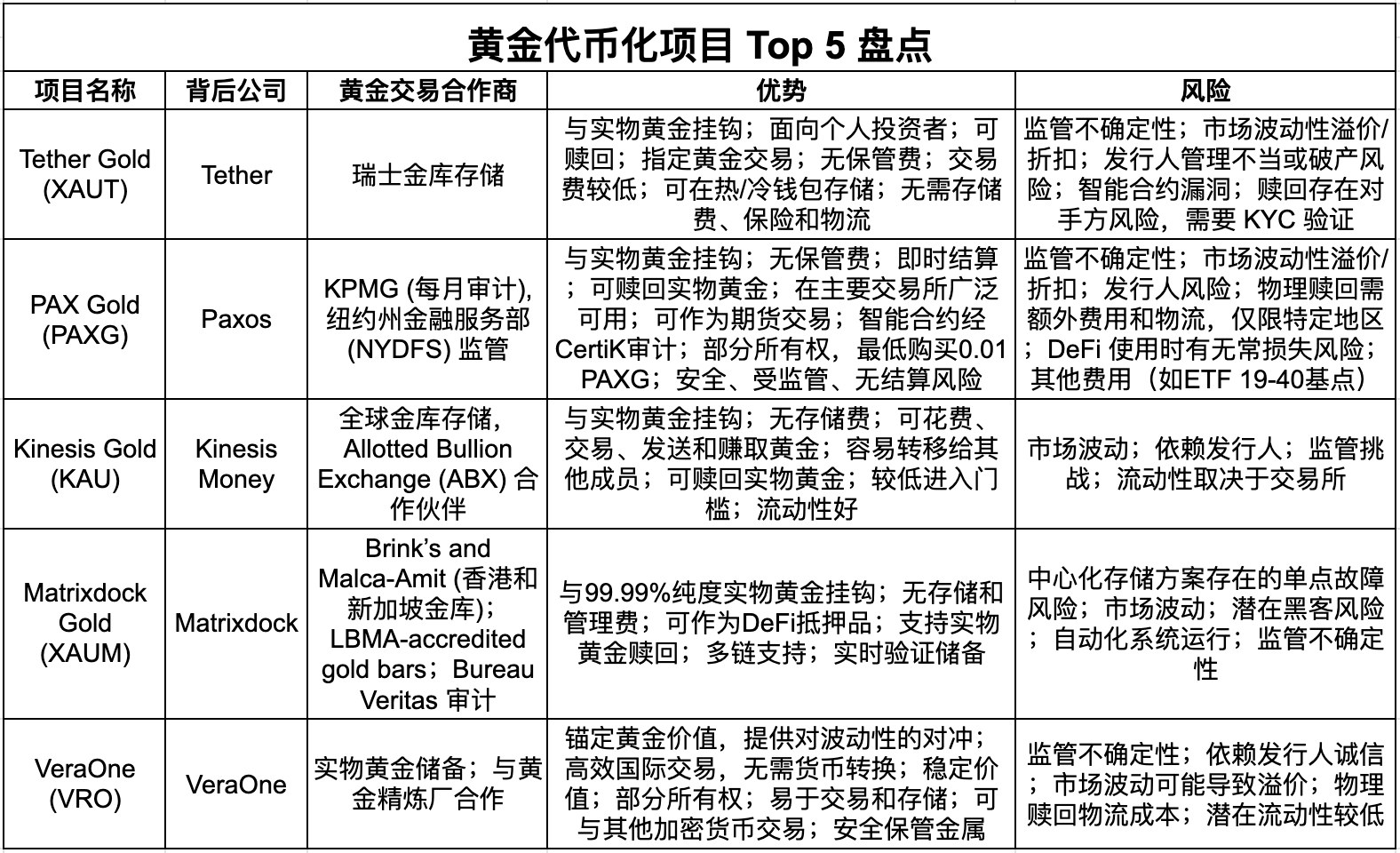
XAUT:背靠 Tether,市值 13.2 亿美元

据 链上数据信息,Tether 于 8 月初在以太坊上铸造了 129,000 枚,现价值约 4.55 亿美元,由此,其市值现报 13.2 亿美元。

此前,Tether CEO Paolo Ardoino 发文披露 称,如果将 Tether 看做是一个「国家」,那么其实物黄金持有量排名前 40;7 月,Tether 发布 XAUT 审计报告 称,彼时 XAUT 代币流通量为 246.524.330 枚(现已增长至 375572 枚左右),流通中的 XAUT 代币由超过 7.66 吨实物黄金支持。

PAXG:背靠 Paxos,市值约 10 亿美元

PAXG 由美国稳定币公司 Paxos 推出,其市值在近 3 个月内飙升至创纪录超 10 亿美元。自 6 月以来,该代币持续净流入,单月流入资金量一度达 1.415 亿美元。目前该代币流通量为 282,566 枚。

KAU:背靠 Kinesis&ABX,市值约 1.6 亿美元

KAU 由注册于开曼群岛的英国 数字资产实用平台 Kinesis 推出,每枚 KAU 都与 1 克投资级黄金挂钩,存储于 Kinesis 保险库中。与其他黄金代币略显不同的是,KAU 支持购买、交易、消费和转移。除去支持赎回以外,在 Kinesis 平台上持有资产的用户还可通过重新分配的交易费收入赚取每月收益;在 Kinesis 虚拟卡上消费 KAU 也可获得收益,该卡支持在全球超过 8000 万个地点通过实时、即时转换来买入黄金、白银和加密货币。

XAUm:背靠 Matrixport,市值约 4700 万美元

8 月初,Matrixport 宣布 正式上线 XAUm 固收产品,支持 7 - 365 天大范围投资周期,支持 BTC、ETH、SOL、BNB、USDT 等 15 种主流资产。此外,Matrixport 平台支持 XAUm Mint,Swap 以及 XAUm 抵押借贷,该代币由 Matrixport 旗下 RWA 代币化平台 Matrixdock 发行;于上个月完成了由国际知名公司币维进行的年度第二次黄金 100% 储备审计,其黄金管理规模在半年内上涨了 500%。

VRO:背靠 VeraOne,市值约 4100 万美元

VRO 由位于英国伦敦的 VeraOne 推出,该项目由 AuCOFFRE.com 集团与加密货币行业人士 Owen Simonin 联合推出,最初创立于 2019 年,代币价格暂报 113 美元左右,流动性相对有限。

以下为主要项目基本信息(整理自@Grok):
现货黄金

结语:黄金的避险属性与避税属性

值得一提的是,黄金本轮的新高上涨,与美元、美债的表现不无关系。桥水基金创始人瑞·达利欧近日表示:美元的不良债务状况间接推动了黄金的价格上涨;国际投资者已开始从美国国债转向黄金。美国总统特朗普曾于 8 月发言表态,称「黄金不会被征税。」

如今,兼具黄金避险属性与避税属性的黄金代币或许将成为越来越多的人的投资选择。

Похожее

Bankless Co-founder: Why I Sold All My ETH

Author David Hoffman, founder of Bankless, explains his decision to sell all his ETH, despite being a prominent figure in the Ethereum ecosystem. He clarifies that his move is not a bearish take on Ethereum itself, which he remains highly optimistic about as a network. His core argument is that the "ETH is money" thesis, which he helped popularize, has largely played out. Hoffman argues that ETH has achieved the market valuation it deserves based on Ethereum's current success and competitive position. He details several reasons for this view. First, the path for ETH to become global money required nearly flawless execution and sustained dominance across Ethereum's entire technical and social stack—a coordination challenge he now believes had a narrower window for success than anticipated. Second, market data shows a strong correlation between L1 chain activity/fees and the price of its native asset; Ethereum's fee dominance has been challenged by competitors like Solana. Third, the "strong version" of crypto (decentralized, native crypto economies) that ETH's monetary thesis relied upon has struggled to maintain a positive mainstream narrative and stable adoption beyond a brief period. Finally, Ethereum's architecture as a "giver"—providing secure block space and tokenization capabilities at cost to L2s and applications—means it doesn't capture premium value directly. Its rollup-centric roadmap further directs most profits to L2s and applications ("fat app theory"). In conclusion, Hoffman believes the opportunity for ETH to be revalued significantly upward as money has diminished. He sold not because ETH will fail, but because its monetary thesis has matured, and he seeks to allocate capital to other opportunities he finds more compelling.

链捕手55 мин. назад

Bankless Co-founder: Why I Sold All My ETH

链捕手55 мин. назад

From Issuer to Infrastructure Owner: Circle's Arc Strategy and the Fatal Gap in the GENIUS Act

Circle raised $222 million for its proprietary Layer-1 blockchain, Arc, positioning itself not just as a stablecoin issuer but as the owner of the settlement infrastructure USDC relies on. This move, backed by investors like BlackRock and Apollo, highlights a significant structural conflict unaddressed by the GENIUS Act of 2025. While the act focuses on stablecoin reserves and issuer oversight, it remains silent on the market structure implications of an issuer controlling the underlying network—a scenario akin to a currency issuer also owning the payment rails. Traditionally, financial regulations separate issuers from settlement infrastructure to ensure neutrality. With Arc, Circle gains control over transaction ordering, fees, and network rules, potentially favoring USDC over competitors. The article argues that this creates a permanent structural temptation, even if no abuse occurs. The solution lies in applying established market infrastructure principles: mandating neutral transaction ordering, transparent fee schedules, and governance separated from Circle’s commercial interests. The current pre-mainnet phase offers a critical window for regulators to establish these rules before Arc becomes entrenched. Once operational, enforcing changes would be costly and disruptive. The core question remains: should a regulated stablecoin issuer be allowed to own the settlement network its competitors must use? The GENIUS Act doesn’t answer this, but Circle’s Arc strategy makes it urgent.

marsbit1 ч. назад

From Issuer to Infrastructure Owner: Circle's Arc Strategy and the Fatal Gap in the GENIUS Act

marsbit1 ч. назад

What Are the Key Variables Determining the AI Bull Market?

Title: What Determines the AI Bull Market? Key Variables Revealed Despite rising oil prices above $100/barrel, persistent inflation, and fragile Fed rate cut expectations—a traditionally hostile environment for high-valuation tech stocks—the AI sector continues to drive the market to new highs. According to analysts, the current AI boom is in a phase of "rational fervor": while bubbles exist, they are not yet out of control. The crucial shift is the emergence of Agentic AI, which is evolving from an assisting tool (Copilot) to an autonomous execution tool (Autopilot), creating a clearer commercial path from investment to revenue. This shift accelerates Token consumption and inference computing demand while boosting revenue forecasts for leading firms. The market is now rewarding capital expenditure as it transforms from a burden into a competitive moat, supporting hardware chains like GPUs, optical modules, and storage. However, valuations have already priced in growth expectations for 2027-2028. The forward P/E ratio for the "Magnificent Seven" tech giants is about 35x, compared to 25x for the rest of the S&P 500. This premium implies AI adoption must occur 5 to 8 times faster than past technological revolutions—a scenario with little room for error. The sustainability of the AI bull market hinges on three key variables: 1. **Short-term liquidity shocks**: Risks include sustained high oil prices, resurgent inflation, rising interest rates, and potential unwinding of the yen carry trade. The critical question is whether the upward revision speed of Annual Recurring Revenue (ARR) can outpace the rise in interest rates. 2. **Mid-term industry realization**: Can the actual pace of AI adoption and commercialization match the current lofty valuations? Historically, general-purpose technology revolutions follow a non-linear path with periods of acceleration and deceleration. 3. **Long-term structural constraints**: These include energy and power grid limitations, employment displacement and consumer purchasing power, social acceptance and potential backlash, and potential hardware technology breakthroughs that could disrupt current supply chains. While the long-term prospects for AI remain optimistic with potential for significant productivity gains, the stock market's pricing depends not just on the vision but on the actual speed of realization amid these growing constraints. The direction is clear, but the pace of execution will determine whether the bubble remains controlled or spirals out of control.

marsbit1 ч. назад

What Are the Key Variables Determining the AI Bull Market?

marsbit1 ч. назад

Торговля

Спот
Фьючерсы
活动图片