Abstract
This week, we focus on the following events: 1) Twitter's Board Approves Musk's US$44 billion Takeover Bid; 2) Web Infrastructure Platform.sh Closes US$140 million Financing; 3) US CFTC Advocates for Expanding Cryptocurrency Market Jurisdiction; ______________________________________________________________________________
Project Analysis: Solend is an algorithmic, decentralized protocol for lending and borrowing on the Solana blockchain that allows its users to earn interest on deoposits and borrow assets. Recently, there was a ridiculous proposal for Solend to take over control of a whale’s account. This week’s report will analyze why Solend made this decision and the actions taken by Solend after receiving criticism for making this decision.
1. Industry overview
I. Overall market trend
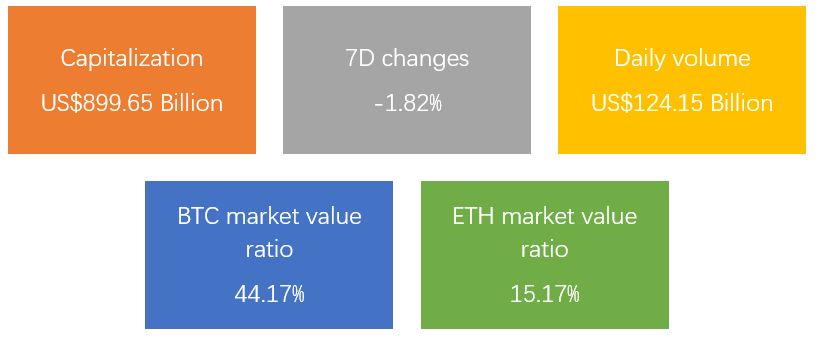
Figure 1. Overall market data
Source: CoinMarketCap
Crypto markets have failed to maintain their momentum with a drop in total market capitalization to US$899.65 billion, a negative 1.82% as compared to a week ago. Bitcoin’s price has fallen by 3% in the last 7 days and is currently trading at US$20,516 at the time of writing. Bitcoin has managed to re-gain the US$20,000 mark and we anticipate that BTC could possibly touch the crucial US$22,000 resistance level if buying volume increase within the next few days. However, the daily trend for BTC continues to traverse within a descending channel and the next key support level for BTC is expected to be at US$14,000. Ethereum’s price decreased by over 3% to US$1102 in the last 24 hours. Other cryptocurrencies like BNB, Solana, XRP, ADA have also decreased by about 2-5% in the past 24 hours but all have experienced gains in the last 7 days.
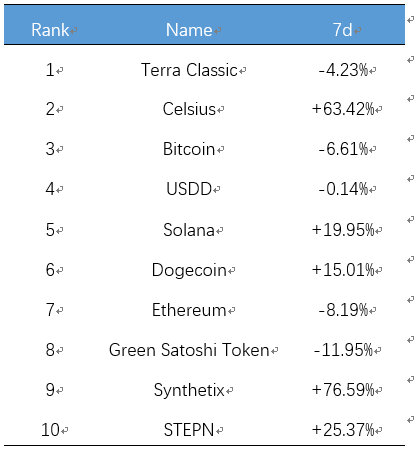
Table 1. Last week's hot currencies
Source: CoinMarketCap
While many of the crytpo assets are trading in the green, the current rally is unlikely to bring the bulls back into the market due to several factors such as recession fears looming around the financial markets. Investor interest in tech-based crypto assets has withered away as the macroeconomic conditions remain unfavourable. As the price of Bitcoin has dropped to its lowest level since 2020 last week, investors have trimmed their positions in funds designed to profit from further declines in the cryptocurrency. Bitcoin miners are also feeling the pressure. Bitfarms have sold almost half of their stash of the cryptocurrency in the past week for US$62 million to reduce debt as they feel the squeeze of the recent market downturn.
II.NFT
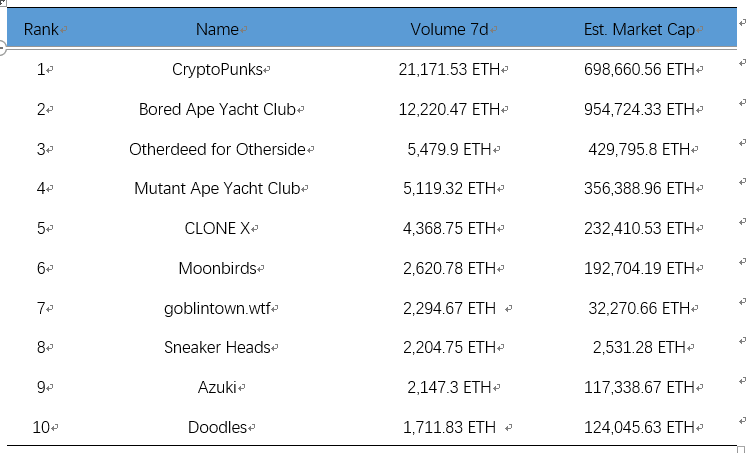
Table 2. NFT Collections Listed By Sales Volume (7d)
Source: CoinMarketCap
The NFT market is continuing to recover from the decrease in investor interest in digital collections. NFT marketplaces’ total volume was only around US$4 billion for the month of may as compared to April where total volume was upwards of US$7 billion. The total sales volume has also dropped by 75% in just four months. In January 2022, total sales volume was US$16.57 billion which then declined by US$12.57 billion by May 2022. CryptoPunks has an average sale value of US$136,800 which is the lowest it has been in 10 months. Likewise, Bored Ape Yacht Club (BAYC) and Mutant Ape Yacht Club (MAYC) have average sales of US$218,740 and US$57,580 respectively, which is a six and five month low for each collections respectively.
Rank Platform Chain Floor Price Weekly volume Whale sales
1 More Loot Ethereum 0.0038 ETH 53.1 million 0
2 Meebitz Ethereum 4.8 ETH 34.92 million 32
3 Bored Ape Yacht Club Ethereum 80 ETH 9.9 million 36
4 Dreadfulz Ethereum 0.03 ETH 18.12 million 0
5 Otherdeed Ethereum 2.29 ETH 5.63 million 90
6 CryptoPunks Ethereum 66.95 ETH 21.43 million 117
7 Mutant Ape Yacht Club Ethereum 17.77 ETH 3.95 million 8
8 Art Blocks Ethereum 0.032 ETH 3.04 million 143
9 Azuki Ethereum 10.69 ETH 2.05 million 18
10 Clone X Ethereum 9.945 ETH 3.56 million 13
Table 3. Top trending collections on NFTGO (by daily volume)
Source: NFTGO
III.DeFi
Rank DeFi TVL in billions US$
1 MakerDAO (MKR) 7.78
2 Curve (CRV) 5.74
3 AAVE (AAVE) 5.07
4 Lido (LDO) 4.79
5 Uniswap (UNI) 4.78
6 Convex Finance (CVX) 2.99
7 PancakeSwap (CAKE) 2.96
8 Compound (COMP) 2.78
9 JustLend (JST) 1.64
10 Instadapp (INST) 1.56
Table 4. DeFi market TVL ranking
IV.Layer 2
2. Rank Layer2 TVL in million US$ Market Share
1 Arbitrum 1960 50.01%
2 Optimism 771 19.64%
3 dYdX 715 18.21%
4 Loopring 161 4.11%
5 Metis Andromeda 92.89 2.36%
6 zkSync 58.71 1.49%
7 Boba Network 50.83 1.29%
8 ZKSpace 35.34 0.90%
9 Immutable X 26.08 0.66%
10 DeversiFi 23.00 0.59%
Table 5. Layer2 protocols ranking and market share
Source: l2beat
3. Market news
I. Industry news
Ethereum Foundation Announces Deprecation of Ropsten, Rinkeby and Kiln Testnets
The Ethereum Foundation announced the deprecation of testnets such as Ropsten, Rinkeby, and Kiln, but users and developers still have time to complete the migration before a complete shutdown. Specifically, the Kiln Merge testnet will shut down shortly after the Ethereum mainnet transitions to proof-of-stake. Ropsten has transitioned to Proof of Stake and will close in Q4 2022. Rinkeby is a Geth-based proof-of-authority testnet that will not transition to proof-of-stake and will close in Q2/Q3 2023. It is reported that the measure is designed to encourage users and developers to migrate to Goerli or Sepolia as soon as possible to test Ethereum in the combined environment. After the merger, Rinkeby will no longer be a suitable test environment for the Ethereum mainnet.
Twitter's Board Approves Musk's US$44 billion Takeover Bid
Twitter’s board approved Elon Musk’s US$44 billion takeover offer, Bitcoin Magazine has tweeted.
Tether’s Market Value Shrank by More Than US$10 billion in May
According to the snapshot data of Tether’s market value extracted by BeinCrypto, Tether’s market value at the end of May was about US$72.5 billion, down 12% from the US$83.16 billion market value at the beginning of the month, which means that Tether’s market value in May shrank by more than US$10 billion. BeinCrypto analysis believes that with the strengthening of the U.S. dollar and the increased demand for government bonds and bills caused by interest rate hikes, many retail and institutional investors sold digital assets around May 9, which had a huge impact on the market value of USDT.
II. Investment and Financing
Web Infrastructure Platform.sh Closes US$140 million Financing
Web infrastructure Platform.sh closed a US$140 million Series D round led by Digital Partners.Participants include Morgan Stanley Extended Capital, Revaia, BGV, Eurazeo, Hiinov and Partech. Platform.sh has raised a total of US$187 million to date. Platform.sh founder Plais said the money will go toward hiring efforts and "doubling down" on developing automation.
Blockchain Payment Company Roxe Holding to Go Public at US$3.65 billion Valuation via SPAC
Blockchain payments company Roxe Holdings Inc is about to go public via a SPAC through a merger with Goldenstone Acquisition Ltd, valuing the company at US$3.65 billion. The merger is expected to be announced publicly in the near future, the sources said. Investors in Roxe Holding Inc. have no plans to sell their shares, and they are also entitled to the proceeds of additional shares in the combined company. Founded in 2019, Roxe is a connecting bank, payments company and remittance company that facilitates cross-border payments through its private blockchain Token.
Crypto infrastructure firm Prime Trust closes US$107 million Series B round
Crypto infrastructure company Prime Trust has announced the completion of a US$107 million Series B financing. The specific financing information has not been disclosed. Funds from this round of financing will be used to expand its product categories, including encrypted pension products and asset tokenization products. Previously, Prime Trust announced in July 2021 the completion of a US$64 million Series A financing led by Mercato Partners’ growth equity fund Traverse, with participation from Samsung Next, Kraken Ventures, and Seven Peaks Ventures.
III. Supervision
US CFTC Advocates for Expanding Cryptocurrency Market Jurisdiction
More than a decade has passed since Bitcoin was created, but lawmakers and regulators continue to debate important questions, such as which regulator should be allowed to regulate digital assets. Federal regulators, including the Commodity Futures Trading Commission (CFTC), are increasing resources to help police fight fraud in digital asset markets. Except in incidents of fraud or manipulation, the CFTC does not currently regulate spot or cash market transactions involving digital assets that do not rely on margin, leverage, or financing, nor does it regulate market participants who engage in such transactions. However, current CFTC Chairman Rostin Behnam is seeking to expand the agency's remit. In his testimony, Behnam strongly advocated allowing the CFTC to regulate spot digital asset trading. Behnam said the CFTC is well-positioned to play an increasingly important role in regulating the commodity market for cash digital assets. Fundamentally, the CFTC is a market regulator designed to ensure market integrity and vitality and to support financial stability. While overseeing exchanges, clearing houses, data repositories and market participants through principles-based individual customer protection. This flexible approach has allowed the CFTC, under the authority of Congress, to evolve with the derivatives market, from its historical roots in overseeing agricultural markets to now overseeing everything from energy and “precious metals” to financial indices and swaps. We are now poised to develop a new track record in digital asset commodities The market does the same thing.
Bank of Israel: Smart Contracts May Need Regulation
Research published by the Central Bank of Israel shows that smart contracts may require regulation to prevent malicious behavior. Allowing anyone to write smart contracts on the blockchain could pose significant risks to the entire system, the report said. As previously reported, on March 11, the Bank of Israel issued draft guidelines for cryptocurrency deposits, requiring banks to conduct risk assessments of cryptocurrency-related businesses and develop policies and procedures for the transfer of funds to or from cryptocurrencies.
U.S. Crypto Tax Enforcement Agency Considering Implementing a Whistleblower Rewards Program
The U.S. cryptocurrency tax enforcement agency is considering implementing a whistleblower reward program. If a taxpayer underreports or fails to pay income tax from cryptocurrency income sources, they could face criminal and civil liability. While federal statutes have failed to reach this far in the past, cooperative agency efforts are using state legislation to target noncompliant taxpayers across the country. To further their efforts, some of these programs are considering implementing whistleblower programs to bolster their own abilities to identify and prosecute tax evasion and fraud involving digital currencies and non-fungible tokens. U.S. authorities may soon step up enforcement efforts by rewarding individuals who provide information about falsely reported earnings from virtual currency transactions.
4. Trending project analysis – Solend : An outrageous proposal that threatens decentralization
Solend and DeFi applications
Solend is an algorithmic, decentralized protocol for lending and borrowing on the Solana blockchain that lets you earn interest on deposits and borrow assets. They currently have 16 assets that can be borrowed across 46 pools with a total value of US$399 million lent out and US$163 million borrowed.
The total value locked (TVL) in the Solend protocol was US$1.4 billion at its peak in the beginning of April. Since then, that amount has been cut in half to US$725 million during the collapse of Terra in May and is continuing its downward spiral over the past week.
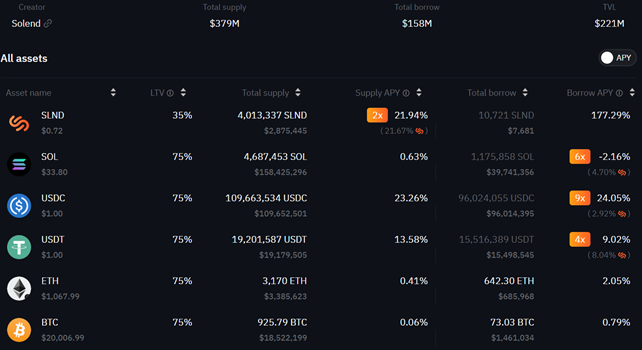
Figure 1: Assets in Main Pool of Solend
Source: Solend
The current pain being experienced by DeFi applicatons is triggered by the frozen deposits of centralised crypto lenders such as Celcius network and Babel as well as the collapse of Three Arrows Capital. These events have caused crypto prices to dive downwards in the double digits over the past seven days. According to DeFi Llama, the total value locked in DeFi has plunged more than 50% to US$70.6 billion from US$205.7 billion on 5th May, just before the Terra blockchain’s collapse set off this year’s biggest crypto crisis.
Why are DeFi apps suffering?
Many DeFi apps are suffering because they tend to be interconnected to one another. Problems in one app could have a snowball effect on others. This is because users usually put up tokens as collateral to borrow a coin in one app in order to deposit them into another app to earn higher yields. When crypto prices fall, users who do not add collateral to their positions will then get liquidated.
A ridiculous vote to take over a whale’s account
On 19 June, governance token holders of Solend, voted to temporarily take over a whale’s account that faced the threat of a large liquidation, a move that can be considered to be extreme and the very first of its kind, an event previously unheard of in the crypto space, This took place right after MakerDAO, an app that supports stablecoin DAI and is run by a crypto community that formed the first ever decentralised autonomous organisation (DAO), voted to suspend DAI from being deposited and minted in Aave.
On 19 of June, Solend token holders voted largely in favour of a proposal to take over a whale’s account temporarily as the threat of a massive liquidation drew closer and the attempt to contact the user was to no avail. The rationale for this proposal was that a sudden surge in bots competing to trigger the liquidation would result in chaos and put an incredible amount of pressure on the Solana network. By taking over the acocunt, Solend planned on liquidating the position strategicaly such that the price of the tokens would be affected to a smaller degree through an over-the-counter (OTC) sale with a buyer.
Critisicm by the community
Many community members were infuriated at the decision. While many DeFi apps are governed by their token holders, proposals usually included creating a new product or changing an app’s fee structure and it was a safe assumption that it was impossible for someone’s account to be taken over in the realms of DeFi. One main attraction of DeFi is that users are protected from the power of traditional financial instituitions and governments, but this move seems to suggest that DeFi apps could possibly be more centralised than currently perceived by the community. The majority of governance token holders that voted for the proposal was held by a single crypto address. This raised questions as to whether the idea of a ‘community’ is being undermined.
Many DeFi applications face this same issue where a handful of crypto addresses hold the majority of coins and conseuqently have an disproportionate amount of influence and control over the outcomes of votes. This naturally brought up concerns as to whether other DeFi apps could also pull such a stunt and assume control over an account which will most likely result in unrest amongst the community members.
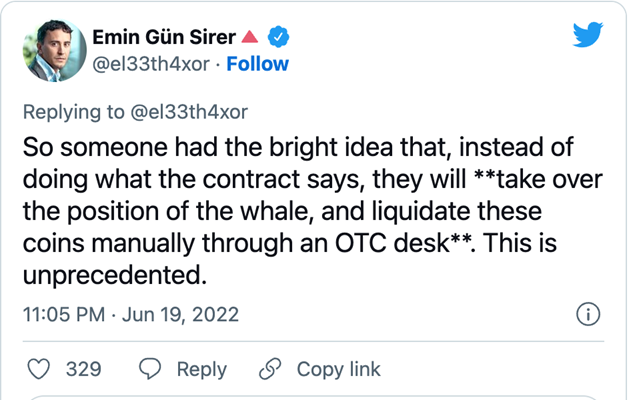
Figure 2: Tweet about Solend’s decision to take over whale’s account
Source: Twitter
After the widespread critism that ensued after this vote, a second vote was held on the 20 June that reversed the seizure of the whale’s account. This reversal passed with a 99.8% “yes” votes and Solend has since announced that they will be working on a new proposal that does not involve emergency powers to take over any account.
What happened after the second s vote?
On 21 June, Solend announced that the whale borrower had moved US$25 million worth of USDC debt to another Solana-based lending market called Mango Markets. This succesfulyl alleviated some of the burden on Solend and reduced the protocol’s risk. While this does reduce Solend’s exposure, it does not remove it competely as the borrower still owes US$84 million to the protocol.
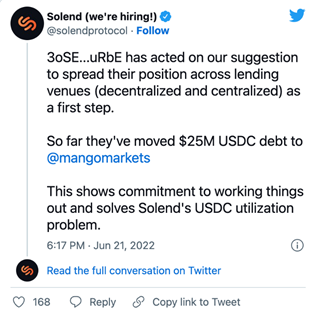
Figure 3: Tweet from Solend explaining its reduced exposure
Source: Twitter
Since then, the commuinity has taken action to mitigate and prevent something like this from happening again. A proposal was approved that imposes a US$50 million borrowing limit per account and the smart contract will be adjusted so that 1% of the deposits on undercollaterised loans will be liquidated instead of the current 20%.
5. Calendar of future popular asset events
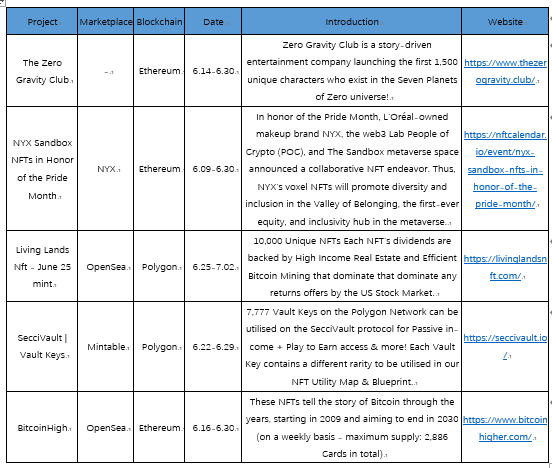
I. NTF mint Calendar
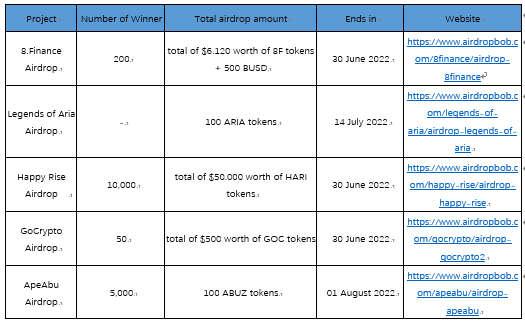
II. Token Airdrops
About Huobi Research Institute
Huobi Blockchain Application Research Institute (referred to as "Huobi Research Institute") was established in April 2016. Since March 2018, it has been committed to comprehensively expanding the research and exploration of various fields of blockchain. As the research object, the research goal is to accelerate the research and development of blockchain technology, promote the application of blockchain industry, and promote the ecological optimization of the blockchain industry. The main research content includes industry trends, technology paths, application innovations in the blockchain field, Model exploration, etc. Based on the principles of public welfare, rigor and innovation, Huobi Research Institute will carry out extensive and in-depth cooperation with governments, enterprises, universities and other institutions through various forms to build a research platform covering the complete industrial chain of the blockchain. Industry professionals provide a solid theoretical basis and trend judgments to promote the healthy and sustainable development of the entire blockchain industry.
Official website:
https://research.huobi.com/#/
Consulting email:
research@huobi.com
Twitter: @Huobi_Research
https://twitter.com/Huobi_Research
Medium: Huobi Research
https://medium.com/huobi-research
Disclaimer
1. The author of this report and his organization do not have any relationship that affects the objectivity, independence, and fairness of the report with other third parties involved in this report.
2. The information and data cited in this report are from compliance channels. The sources of the information and data are considered reliable by the author, and necessary verifications have been made for their authenticity, accuracy and completeness, but the author makes no guarantee for their authenticity, accuracy or completeness.
3. The content of the report is for reference only, and the facts and opinions in the report do not constitute business, investment and other related recommendations. The author does not assume any responsibility for the losses caused by the use of the contents of this report, unless clearly stipulated by laws and regulations. Readers should not only make business and investment decisions based on this report, nor should they lose their ability to make independent judgments based on this report.
4. The information, opinions and inferences contained in this report only reflect the judgments of the researchers on the date of finalizing this report. In the future, based on industry changes and data and information updates, there is the possibility of updates of opinions and judgments.
5. The copyright of this report is only owned by Huobi Blockchain Research Institute. If you need to quote the content of this report, please indicate the source. If you need a large amount of reference, please inform in advance (see "About Huobi Blockchain Research Institute" for contact information) and use it within the allowed scope. Under no circumstances shall this report be quoted, deleted or modified contrary to the original intent.