President Donald Trump signed an executive order on Thursday to establish a Strategic Bitcoin Reserve, according to a post on...
Trusted Editorial content, reviewed by leading industry experts and seasoned editors. Ad Disclosure
President Donald Trump signed an executive order on Thursday to establish a Strategic Bitcoin Reserve, according to a post on X by White House Crypto and AI czar David Sacks. The announcement was expected to boost market confidence, but instead, Bitcoin fell as the order details disappointed investors who had anticipated a more bullish stance from the administration.
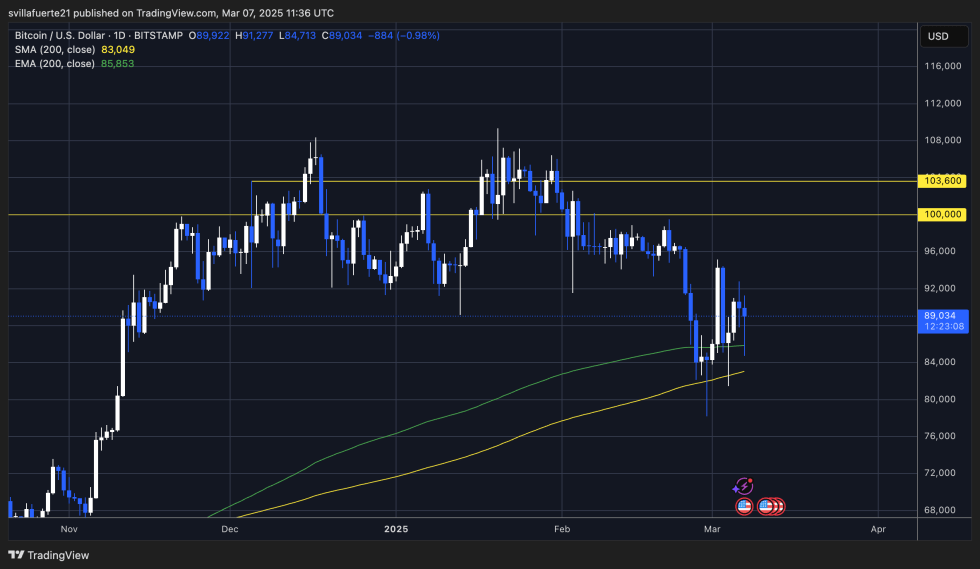
Bitcoin has been struggling around the $90,000 level, unable to reclaim it as support or confirm a recovery from the selling pressure that has dominated the market in recent weeks. Despite several attempts to push higher, BTC has remained in a volatile range, with uncertainty keeping traders cautious.
Key on-chain data from CryptoQuant reveals that the Realized Cap HODL Waves chart shows a substantial portion of Bitcoin is currently concentrated in the 3–6 month holding range. This suggests that many investors who entered the market recently are still holding onto their coins, despite the volatility.
With Bitcoin failing to break key resistance, traders are watching for a decisive move—either a breakout above $90K or a deeper correction. The next few days will be crucial in determining BTC’s short-term trajectory as uncertainty continues to dominate the market.
Bitcoin Shows Signs Of Recovery Amid Volatility
Bitcoin is struggling to reclaim the $90,000 mark but continues to hold firm above $85,000, a critical support level that could serve as a decisive point of inflection if bulls fail to defend it. With BTC trapped in a volatile range, a break below $85K could trigger a deeper correction, while a reclaim of $90K could signal renewed strength and a push toward higher levels.
The decline in cryptocurrencies closely mirrors the downtrend in U.S. stock markets as investors react to fears of a widening global trade war and broader economic instability. However, this turbulence could fade if upcoming policy decisions—such as tax cuts, regulatory clarity, and institutional incentives—provide tangible benefits for investors. If confidence returns, Bitcoin could stage a strong recovery and move toward new all-time highs.
Top analyst Axel Adler shared insights on X, pointing to on-chain data from the Realized Cap HODL Waves chart, which reveals that a significant portion of Bitcoin is currently concentrated in the 3–6 month holding range. Adler notes that historically, the longer coins remain “locked in” by investors, the stronger market confidence becomes. This suggests that many recent buyers are holding firm despite volatility, reinforcing the notion that Bitcoin’s long-term outlook remains strong.
With market sentiment still mixed, traders are watching whether BTC can hold $85K and push higher or risk another leg down. The next few days will be crucial in determining whether Bitcoin can reclaim key resistance levels or if further downside awaits.
BTC Bulls Face A Critical Test
Bitcoin is currently trading at $89,000, facing persistent selling pressure as bulls struggle to regain control of key levels. Despite multiple attempts to push higher, BTC remains uncertain, unable to confirm a move into higher supply zones or a deeper drop into lower demand levels.
For bulls to reclaim momentum, Bitcoin must break above $90,000 with strength and quickly aim for a move toward $100,000. A decisive reclaim of these levels would signal renewed buying interest and trigger a strong rally. However, BTC remains at risk of continued sideways action or another sell-off without a clear breakout.
If Bitcoin fails to reclaim $90K and loses support at $85K, the market could see another leg down, with $78,000 emerging as the next key target. This would indicate increased selling pressure and potential panic selling, forcing BTC into a deeper correction.
For now, uncertainty continues to dominate, leaving traders watching whether BTC will hold above $85K or break higher. The coming days will be crucial in determining whether Bitcoin reclaims strength or faces another wave of downside pressure.
Featured image from Dall-E, chart from TradingView
Editorial Process for bitcoinist is centered on delivering thoroughly researched, accurate, and unbiased content. We uphold strict sourcing standards, and each page undergoes diligent review by our team of top technology experts and seasoned editors. This process ensures the integrity, relevance, and value of our content for our readers.
Sebastian's journey into the world of crypto began four years ago, driven by a fascination with the potential of blockchain technology to revolutionize financial systems. His initial exploration focused on understanding the intricacies of various crypto projects, particularly those focused on building innovative financial solutions. Through countless hours of research and learning, Sebastian developed a deep understanding of the underlying technologies, market dynamics, and potential applications of cryptocurrencies.
As his knowledge grew, Sebastian felt compelled to share his insights with others. He began actively contributing to online discussions on platforms like X and LinkedIn, focusing on fintech and crypto-related content. His goal was to expose valuable trends and insights to a wider audience, fostering a deeper understanding of the rapidly evolving crypto landscape. Sebastian's contributions quickly gained recognition, and he became a trusted voice in the online crypto community.
To further enhance his expertise, Sebastian pursued a UC Berkeley Fintech: Frameworks, Applications, and Strategies certification. This rigorous program equipped him with valuable skills and knowledge regarding Financial Technology, bridging the gap between traditional finance (TradFi) and decentralized finance (DeFi). The certification deepened his understanding of the broader financial landscape and its intersection with blockchain technology.
Sebastian's passion for finance and writing is evident in his work. He enjoys delving into financial research, analyzing market trends, and exploring the latest developments in the crypto space. In his spare time, Sebastian can often be found immersed in charts, studying 10-K forms, or engaging in thought-provoking discussions about the future of finance.
Sebastian's journey as a crypto analyst and investor has been marked by a relentless pursuit of knowledge and a dedication to sharing his insights. His ability to navigate the complex world of crypto, combined with his passion for financial research and communication, makes him a valuable asset to the industry. As the crypto landscape continues to evolve, Sebastian remains at the forefront, providing valuable insights and contributing to the growth of this revolutionary technology.
Добро пожаловать на HTX.com! Мы сделали приобретение Waves (WAVES) простым и удобным. Следуйте нашему пошаговому руководству и отправляйтесь в свое крипто-путешествие.Шаг 1: Создайте аккаунт на HTXИспользуйте свой адрес электронной почты или номер телефона, чтобы зарегистрироваться и бесплатно создать аккаунт на HTX. Пройдите удобную регистрацию и откройте для себя весь функционал.Создать аккаунтШаг 2: Перейдите в Купить криптовалюту и выберите свой способ оплатыКредитная/Дебетовая Карта: Используйте свою карту Visa или Mastercard для мгновенной покупки Waves (WAVES).Баланс: Используйте средства с баланса вашего аккаунта HTX для простой торговли.Третьи Лица: Мы добавили популярные способы оплаты, такие как Google Pay и Apple Pay, для повышения удобства.P2P: Торгуйте напрямую с другими пользователями на HTX.Внебиржевая Торговля (OTC): Мы предлагаем индивидуальные услуги и конкурентоспособные обменные курсы для трейдеров.Шаг 3: Хранение Waves (WAVES)После приобретения вами Waves (WAVES) храните их в своем аккаунте на HTX. В качестве альтернативы вы можете отправить их куда-либо с помощью перевода в блокчейне или использовать для торговли с другими криптовалютами.Шаг 4: Торговля Waves (WAVES)С легкостью торгуйте Waves (WAVES) на спотовом рынке HTX. Просто зайдите в свой аккаунт, выберите торговую пару, совершайте сделки и следите за ними в режиме реального времени. Мы предлагаем удобный интерфейс как для начинающих, так и для опытных трейдеров.
Добро пожаловать в Сообщество HTX. Здесь вы сможете быть в курсе последних новостей о развитии платформы и получить доступ к профессиональной аналитической информации о рынке. Мнения пользователей о цене на WAVES (WAVES) представлены ниже.