$73M Crypto Laundering Scheme Uncovered as Suspect Pleads Guilty—Key Details

bitcoinistОпубликовано 2024-11-14Обновлено 2024-11-14

Введение

A 41-year-old dual citizen of China and St. Kitts and Nevis, Daren Li, has pleaded guilty to one count of...

A 41-year-old dual citizen of China and St. Kitts and Nevis, Daren Li, has pleaded guilty to one count of conspiracy to commit money laundering utilizing crypto. The charge involves a complex scheme that allegedly laundered millions of dollars linked to crypto investment scams.

The US Department of Justice, in a press release uploaded on November 12, announced that Li and his co-conspirators had moved more than $73 million through a network of shell companies and bank accounts worldwide.

The Laundering Scheme’s Mechanics

According to court documents, Li admitted to collaborating with associates to launder funds extracted from unsuspecting victims via cryptocurrency scams.

To disguise the movement of funds, Li and his co-conspirators employed encrypted communication channels and established US-based bank accounts under the guise of shell companies.

This operation aimed to obscure the fraudulently acquired funds’ origin, ownership and intended use. Li reportedly monitored incoming transfers, facilitated their conversion to virtual currencies, such as Tether (USDT), and oversaw their further distribution across cryptocurrency wallets under his control.

Additionally, court documents revealed that a substantial portion of the victim funds, totaling over $73.6 million, flowed directly into bank accounts connected to Li and his co-conspirators.

Of this amount, at least $59.8 million was reportedly deposited from US-based shell companies that launder the ill-gotten proceeds.

According to the release from the DoJ, the scheme was engineered to defraud unsuspecting investors through crypto-related scams, with Li playing a pivotal role in managing and transferring the funds involved.

US Attorney Martin Estrada for the Central District of California emphasized the extensive damage caused by financial criminals, stating that their actions often leave a trail of financial ruin. The US attorney added:

Investors should be diligent and on guard against anyone offering quick riches via new, exotic investments. A healthy dose of skepticism could prevent financial ruin down the road.

The Collaboration Behind The Bust

As reported by the DoJ, the US Secret Service’s Global Investigative Operations Center is leading the investigation, with assistance from agencies such as Homeland Security Investigations’ El Camino Real Financial Crimes Task Force, Customs and Border Protection’s National Targeting Center, and several other international and domestic law enforcement partners.

Furthermore, the DoJ revealed that Li’s sentencing is scheduled for March 3, 2025, with a maximum penalty of 20 years in prison. Additionally, the federal district court judge overseeing the case will weigh multiple factors, including the US Sentencing Guidelines, before issuing a final sentence.

The global crypto market cap value on TradingView
The global digital currency market cap value on the 1-day chart. Source: TradingView.com

Featured image created with DALL-E, Chart from TradingView

Samuel Edyme

Samuel Edyme

Edyme is a writer, a content writer that specialises in writing about the crypto realm. Asides Bitcoinist and NewsBTC, Edyme's writing has been featured in top sites such as Blockchain.News, CoinMonk, Blockchain Reporter, Bitcoin Insider among others.

Похожее

When Hyperliquid Steals Solana's 'Internet Capital Market' Script

The article "When Hyperliquid Steals Solana's 'Internet Capital Markets' Playbook" discusses Solana's struggles to maintain its "internet capital markets" narrative by 2026. Despite its initial success as a high-performance "Ethereum killer," SOL's price has underperformed, dropping significantly compared to other major cryptocurrencies. Solana's vision of a global, on-chain trading network for all assets is being challenged not primarily by Ethereum, but by Hyperliquid. Hyperliquid, evolving from a perpetual contracts platform into a dedicated financial infrastructure Layer 1, has become a major beneficiary of the shift of derivatives trading from centralized exchanges to on-chain. The article argues that for high-frequency financial trading, a specialized, performance-focused chain like Hyperliquid may be more suitable than a general-purpose ecosystem like Solana. Further compounding Solana's issues was a major $200+ million exploit on its key perpetual protocol, Drift, in April, which damaged market confidence. In response, Solana founder Anatoly Yakovenko heavily promoted the protocol Phoenix as a replacement, boosting its visibility but not its trading volume, which remains far behind leading platforms. Solana supporters have launched a public critique of Hyperliquid's decentralization, pointing to its limited validators and closed-source code. Critics, however, note Solana's own declining validator count and centralization metrics. This strategy has also caused internal friction, with developers of other Solana protocols expressing discontent over the foundation's perceived favoritism towards Phoenix. The conclusion is that Hyperliquid's rise represents a challenge to the "general-purpose blockchain" narrative, proving that the core of a capital market might be a specialized trading engine rather than a broad ecosystem. If Solana cannot regain dominance in derivatives, it risks remaining a "meme coin paradise" while its grand "internet capital markets" ambition slips away.

marsbit4 мин. назад

When Hyperliquid Steals Solana's 'Internet Capital Market' Script

marsbit4 мин. назад

When Hyperliquid Steals Solana's 'Internet Capital Markets' Playbook

The article discusses how Solana's grand vision of becoming an "Internet Capital Markets" platform is facing significant challenges in 2026, primarily from the unexpected rise of Hyperliquid. Solana's performance has weakened, with its token SOL experiencing the largest price decline among major cryptocurrencies. Its core narrative of building a global, chain-based marketplace for all assets is under pressure both internally and externally. Hyperliquid, originally a perpetual futures exchange, has evolved into a dedicated Layer 1 financial infrastructure network. Its focused, trading-centric approach is attracting capital and challenging the assumption that a "general-purpose" ecosystem like Solana is necessary for a capital market. Hyperliquid's success suggests that for high-frequency trading, superior performance, liquidity, and user experience may be more critical than a broad application ecosystem. Internally, Solana's strategy suffered a blow from a major hack on the Drift Protocol in April, resulting in over $200 million in losses. In response, Solana founder Anatoly Yakovenko has heavily promoted Phoenix as a new decentralized perpetual futures platform on Solana. While this boosted Phoenix's visibility, its trading volume remains far behind leading platforms. Solana's community has launched a rhetorical attack against Hyperliquid, questioning its decentralization due to its limited validator set and closed-source code. Critics, however, point out Solana's own decreasing validator count and increasing centralization of stake. This focus on "decentralization metrics" has also caused internal friction, with other Solana ecosystem developers expressing discontent over the foundation's perceived favoritism towards Phoenix. The article concludes that the rise of Hyperliquid represents a challenge to the "general-purpose blockchain" narrative, proving that an efficient trading engine might be more central to a capital market than a vast ecosystem. If Solana cannot regain dominance in the derivatives space, it risks remaining a "meme coin paradise" rather than achieving its ambition of hosting global assets.

链捕手12 мин. назад

When Hyperliquid Steals Solana's 'Internet Capital Markets' Playbook

链捕手12 мин. назад

Samsung Bets on Mobile HBM: AI Moves from Cloud to Palm, a New Frontier in Semiconductor Investment?

Samsung is betting on bringing high-bandwidth memory (HBM) technology from servers to mobile devices, aiming to enable powerful on-device AI features in smartphones and tablets. This move is driven by the booming AI market, where HBM demand from data centers has fueled Samsung's record profits, with HBM4 already in mass production. By integrating mobile HBM, Samsung seeks to transform user AI experiences—making tasks like image generation and real-time translation faster, seamless, and more private by processing data locally. Strategically, this allows Samsung to leverage its vertical integration in memory, advanced packaging, and Exynos processors to differentiate its Galaxy devices against competitors like Apple and Qualcomm. It also opens a new consumer growth avenue, reducing reliance on volatile server HBM demand alone. The initiative is expected to benefit the broader supply chain, boosting demand for advanced packaging materials, thermal solutions, and other components. While promising, risks include potential delays in mobile HBM mass production beyond 2027, high initial costs, and the cyclical nature of the memory market. Nonetheless, Samsung's push signals a broader industry shift toward hybrid cloud-edge AI computing, positioning it as a key player in defining the future of AI-powered devices and presenting a potential long-term investment theme in semiconductors.

marsbit22 мин. назад

Samsung Bets on Mobile HBM: AI Moves from Cloud to Palm, a New Frontier in Semiconductor Investment?

marsbit22 мин. назад

Trillion-Dollar Banking Giant Adjusts Portfolio: Buys XRP Heavily, Clears Out Solana

In a significant portfolio rebalancing move, Italian banking giant Intesa Sanpaolo, with $1.1 trillion in assets, has made a notable shift in its cryptocurrency holdings. According to disclosures from Q4 2025 to Q1 2026, the bank's total crypto exposure surged from $100 million to approximately $235 million. The most striking action was its first-time establishment of an XRP position, investing around $18 million through the Grayscale XRP Trust. This marks a milestone as one of the first major European banks to adopt XRP via a regulated investment vehicle. This move is part of a broader, systematic digital asset strategy. The bank also substantially increased its Bitcoin exposure via ETFs and initiated its first Ethereum investment through a staking trust. In a contrasting strategic pivot, Intesa Sanpaolo drastically reduced its Solana holdings by over 99%, nearly exiting its position in a Bitwise Solana staking ETF. This shift is interpreted as reflecting a institutional preference for assets perceived with lower regulatory and operational risk, especially following Solana's network stability issues and improved clarity for XRP after its legal settlements. The bank's actions highlight key drivers for institutional adoption: clearer regulations, the availability of compliant ETF products, and the search for portfolio diversification. This trend signifies crypto's evolving status from a niche experiment to a recognized component of mainstream asset allocation, with institutions favoring gradual, regulated entry points over direct token ownership.

marsbit1 ч. назад

Trillion-Dollar Banking Giant Adjusts Portfolio: Buys XRP Heavily, Clears Out Solana

marsbit1 ч. назад

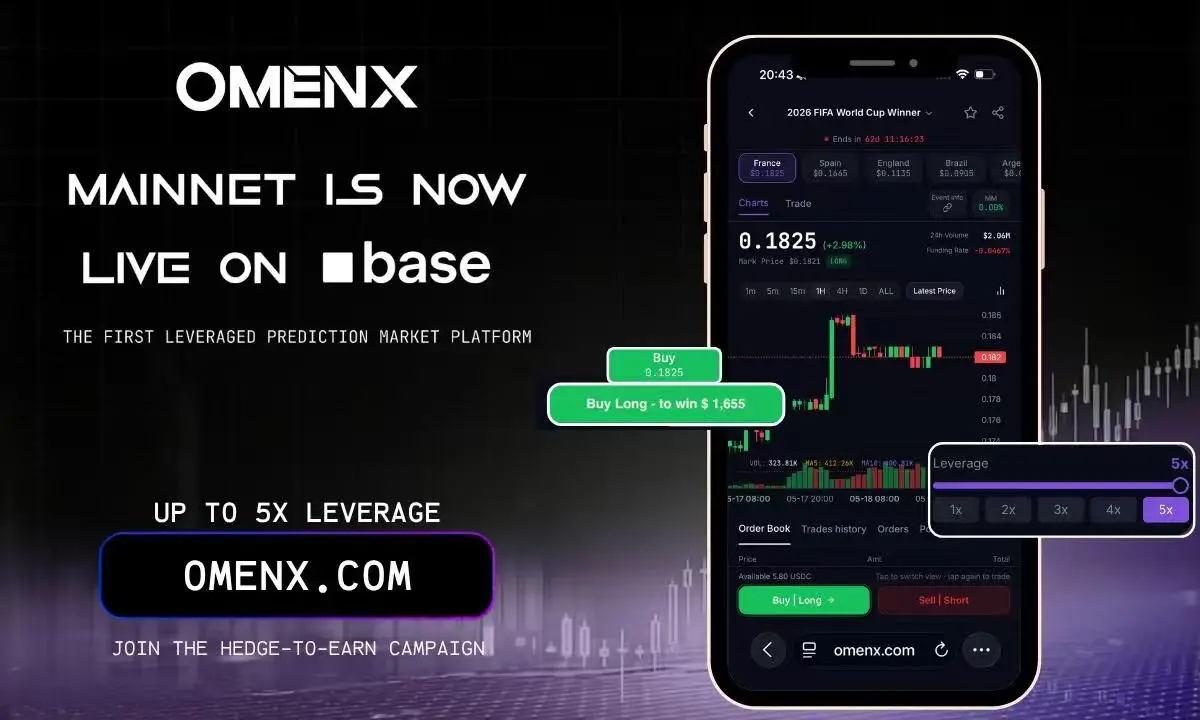
Base Native Leveraged Prediction Market OmenX Officially Launches on Mainnet

Base-native leveraged prediction market platform OmenX has officially launched on mainnet. It currently supports up to 5x leverage, with plans to increase to 10x based on platform liquidity and market conditions. Unlike traditional prediction markets where users fully collateralize YES/NO positions and wait for settlement, OmenX aims to create a trading platform-like experience. Users can open leveraged positions on event outcomes, and actively trade, adjust, or hedge these positions before the event concludes for greater capital efficiency. Alongside the mainnet launch, OmenX introduced a "Hedge-to-Earn" campaign targeting existing users of other prediction markets (initially Polymarket). This initiative allows users to claim incentives or hedging benefits on OmenX based on their existing positions, aiming to introduce them to leveraged trading and active risk management. OmenX positions itself as a derivatives trading platform for prediction market assets. The team believes that as platforms like Polymarket mainstream prediction markets, event outcomes are becoming a new tradable asset class. The next phase of demand will focus on leverage, liquidity, and advanced trading tools. Post-launch, OmenX plans to expand supported market types, optimize liquidity, and develop APIs and additional trading tools. The team is also in discussions with investors and partners to secure resources for further development.

链捕手1 ч. назад

Base Native Leveraged Prediction Market OmenX Officially Launches on Mainnet

链捕手1 ч. назад

Торговля

Спот
Фьючерсы
活动图片