Celsius exodus: $320M in crypto sent to FTX, user withdrawals paused

CointelegraphОпубликовано 2022-06-13Обновлено 2022-06-13

Введение

Crypto staking and lending platform Celsius may be dealing with its rumored liquidity crisis by unstaking $247 million worth of Wrapped Bitcoin from Aave and sending it to thFTX exchange.

Crypto staking and lending platform Celsius may be dealing with its rumored liquidity crisis by unstaking $247 million worth of Wrapped Bitcoin from Aave and sending it to thFTX exchange.
Speculations among the crypto community are now flaring as the project has been moving massive amounts of WBTC, ETH, and other crypto assets in addition to pausing withdrawals for users.
Celsius users have criticized the platform for how they believe the project has mismanaged its funds following the collapse of the Anchor Protocol on the now-named Terra Classic blockchain. The project could be addressing those concerns with the recent moves to stabilize liquidity.
Some think that if Celsius fails, it would sell its significant stack of staked ETH (stETH), which would cause it to depeg further from ETH. stETH is a token provided by the Lido DeFi lending platform that is given as proof that a user has staked ETH. It is currently trading about 4.4% lower than ETH.
Unusual token movements began at about 18:00 ET on June 12 from Celsius’s main DeFi wallet when it started removing WBTC from the Aave staking and lending platform, which Celsius used to earn interest on its deposits.
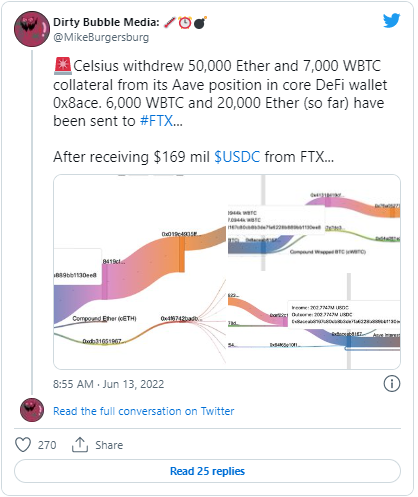

So far, 9,500 WBTC tokens worth about $247 million have been redeemed from Aave. Following a series of transactions, all of those tokens have been sent to the FTX exchange for an unknown reason.
In addition to WBTC, it appears that 54,749 ETH worth about $74.5 million have been sent to FTX.
While such activity bodes very poorly for the transparency of Celsius until it explains the moves, the firm may be trying to ensure its liquidity is stable by replacing many of the volatile funds like WBTC and ETH it withdrew from Aave with stablecoins.
Since June 12, Celsius has staked 204 million USDC stablecoins on Aave. It also has deposited 10 million USDC plus about 8.2 million DAI stablecoins to Compound, another DeFi staking and lending platform.
The total 222 million stablecoins re-staked by Celsius is almost equal to the value of WBTC tokens it removed but still does not come close to matching the combined value of WBTC and ETH.
The Celsius team’s plans with the cryptos that have been moved are still not clear. There is a real possibility that it could sell the assets it sent to FTX, but another likely option is that it intends to stake the tokens they are sending to the exchange to earn yields.
As of the time of writing, Celsius has sent 9,500 WBTC, 54,749 ETH, 375,343 FTT worth $10 million, 2,455 MATIC ($1,158), 260,000 UNI ($1 million), 2 million Pax Dollars (USDP), and 300,000 TrueUSD (TUSD) stablecoins to FTX. However, token movements were still taking place by 23:00 ET.


Presently, Celsius users might be biting their nails in anxiousness because the platform paused withdrawals in order to “put Celsius in a better position to honor, over time, its withdrawal obligations,” according to an announcement from the project on June 13.
“We are working with a singular focus: to protect and preserve assets to meet our obligations to customers.”
Cointelegraph reported in May that Celsius CEO Alex Mashinsky deflected blame for the problems facing the platform, including rumors of insolvency, to shadowy opportunists on Wall Street.
Crypto investors are largely unimpressed with the new round of FUD coming from Celsius. The total crypto market cap has dropped 7.6% to $1.07 trillion over the past 24 hours. CEL, Celsius’s own token, has dropped more than 60% over the past 12 hours to $0.15. All prices listed in the article came from price tracker CoinGecko.


Похожее

$9.4 Billion: The Largest Robotics Funding This Year Has Emerged

Munich-based humanoid robotics company Neura has completed a $1.4 billion (approximately RMB 94.9 billion) Series C funding round, valuing the company at around $7 billion and positioning it among the global leaders in the sector. The investment round is notable not just for its size—reportedly the largest in robotics this year—but also for its strategic backers, which include tech giants like NVIDIA and Amazon, alongside established industrial players such as German engineering firms Bosch and Schaeffler. This mix of investors signals a significant shift in the industry's focus from technological demonstrations and general-purpose narratives toward practical, industrial deployment and commercialization. Neura's approach centers on developing humanoid robots for defined, high-value industrial tasks rather than pursuing a general-purpose model. Its early validation comes from a partnership with BMW, where its robots are being tested on actual production lines. The involvement of Bosch and Schaeffler, companies deeply embedded in global manufacturing, underscores a growing belief that humanoid robots are transitioning from labs to viable factory-floor solutions. The article highlights two converging trends driving investment: advancements in AI and large language models, which enhance robots' perception and decision-making in unstructured environments, and mounting pressure from labor shortages and rising costs in major manufacturing regions. The funding landscape is now bifurcating between companies like Figure AI, focusing on versatile general-purpose robots, and firms like Neura, targeting specific vertical industrial applications with clearer, shorter paths to ROI. While technical hurdles remain, the core challenges for widespread adoption are increasingly seen as engineering and commercial in nature: managing the high integration and customization costs for different factory environments and establishing robust, localized maintenance and service networks. The record investment in Neura, particularly from industrial capital, indicates the industry's growing confidence in moving from proving feasibility to solving the practical problems of scalability, reliability, and building sustainable business models around humanoid robots in real-world settings like automotive manufacturing and hazardous labor environments.

marsbit56 мин. назад

$9.4 Billion: The Largest Robotics Funding This Year Has Emerged

marsbit56 мин. назад

"119 to 176 Dollars": Behind SpaceX's Listing, MSX Once Again Successfully Executes the Pre-IPO Closed Loop

Following May's 300% gain on Cerebras, MSX delivered another outstanding performance during SpaceX's listing night. On June 12, SpaceX (SPCX) launched on Nasdaq, reaching a high of $176. This marked the successful culmination of MSX's Pre-IPO project launched in March, where users subscribed at $119, achieving gains of approximately 40-48%. This event validated MSX's complete Pre-IPO mechanism, a crucial advantage in a market where access to top-tier private company equity is typically limited to institutions. MSX's model provides a full cycle for users: subscription (at $119 for SpaceX), real-time on-chain portfolio tracking, optional early redemption, seamless conversion to tradable spot assets (SPCX.M) upon IPO, and final settlement in stablecoins. This end-to-end process distinguishes MSX from platforms that faced settlement issues during the SpaceX IPO, highlighting that the core challenge of Pre-IPO is not just access, but a clear exit and conversion path post-listing. This success with SpaceX is MSX's second major Pre-IPO verification, following the Cerebras listing in May, which yielded ~300% returns for early participants. These back-to-back achievements demonstrate MSX's capability to source, structure, and deliver real assets through a replicable on-chain model. The true barrier for Pre-IPO products lies not in providing an entry point, but in ensuring reliable fulfillment from subscription through to post-IPO liquidity. MSX's proven闭环 (closed-loop) process addresses this, offering Web3 users a structured way to access high-growth, pre-public companies in sectors like AI and frontier tech. MSX plans to continue expanding its Pre-IPO portfolio with this focus on authenticity, transparency, and post-listing execution.

Odaily星球日报13 ч. назад

"119 to 176 Dollars": Behind SpaceX's Listing, MSX Once Again Successfully Executes the Pre-IPO Closed Loop

Odaily星球日报13 ч. назад

Торговля

Спот
Фьючерсы
活动图片