[Key interpretation] BTC's biggest risk is that there are too many profiteers, and ETH's market is depressed during the week

Huobi ResearchОпубликовано 2022-06-10Обновлено 2022-06-13

Введение

BTC runs sideways, and the volatility is reduced to prepare for a change.

1、 BTC volatility decreased significantly

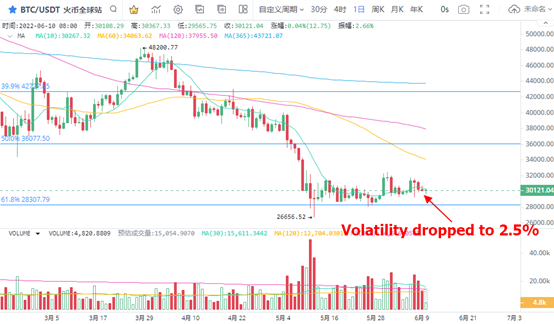
After the continuous correction of BTC in the short term, while the price remained weak, the volatility dropped to 2.5%. At the same time, BTC's weekend market was relatively flat after the trading volume was close to the equivalent line. Without strong capital flow, it is more likely to maintain weak consolidation.

In terms of moving average, the BTC price is lower than the 10 day moving average, and there is little profit space during the rebound. With the continuation of the adjustment, the long and short sides may choose the direction of breakthrough after a fight near us $30000. As for the range fluctuation opportunities, we can pay attention to the trading opportunities of BTC in the range of USD 28000 to USD 32000.
2. BTC investors have a high percentage of profits from holding currency

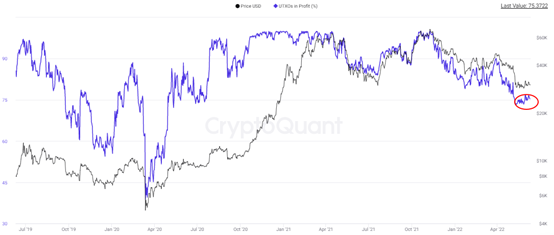
The BTC price was running around USD 30000, which was significantly retreated from the historical high of USD 69000, but the overall profit performance of investors remained unchanged. According to the performance of uxto, a transaction that has never been spent, the index value shows that the overall profit space is around 75%, which is equivalent to the level before July 2020. In this sense, the transaction output not spent by BTC still has a large callback space.

This shows that the profits accumulated in the bull market may continue to flee, and the fixed investment transaction can expect a competitive buying price.
3. Eth horizontal plate below pressure level

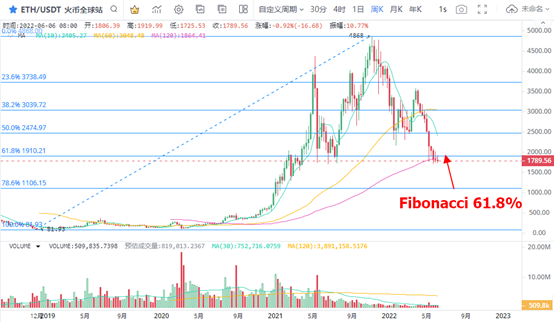
Weekly K-line chart shows that eth is sideways clearing below the pressure level of $1910 corresponding to the key 61.8% of Fibonacci, and has not sent any effective trading signal at present. In terms of trading volume, the weekly trading volume is significantly lower than that before May 2021.

The current trend of eth is relatively sluggish. In addition to continuing the trend of price adjustment, the new market entry funds are limited, affecting the efficiency of bottom confirmation. Within the week, the ETH price failed to rise above the 120 day moving average, which means that the bulls have insufficient ability to raise the price, and the market maintains the status quo of range fluctuation.
4. Xtz short-term rebound is blocked

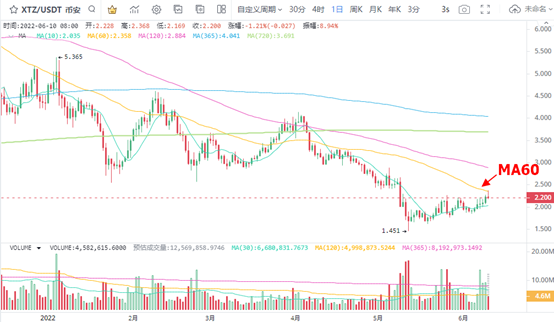
The recent trading heat of xtz has increased slightly, and the price increase has reached around $2.35 corresponding to the 60 day moving average, showing good price elasticity. Recent news shows that tether has announced that it will launch usdt on tezos (xtz) blockchain. This announcement now means that usdt can be used on 12 blockchain networks, including Ethereum (ETH), Tron (TRX) .

Alessandro de Carli, the founder of papers, said: "with the introduction of USD ₮ the entrance and exit of tezos defi ecosystem have been simplified and efficient." the introduction of USD ₮ on tezos will undoubtedly unlock new defi products, which I expect will have a significant impact on the growth of tezos defi ecosystem. "

In terms of price impact, xtz rose and fell in the short term, which is consistent with the trend of mainstream currencies, but the market performance is stronger than BTC and eth. Stabilize the currency entering tezos network, and the positive effect on xtz price will be reflected in the long-term price performance.

Похожее

$9.4 Billion: The Largest Robotics Funding This Year Has Emerged

Munich-based humanoid robotics company Neura has completed a $1.4 billion (approximately RMB 94.9 billion) Series C funding round, valuing the company at around $7 billion and positioning it among the global leaders in the sector. The investment round is notable not just for its size—reportedly the largest in robotics this year—but also for its strategic backers, which include tech giants like NVIDIA and Amazon, alongside established industrial players such as German engineering firms Bosch and Schaeffler. This mix of investors signals a significant shift in the industry's focus from technological demonstrations and general-purpose narratives toward practical, industrial deployment and commercialization. Neura's approach centers on developing humanoid robots for defined, high-value industrial tasks rather than pursuing a general-purpose model. Its early validation comes from a partnership with BMW, where its robots are being tested on actual production lines. The involvement of Bosch and Schaeffler, companies deeply embedded in global manufacturing, underscores a growing belief that humanoid robots are transitioning from labs to viable factory-floor solutions. The article highlights two converging trends driving investment: advancements in AI and large language models, which enhance robots' perception and decision-making in unstructured environments, and mounting pressure from labor shortages and rising costs in major manufacturing regions. The funding landscape is now bifurcating between companies like Figure AI, focusing on versatile general-purpose robots, and firms like Neura, targeting specific vertical industrial applications with clearer, shorter paths to ROI. While technical hurdles remain, the core challenges for widespread adoption are increasingly seen as engineering and commercial in nature: managing the high integration and customization costs for different factory environments and establishing robust, localized maintenance and service networks. The record investment in Neura, particularly from industrial capital, indicates the industry's growing confidence in moving from proving feasibility to solving the practical problems of scalability, reliability, and building sustainable business models around humanoid robots in real-world settings like automotive manufacturing and hazardous labor environments.

marsbit1 ч. назад

$9.4 Billion: The Largest Robotics Funding This Year Has Emerged

marsbit1 ч. назад

"119 to 176 Dollars": Behind SpaceX's Listing, MSX Once Again Successfully Executes the Pre-IPO Closed Loop

Following May's 300% gain on Cerebras, MSX delivered another outstanding performance during SpaceX's listing night. On June 12, SpaceX (SPCX) launched on Nasdaq, reaching a high of $176. This marked the successful culmination of MSX's Pre-IPO project launched in March, where users subscribed at $119, achieving gains of approximately 40-48%. This event validated MSX's complete Pre-IPO mechanism, a crucial advantage in a market where access to top-tier private company equity is typically limited to institutions. MSX's model provides a full cycle for users: subscription (at $119 for SpaceX), real-time on-chain portfolio tracking, optional early redemption, seamless conversion to tradable spot assets (SPCX.M) upon IPO, and final settlement in stablecoins. This end-to-end process distinguishes MSX from platforms that faced settlement issues during the SpaceX IPO, highlighting that the core challenge of Pre-IPO is not just access, but a clear exit and conversion path post-listing. This success with SpaceX is MSX's second major Pre-IPO verification, following the Cerebras listing in May, which yielded ~300% returns for early participants. These back-to-back achievements demonstrate MSX's capability to source, structure, and deliver real assets through a replicable on-chain model. The true barrier for Pre-IPO products lies not in providing an entry point, but in ensuring reliable fulfillment from subscription through to post-IPO liquidity. MSX's proven闭环 (closed-loop) process addresses this, offering Web3 users a structured way to access high-growth, pre-public companies in sectors like AI and frontier tech. MSX plans to continue expanding its Pre-IPO portfolio with this focus on authenticity, transparency, and post-listing execution.

Odaily星球日报14 ч. назад

"119 to 176 Dollars": Behind SpaceX's Listing, MSX Once Again Successfully Executes the Pre-IPO Closed Loop

Odaily星球日报14 ч. назад

Торговля

Спот
Фьючерсы
活动图片