24-Year-Old "Wall Street Newcomer" Portfolio Adjustments Revealed: Shorts Chips Heavily in Q1, Bullish on Energy and AI Infrastructure

marsbitОпубликовано 2026-05-19Обновлено 2026-05-19

Введение

A 24-year-old Wall Street prodigy, Leopold Aschenbrenner, has disclosed the Q1 portfolio adjustments for his fund, Situational Awareness LP. The fund's assets under management skyrocketed from $5.52 billion to $13.7 billion. The most significant move was a massive bearish bet on the semiconductor sector. The fund established $8.46 billion in put options, targeting chipmakers like NVIDIA ($1.6B in puts) and the VanEck Semiconductor ETF (SMH, $2B in puts). This bearish stance extended to Broadcom, Oracle, AMD, Micron, ASML, Intel, Corning, and TSMC. However, the fund made a selective bullish exception, adding shares and call options for memory chip maker SanDisk. The fund maintained its core bullish thesis on energy and AI infrastructure. Bloom Energy remained its largest long equity holding. It also increased stakes in cryptocurrency mining/data center firms like CleanSpark, Riot Platforms, Applied Digital, and IREN Limited, viewing them as providers of critical ready-to-use infrastructure—land, power, and grid permits—for AI expansion. The 13F filing was submitted one day late. Overall, the fund's strategy involves substantial bearish semiconductor bets while maintaining concentrated, high-volatility investments in selective tech, computing, and infrastructure plays aligned with AI growth.

Source: Cailian Press

On Monday Eastern Time, the eagerly awaited Q1 US stock portfolio adjustment report (13F) for the fund "Situational Awareness LP," managed by the much-watched Wall Street newcomer, 24-year-old Leopold Aschenbrenner, was finally released. (Related Reading: Liquidated NVIDIA, Frenzied Buying of Fuel Cells: The 'Physical Arbitrage' Logic of a 24-Year-Old Investment Prodigy)

As described in our previous report, as the world's youngest manager of a mega-fund, Leopold Aschenbrenner foresaw the importance of AI infrastructure "logistics" as early as 2024, making significant investments in power, land, and infrastructure, propelling his fund to massive expansion in less than two years since its inception.

This belated report shows that the market value of the fund managed by Leopold Aschenbrenner has surged from $5.52 billion in the previous quarter to $13.7 billion—and just under two years ago, the fund's initial AUM was only $255 million.
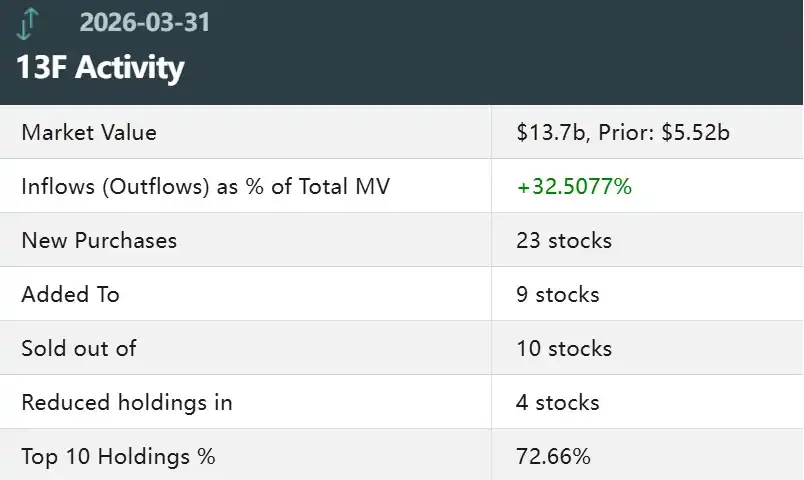
Such a rocket-like surge in assets under management indicates that the "Situational Awareness" fund has clearly become a star fund highly sought after on Wall Street—in fact, Leopold Aschenbrenner's portfolio moves have already become one of the most closely watched sources for "copying homework" among Wall Street institutions and retail investors in recent quarters.

Let's take a closer look at what this Wall Street star has done in the first quarter of this year.

Heavily Buys Short Positions in Chipmakers

From this adjustment report, the most significant move made by Leopold Aschenbrenner in Q1 was heavily shorting chipmakers.

As of the end of Q1, the fund aggressively purchased put options with a notional value of up to $8.46 billion, covering numerous chipmaker stocks, including a $2 billion put option on the VanEck Semiconductor ETF (ticker: SMH) and a $1.6 billion put option on AI giant NVIDIA.
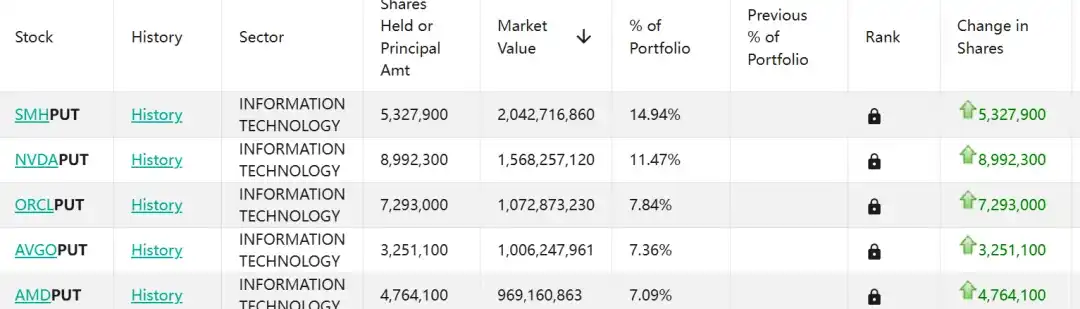
Massive Purchase of Chip Put Options

Additionally, the fund established put option positions on Broadcom, Oracle, AMD, Micron Technology, ASML, Intel, Corning, and TSMC.

These bearish options are not only among the fund's top five purchases for Q1 but also rank among its top five holdings. This undoubtedly highlights Leopold Aschenbrenner's pessimistic outlook on the prospects of chip stocks.

However, Leopold Aschenbrenner is not bearish on all chip stocks.

In Q1, the fund slightly increased its holdings of memory giant SanDisk by 80,000 shares and established a SanDisk call value option position worth $380 million, possibly hinting that it expects the memory boom to continue and that the fund is making selective bets within the semiconductor industry.

Still Heavily Betting on Energy and AI Infrastructure

As of the end of Q1, US biofuel company Bloom Energy (ticker: BE) remained Aschenbrenner's largest bullish bet on an individual stock. His fund holds 6.5 million shares of Bloom Energy, valued at $879 million, and holds 409,000 Bloom Energy call options with a notional value of $55 million.

Furthermore, Situational Awareness increased its holdings in cryptocurrency mining/data center operators CleanSpark (ticker: CLSK), Riot Platforms (ticker: RIOT), Applied Digital (ticker: APLD), and IREN Limited (ticker: IREN).

As we previously analyzed, Aschenbrenner's bet on Bitcoin miners is not for cryptocurrency speculation but for the ready-to-use land, power, and grid permits held by these miners. In the era of massive AI infrastructure expansion, these resources are equivalent to "ready-made" AI infrastructure, saving years of approval time.

A Belated 13F Report

It is worth noting that Aschenbrenner's 13F filing was originally due last Friday—according to regulations, all institutional investment management companies holding securities over $100 million must submit this disclosure document to the U.S. Securities and Exchange Commission within 45 days after the quarter ends—but Situational Awareness did not submit the report until Monday morning.

Typically, late or missed 13F filings can lead to civil penalties at the SEC's discretion, ranging from small fines to a maximum of $750,000.

However, investors' attention is certainly focused on Aschenbrenner's specific portfolio adjustments.

Overall, while he aggressively established semiconductor put option positions in Q1, his fund still holds a significant amount of highly volatile tech stocks and continues to make selective investments in computing, memory, and data center infrastructure. This adjustment trend might be worth investors' reference.


Связанные с этим вопросы

QWho is the 24-year-old fund manager mentioned in the article and what is the name of his fund?

AThe fund manager is Leopold Aschenbrenner, and his fund is called 'Situational Awareness LP'.

QWhat was the most significant action taken by Situational Awareness LP in Q1 regarding the semiconductor industry?

AThe fund's most significant action was establishing a large short position in chipmakers by purchasing put options with a notional value of $8.46 billion against companies like Nvidia and the VanEck Semiconductor ETF (SMH).

QDespite the broad short position, which specific semiconductor stock did the fund show bullish sentiment towards in Q1?

AThe fund showed selective bullishness towards SanDisk by increasing its stock holdings by 80,000 shares and establishing $380 million in call options on the company.

QWhat is the fund's largest long stock position as of the end of Q1?

AThe fund's largest long stock position is in Bloom Energy (BE), holding 6.5 million shares valued at $879 million.

QWhy does the fund invest in Bitcoin mining companies like CleanSpark and Riot Platforms, according to the article's analysis?

AThe fund invests in Bitcoin mining companies not for cryptocurrency speculation, but for their valuable physical infrastructure assets like land, power supply, and grid permits, which are seen as 'ready-made' AI infrastructure that can save years of approval time.

Похожее

Will the Next Crypto Bull Run Start with On-Chain Trading of SpaceX?

This article presents a scenario-based forecast for the crypto industry from 2026 to 2029, arguing that the next major cycle will be driven not by technological narratives but by legal access to real-world assets. The author predicts that by mid-2026, pre-IPO perpetual contracts for top private companies like SpaceX, OpenAI, and Anthropic on platforms like Hyperliquid will become the primary gateway for accessing quality assets, as most crypto-native tokens fail to capture real value. The much-hyped AI x Crypto intersection largely fails except for prediction markets, which thrive on betting on AI model supremacy. By 2027, public blockchain foundations are forced to choose between catering to retail speculation or building compliant infrastructure for institutions, with many opting for the latter. Growth in stablecoins and tokenized private credit/equity hits a "triple ceiling" due to regulatory and political uncertainty rather than market demand. The pivotal shift is forecast for 2028. A major liquidation event in pre-IPO perpetuals exposes the structural flaw of synthetic markets lacking a real underlying asset anchor. In response, regulatory changes finally allow the public solicitation of private securities resales to verified accredited investors. This creates a legitimate secondary market for real company equity, which then becomes the core asset class of the new bull market, relegating synthetic perps to a niche role. By 2029, the industry becomes "boring" but foundational. Tokens without claims on real cash flows or assets cease trading. Stablecoin growth is steady but politically capped. Crypto infrastructure fades from view as it gets absorbed into traditional finance backends. The article's central thesis is that the key bottleneck for crypto's next phase is legal and regulatory channels for real asset ownership, not technology.

marsbit17 мин. назад

Will the Next Crypto Bull Run Start with On-Chain Trading of SpaceX?

marsbit17 мин. назад

The Value Distribution of Stablecoins

**Summary: The Value Distribution of Stablecoins** The article argues that stablecoins are evolving from mere trading tools into broader channels for dollar access. It divides the stablecoin ecosystem into four layers to analyze how value is distributed: 1. **Issuance Layer:** Mints stablecoins, holds reserve assets, and captures the spread between reserve yield and user costs (e.g., Tether, Circle). This layer currently earns the largest profit margin. 2. **Infrastructure Layer:** Connects stablecoins to the traditional financial system, handling fiat on/off-ramps, banking integration, compliance (KYC/AML), and asset management (e.g., Bridge, BVNK). This is the "unglamorous" but critical work, building the essential bridges between crypto and real-world finance. 3. **Acquiring/Distribution Layer:** Integrates stablecoins into merchant systems, manages payment flows, and provides enterprise financial software (e.g., Stripe, Coinbase). They act as the access point for businesses. 4. **Application Layer:** The end-users and businesses that ultimately use stablecoins for payments, settlements, or as a store of value. They benefit from convenience but have little pricing power. The core thesis is that while the issuance layer currently dominates profits, the often-overlooked **infrastructure layer holds significant long-term potential**. The real challenge and barrier to mass adoption is not the on-chain transfer of stablecoins (which is simple), but the complex "last mile" integration into existing business workflows, banking systems, and regulatory frameworks across different countries. Companies in this layer are currently in a "land grab" phase, investing heavily to build networks, secure bank partnerships, and establish compliance pathways. While their position is currently pressured by the profitable issuers above and distribution platforms below, the article suggests that if stablecoins become a default financial rail for businesses, the infrastructure providers who have done the hard work of integration will ultimately gain strong pricing power and become entrenched, essential players.

marsbit7 ч. назад

The Value Distribution of Stablecoins

marsbit7 ч. назад

The Value Distribution of Stablecoins

The Value Distribution of Stablecoins The article argues that stablecoins are evolving from a mere trading tool into a broad "dollar channel." It analyzes the industry's value chain through four layers: 1. **Issuance Layer (e.g., Tether, Circle):** The top layer that mints stablecoins, holds reserve assets, and captures the thickest interest rate spread. 2. **Infrastructure Layer (e.g., Bridge, BVNK):** Connects stablecoins to the traditional financial system, handling critical but complex "dirty work" like fiat on/off-ramps, banking integration, compliance (KYC/AML), and cross-border settlement. 3. **Acquiring/Distribution Layer (e.g., Stripe, Coinbase):** Embeds stablecoins into merchant systems, manages payment flows, and integrates with enterprise software. 4. **Application Layer:** End-users and businesses that ultimately use stablecoins for payments, settlement, or storing value. The author posits that while the issuance layer currently captures the most profit, the most overlooked and potentially critical layer is infrastructure. The core challenge for stablecoin adoption isn't the on-chain transfer (which is simple), but bridging the gap between blockchain and the real-world financial system. This involves solving practical problems for businesses: fiat conversion, reconciliation, tax handling, and user onboarding. Infrastructure companies are currently in a difficult "land-grab" phase—building networks, securing banking relationships, and achieving compliance country-by-country. They face pressure from both the profitable issuance layer above and distribution platforms below. However, the author suggests this layer is building a crucial moat. Once stablecoins become a default business rail, the infrastructure players who have done the hard work of integration may gain significant, durable value and pricing power.

链捕手7 ч. назад

The Value Distribution of Stablecoins

链捕手7 ч. назад

Торговля

Спот
Фьючерсы
活动图片