'Huge testing milestone' for Ethereum: Ropsten testnet Merge set for June 8

CointelegraphОпубликовано 2022-05-19Обновлено 2022-05-19

Введение

The Ethereum ecosystem is set for a “huge testing milestone” with the Ropsten testnet Merge set to be conducted on June 8.

The Ethereum ecosystem is set for a “huge testing milestone” with the Ropsten testnet Merge set to be conducted on June 8.
According to the Merge testnets page on Github, Ethereum DevOps engineer Parathi Jayanathi submitted a pull request for the Ropsten testnet Merge configuration code on Monday, suggesting the implementation is ready to go.
Ropsten is one of several testnets created by the Ethereum Foundation in 2017 and which is currently maintained by the Geth developer team.
This specific testnet is seen as the best replication of the Ethereum Mainnet as it follows a similar network structure. This enables devs to conduct realistic deployment testing before making updates to the actual mainnet.
The Ropsten testnet Merge will see the proof-of-work network combined with a new proof-of-stake (PoS) consensus layer testnet, with its genesis set for May 30. It will simulate what will happen once the actual Merge between Ethereum and the Beacon Chain finally takes place and it becomes a PoS network.
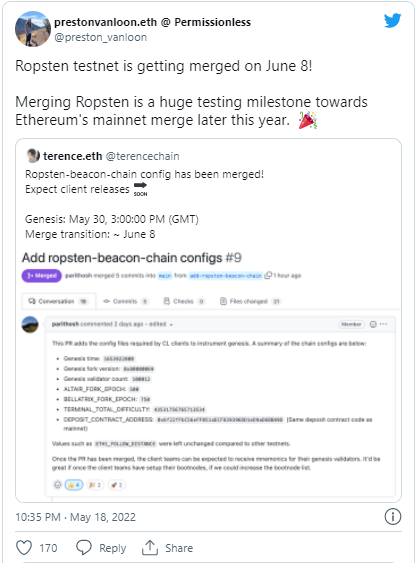
Devs in the community have been posting their bullishness about the testnet news online. Preston Van Loon, an Ethereum core developer at Prysmatic Labs said that:
“Ropsten testnet is getting merged on June 8! Merging Ropsten is a huge testing milestone towards Ethereum's mainnet Merge later this year.”
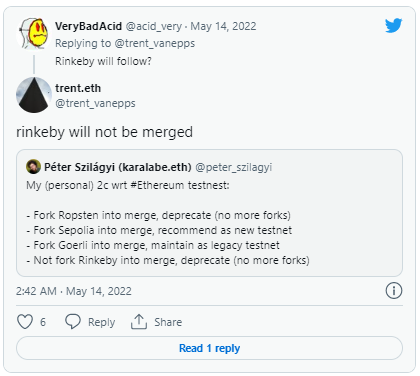
Another core developer who goes by trent_vanepps on Twitter said last week prior to the June 8 confirmation of Ropsten that the Sepolia and Georli testnets could be set for trial Merges as well.
Notably, the testnet timeline falls in line with comments from Ethereum developer Tim Beiko who stated last month that the Merge would not be ready to go live until a “few months after June.”
“No firm date yet, but we’re definitely in the final chapter of PoW on Ethereum,” he said.
Another strong indicator that things are moving in the right direction, is the announcement from the Ethereum Foundation earlier this week that it had 'merged' its PoW mainnet and PoS consensus layer bug bounty programs into one.
In general, the max reward now stands at $250,000 for reporting bugs on Ethereum, however the amount can also be doubled during important times such as upgrades going on public testnets which are also set for the mainnet.
“In total, this marks a 10x increase from the previous maximum payout on Consensus Layer bounties and a 20x increase from the previous max payout on Execution Layer bounties,” the announcement read.


Похожее

Podcast Notes: Hyperliquid Has Become the Top Interest Point for Traditional Hedge Funds

Empire Podcast hosts Jason Yanowitz and Santiago Santos discuss the surging institutional interest in Hyperliquid, a decentralized perpetual exchange, marking the highest level of engagement from traditional hedge fund managers since Paul Tudor Jones endorsed Bitcoin in 2020. The primary driver is the demand for weekend trading of commodities like oil, especially during geopolitical tensions such as the Iran conflict, as Hyperliquid provides the only active price discovery venue when traditional markets are closed. Trade XYZ, a front-end on Hyperliquid, has seen significant growth, with weekend oil price predictions having a median error of only 50 basis points. Santos predicts commodity trading volume on Hyperliquid will surpass Bitcoin within the year and that its market cap could rise from $25 billion to $100 billion. Other key points include Kraken raising $200 million at a reduced valuation of $13.3 billion, and the SEC clarifying that self-custodied DeFi frontends like MetaMask are not subject to broker-dealer rules, resolving a major regulatory uncertainty. The hosts also note the strong correlation between crypto and macro markets, with the S&P 500 posting one of its best 10-day rallies since 1950. They highlight MicroStrategy's continued Bitcoin acquisitions and the potential of real-world asset (RWA) tokenization as a key trend. The discussion concludes with skepticism towards many L2 projects, predicting a wave of protocols truly going to zero as capital concentrates in proven assets like Bitcoin and Hyperliquid.

marsbit5 ч. назад

Podcast Notes: Hyperliquid Has Become the Top Interest Point for Traditional Hedge Funds

marsbit5 ч. назад

a16z: The Next Frontier of AI, The Triple Flywheel of Robotics, Autonomous Science, and Brain-Computer Interfaces

a16z presents a comprehensive investment thesis for the next frontier of AI: Physical AI, centered on a synergistic flywheel of robotics, autonomous science, and novel human-computer interfaces (HCIs) like brain-computers. While the current AI paradigm scales on language and code, the most disruptive future capabilities will emerge from three adjacent fields leveraging five core technical primitives: 1) learned representations of physical dynamics (via models like VLA, WAM, and native embodied models), 2) embodied action architectures (e.g., dual-system designs, diffusion-based motion generation, and RL fine-tuning like RECAP), 3) simulation and synthetic data as scaling infrastructure, 4) expanded sensory channels (touch, neural signals, silent speech, olfaction), and 5) closed-loop agent systems for long-horizon tasks. These primitives converge to power three key domains: * **Robotics:** The literal embodiment of AI, requiring all primitives for real-world physical interaction and manipulation. * **Autonomous Science:** Self-driving labs that conduct hypothesis-experiment-analysis loops, generating structured, causally-grounded data to improve physical AI models. * **Novel HCIs:** Devices (AR glasses, EMG wearables, BCIs) that expand human-AI bandwidth and act as massive data-collection networks for real-world human experience. These domains form a mutually reinforcing flywheel: Robotics enable autonomous labs, which in turn generate valuable data for robotics and materials science. New interfaces provide rich human-physical interaction data to train better robots and scientists. Together, they represent a new scaling axis for AI, moving beyond the digital realm to interact with and learn from physical reality, promising significant emergent capabilities and value.

marsbit5 ч. назад

a16z: The Next Frontier of AI, The Triple Flywheel of Robotics, Autonomous Science, and Brain-Computer Interfaces

marsbit5 ч. назад

Торговля

Спот
Фьючерсы
活动图片