2026 Crypto Predictions: Dragonfly’s Hadick Calls Outlook ‘Constructive’

bitcoinistОпубликовано 2025-12-25Обновлено 2025-12-25

Введение

Dragonfly general partner Rob Hadick expresses a constructive outlook for crypto in 2026, emphasizing long-term adoption trends over recent volatility. He highlights significant growth in stablecoins, noting they now handle 3% of cross-border payments and could see a tenfold increase. Prediction markets, like Polymarket, are also expanding beyond sports into broader financial use cases. Hadick avoids favoring Ethereum or Solana, stating both will coexist as the market matures, with Ethereum strong in value and stablecoins, and Solana optimized for high-volume, low-cost transactions. He remains optimistic about macroeconomic conditions, tokenization, and continued innovation driving the industry forward.

Dragonfly general partner Rob Hadick struck an upbeat tone on crypto’s medium-term setup, arguing that recent volatility has obscured a broader trend of adoption, especially in stablecoins and prediction markets, that he expects to accelerate into 2026.

Speaking on CNBC’s Squawk Box on Dec. 24, Hadick pushed back on the idea that crypto has entered a new “winter,” framing the year’s disappointment as a function of recency bias rather than a clean break in market structure.

“It hasn’t had a great year. But I think it’s important to zoom out,” Hadick said. “If you look at the returns for bitcoin relative to the day before the election in ’24, bitcoin is up about 26%, Nasdaq is up about 28%... even further than that two years, bitcoin’s doubled, Nasdaq is up 50%.”

Hadick emphasized he’s not trading chart patterns. “I’m not a technical investor. I’m a long-term investor. We’re a VC fund,” he said, adding that he “continue[s] to see a strong and constructive 2026.

2026 Crypto Predictions

Pressed on what “a good 2026” means in practice for the crypto market, Hadick tied his outlook to macro conditions and what he sees as compounding real-world usage. “For the token prices themselves—bitcoin, ethereum—there’s likely to be continued momentum,” he said. “I think from a macroeconomic perspective... we’ll have better monetary policy. And then we’re going to have more and more adoption of tokenized assets.”

One data point he said: “McKinsey just said that they think 3% of all cross-border payments is happening in stablecoins right now. That’s up from basically 0% a year ago,” Hadick said, adding that he expects “another tenfold increase.”

Hadick described Dragonfly as deliberately non-ideological across chains and sectors, positioning the firm less as a “bitcoin vs. ethereum” shop and more as a bet on market-structure innovation. “We invest in everybody that’s doing anything that’s interesting in tokenized digital assets,” he said. “We’re not what I would say ideological about crypto. What we are is investing in the future of innovation in financial markets.”

When the conversation turned from majors to categories, Hadick leaned into two themes: stablecoins and prediction markets. “Stablecoins I think are here to stay. I think it’s going to grow tenfold,” he said. “I think prediction markets are here to stay. I think they’re going to grow tenfold.”

On prediction markets specifically, Hadick argued the addressable market extends well beyond sports betting, despite the current overlap. He pointed to Polymarket’s growth as evidence of expanding use cases. “If you look at Polymarket volume today, they’ve gone from $50 million a month in early ’24... they’re now going to do probably about $4 billion of volume this month,” he said, adding that “only about 35% of that is sports,” putting Polymarket in contrast with Kalshi, which he characterized as “more of a sports platform because they’re infrastructure for Robinhood.”

Hadick also invoked Intercontinental Exchange CEO Jeff Sprecher’s long-running tokenization thesis to argue prediction markets may converge with broader financial infrastructure rather than remain a niche wagering product. “If you talk to Jeff Sprecher over at ICE... he’ll tell you he believes in the tokenization of all markets,” Hadick said. “I talked to him before he made the investment in Polymarket... his perspective is that this is going to be as big as ICE itself. Probably.”

He suggested the functional framing is less “bets” and more programmable risk transfer. “I talked to an insurance company maybe a month ago that was thinking about how they can hedge out risk in weather related activities,” Hadick said. “That’s just one use case... every single thing and every single market and outcome that can be put [into] a market—or really just a binary option, which is what it is.”

Ethereum Vs. Solana

Asked to pick sides in the Ethereum–Solana debate, Hadick refused the “MySpace vs. Facebook” framing. “No, they’re both Facebook,” he said, arguing the market will require multiple settlement environments if tokenization becomes mainstream. In his view, Ethereum’s advantage is where value and stablecoin liquidity already sit, while Solana’s edge is high-throughput, low-cost flow.

“Most stablecoins today are on Ethereum,” Hadick said. “Ethereum is where a large amount of... economic activity exists... but if you look at the trading volume, it’s happening more on Solana, which is more optimized for that type of transaction flow and for low cost transactions.”

Still, Hadick conceded the platform layer is not frozen. He said Dragonfly is invested in a newer chain, Monad, describing it as “trying to be a Solana killer,” and cited figures he said reflected early-stage market positioning: a roughly $2 billion valuation and a token price around $0.002.

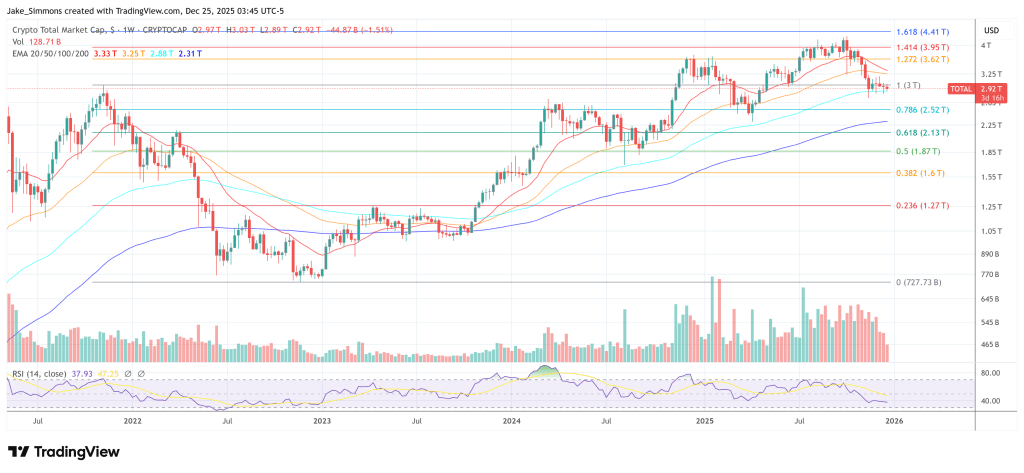
At press time, the total crypto market cap stood at $2.92 trillion.

Total crypto market cap sits below the 2021 high, 1-week chart | Source: TOTAL on TradingView.com

Связанные с этим вопросы

QWhat is Rob Hadick's overall outlook for the crypto market in 2026?

ARob Hadick has a 'constructive' and positive outlook for the crypto market in 2026. He expects continued momentum for major tokens like Bitcoin and Ethereum, better monetary policy, and accelerated adoption of tokenized assets, stablecoins, and prediction markets.

QAccording to Hadick, what is the current percentage of cross-border payments happening in stablecoins and what growth does he predict?

AHadick cited a McKinsey report stating that 3% of all cross-border payments are currently happening in stablecoins, up from nearly 0% a year ago. He predicts this will see 'another tenfold increase.'

QWhich two specific crypto categories does Hadick highlight as having significant growth potential?

AHadick highlights stablecoins and prediction markets as two categories with massive growth potential, stating that he believes each is 'here to stay' and will 'grow tenfold.'

QHow does Hadick characterize the debate between Ethereum and Solana?

AHadick refuses to frame it as a 'MySpace vs. Facebook' debate, instead stating 'they’re both Facebook.' He believes the market will require multiple settlement layers, with Ethereum's strength being its existing value and stablecoin liquidity, and Solana's being its high-throughput, low-cost transaction flow.

QWhat example does Hadick give to show that prediction markets extend beyond sports betting?

AHadick gives the example of an insurance company that was exploring how to use prediction markets to hedge risk in weather-related activities. He suggests the functional framing is less about 'bets' and more about programmable risk transfer for various markets and outcomes.

Похожее

Four Questions on the Zcash Orchard Vulnerability: Was It Exploited? Can Funds Be Recovered? Is the Supply Verifiable? And Are There Others?

Zcash Orchard Bug: Four Key Questions Answered A critical forgery vulnerability was discovered in Zcash's Orchard privacy pool, raising four major concerns for users. 1. **Was the Orchard bug exploited?** The likelihood is considered low. The bug was found proactively using advanced AI-assisted tools and was promptly patched, limiting any potential attack window. If exploitation had occurred, evidence would likely have surfaced by now. 2. **Can legitimate Orchard funds be recovered?** It is believed so, based on the assessment that the bug was not exploited. If forgery did happen, existing "turnstile" mechanisms could prevent full recovery of legitimate funds if forged coins were moved out first, though this scenario is deemed unlikely. Users can choose to move funds, but this carries risks like loss of privacy or new wallet/software issues. 3. **Can users verify Zcash's total supply?** Currently, no. The vulnerability's prior existence prevented independent verification of the shielded supply. The proposed "Ironwood" network upgrade will restore this ability by sealing the Orchard pool, allowing anyone running a node to verify that the circulating ZEC does not exceed the correct amount. 4. **Are there other forgery bugs?** Ongoing intensive audits by multiple teams, including AI-assisted analysis, have not found additional forgery vulnerabilities, increasing confidence that none remain. Further work and collaborations are planned to provide additional guarantees. In conclusion, while the team assesses that exploitation was unlikely and the supply is safe, the upcoming upgrade is critical to restore users' ability to independently verify Zcash's supply integrity, moving away from reliance on trust.

marsbit20 мин. назад

Four Questions on the Zcash Orchard Vulnerability: Was It Exploited? Can Funds Be Recovered? Is the Supply Verifiable? And Are There Others?

marsbit20 мин. назад

Four Questions on the Zcash Orchard Vulnerability: Was it Exploited? Can Funds Be Recovered? Is the Supply Verifiable? Are There Others?

**Summary: Zcash Orchard Vulnerability Analysis** A critical forgery vulnerability was recently discovered in Zcash's Orchard shielded pool, raising concerns about the coin's supply and user funds. The developers, led by Zcash Open Development Labs, acted swiftly to temporarily freeze the pool and deploy a fix. The article addresses four key questions: 1. **Was the vulnerability exploited?** While unknown, the developers believe it is unlikely for several reasons: the bug was difficult to find, using advanced AI tools; the fix was deployed quickly; and typical crypto exploits are fast, with no evidence of abnormal outflows. 2. **Can legitimate Orchard funds be recovered?** If the bug was not exploited, all funds are safe. If exploited, a mechanism limits total withdrawals from the pool to the amount legitimately entered, potentially blocking some legitimate funds. The developers deem this unlikely but advise cautious users to consider moving funds, noting the privacy and risk trade-offs of moving to transparent or Sapling pools. 3. **Can users verify Zcash's total supply?** Not currently. The vulnerability temporarily broke the ability for users to independently verify that no extra ZEC was created. 4. **Are there other forgery bugs?** Ongoing audits by multiple teams, including using advanced AI analysis, have so far found no others, increasing confidence. The proposed "Ironwood" network upgrade is the core solution. It will **seal** the Orchard pool, preventing new entries or internal circulation. This action, combined with the existing withdrawal mechanism, will restore the ability for any node operator to verify that Zcash's supply limit has not been violated, regardless of whether exploitation occurred in the past. The upgrade aims to restore the system's long-term credibility through user-verifiable supply integrity.

Odaily星球日报21 мин. назад

Four Questions on the Zcash Orchard Vulnerability: Was it Exploited? Can Funds Be Recovered? Is the Supply Verifiable? Are There Others?

Odaily星球日报21 мин. назад

An AI Version of the 'Subprime Crisis'? A Hidden Debt of $1.8 Trillion is Accumulating in the Shadows Amid the Frenzy

Amidst the AI infrastructure construction boom, a massive debt expansion is forming, with the most dangerous portion remaining off-balance sheets. Morgan Stanley research reveals approximately $1.8 trillion in off-balance-sheet exposures, including nearly $1 trillion in purchase commitments and over $800 billion in non-active lease contracts. These future cash outflows are not recorded as liabilities. The leverage of hyperscale cloud companies has surged from 0.9x to 1.8x in just two quarters. Private credit firms like Apollo and Blackstone are shifting leverage into the supply chain through complex, opaque SPV (Special Purpose Vehicle) financing structures. Global AI-related bond issuance has skyrocketed, with annual volume projected to exceed $570 billion. However, capital expenditure growth is outpacing revenue and free cash flow. Major cloud providers may see free cash flow approach zero or turn negative in 2026. A significant 'depreciation cliff' looms as vast amounts of current capital spending, recorded as 'construction in progress,' have yet to begin depreciating, artificially inflating current profit margins. Future depreciation could severely pressure earnings. The core risk is identified as a series of timing mismatches, not an immediate solvency crisis. Investment is racing ahead of monetization, leverage is being obscured, and accounting classifications hinder comparability. The entire financing structure faces a fundamental stress test if AI commercialization lags or enterprise clients shift to cheaper alternatives, potentially triggering chain reactions within the highly interconnected funding ecosystem.

marsbit32 мин. назад

An AI Version of the 'Subprime Crisis'? A Hidden Debt of $1.8 Trillion is Accumulating in the Shadows Amid the Frenzy

marsbit32 мин. назад

Торговля

Спот
Фьючерсы

Популярные статьи

Как купить S

Добро пожаловать на HTX.com! Мы сделали приобретение Sonic (S) простым и удобным. Следуйте нашему пошаговому руководству и отправляйтесь в свое крипто-путешествие.Шаг 1: Создайте аккаунт на HTXИспользуйте свой адрес электронной почты или номер телефона, чтобы зарегистрироваться и бесплатно создать аккаунт на HTX. Пройдите удобную регистрацию и откройте для себя весь функционал.Создать аккаунтШаг 2: Перейдите в Купить криптовалюту и выберите свой способ оплатыКредитная/Дебетовая Карта: Используйте свою карту Visa или Mastercard для мгновенной покупки Sonic (S).Баланс: Используйте средства с баланса вашего аккаунта HTX для простой торговли.Третьи Лица: Мы добавили популярные способы оплаты, такие как Google Pay и Apple Pay, для повышения удобства.P2P: Торгуйте напрямую с другими пользователями на HTX.Внебиржевая Торговля (OTC): Мы предлагаем индивидуальные услуги и конкурентоспособные обменные курсы для трейдеров.Шаг 3: Хранение Sonic (S)После приобретения вами Sonic (S) храните их в своем аккаунте на HTX. В качестве альтернативы вы можете отправить их куда-либо с помощью перевода в блокчейне или использовать для торговли с другими криптовалютами.Шаг 4: Торговля Sonic (S)С легкостью торгуйте Sonic (S) на спотовом рынке HTX. Просто зайдите в свой аккаунт, выберите торговую пару, совершайте сделки и следите за ними в режиме реального времени. Мы предлагаем удобный интерфейс как для начинающих, так и для опытных трейдеров.

1.5k просмотров всегоОпубликовано 2025.01.15Обновлено 2026.06.02

Как купить S

Sonic: Обновления под руководством Андре Кронье – новая звезда Layer-1 на фоне спада рынка

Он решает проблемы масштабируемости, совместимости между блокчейнами и стимулов для разработчиков с помощью технологических инноваций.

2.3k просмотров всегоОпубликовано 2025.04.09Обновлено 2025.04.09

Sonic: Обновления под руководством Андре Кронье – новая звезда Layer-1 на фоне спада рынка

HTX Learn: Пройдите обучение по "Sonic" и разделите 1000 USDT

HTX Learn — ваш проводник в мир перспективных проектов, и мы запускаем специальное мероприятие "Учитесь и Зарабатывайте", посвящённое этим проектам. Наше новое направление .

1.8k просмотров всегоОпубликовано 2025.04.10Обновлено 2025.04.10

HTX Learn: Пройдите обучение по "Sonic" и разделите 1000 USDT

Обсуждения

Добро пожаловать в Сообщество HTX. Здесь вы сможете быть в курсе последних новостей о развитии платформы и получить доступ к профессиональной аналитической информации о рынке. Мнения пользователей о цене на S (S) представлены ниже.

活动图片