10 Claude Code Usage Tips: The Sooner You Know, The Sooner You Benefit

marsbitОпубликовано 2026-04-08Обновлено 2026-04-08

Введение

Here is an English summary of the article "10 Must-Know Claude Code Tips: The Sooner You Know, The Sooner You Benefit": This article shares essential tips for using Claude Code, an AI coding assistant, to significantly boost productivity. It is divided into three main sections. First, it covers three ways to launch Claude: 1) A simple GUI desktop app for non-programmers, 2) A command-line method with a key tip (`claude -c`) to resume from a specific point in the chat history, avoiding restarting context, and 3) A headless mode (`-p` flag) for automation tasks using a subscription token. Second, it details three crucial in-session techniques: 1) Using `Esc` to gracefully interrupt a response and `Esc+Esc` to revert to a previous checkpoint, 2) Using the `!` syntax (e.g., `!ls`) to run shell commands without leaving the chat, and 3) Managing context with `/clear` to remove history or `/compact` to optimize it when performance slows down. Finally, the article recommends companion software to solve human-AI collaboration bottlenecks: 1) **Superpowers**, a structured workflow methodology for higher-quality code output. 2) Voice input tools like **Typeless** and **Douban Input法** to overcome typing speed limit. 3) Tools like **Cmux** (a terminal for managing multiple AI agent instances) and **Vibe Island** (for seamless context switching between tasks) to solve the problem of lost focus when multitasking. The overall goal is to help users focus more deeply on their programming...

Below are the Claude code usage tips that I've often lamented not knowing earlier over the past six months.

They have saved me a massive amount of time, allowing me to enter a state of smooth flow while coding and writing content.


The article is divided into three parts:

1. Three Ways to Launch

2. Usage Tips While Running

3. Using Companion Software to Solve Human-Machine Collaboration Efficiency Issues

All of this is about: allowing you to focus more on programming and other activities at hand.

I wish someone had sent me this guide a few months ago, so I could have taken fewer detours and started smoothly:

1. Save this guide, spend 30 minutes this weekend to master Claude code techniques.

2. Send it to anyone who tells you "I think Claude code is difficult, but I've never tried it".

Alright, first let's start with the simplest launch (you read that right, even launching has its tricks)

Three Ways to Launch Claude

Simple Launch

Launching Claude is a very simple thing, simply in the command line.

But for friends who don't like command-line tools, Claude code actually has a visual interface.

How to do it?

Go to this website: https://claude.com/download, under Claude Desktop, follow the steps below and you'll get a visual Claude.
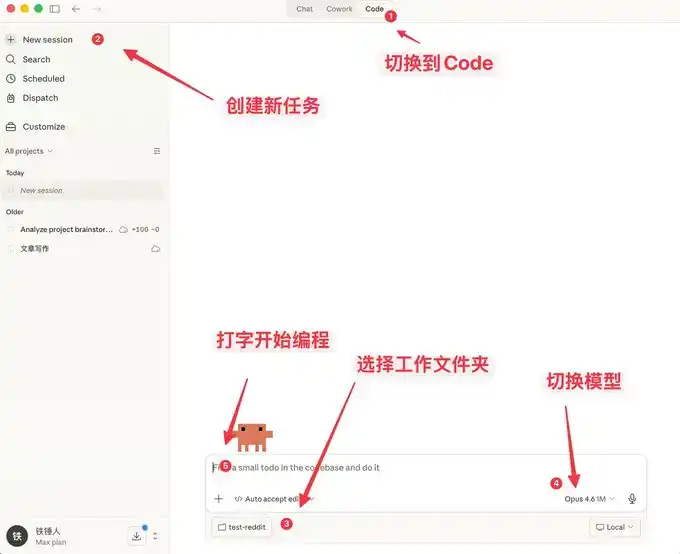
Here you can not only chat, but it also comes with many features similar to OpenClaw.
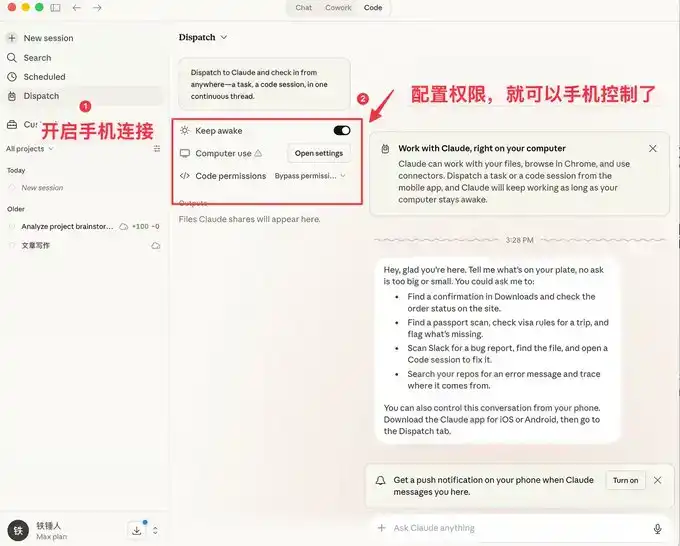
The visual interface is easier for ordinary people to use, but programmers prefer the command-line launch method.

Below I'll introduce a few commands to speed up launching.

Command Line Launch

Launch with Specific History

During our use of Claude code, we often encounter situations that require restarting. Every time we restart, we need to restore the previous conversation context:


I used to always use:
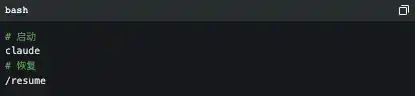
But the official actually provides some pretty good launch commands:
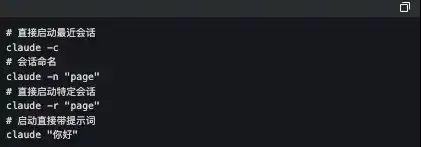
The one I use frequently here is `claude -c`, a short command that has saved me a lot of life.


-p Launch in Automated Mode

Claude Code can be launched without a UI, simply use the following command:

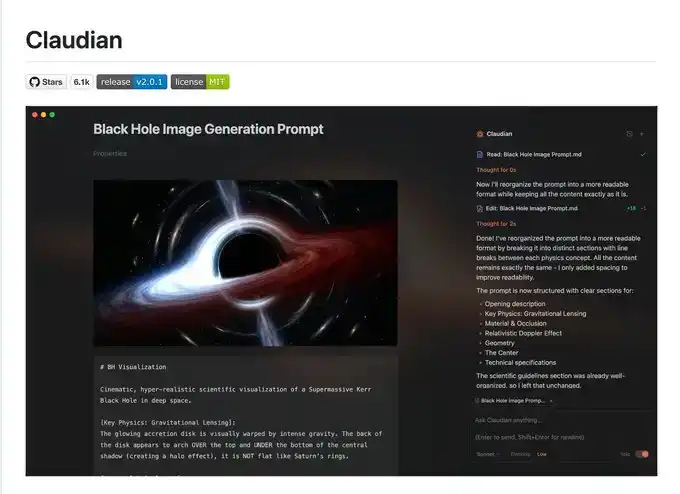
It's worth noting that if you want to use a local subscription Token to automate tasks, this is currently the only way to do it.

The famous Obsidian + Claude Code tool below made its own SDK to use the local subscription Token this way.
I admit what I said earlier might be a bit complicated, let's talk about a few simple commands to use during operation.

3 Must-Know Small Tips While Using Claude code

Elegantly Terminate and Rollback Tasks

When first using claude code, everyone still likes to use Ctrl+C to close the current conversation, only to find it closes Claude entirely. The correct way is to press the Esc key once, which will interrupt the conversation immediately, preventing things from getting worse.

If Claude suddenly goes crazy, we can press Esc+Esc twice, then a list will pop up:
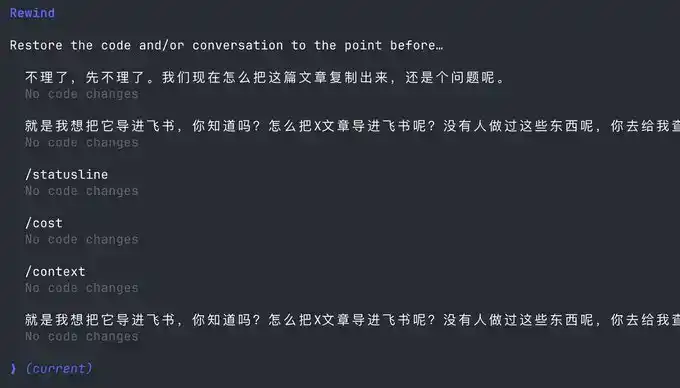
You can use this function to return to any checkpoint, avoiding Claude code messing up the code.

Execute Commands Without Leaving Claude

Sometimes we want to run a test command ourselves, but to not interrupt the current Claude, we have to open another command window.

Actually, we can use the ! syntax:

Context Management

As the conversation continues, the more chat history we accumulate, the more tokens are consumed per interaction, and Claude code will run slower and slower.

You have two choices, open a new window or use the /clear command

A simple command to clean up useless context is like closing 20 chrome tabs at once.

But what if I don't want to clear this context? Use /compact to compress it.

It's like giving claude a Red Bull to wake up and refresh.

I hope the above small tips help you use Claude code more smoothly.

But this is far from enough. Since Claude code is a command-line tool, no matter how many commands you learn, it's a mental burden.

Fortunately, the community has produced quite a bit of companion software to solve the following pain points:

1. Lack of mature prompt methodology, low programming efficiency

2. Slow typing speed leads to low prompt input efficiency

3. During multitasking, humans are fragmented and unable to increase productivity

If any of the above is your pain point, please read on.

Using Companion Software to Solve Human-Machine Collaboration Problems

Now, we are slowly discovering that humans are starting to跟不上 (cannot keep up with) the speed of machines. To address this, the community has produced a series of software.

First, we need a mature programming methodology:

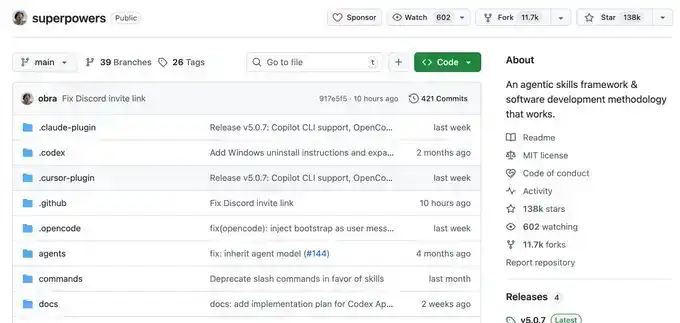
Superpowers

Ordinary people have no method when Vibecoding, they just do whatever comes to mind. This Skills is a programming workflow summarized by an experienced programmer.

He packaged top software engineering best practices into one-click Skills. From requirement梳理 (sorting), Spec confirmation, detailed planning, to TDD test-driven + automatic Code Review, the entire process enforces a structured workflow, allowing AI to output high-quality, maintainable code like a mature engineering team, significantly improving the one-time success rate, so you no longer have to repeatedly put out fires.

This project already has 138k Stars, you can go check it out for details, I won't elaborate here.
Once you have a mature programming Skills, you will find that it requires frequent information input, and then you discover that typing speed becomes your efficiency bottleneck.

You wonder, is there any software that can quietly convert speech to text in the office, with particularly accurate Chinese and English recognition?

Yes, yes, and there are many, but I only recommend two, typeless and Douban Input Method.

Voice Input Software

The advantage of Douban Input Method is that it's fast, has decent Chinese and English recognition, and most importantly, it's free. It's a bit like the Android system, I use it too.

But typeless, aside from needing payment, doesn't have many shortcomings, and you can try it.
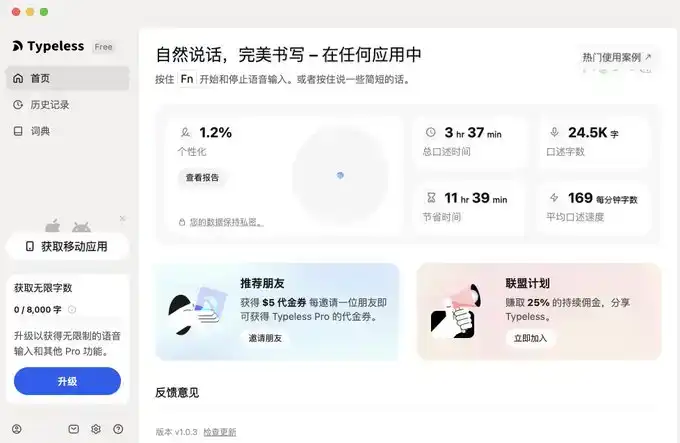
I'll provide links for both below.

typeless (I recommend, affiliate link): https://www.typeless.com/?via=lxfater


Douban Input Method is still in the testing phase, you can search for the installation package.

Once you start voice input, you can provide more context to Claude code, and the one-time success rate will get higher and higher. At this point, the efficiency limitation becomes the running time of Claude code.

We can use multiple Claude code instances simultaneously. At this time, our bottleneck becomes the human problem of losing context when switching between multiple tasks.

Solve Your Attention Switching Problem

First, I recommend a software called Cmux:

It's a macOS native terminal built based on Ghostty, specifically designed for running multiple coding agents simultaneously: vertical tabs + smart sidebar, flexible split-screen, smart notification highlighting, built-in browser split-screen + Socket API.

This is an open-source project: https://github.com/manaflow-ai/cmux
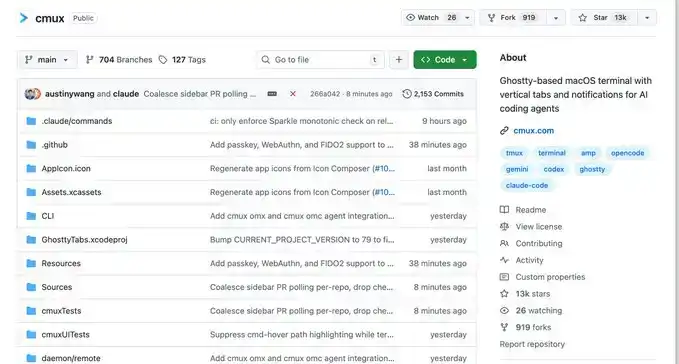
My favorite is the split-screen function, but once you split the screen, you won't know which window completed the task.

Fortunately, this software will directly highlight a certain terminal area, helping you switch to the corresponding window in time.
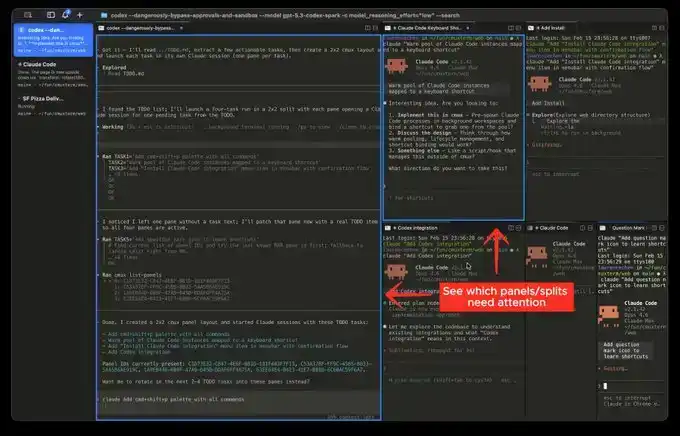
But the next software I'm about to介绍 (introduce) will make this switching incredibly smooth:

This is a relatively popular product recently, called Vibe Island

The UI is beautiful, right? But the most powerful aspect of this product is its support for switching between many different tools.

And each switch will automatically唤醒 (wake up) and focus the window of the APP you are in, and you can input directly.

Theoretically, as long as you switch fast enough and open enough windows, it will continuously push the windows that need processing in front of you. You'll feel like you're handling an assembly line.

Finally

I hope this content is helpful to you. This is quite beginner-friendly, actually common knowledge for programmers.

But I still hope it can help you. If you feel this content was helpful to you!

Связанные с этим вопросы

QWhat are the three main parts of the Claude code usage guide?

AThe three main parts are: 1. Three ways to launch Claude, 2. Tips for using it while it's running, and 3. Using supporting software to solve human-machine collaboration efficiency problems.

QWhat is the purpose of the `-c` command line argument when starting Claude?

AThe `-c` command line argument is used to start Claude and continue from a specific previous history or context, saving time by avoiding the need to re-establish the previous state manually.

QHow can you gracefully interrupt a Claude code response without quitting the entire application?

AYou can press the Escape (Esc) key once to immediately interrupt the current conversation and prevent it from going further off track.

QWhat command can be used within Claude to execute a system command without leaving the Claude interface?

AYou can use the exclamation mark syntax (`!`) followed by the command to execute a system command without leaving the Claude interface.

QWhat are the two recommended software tools mentioned for voice input to improve efficiency when working with Claude?

AThe two recommended voice input software tools are Typeless and Douban Input法 (Douban Input Method).

Похожее

DAT Failing? Listed Companies Betting on HYPE Have Floating Profits of $12.5 Billion

Facing a potential need to sell Bitcoin to pay dividends amid a $12.5B quarterly net loss, the crypto treasury strategy pioneered by Strategy appears strained. In contrast, public companies that adopted a similar strategy by betting on the HYPE token are seeing massive gains, with collective unrealized profits exceeding $1.25 billion. Three key HYPE treasury companies are highlighted: 1. **Hyperliquid Strategies Inc. (PURR):** The largest holder, with approximately 22.3 million HYPE tokens valued at ~$1.636 billion, resulting in ~$1.22 billion in unrealized gains. It has fully transitioned from a biotech firm to a native crypto treasury, focusing on staking and ecosystem participation via validator operations. 2. **Hyperion DeFi (HYPD):** Holds about 2 million HYPE tokens (~$147M value) with ~$49.4M in gains. It is deeply integrated into the Hyperliquid ecosystem, running a top validator node and building DeFi products to generate additional yield. 3. **Lion Group Holding (LGHL):** A smaller player holding ~193,775 HYPE tokens (~$14.14M value), maintaining a long-term holding strategy alongside other crypto assets. The article argues that HYPE treasuries have an advantage over Bitcoin-based ones like Strategy's. Their success stems not just from price appreciation but from active on-chain participation—staking, earning validator rewards, and engaging with ecosystem protocols—creating a compounding "flywheel" effect. With Hyperliquid dominating the on-chain perpetuals market and HYPE's tokenomics encouraging buys and burns, these treasuries are positioned to benefit further if HYPE's price rises as some predict. While the original Bitcoin treasury strategy isn't declared a failure, the current narrative highlights the outsized success of early movers into the HYPE ecosystem.

Odaily星球日报3 мин. назад

DAT Failing? Listed Companies Betting on HYPE Have Floating Profits of $12.5 Billion

Odaily星球日报3 мин. назад

Comics Illustration: Helping You Understand China's New Regulations on Outbound Investment

Summary: Understanding China's New Regulations on Overseas Investment The State Council has announced new regulations on overseas investment, effective July 1, 2026. The core message is not a prohibition on international investment, but a call for both companies and individuals to operate with strong regulatory awareness. Here are the key points: 1. **Scope is Broad:** The rules apply not only to companies but also to other organizations and individual residents. 2. **Definition of Investment is Wide:** It encompasses not just capital transfers but also asset contributions, obtaining equity or rights, financing, providing guarantees, and direct or indirect acquisition of rights related to overseas entities or assets. 3. **Companies Must Plan Comprehensively:** Beyond simple ownership charts, firms need clear plans covering the investing entity, required approvals or filings, fund transfer paths, and compliance with technology, data, and security reviews. 4. **Individuals Should Prioritize Compliance:** Before focusing on returns, individuals must first assess their eligibility, understand legal channels for capital outflow, know what they are acquiring, and identify responsible parties in case of issues. 5. **Penalties are Significant:** Violations can result in fines and potentially restrictions on future overseas investment activities. In essence, overseas investment remains possible, but it must be approached with regulatory compliance as a fundamental priority, not solely based on commercial opportunity. *Note: This is a general informational summary and does not constitute legal advice or investment recommendations.*

marsbit17 мин. назад

Comics Illustration: Helping You Understand China's New Regulations on Outbound Investment

marsbit17 мин. назад

Nvidia Rack Disassembly Reveals New Growth Opportunity, MLCC Value Surges 182%

Supply bottlenecks in AI infrastructure have expanded to fundamental hardware components like multilayer ceramic capacitors (MLCCs), crucial for stabilizing power and filtering noise in AI servers. Both Goldman Sachs and Morgan Stanley highlight MLCCs as entering a historic "volume-price dual increase" supercycle driven by AI. Goldman forecasts the AI server MLCC market to surge over fourfold from ~$1.4B in FY2025 to ~$5.8B in FY2030, a 34% CAGR. The core driver is a structural supply-demand imbalance. While AI server demand is projected to grow ~4.3x by 2030, industry capacity expands at only ~10% annually, constrained by internal production of equipment and materials. This is compounded by strong demand from electric vehicles. The shortage is evident, with lead times for high-end MLCCs exceeding 20 weeks. The price cycle has officially begun. Japanese leaders Murata and Taiyo Yuden have raised prices by 15-35% for AI server and automotive MLCCs since April, citing material costs. Japan's April export data confirms the trend, with MLCC export value up 28% year-over-year. Profit leverage is significant: Goldman estimates a mere 5% price increase could boost Murata's FY2027 operating profit by ~13% and Taiyo Yuden's by up to 37%. Morgan Stanley's teardown of Nvidia's upcoming Vera Rubin AI rack reveals another catalyst: the MLCC value per rack has skyrocketed 182% from the previous generation to ~$4,320, highlighting the component's growing importance. With demand set to massively outstrip constrained supply, and price increases just starting, analysts position MLCCs at the beginning of a major, prolonged upcycle.

marsbit18 мин. назад

Nvidia Rack Disassembly Reveals New Growth Opportunity, MLCC Value Surges 182%

marsbit18 мин. назад

A 134% Surge, 75 P/E Ratio: Why Is the Market Paying Up for Murata's 'Zero Growth'?

Murata Manufacturing, the world's largest passive components maker, saw its stock price surge 134% over the past year and hit a record high on May 28th, despite reporting nearly zero growth in operating profit for its latest fiscal year. This has pushed its valuation to a P/E ratio of approximately 75x. The disconnect is driven by a fundamental market re-rating. The catalyst was a late-May meeting where management upgraded the AI investment cycle outlook to "lasting until around 2030" and noted that demand for its components is roughly double its supply capacity, with customers prioritizing securing volume over price. While Murata's revenue grew only 5.0% and operating profit stagnated at ¥281.8 billion for the fiscal year ending March 2026, its guidance for the current fiscal year projects a 34.8% jump in operating profit to ¥380 billion. This sharp growth is underpinned by expectations that its AI/data center-related revenue will nearly double from ¥170 billion to ¥325 billion, becoming a key pillar of its business. Analysts highlight that this growth stems not from broad price hikes but from a shift towards higher-value, cutting-edge MLCCs for AI servers, where Murata holds over 70% market share. The market is now pricing Murata not as a cyclical component maker but as a critical "AI pick-and-shovel" supplier with structural pricing power. However, the high valuation also carries risk if future AI demand or quarterly guidance falls short of the elevated expectations.

marsbit40 мин. назад

A 134% Surge, 75 P/E Ratio: Why Is the Market Paying Up for Murata's 'Zero Growth'?

marsbit40 мин. назад

a16z: Why Do Prediction Markets Matter?

Prediction markets, which allow users to trade on the outcome of future events, have gained significant traction, especially in the U.S. At their core, these markets function like any other market by aggregating information from all participants and translating it into a price signal—in this case, the perceived probability of a specific event occurring. Unlike polls or surveys that offer static snapshots, prediction markets provide dynamic, quantifiable probability estimates that update in real-time as new information and participants enter. A key advantage is the incentive structure: participants risk their own capital, which encourages serious research and trading based on genuine knowledge. This can surface information that traditional methods might miss. Furthermore, prediction markets can be created for a vast array of specialized questions—from geopolitical events to AI model performance—that aren't covered by traditional financial markets. However, several challenges remain. Infrastructure issues include reliably determining event outcomes and resolving disputes. Market design must ensure participation from well-informed individuals while preventing manipulation, such as insider trading or attempts to sway public perception by artificially moving prices. Addressing these concerns around rules, participation, and contract design is crucial. If these hurdles are overcome, prediction markets could evolve into a powerful, widely-used tool for forecasting and navigating uncertainty.

marsbit51 мин. назад

a16z: Why Do Prediction Markets Matter?

marsbit51 мин. назад

Торговля

Спот
Фьючерсы
活动图片