The Beacon Has Arrived: ETHB Illuminates the Path to Ethereum's Institutionalization

marsbitPublished on 2026-03-13Last updated on 2026-03-13

Abstract

BlackRock's iShares Ethereum Staking ETF (ETHB) launched on Nasdaq on March 12, marking a pivotal moment in Ethereum's institutional adoption. Unlike existing Ethereum spot products, ETHB integrates staking rewards, allowing investors to gain exposure to both ETH’s price and its yield-generating capabilities—addressing a critical gap in earlier offerings. Prior to ETHB, Ethereum spot ETFs failed to capture the asset’s core value proposition as a productive” asset with an annual yield of 3-5%. This structural mismatch contributed to sluggish institutional inflows compared to Bitcoin ETFs. Meanwhile, Ethereum’s underlying infrastructure adoption surged, with RWA supply growing 7x and stablecoin supply doubling since mid-2024, as institutions increasingly used Ethereum for tokenized assets and settlements. ETHB also challenges alternative structured products like digital asset trusts, potentially redirecting capital back to native ETH. The launch comes as Ethereum shows deeply undervalued signals—with MVRV below 1 and prices still below all-time highs—while maintaining low issuance (0.8% annually) and strong network utility. Ultimately, ETHB serves as a litmus test for institutional acceptance of Ethereum’s dual role as a yield-bearing asset and foundational layer for tokenized finance.

Written by: David Christopher

Compiled by: Saoirse, Foresight News

BlackRock's iShares Staking Ethereum Trust ETF (ETHB) officially began trading on the Nasdaq exchange on March 12th. This is BlackRock's first Ethereum staking fund, and it quietly addresses the core issue that has been hanging over the narrative of Ethereum's institutional development since the launch of the spot Ethereum ETF.

This means that Wall Street can, for the first time, access Ethereum in its proclaimed true form — viewing it as a productive asset capable of generating stable yields.

Core Product Launch: Filling the Institutional Investment Gap

The highly anticipated staking Ethereum ETF is officially launched. This fund deeply integrates spot Ethereum exposure with staking rewards, providing institutional investors with an unprecedented compliant channel.

Since its inception, the spot Ethereum ETF has suffered from a fatal product mismatch.

For a long time, Ethereum has been promoted to institutions as a "native internet bond" — possessing scarcity (annual issuance capped at just 1.5%), yield-generating properties (annual compound yield of approximately 3%-5%), and being deeply embedded in the settlement layer of a new financial system composed of stablecoins and tokenized assets.

Even if this concept is slightly "avant-garde," it has gained market acceptance. However, the actual product delivered failed to match this vision.

After the spot ETF launched, it was uniquely missing the core element of "yield." Investors could only gain exposure to price fluctuations but were completely unable to access Ethereum's economic engine. We sold institutions on a yield-bearing asset but delivered a hollow shell without returns.

Bitcoin does not have this problem. The core of its value proposition is "store of value," a logic that is simple and direct; holding the spot asset captures its full value. But Ethereum's logic is截然不同 (completely different). Staking is an inseparable part of its asset属性 (attributes), the fundamental way for holders to benefit from the network's economy and obtain compound returns. The spot ETF could not provide this function.

This is not the only reason, but it is undoubtedly a key factor leading to the severe lag in institutional inflows for Ethereum. BlackRock's Bitcoin spot ETF (IBIT) currently has assets under management (AUM) exceeding $55 billion, while the Ethereum spot ETF (ETHA) has an AUM of only about $6.5 billion. Admittedly, Bitcoin's first-mover advantage and simpler narrative are partial reasons, but the defect of the product itself is the core issue. Institutions got the upside narrative of Ethereum but received a castrated asset.

Wall Street Has Already Entered, Infrastructure Value Recognized

Poor performance on the asset side has masked the rapid development of Ethereum's institutional adoption since the spot ETF launched in July 2024.

During this period, the supply of RWA (Real World Assets) on Ethereum has grown approximately 7-fold, and the stablecoin supply has doubled. Wall Street is increasingly viewing Ethereum as infrastructure — the operating轨道 (track) for stablecoins and tokenized finance, rather than just a single trading target.
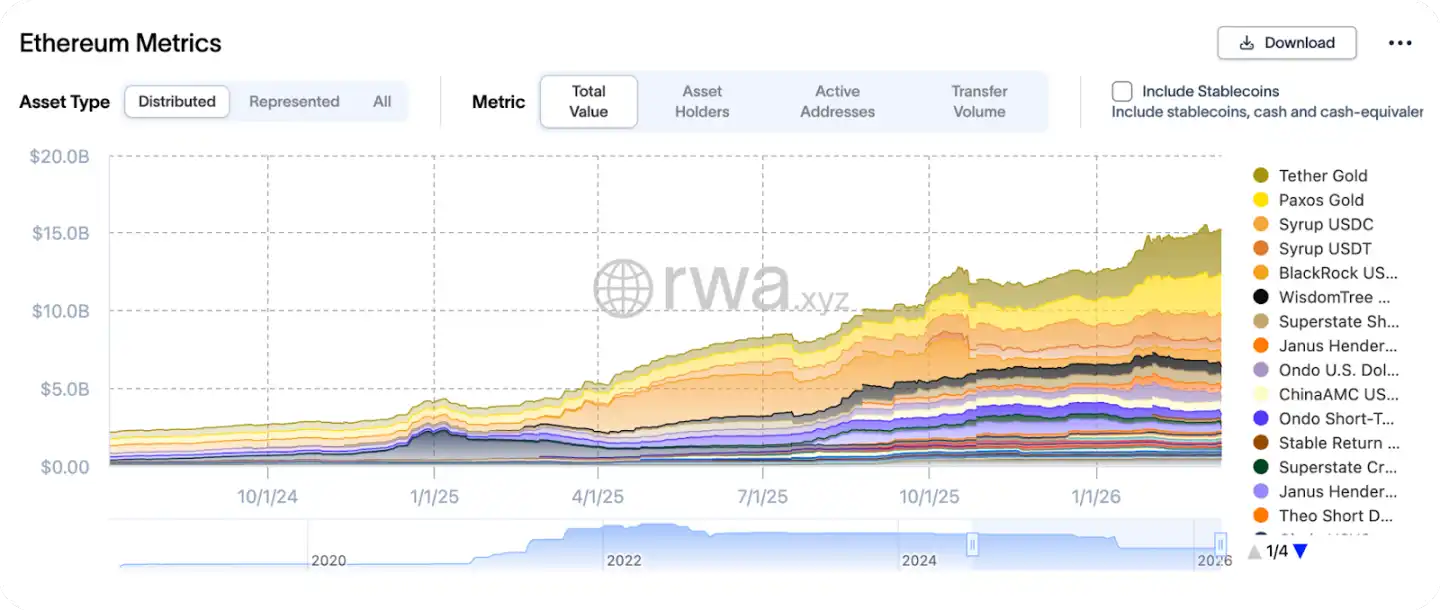
Growth of RWA on Ethereum since July 2024

BlackRock's BUIDL fund, Franklin Templeton's FOBXX money market fund, and an increasing number of tokenized products are all settled on Ethereum or its Layer 2 (L2) networks. Major banks are testing on-chain settlement functions, and SWIFT is among them. Although ETF flows have been disappointing, Ethereum's institutional footprint is actually expanding continuously.

The essence of the problem is that while institutions could hold price exposure to Ethereum, they could not compliantly participate in the Ethereum network economy they increasingly rely on. The emergence of ETHB completely solves this pain point.
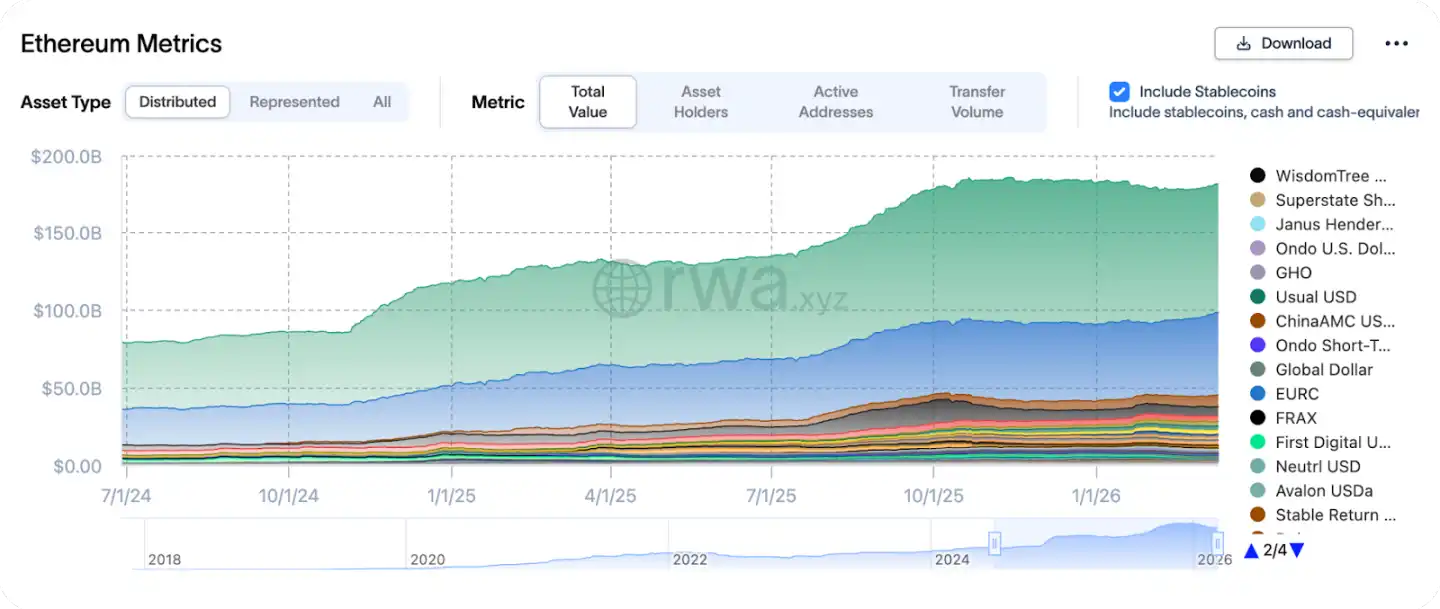
Growth of stablecoins on Ethereum since July 2024

Structural Impact: Reshaping Institutional Investment Logic

This impact far exceeds the ETHB product itself.

Before this, non-crypto-native institutions seeking yield-bearing Ethereum exposure could only use workaround structures like Digital Asset Trusts (DATs). These structures could participate in staking, restaking, and the DeFi ecosystem, but the fund's value was not directly linked to the underlying asset.

The existence of such structures was rooted in regulatory restrictions preventing institutions from directly participating in staking. With the landing of the staking ETF, the rationale for this intermediary path is significantly weakened. Funds that previously had to flow through intermediary channels to these workaround structures are expected to flow directly back to the native Ethereum asset itself.

Market Valuation & Fundamentals: Value in Deep Undervaluation Zone

At the time of ETHB's launch, Ethereum's current valuation is in a reasonable to deeply undervalued range based on multiple cycle indicators.

Its MVRV (Market Value to Realized Value) ratio is below 1, meaning the market is整体 (overall) at a floating loss; the percentage of supply in profit is lower than during the 2022 crash; the price in this cycle has failed to break the 2021 all-time high, remaining within the previous range, showing极佳的压缩性价比 (excellent compressed value) from a historical perspective.

Of course, the underperformance also has reasons related to Ethereum's own development. The Layer 2 (L2) roadmap prioritizes scale and user experience over Layer 1 fee capture. Blob data block technology significantly reduces the anchoring cost for Rollups (L2 scaling solutions), but also drastically reduces the scale of fee burns that once supported the deflation narrative, making its investment logic harder to model.

However, it is worth affirming that Ethereum's monetary system remains intact. Its annualized issuance is about 0.8%, basically on par with Bitcoin's inflation rate. Now, various elements are reconverging: institutional usage demand continues to accelerate, ecosystem applications like RWA, stablecoins, and tokenized funds are growing steadily on Ethereum, the staking yield channel is finally open, and the price is in a value洼地 (depression).

Future Outlook: Wall Street's Litmus Test for Value

For years, Ethereum has been selling itself to institutions as a "yield-bearing reserve asset" and the settlement layer for a tokenized economy. This story has been refined, formalized, and reiterated — placed before institutions that already recognize the network's value but were unable to participate in its economic proposition.

Now, the product design finally perfectly matches the value proposition. The market performance of ETHB will be the key litmus test for whether Wall Street truly recognizes the value of Ethereum as an asset.


Related Questions

QWhat is the significance of BlackRock's iShares Ethereum Trust (ETHB) launching on Nasdaq?

AETHB is BlackRock's first Ethereum staking fund, which allows institutional investors to gain exposure to Ethereum as a productive, yield-generating asset through a compliant channel. It addresses the core issue of previous Ethereum ETFs that lacked the staking reward component, finally aligning the product with Ethereum's value proposition as a yield-bearing asset.

QHow did the initial Ethereum spot ETFs fail to meet institutional investment expectations?

AThe initial Ethereum spot ETFs only provided price exposure without the staking rewards, which are a fundamental part of Ethereum's economic engine. This created a mismatch, as Ethereum was promoted as a 'native internet bond' with yield, but the delivered product was a yield-less shell, hindering institutional adoption.

QWhat institutional developments on Ethereum have occurred since the spot ETF launch in July 2024?

ASince July 2024, Ethereum has seen significant institutional growth: RWA (Real World Assets) supply increased about 7 times, stablecoin supply doubled, and major institutions like BlackRock (BUIDL fund) and Franklin Templeton (FOBXX) have used Ethereum or its L2s for settlement. Banks are testing on-chain settlement, indicating Ethereum's role as infrastructure is expanding.

QWhat impact does ETHB have on the existing institutional investment structures for Ethereum?

AETHB undermines the need for intermediary structures like Digital Asset Trusts (DATs) that were previously used for staking exposure. It allows funds to flow directly back to native Ethereum assets, as institutions can now access staking rewards compliantly without relying on complex, non-native workarounds.

QWhy is Ethereum considered to be in a 'value洼地' (value trough) according to the article?

AEthereum's valuation is in a deep value range based on several metrics: MVRV (Market Value to Realized Value) is below 1, indicating overall market losses; profitable supply is lower than during the 2022 crash; and the price hasn't broken the 2021 high, remaining in a consolidation phase. Additionally, its annual issuance is around 0.8%, similar to Bitcoin's inflation rate, while institutional usage and ecosystem growth continue to accelerate.

Related Reads

Arbitrum Pretends to Be the Hacker, 'Steals' Back the Money Lost by KelpDAO

Title: Arbitrum Poses as Hacker to Recover Stolen Funds from KelpDAO Last week, KelpDAO suffered a hack resulting in nearly $300 million in losses, marking the largest DeFi security incident this year. Approximately 30,765 ETH (worth over $70 million) remained on an Arbitrum address controlled by the attacker. In an unprecedented move, Arbitrum’s Security Council utilized its emergency authority to upgrade the Inbox bridge contract, adding a function that allowed them to impersonate the hacker’s address and initiate a transfer without access to its private key. The council’s action, approved by 9 of its 12 members, moved the stolen ETH to a frozen address in a single transaction before reverting the contract to its original state. The operation was coordinated with law enforcement, which attributed the attack to North Korea’s Lazarus Group. Community reactions are divided: some praise the recovery of funds, while others question the centralization of power, as the council can upgrade core contracts without governance votes. However, such emergency mechanisms are common among major L2s. Despite the partial recovery, over $292 million was stolen in total, with more than $100 million in bad debt on Aave and remaining funds scattered across other chains. The incident highlights escalating security challenges in DeFi, with state-sponsored hackers employing advanced tactics and L2s responding with elevated countermeasures.

marsbit3m ago

Arbitrum Pretends to Be the Hacker, 'Steals' Back the Money Lost by KelpDAO

marsbit3m ago

iQiyi Is Too Impatient

The article "iQiyi Is Too Impatient" discusses the controversy surrounding the Chinese streaming platform IQiyi's recent announcement of an "AI Actor Library" during its 2026 World Conference. IQiyi claimed over 100 actors, including well-known names like Zhang Ruoyun and Yu Hewei, had joined the initiative. CEO Gong Yu suggested AI could enable actors to "star in 14 dramas a year instead of 4" and that "live-action filming might become a world cultural heritage." The announcement quickly sparked backlash. Multiple actors named in the list issued urgent statements denying they had signed any AI-related authorization agreements. This forced IQiyi to clarify that inclusion in the library only indicated a willingness to *consider* AI projects, with separate negotiations required for any specific role. The incident, which trended on social media with hashtags like "IQiyi is crazy," is presented as a sign of the company's growing desperation. Facing intense competition from short-video platforms like Douyin and Kuaishou, as well as Bilibili and Xiaohongshu, IQiyi's financial performance has weakened, with revenues declining for two consecutive years. The author argues that IQiyi is "too impatient" to tell a compelling AI story to reassure the market, especially as it pursues a listing on the Hong Kong stock exchange. The piece concludes by outlining three key "AI questions" IQiyi must answer: defining its role as a tool provider versus a content creator, balancing the "coldness" of AI with the human element audiences desire, and properly managing the interests of platforms, actors, and viewers. The core dilemma is that while AI can reduce costs and increase efficiency, it risks creating homogenized, formulaic content and devaluing human performers.

marsbit57m ago

iQiyi Is Too Impatient

marsbit57m ago

Trading

Spot
Futures

Hot Articles

Discussions

Welcome to the HTX Community. Here, you can stay informed about the latest platform developments and gain access to professional market insights. Users' opinions on the price of S (S) are presented below.

活动图片