The Beacon Has Arrived: ETHB Illuminates the Path to Ethereum's Institutionalization

marsbitPublished on 2026-03-13Last updated on 2026-03-13

Abstract

BlackRock's iShares Ethereum Staking ETF (ETHB) launched on Nasdaq on March 12, marking a pivotal moment in Ethereum's institutional adoption. Unlike existing Ethereum spot products, ETHB integrates staking rewards, allowing investors to gain exposure to both ETH’s price and its yield-generating capabilities—addressing a critical gap in earlier offerings. Prior to ETHB, Ethereum spot ETFs failed to capture the asset’s core value proposition as a productive” asset with an annual yield of 3-5%. This structural mismatch contributed to sluggish institutional inflows compared to Bitcoin ETFs. Meanwhile, Ethereum’s underlying infrastructure adoption surged, with RWA supply growing 7x and stablecoin supply doubling since mid-2024, as institutions increasingly used Ethereum for tokenized assets and settlements. ETHB also challenges alternative structured products like digital asset trusts, potentially redirecting capital back to native ETH. The launch comes as Ethereum shows deeply undervalued signals—with MVRV below 1 and prices still below all-time highs—while maintaining low issuance (0.8% annually) and strong network utility. Ultimately, ETHB serves as a litmus test for institutional acceptance of Ethereum’s dual role as a yield-bearing asset and foundational layer for tokenized finance.

Written by: David Christopher

Compiled by: Saoirse, Foresight News

BlackRock's iShares Staking Ethereum Trust ETF (ETHB) officially began trading on the Nasdaq exchange on March 12th. This is BlackRock's first Ethereum staking fund, and it quietly addresses the core issue that has been hanging over the narrative of Ethereum's institutional development since the launch of the spot Ethereum ETF.

This means that Wall Street can, for the first time, access Ethereum in its proclaimed true form — viewing it as a productive asset capable of generating stable yields.

Core Product Launch: Filling the Institutional Investment Gap

The highly anticipated staking Ethereum ETF is officially launched. This fund deeply integrates spot Ethereum exposure with staking rewards, providing institutional investors with an unprecedented compliant channel.

Since its inception, the spot Ethereum ETF has suffered from a fatal product mismatch.

For a long time, Ethereum has been promoted to institutions as a "native internet bond" — possessing scarcity (annual issuance capped at just 1.5%), yield-generating properties (annual compound yield of approximately 3%-5%), and being deeply embedded in the settlement layer of a new financial system composed of stablecoins and tokenized assets.

Even if this concept is slightly "avant-garde," it has gained market acceptance. However, the actual product delivered failed to match this vision.

After the spot ETF launched, it was uniquely missing the core element of "yield." Investors could only gain exposure to price fluctuations but were completely unable to access Ethereum's economic engine. We sold institutions on a yield-bearing asset but delivered a hollow shell without returns.

Bitcoin does not have this problem. The core of its value proposition is "store of value," a logic that is simple and direct; holding the spot asset captures its full value. But Ethereum's logic is截然不同 (completely different). Staking is an inseparable part of its asset属性 (attributes), the fundamental way for holders to benefit from the network's economy and obtain compound returns. The spot ETF could not provide this function.

This is not the only reason, but it is undoubtedly a key factor leading to the severe lag in institutional inflows for Ethereum. BlackRock's Bitcoin spot ETF (IBIT) currently has assets under management (AUM) exceeding $55 billion, while the Ethereum spot ETF (ETHA) has an AUM of only about $6.5 billion. Admittedly, Bitcoin's first-mover advantage and simpler narrative are partial reasons, but the defect of the product itself is the core issue. Institutions got the upside narrative of Ethereum but received a castrated asset.

Wall Street Has Already Entered, Infrastructure Value Recognized

Poor performance on the asset side has masked the rapid development of Ethereum's institutional adoption since the spot ETF launched in July 2024.

During this period, the supply of RWA (Real World Assets) on Ethereum has grown approximately 7-fold, and the stablecoin supply has doubled. Wall Street is increasingly viewing Ethereum as infrastructure — the operating轨道 (track) for stablecoins and tokenized finance, rather than just a single trading target.
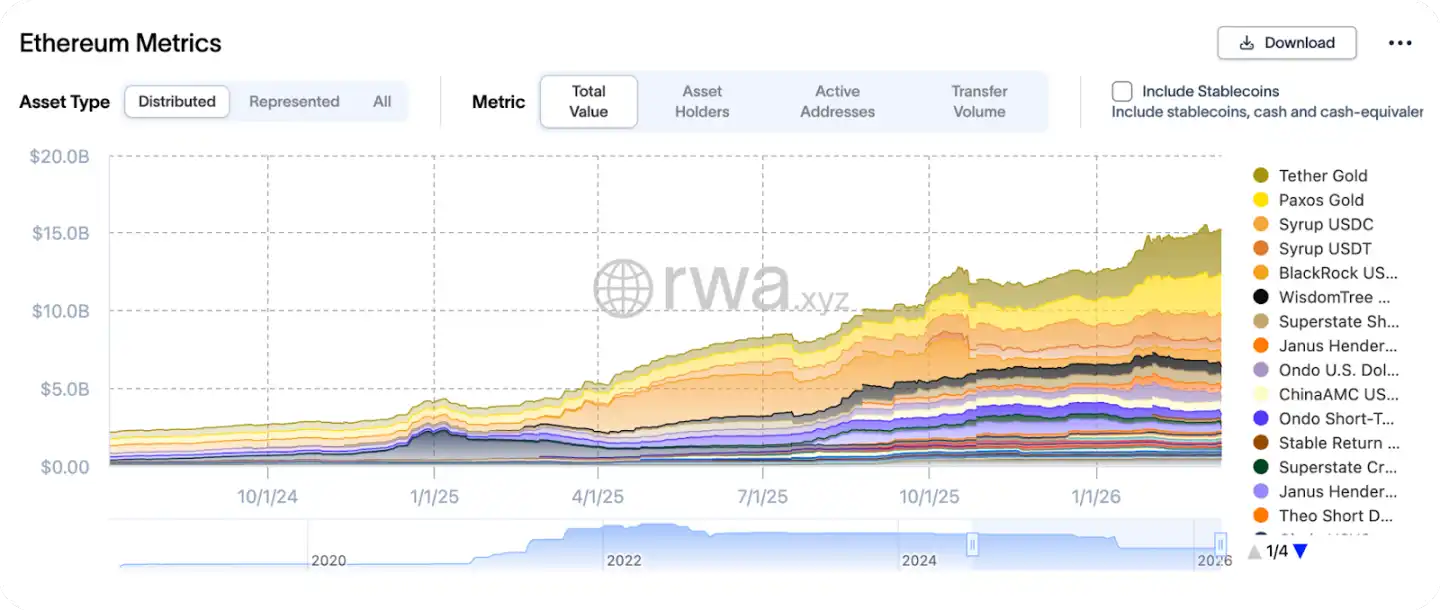
Growth of RWA on Ethereum since July 2024

BlackRock's BUIDL fund, Franklin Templeton's FOBXX money market fund, and an increasing number of tokenized products are all settled on Ethereum or its Layer 2 (L2) networks. Major banks are testing on-chain settlement functions, and SWIFT is among them. Although ETF flows have been disappointing, Ethereum's institutional footprint is actually expanding continuously.

The essence of the problem is that while institutions could hold price exposure to Ethereum, they could not compliantly participate in the Ethereum network economy they increasingly rely on. The emergence of ETHB completely solves this pain point.
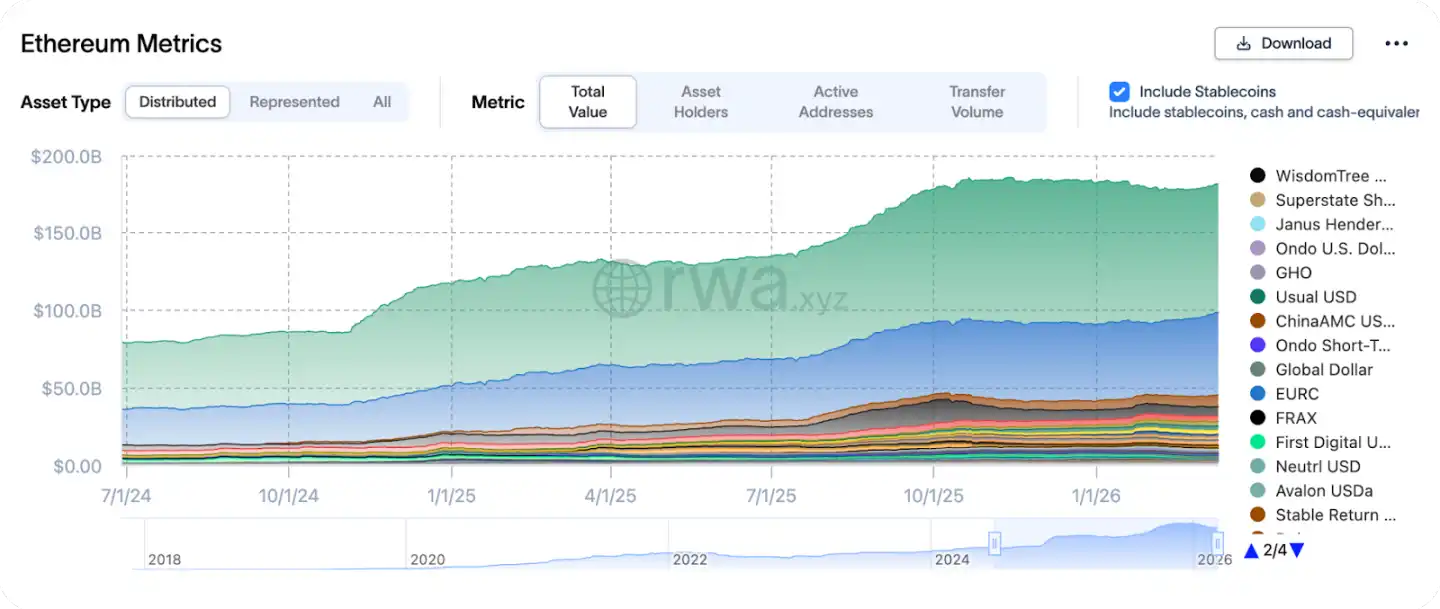
Growth of stablecoins on Ethereum since July 2024

Structural Impact: Reshaping Institutional Investment Logic

This impact far exceeds the ETHB product itself.

Before this, non-crypto-native institutions seeking yield-bearing Ethereum exposure could only use workaround structures like Digital Asset Trusts (DATs). These structures could participate in staking, restaking, and the DeFi ecosystem, but the fund's value was not directly linked to the underlying asset.

The existence of such structures was rooted in regulatory restrictions preventing institutions from directly participating in staking. With the landing of the staking ETF, the rationale for this intermediary path is significantly weakened. Funds that previously had to flow through intermediary channels to these workaround structures are expected to flow directly back to the native Ethereum asset itself.

Market Valuation & Fundamentals: Value in Deep Undervaluation Zone

At the time of ETHB's launch, Ethereum's current valuation is in a reasonable to deeply undervalued range based on multiple cycle indicators.

Its MVRV (Market Value to Realized Value) ratio is below 1, meaning the market is整体 (overall) at a floating loss; the percentage of supply in profit is lower than during the 2022 crash; the price in this cycle has failed to break the 2021 all-time high, remaining within the previous range, showing极佳的压缩性价比 (excellent compressed value) from a historical perspective.

Of course, the underperformance also has reasons related to Ethereum's own development. The Layer 2 (L2) roadmap prioritizes scale and user experience over Layer 1 fee capture. Blob data block technology significantly reduces the anchoring cost for Rollups (L2 scaling solutions), but also drastically reduces the scale of fee burns that once supported the deflation narrative, making its investment logic harder to model.

However, it is worth affirming that Ethereum's monetary system remains intact. Its annualized issuance is about 0.8%, basically on par with Bitcoin's inflation rate. Now, various elements are reconverging: institutional usage demand continues to accelerate, ecosystem applications like RWA, stablecoins, and tokenized funds are growing steadily on Ethereum, the staking yield channel is finally open, and the price is in a value洼地 (depression).

Future Outlook: Wall Street's Litmus Test for Value

For years, Ethereum has been selling itself to institutions as a "yield-bearing reserve asset" and the settlement layer for a tokenized economy. This story has been refined, formalized, and reiterated — placed before institutions that already recognize the network's value but were unable to participate in its economic proposition.

Now, the product design finally perfectly matches the value proposition. The market performance of ETHB will be the key litmus test for whether Wall Street truly recognizes the value of Ethereum as an asset.


Trending Cryptos

Related Questions

QWhat is the significance of BlackRock's iShares Ethereum Trust (ETHB) launching on Nasdaq?

AETHB is BlackRock's first Ethereum staking fund, which allows institutional investors to gain exposure to Ethereum as a productive, yield-generating asset through a compliant channel. It addresses the core issue of previous Ethereum ETFs that lacked the staking reward component, finally aligning the product with Ethereum's value proposition as a yield-bearing asset.

QHow did the initial Ethereum spot ETFs fail to meet institutional investment expectations?

AThe initial Ethereum spot ETFs only provided price exposure without the staking rewards, which are a fundamental part of Ethereum's economic engine. This created a mismatch, as Ethereum was promoted as a 'native internet bond' with yield, but the delivered product was a yield-less shell, hindering institutional adoption.

QWhat institutional developments on Ethereum have occurred since the spot ETF launch in July 2024?

ASince July 2024, Ethereum has seen significant institutional growth: RWA (Real World Assets) supply increased about 7 times, stablecoin supply doubled, and major institutions like BlackRock (BUIDL fund) and Franklin Templeton (FOBXX) have used Ethereum or its L2s for settlement. Banks are testing on-chain settlement, indicating Ethereum's role as infrastructure is expanding.

QWhat impact does ETHB have on the existing institutional investment structures for Ethereum?

AETHB undermines the need for intermediary structures like Digital Asset Trusts (DATs) that were previously used for staking exposure. It allows funds to flow directly back to native Ethereum assets, as institutions can now access staking rewards compliantly without relying on complex, non-native workarounds.

QWhy is Ethereum considered to be in a 'value洼地' (value trough) according to the article?

AEthereum's valuation is in a deep value range based on several metrics: MVRV (Market Value to Realized Value) is below 1, indicating overall market losses; profitable supply is lower than during the 2022 crash; and the price hasn't broken the 2021 high, remaining in a consolidation phase. Additionally, its annual issuance is around 0.8%, similar to Bitcoin's inflation rate, while institutional usage and ecosystem growth continue to accelerate.

Related Reads

The Verdict in Choi Tae-won's Divorce Case: Revealing the Inheritance Undercurrent Behind SK Hynix's Trillion-Won Empire

SK Group Chairman Chey Tae-won's high-profile divorce case, involving a record 1.38 trillion won settlement, has drawn attention to the succession plans for Korea's second-largest conglomerate, especially its crown jewel, SK hynix. Unlike traditional chaebol scripts centered on the eldest son, Chey's three children from his marriage to former President Roh Tae-woo's daughter, Roh Soh-yeong, are carving distinct, non-traditional paths. Eldest daughter Chey Yun-jung (b. 1989) is seen as the most evident successor. With a scientific and consulting background, she holds executive roles at SK bioscience and SK Inc.'s growth support department, focusing on future strategy and biopharma. Her marriage is to an AI infrastructure entrepreneur, not a traditional business alliance. Second daughter Chey Min-jung (b. 1991) took a unique route, voluntarily serving as a South Korean naval officer, including an anti-piracy deployment. She later worked on policy and strategy for SK hynix in Washington D.C. before co-founding an AI-driven healthcare startup. She married a former U.S. Marine Corps officer, connecting her to U.S. defense and policy circles—networks crucial for a global semiconductor giant. The only son, Chey In-geun (b. 1995), who studied physics like his father, worked briefly at SK E&S before joining McKinsey. Despite fitting the traditional "heir" profile as the eldest son, he remains silent and holds no public position or shares in SK, suggesting the old succession playbook is obsolete. As SK hynix's valuation soars, becoming a geopolitical asset in the AI era, the heirs' legitimacy is no longer automatic. They must prove themselves in fields like AI biotech, global policy, and strategic consulting. Their marriages also reflect new elite networks in tech and defense, not old political alliances. Their inheritance is the complex challenge of navigating a globalized, tech-driven world, not just a corporate throne.

marsbitYesterday 09:06

The Verdict in Choi Tae-won's Divorce Case: Revealing the Inheritance Undercurrent Behind SK Hynix's Trillion-Won Empire

marsbitYesterday 09:06

From OpenSea to OpenRouter: Is Alex Atallah Repeating His 'Exit at the Peak' Playbook?

From OpenSea to OpenRouter: Is Alex Atallah Repeating His "Exit at the Peak" Playbook? According to the Wall Street Journal, payments giant Stripe is in talks to acquire the AI model aggregation platform OpenRouter in a potential deal valuing the company near $100 billion. This would mark founder Alex Atallah's second creation of a company reaching a $100 billion valuation, following his co-founding of NFT marketplace OpenSea. OpenRouter, founded just over three years ago, has grown rapidly by acting as a unified gateway for developers to access over 400 AI models. It currently has about 10 million users and processes over 200 trillion tokens monthly. While the platform's annualized revenue is around $50 million, its valuation has skyrocketed from $1.3 billion in March 2026. The potential acquisition by Stripe, a company OpenRouter's founder once likened it to, represents a major expansion into AI infrastructure for the payments leader. This move echoes Atallah's previous timing with OpenSea, where he departed before the NFT market's significant downturn. For OpenRouter, selling now may be strategic. Despite its scale, its business model—charging a 5-5.5% fee on AI inference calls—faces pressure from competition, open-source models, and potential price wars among model providers, limiting its profitability narrative for an IPO. A key asset for potential acquirers like Stripe is OpenRouter's vast repository of real-world AI usage data, which offers unique insights into model performance and developer preferences that are difficult to replicate. Whether this potential deal signifies a new valuation benchmark for AI infrastructure or another market peak signal remains to be seen.

链捕手Yesterday 08:42

From OpenSea to OpenRouter: Is Alex Atallah Repeating His 'Exit at the Peak' Playbook?

链捕手Yesterday 08:42

Trading

Spot

Hot Articles

Discussions

Welcome to the HTX Community. Here, you can stay informed about the latest platform developments and gain access to professional market insights. Users' opinions on the price of S (S) are presented below.

活动图片















