Meme Coin Reappears, Does the Bitcoin Ecosystem Really Have Something New?

marsbitPublished on 2026-05-26Last updated on 2026-05-26

Abstract

The Bitcoin ecosystem is heating up again with new projects and substantial price surges. Key developments include: **Bound Exchange:** Merging former entities radfi and Bound, this platform has gained attention after its $BOUND token surged ~46x. It simplifies trading by allowing deposits in various cryptocurrencies (SOL, ETH, etc.) for conversion to BTC to trade Runes, avoiding long Bitcoin confirmation waits. It features a 2-of-2 multi-signature wallet with a timelock for user asset security and a price protection mechanism for launchpad tokens to manage sell pressure. **Tacit:** This privacy-focused protocol for Bitcoin assets remains active, with its $TAC token holding a stable ~$5.5M market cap. Developers recently implemented double-blind tokens and are working on a permissionless ETH-BTC bridge using zero-knowledge proofs. **Alkanes & $DIESEL:** While not new, the Alkanes protocol's $DIESEL token has risen ~17x since late April. Its limited circulating supply (under 10% of the total 1.562 million) and a revised mining mechanism—where participants bid for block rewards—contribute to its volatile "meme coin" status. These projects, featuring simplified UX, security innovations, and speculative assets, are driving renewed excitement and questions about substantial new developments in the Bitcoin ecosystem.

The recent emergence of the new Bitcoin asset protocol Tacit has reignited market interest in the Bitcoin ecosystem. And lately, a new 10x "golden dog" has appeared in the Bitcoin ecosystem, making everyone exclaim that the familiar "ordi" flavor is back. Why has the Bitcoin ecosystem been so hot recently? Has something genuinely new emerged?

Bound Exchange

The predecessor of this platform was radfi, which previously gained attention due to the "Node Monkey" strategy coin $NODESTRAT. $NODESTRAT is similar to $PUNKSTR on Ethereum, both utilizing trading fees to repurchase NFTs, then listing them for sale with different profit targets. The profits from selling these NFTs are then partially used to buy back and burn the token, creating a flywheel effect.

Previously, radfi and Bound operated separately. radfi handled Bitcoin/Rune AMM and Launchpad, while Bound focused on stablecoins. Now, the two have merged into Bound. The merged platform offers comprehensive features, including trading, lending, Launchpad, and an NFT marketplace.

Bound recently attracted market attention because its token $BOUND has surged approximately 46 times since May 21st.
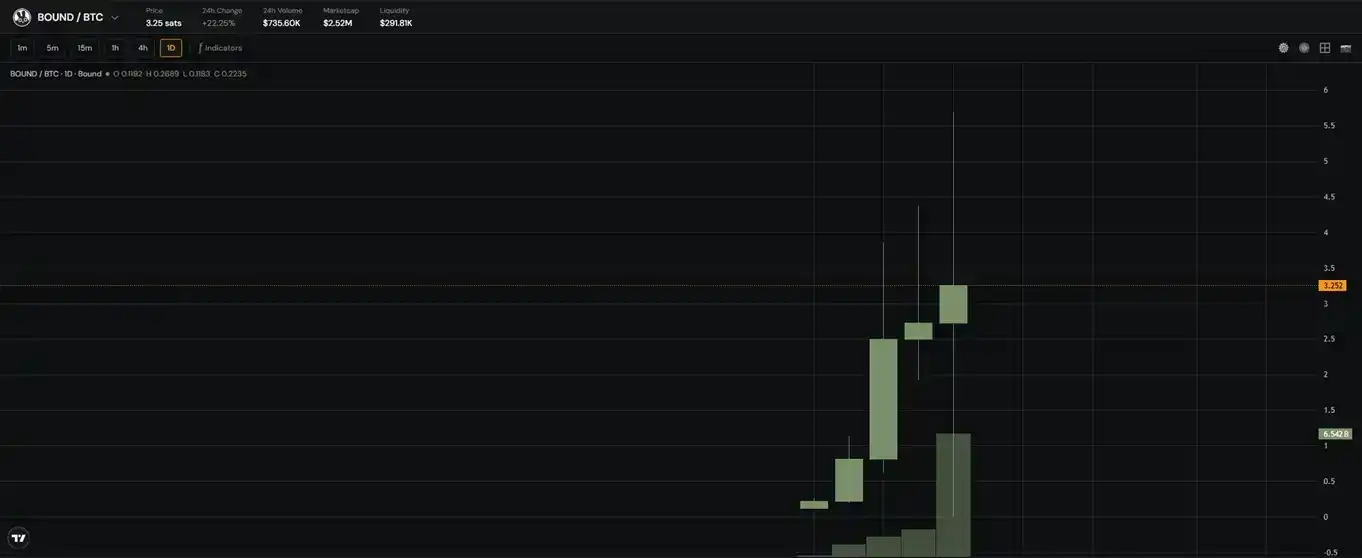
Returning to the project itself, the main points praised by the community about Bound are as follows:

Greatly simplified trading process. Traditional Rune AMMs typically require depositing Bitcoin first, then waiting for several block confirmations. This confirmation time can be as short as half an hour, but longer if block production is slow, potentially taking over an hour. On Bound, besides depositing Bitcoin, users can also deposit SOL, ETH, HYPE, or BNB. These are swapped to BTC via corresponding BTC trading pairs, allowing users to directly trade Rune tokens on the platform. The overall time required is significantly reduced, naturally enhancing the user experience.

Instant trade confirmation. Avoiding long waits for Bitcoin block confirmations has been a goal for platforms dealing with Runes in the Bitcoin ecosystem. This isn't inherently difficult; once funds are deposited and confirmed on the platform, trades can be processed internally/off-chain first, using the Bitcoin mainnet as a confirmation layer. However, the key issue is solving the security problem. Previous platforms like odin.fun also gained popularity but eventually faded after repeated asset theft incidents. Bound's solution is to add a 2-of-2 multisig to user asset deposit addresses. One signature is held by the user (stored as a passkey on the user's device), and the other is held by the platform's backend.

This means even if the Bound platform is hacked, assets cannot be stolen because the hacker can only satisfy one signature layer. There's another question: what if the platform runs away? Therefore, Bound added a timelock. If Bound's signature expires after 3 months, users can directly withdraw their assets using their own passkey.

Price protection mechanism. Bound's official Twitter account retweeted an explanation by @SkyAAmen regarding this mechanism: "For Rune tokens launched via Launchpad, the post-launch token price is calculated based on the average minting price. 75% of the raised liquidity is placed below this price to act as a floor against potential selling pressure, while the remaining 25% is paired above this price."
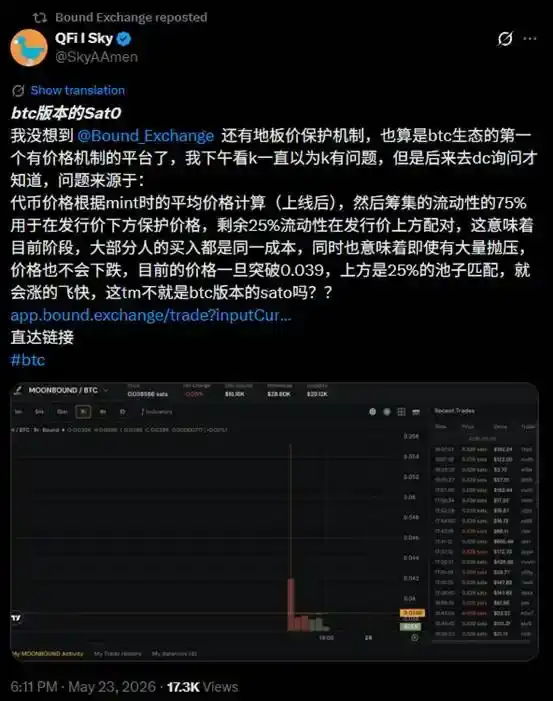
Regarding token issuance, Bound also introduced a virtual mempool, which can be understood as a virtual chain tracking Bitcoin mainnet block production. Users minting new Rune tokens on the Launchpad don't pay fees to miners; the money is instead used for the aforementioned price protection and liquidity provision. Additionally, to reward holders, those who mint 1 million tokens or more and do not sell can share 50% of the trading fees.

The above three points are the main advantages. Furthermore, Leonidas, a well-known figure in the Bitcoin ecosystem, has also expressed support for Bound:
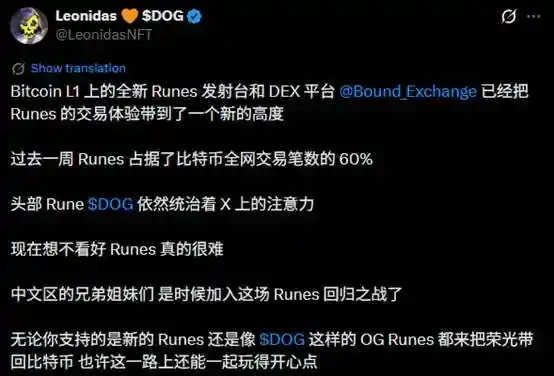
Tacit

BlockBeats previously published a detailed article introducing Tacit:

New Protocol Tacit: The ZEC of the Bitcoin Ecosystem?

Currently, the price of Tacit's leading token $TAC remains stable, with a corresponding market cap of approximately $5.5 million. The developer @z0r0zzz continues to maintain a high update frequency. On May 23rd, they implemented double-blind tokens on Bitcoin, further strengthening the protocol's privacy features. Additionally, work is ongoing on a permissionless ETH-BTC bridge implemented via SP1 zero-knowledge proofs.

Alkanes

We have also previously introduced Alkanes: Another 10x Runner in Bitcoin Ecosystem, What is the New Asset Protocol Alkanes? This protocol gained attention because $DIESEL has risen approximately 17 times since late April and is still climbing:
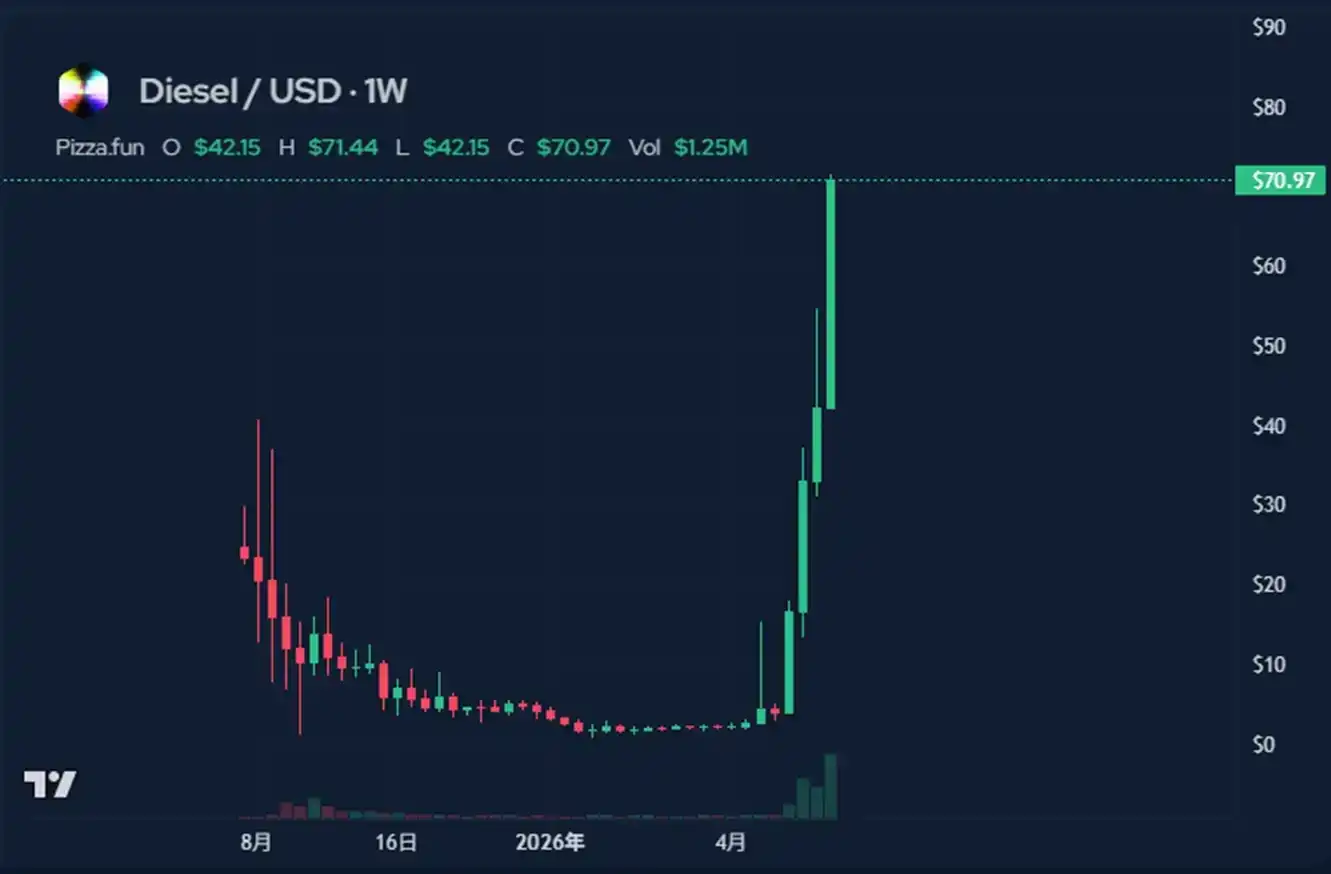
Alkanes isn't a new protocol. In fact, Oyl Wallet, which initially led it, is no longer active. The subfrost team now responsible for protocol updates and maintenance consists of the original technical team from Oyl Wallet that handled Alkanes. Despite Oyl's disbandment, the subfrost team has been consistently updating, implementing significant performance optimizations such as embedding contracts into the indexer.

However, the substantial rise of $DIESEL is likely due to its very small actual circulating supply. The previous mining mechanism for $DIESEL awarded the entire block's $DIESEL reward to the single minting transaction that paid the highest miner fee within that block. This essentially allowed "scientists" (automated traders/bots) to dominate, making it difficult for ordinary users to participate. In August last year, the mining mechanism was updated. Now, all successful minting transactions in a block share the $DIESEL reward proportionally based on their bid amount. This means those who believe in $DIESEL's value can mine more. Mining has become a small "beast" (auction) occurring every block, with a fixed total reward (currently about 3.125 $DIESEL per block, synchronized with Bitcoin's halving cycle), but the bidding situation within each block changes.

Simultaneously, 50% of all funds bid for minting $DIESEL within a block are converted into $DIESEL and directed to the project's treasury for protocol development. Therefore, although the $DIESEL production per block is about 3.125 tokens, the amount users actually receive from minting is less, as a portion goes directly to the project team.

The total supply of $DIESEL is 1,562,000 tokens. Currently, approximately 640,000 tokens have been mined and are potentially circulating, but the actual amount available for trading might be less than 10% of the total supply. Combined with the recent massive price surge, I'd call it the "meme coin" of the Bitcoin ecosystem.


Related Questions

QWhat is the Bound platform, and why has it recently gained significant attention in the Bitcoin ecosystem?

ABound is a comprehensive financial platform formed by merging radfi and Bound's previous services. It offers trading, lending, Launchpad, and an NFT marketplace. It gained significant attention because its token $Bound surged approximately 46 times since May 21st. Key praised features include a simplified trading process using multiple cryptocurrencies, instant transaction confirmations via a 2-of-2 multi-sig security model, and a price protection mechanism for new token launches.

QHow does the Bound platform address the security concerns associated with off-chain trading confirmations?

ABound addresses security by implementing a 2-of-2 multi-signature setup for user deposit addresses. One signature key is held by the user (a passkey on their device), and the other is held by the platform's backend. This means even if the platform is hacked, assets cannot be stolen as the hacker only controls one signature. Additionally, a timelock feature is added: if Bound's signature expires after 3 months, users can withdraw their assets directly using their own passkey.

QWhat is the Alkanes protocol, and what is notable about its token $DIESEL?

AAlkanes is a Bitcoin-native asset protocol. Its notable token, $DIESEL, has increased in price by about 17 times since late April and is still rising. It is considered a 'weird coin' or '妖币' in the Bitcoin ecosystem. This dramatic rise is attributed to its very small circulating supply (likely less than 10% of its total 1.562 million supply is tradeable). Its mining mechanism was updated to allow proportional reward distribution based on bidding, making it more accessible than its previous 'scientist-dominated' model.

QWhat recent update did the Tacit protocol implement, and what is its primary focus?

AOn May 23rd, the Tacit protocol implemented dual-blind tokens on Bitcoin, significantly enhancing the protocol's privacy features. Tacit's primary focus is on privacy, aiming to be a privacy-preserving asset protocol within the Bitcoin ecosystem, similar to Zcash (ZEC). The developer is also working on a permissionless ETH-BTC bridge using SP1 zero-knowledge proofs.

QAccording to the article, what is a major user experience improvement offered by the Bound platform for trading Runes?

AA major user experience improvement is the significant simplification and speed-up of the trading process. Instead of only depositing Bitcoin and waiting for multiple block confirmations (which can take 30 minutes to over an hour), users on Bound can deposit various cryptocurrencies like SOL, ETH, HYPE, or BNB. These are converted to BTC via corresponding trading pairs on the platform, allowing users to trade Rune tokens almost immediately without the long Bitcoin network confirmation wait, greatly enhancing the user experience.

Related Reads

Anthropic's IPO Launch: Commercial Miracle or Valuation Bubble?

Anthropic has confidentially filed for an IPO, led by Morgan Stanley and Goldman Sachs, potentially going public by October. Following its latest $650 billion funding round, its pre-IPO valuation stands at $965 billion, with projections reaching up to $2 trillion at listing, which would make it the highest-valued private company ever. The article, written by Fu Sheng, addresses skepticism that this represents an AI bubble akin to the 2000 dot-com crash. It argues the current situation differs fundamentally. Unlike the internet bubble era, which relied on speculative narratives with little revenue, Anthropic's valuation is backed by unprecedented, measurable financial performance. Key data points include: * **Revenue Growth:** ARR skyrocketed from $10 billion in early 2025 to $470 billion by May 2026, targeting $100 billion by year-end—a growth curve unmatched in business history. * **Profitability:** It achieved operating profitability in Q2 2026 with an estimated $5.6 billion profit. * **Efficiency:** With ~3,000 employees and ~$470 billion ARR, its revenue per employee exceeds $10 million. Products like Claude Code, launched less than a year ago, already generate $25 billion in annualized revenue. * **Enterprise Adoption:** It boasts a strong enterprise client base, with 8 of the Fortune 10 and over 1,000 large firms spending over $1 million annually on Claude. The valuation is framed using a traditional SaaS model (e.g., a 10x Price-to-Sales multiple on $100 billion revenue). The author contends the core question for analysts has shifted from "How big could this be?" to "How much is it earning and will earn next quarter?" The discussion extends beyond Anthropic to a broader paradigm shift: the transition from a "carbon-based" to a "silicon-based" economy. Companies are increasingly prioritizing investment in compute and AI capabilities over human resources, as these directly scale productivity and competitive advantage. Anthropic's IPO is thus positioned not just as a corporate milestone, but as a price anchor for this new economic era.

链捕手49m ago

Anthropic's IPO Launch: Commercial Miracle or Valuation Bubble?

链捕手49m ago

Near Returns to the AI Stage: Transformation into a Public Chain Due to 'Payroll Difficulties,' Agent and Privacy Emerge as New Growth Narratives

NEAR Returns to AI Origins: From Payroll Struggles to Blockchain, Now Focusing on AI Agents and Privacy NEAR Protocol's journey began not with grand blockchain ambitions, but from a practical hurdle: its AI startup founders, including Transformer paper co-author Illia Polosukhin, couldn't efficiently pay international developers in 2017. This led them to pivot and build a high-performance, scalable blockchain. After years navigating various crypto narratives like sharding and cross-chain interoperability, NEAR is now leveraging its AI roots to re-enter the AI arena. A key driver is its "NEAR Intents" layer, which abstracts complex cross-chain transactions. Users simply state their goal (e.g., swap BTC for ETH), and a solver network finds the optimal route. This system has processed over $20B in cross-chain volume, generating significant fee revenue. A major growth area is private transactions via "Confidential Intents/Swaps," which hide trade details until settlement to protect against MEV and front-running. Remarkably, private swaps recently accounted for over 40% of NEAR's transaction volume, highlighting strong demand but also potential regulatory scrutiny. With its AI-founder pedigree, NEAR is positioning itself at the intersection of blockchain, AI agents, and privacy, aiming to become infrastructure for the emerging agent economy while navigating the challenges of its rapid adoption.

marsbit3h ago

Near Returns to the AI Stage: Transformation into a Public Chain Due to 'Payroll Difficulties,' Agent and Privacy Emerge as New Growth Narratives

marsbit3h ago

From Ethereum to AI's 'CROPS': What Exactly is This Set of 'Slow Variables' That Vitalik Repeatedly Emphasizes?

In recent discussions, Vitalik Buterin has frequently emphasized the concept of "CROPS," a framework defining core values for Ethereum's development. CROPS stands for Censorship Resistance, Capture Resistance, Open Source, Privacy, and Security. Initially outlined in the Ethereum Foundation's "EF Mandate," it represents a commitment to user sovereignty, ensuring that the network resists external control, remains open, protects privacy, and prioritizes security. The relevance of CROPS extends beyond Ethereum's foundational principles, becoming crucial in the context of AI integration. As AI agents begin handling wallet operations and automated transactions, the risk increases that users may cede control over their digital assets, privacy, and intentions to centralized AI service providers. A "CROPS AI" would therefore emphasize local execution where possible, privacy-preserving remote model calls (e.g., using zero-knowledge proofs), and transparent, verifiable processes to maintain user agency. Vitalik highlights a significant convergence between "CROPS Ethereum access layer" and "CROPS AI." Both address the same fundamental challenge: how users can access powerful services—be it blockchain data via RPCs or AI models—without exposing sensitive information or relinquishing ultimate control. This intersection points toward a future digital entry point that is more private, secure, and user-controlled. Ultimately, CROPS is not merely an abstract ideal but a practical guidepost. It steers development—from protocol resilience and wallet design to AI agent safety—towards a future where users retain self-sovereignty even as digital systems grow more complex and powerful. In an era of accelerating AI adoption, these "slow variables" of censorship resistance, openness, privacy, and security may define Ethereum's enduring value.

marsbit3h ago

From Ethereum to AI's 'CROPS': What Exactly is This Set of 'Slow Variables' That Vitalik Repeatedly Emphasizes?

marsbit3h ago

Trading

Spot
Futures

Hot Articles

Discussions

Welcome to the HTX Community. Here, you can stay informed about the latest platform developments and gain access to professional market insights. Users' opinions on the price of MEME (MEME) are presented below.

活动图片