How Can an Average Person Identify if a Token Has a Whale Behind It in 10 Minutes?

marsbitPublished on 2026-04-09Last updated on 2026-04-09

Abstract

This article argues that identifying whether a token has a "whale" (a large, controlling holder) is the wrong question, as all successful tokens have them. The key is determining the whale's current phase: accumulation, markup (pumping), distribution (dumping), or having already exited. It provides a framework using on-chain and off-chain signals to identify these phases. Key on-chain metrics include: analyzing linked wallets to find true concentration, not just top holders; checking if trading volume is real or fake based on volume/holder ratio; monitoring DEX liquidity pool changes; analyzing trade volume concentration and net buy volume; and comparing price action to holder growth rates to pinpoint the whale's phase. The core thesis is that whales are not a bug but a fundamental feature of the market; concentrated筹码 (chips/tokens) and capital are prerequisites for a pump. The structural disadvantage for retail is being "long-only"—entering at high prices with no safety net, making them vulnerable. The article proposes that decentralized shorting mechanisms could be a solution, allowing retail to profit from correctly identifying distribution phases and breaking the whale's monopoly on price control. However, shorting carries extreme risks like unlimited losses and being squeezed. It is framed not as a guarantee of profits but as a necessary tool for "symmetrical armament," allowing retail to participate in two-way betting and transition from being "prey" to a "hunter" o...

Author: danny

Many people study on-chain data to find out "if this coin has a whale behind it," and then try to avoid, embrace, or follow it. But the truth is—coins without whales won't rise at all. So the truly useful question isn't "is there a whale?" but "what stage is the whale in?"—accumulation, markup, distribution, or has it already left?

Let's get straight to the point: you will definitely find whales, because whales are everywhere.

This article provides you with a framework of on-chain + off-chain signals. It's not about playing detective to catch the manipulators, but about quickly determining: at this moment, is this market in a stage that is friendly to retail investors?

I. On-Chain Signals: What Chips and Capital Are Saying

Remember: This cycle isn't short on capital or data; it's short on capital willing to enter the market. Like all games, everything revolves around getting you to "pay to play." As long as you keep paying attention, there's a thousand memes with a thousand faces, and there's always one tailored for you.

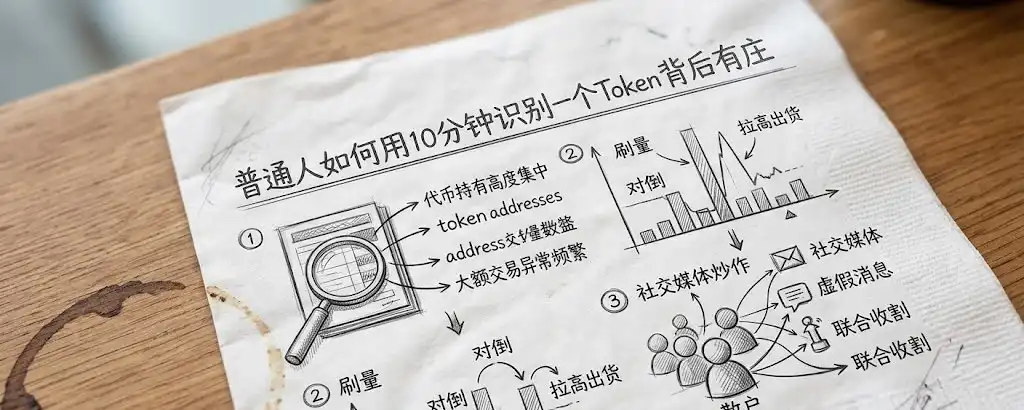
1: Token Concentration — Consolidate related wallets. Concentration itself isn't important; the degree of concentration is. Don't just look at the "Top 10 Holders %". Anyone can see that number, and it's easily disguised—a whale can split holdings into 50 wallets, each holding only 1%, making the Top 10 look "healthy." The right approach is to open a professional tracker and look at the bubble chart, consolidating addresses with connections (direct transfer relationships). Three wallets each holding 2% that have transferred to each other mean one entity holds 6%. Then look at the buy-in time of these related addresses—if they were all accumulated on the same day or even within the same hour, do you believe in coincidences?

Funding Source Tracing (Funding Wallet Analysis) — Where did the initial ETH/BNB for these wallets come from? If the gas fees for 50 wallets all came from the same CEX withdrawal address or the same funding wallet, even if there are no direct transfers between them, they are likely the same person. If someone is spending money to accumulate, what do you think they want to do?

2: Trading Volume Authenticity — Vol / Holder (OI) Ratio 24h Trading Volume ÷ Total Number of Holders = Average trading volume contributed per holder. If a coin with only 800 holders has a 24h volume of $2 million, that's $2500 per person on average—this is most likely a few addresses wash trading疯狂对倒刷量, or bots running. Why would someone spend money to inflate the volume?

3: DEX Liquidity Pool Monitoring Observe the addition/removal of LP (Liquidity Pool) — A whale removing LP / adding thick LP is a signal of preparing to exit / stir things up. If the LP is not locked (unlocked), or the lock is about to expire, the risk is extremely high. Also observe changes in LP depth. If the price is rising but the LP depth is thinning, it indicates the whale might be quietly withdrawing liquidity to minimize their losses when they exit, and vice versa.

4: Turnover Rationality — 24h Vol / Market Cap Measures "what percentage of the market cap is traded in a day." Break it down by hour. If the volume spikes significantly in a few specific hours far exceeding other periods, it indicates concentrated wash trading. Normal retail trading time distribution is relatively smooth; sudden spikes are likely the prelude to manipulation. Furthermore, net buy volume is more valuable than total volume.

5: Number of Trades vs. Trading Volume — Large Order Percentage Look at the average value per transaction within 24 hours. If the top 10% of large transactions account for over 60% of the total volume, this market is driven by a minority of addresses, and the price action depends entirely on these few addresses. (A better method is to quantify the concentration of trading volume using the Gini coefficient, between 0 and 1; the closer to 1, the more concentrated). When these addresses stop moving is more important than when they move.

6: Address/Account/OI Growth Rate vs. Price Change Rate — Determining the Whale's Stage Combine the calculations from the previous 5 indicators (must be processed, screened, and calculated), then use the data analysis to determine which stage the asset is currently in:

  • Accumulation Stage: Price consolidates at low levels or even dips slightly, on-chain large addresses buy slowly, wallet/account count changes little. The whale is quietly accumulating chips. (The number of linked addresses doesn't count here).

  • Markup Stage (Pump): For example: price rises 30%, but wallet/account count only increases 5% → Chips haven't been distributed; a minority is pumping it themselves.

  • Distribution Stage (Most Dangerous): Price consolidates or even dips slightly, but wallet/account count increases (sometimes also in long/short ratio) by 20% → The whale is slowly distributing at high to retail; it looks like "the community is growing," but actually the whale is retreating.

  • Exited Stage: Price falls, wallet/account count doesn't decrease → Retail is bag-holding, the whale has finished exiting.

II. After Reading This, Then What?

Okay, you spent time confirming there's a whale, and it's in the xxx stage. Then what? Switch to another one? The next one will also have a whale. Because—

III. Whales Aren't a Bug; They Are the Underlying Structure of This Game

What makes a Token rise? Pumping requires two things: Chips + Capital. Combined, these are called Pricing Power. If chips aren't concentrated enough, and there isn't sufficient stake, no one has the incentive to pump the price.

Chip concentration isn't a conspiracy; it's a prerequisite for a pump. No whale, no rally.

IV. How Do Whales Win Against You?

Pricing power is just the entry ticket. What really makes whales win steadily is that their way of trading is completely different from yours. You operate on feeling; they operate with a system.

  • Whale's Cost Awareness: Calculate the profit of pumping and distributing, act if Expected Value (EV) is positive. Retail FOMOs in based on screenshots.

  • Whale's Probabilistic Thinking: Continuously adjust probabilities and position sizing. Retail repeatedly gambles.

  • Whale's Exploitation of Psychology: Create FOMO, exploit sunk cost fallacy to make you hold bags.

  • Whale's Tool Advantage: Ability to hedge, possess cost/information advantages, operational dimensions and error tolerance crush retail.

V. Then How Can Retail Win?

On the whale's home turf, using the whale's rules, retail cannot win. The asymmetry in information, tools, and psychology is comprehensive. But there is one asymmetry that can be broken.

VI. Retail's Biggest Structural Flaw: Can Only Go Long

In the era before perpetual contracts (perp), whales indeed could only go long, but they didn't need to short. The reason lies in cost.

The whale's chip cost is close to zero (gas fees or extremely low early prices). Even if it drops 90%, they are still profitable, just "less profitable." Ultra-low cost gives them enormous error tolerance.

But retail buys in during the FOMO phase, with a cost potentially 50 times higher than the whale's. Your cost structure determines that you cannot withstand drawdowns. Retail lacks both shorting tools and a low-cost safety net. The only profitable scenario is: buy, then it rises, and sell before it falls.

One direction, one window, almost zero error tolerance. This is structural unfairness.

VII. What If Retail Could Also Short?

When signals point to the distribution stage, false prosperity—you aren't just "running away," you can open a short, turning the whale's distribution into your profit. When truth reverts, you can be on the winning side. Your analytical skills are finally not wasted.

VIII. Mechanism Perspective: With Shorting Rights, Can Retail Master Pricing Power?

Straight to the conclusion: No.

The formula for pricing power is always: Chips + Capital. The essence of retail is a dispersed, uncoordinated group of capital. No matter how clever the mechanism, it cannot turn a pile of sand into a cannon. However, introducing decentralized spot leverage and lending protocols isn't about making retail "become the whale," but about breaking the whale's "absolute monopoly" on pricing power.

Deconstructing the mechanism, this reshapes the structure in three dimensions:

  1. Creating "Selling Pressure" Out of Thin Air, Depriving Unilateral Control: In a pure spot market, if the whale doesn't sell, there is no selling pressure; they can pump the price by trading with themselves. But with shorting mechanisms介入, retail can borrow tokens through over-collateralized loans and sell them into the market, turning previously "locked" dead筹码 into active selling pressure. This forcibly increases the real capital cost for the whale to continue pumping. To keep pumping, the whale must use real money to buy up the sell orders created by shorting.

  2. Symmetry in Price Discovery: Popping "False Narratives": Previously, upon discovering whale distribution or narrative invalidation, retail could only "not buy"; bad news couldn't be reflected in price drops. Shorting mechanisms allow retail to convert "bearish information" into substantive sell orders, making price action no longer a one-sided game drawn by the whale, but the real result of long-short博弈.

  3. Transformation from "Sitting Duck" to "Hunter": Shorting mechanisms actually accelerate the lifecycle of Meme coins. This mechanism doesn't let you become the rule-making whale, but it transforms retail from "bag-holders who can only take hits" into "hunters with guns."

IX. But Shorting Isn't a Panacea — Risks You Must Know

Shorting Meme coins is extremely high risk, with theoretically unlimited losses. What whales excel at is short squeezing (Short Squeeze). Intentionally pump the price to trigger short liquidations, using your liquidation funds to push the price even higher. Wrong timing means losing even if the direction is right. Plus, poor liquidity and high slippage make shorting costly.

Shorting isn't "make money if you understand"; it gives you an additional directional option. You still need to control position size and set stop losses. Shorting turns you from "chips" into a "player," and players can also lose—but they lose with more dignity.

Finally

This article teaches you not "how to avoid whales," but to understand:

  1. Whales are everywhere. Don't look for "coins without whales"; the key is to judge which stage the whale is in.

  2. Retail's biggest disadvantage is unidirectional exposure. Whales have low costs as a safety net; you don't. Understanding a rise can make money; understanding a fall can only make you run—this is不合理 unreasonable.

  3. The right to short is the final piece of the puzzle for retail to go from "being harvested" to "sitting at the table."

It is a weapon, not a talisman. Even if this gun has the risk of backfiring, having a gun and not having a gun are two completely different levels of博弈 game theory. What we need is "symmetrical armament," allowing retail to also possess two-way gaming capabilities.

Related Questions

QWhat is the main purpose of the article regarding identifying a token's 'zhuang' (market manipulator)?

AThe main purpose is not to help readers avoid tokens with a zhuang, but to teach them how to quickly identify which stage the zhuang is currently in—accumulation, markup, distribution, or having already exited—to determine if it's a散户-friendly phase.

QAccording to the article, what is a key on-chain signal to assess the authenticity of trading volume?

AA key signal is the ratio of 24-hour trading volume divided by the number of holders. An abnormally high average volume per holder indicates potential wash trading or bot activity by a few addresses.

QWhat structural disadvantage do retail investors face compared to zhuang, as highlighted in the article?

ARetail investors' biggest structural disadvantage is that they can only go long (buy). They enter at high prices during FOMO, have no low-cost safety net, and have almost zero margin for error, making them structurally unequal to zhuang who have ultra-low cost bases.

QHow does the introduction of a shorting mechanism theoretically help rebalance the power dynamic between retail and zhuang?

AIt allows retail to profit from a token's price decline during the distribution phase, creates real selling pressure that increases the zhuang's cost to pump the price, and enables price discovery to reflect negative news, transforming retail from 'fodder' into 'hunters' with a choice of direction.

QWhat is a significant risk associated with shorting meme tokens mentioned in the article?

AA significant risk is the potential for unlimited losses from a short squeeze, where the zhuang intentionally drives the price up to trigger mass liquidations of short positions, using the resulting buying pressure to push the price even higher.

Related Reads

Interview with Jeff Hoffman: How Web3 and AI Are Reshaping the Trillion-Dollar Social Travel Market

Interview with Jeff Hoffman: Web3 and AI Reshaping the Trillion-Dollar Social Travel Market Jeff Hoffman, co-founder of Priceline, discusses how Web3 and AI are transforming the social travel industry. He highlights that the current travel market is fragmented and inefficient, dominated by traditional online travel agencies (OTAs) that act as intermediaries with opaque models. Web3 introduces direct connections, transparency, and faster settlements, shifting value back to travelers. Key trends driving this change include demand for flexible rewards, digital payments, and trust in communities over ads. Hoffman joined Staynex not for its Web3 label, but because it addresses industry inefficiencies by integrating booking, payments, AI-driven itineraries, and rewards into a single ecosystem. This Web2.5 model combines Web2 scale with Web3 incentives. He emphasizes the team’s focus on execution over hype as a key reason for his involvement. Looking ahead, blockchain will enable transparent rewards and seamless cross-border payments, while AI provides personalization. Together, they will turn travel into a continuous relationship rather than a transaction. Hoffman predicts traditional OTAs will persist, but value will shift to platforms that own payment, loyalty, and community networks. Social travel represents a significant, underestimated opportunity in Web3.

marsbit29m ago

Interview with Jeff Hoffman: How Web3 and AI Are Reshaping the Trillion-Dollar Social Travel Market

marsbit29m ago

Trading

Spot
Futures

Hot Articles

What is USDC(WORMHOLE)

USD Coin (Wormhole): A Comprehensive Overview Introduction In the rapidly evolving world of cryptocurrencies, USD Coin (Wormhole), referred to as $USDC(Wormhole), stands out as a pioneering solution within the DeFi (Decentralized Finance) landscape. Operating on several blockchain platforms, including Solana, USD Coin (Wormhole) is more than just a digital representation of the United States dollar. It embodies the innovative spirit of modern finance, enabling seamless cross-chain transactions and enhanced interoperability among diverse blockchain ecosystems through the advanced Wormhole protocol. What is USD Coin (Wormhole)? USD Coin (Wormhole) is a tokenized version of the US dollar designed to facilitate frictionless transactions across different blockchain networks. Its primary aim is to bolster liquidity and enhance the functionality of the DeFi ecosystem. By leveraging the Wormhole protocol, which establishes a robust cross-chain communication network, users can effortlessly transfer USDC tokens across various platforms. This cross-chain capability marks a significant advancement in cryptocurrency use, promoting a more interconnected and efficient ecosystem where assets can flow freely between different blockchains. The value proposition of USD Coin (Wormhole) lies not only in its stability, being pegged to the US dollar, but also in its ability to bridge gaps between disparate blockchain environments. This innovative approach fosters a greater level of participation among users and developers, paving the way for new and exciting applications within decentralized finance. Who is the creator of USD Coin (Wormhole)? The origins of USD Coin (Wormhole) are intricately tied to the Wormhole network, which was developed by Jump Crypto. While specific individual creators are not prominently documented, Jump Crypto is notable for its involvement in advancing blockchain technology and supporting its applications in finance. By creating the Wormhole network, Jump Crypto has played a vital role in promoting cross-chain asset transfers, enhancing the efficiency and diversity of cryptocurrency usage. Who are the investors of USD Coin (Wormhole)? The success of USD Coin (Wormhole) is supported by investments from several notable funds and organizations within the cryptocurrency realm. Key investors include: Coinbase Ventures: A prominent venture capital arm backed by one of the leading cryptocurrency exchanges in the industry, Coinbase Ventures provides essential capital and strategic support to promising blockchain projects. Arrington XRP Capital: Specializing in digital assets, Arrington XRP Capital recognizes the potential of innovative projects like USD Coin (Wormhole) and has invested accordingly to back its development. Jump Trading: As the parent organization of Jump Crypto, Jump Trading brings not only investment but a wealth of expertise in trading technology and market dynamics to bolster the Wormhole project. How Does USD Coin (Wormhole) Work? The operational framework of USD Coin (Wormhole) is intricately designed to facilitate effective cross-chain transactions, maximizing security and efficiency. Here’s a simplified overview of how it functions: Asset Locking: When a user wishes to transfer USDC from one blockchain to another, they first lock their tokens on the source blockchain. This process ensures that the assets are secure and are set to be either burned or moved later. Token Minting: After the tokens are locked, an equivalent amount of USDC is minted on the destination blockchain. This provides the user with access to their funds on a new platform, reflecting the flexibility that the Wormhole protocol enables. Cross-Chain Transfer: The Wormhole protocol efficiently facilitates the entire transfer process. It ensures that once the USDC is minted on the destination chain, the equivalent tokens are burned on the source chain. The result is a seamless transfer of value between two distinct blockchain environments. This cross-chain methodology ensures that transactions remain secure and transparent, significantly enhancing liquidity within the different DeFi ecosystems. Timeline of USD Coin (Wormhole) Understanding the evolution of USD Coin (Wormhole) provides vital context for its significance in the cryptocurrency arena. Here’s a timeline highlighting important milestones in the project’s history: 2021: The Wormhole project is launched, establishing a framework for cross-chain asset transfers and setting the stage for the development of USD Coin (Wormhole). 2022: The Wormhole network experiences a significant challenge with a security breach that results in a $325 million theft. However, the incident is later addressed and refunded by Jump Crypto, showcasing the project’s commitment to security and transparency. 2023: USD Coin (Wormhole) integrates with Circle’s Cross-Chain Transfer Protocol (CCTP), enhancing its capabilities for cross-chain transfers and further solidifying its place within the DeFi ecosystem. 2024: Ongoing development and expansion of the Wormhole network continue, aimed at increasing the utility and reach of USD Coin (Wormhole) as well as enhancing its operational framework. Key Features The success of USD Coin (Wormhole) can be attributed to several key features that differentiate it from other cryptocurrency offerings: Cross-Chain Interoperability At the core of USD Coin (Wormhole) is its ability to facilitate seamless transfers across multiple blockchain networks. This interoperability serves as a cornerstone for decentralized finance, allowing various platforms to interact with each other, thereby accelerating the evolution of financial services. Security Wormhole employs a well-designed Guardian Network comprised of node validators that ensure secure cross-chain transactions. This collective oversight minimizes the risk of fraud and provides users with confidence that their assets are protected during cross-chain transfers. Liquidity Enhancement By enabling USDC to circulate freely across different blockchains, USD Coin (Wormhole) enhances liquidity in the DeFi ecosystem. This increased liquidity can foster more efficient trading, contribute to better pricing strategies, and improve the overall market dynamics encompassing various digital assets. Conclusion USD Coin (Wormhole) is a pivotal innovation in the blockchain space, reinforcing the capabilities of decentralized finance (DeFi) and establishing a more connected financial ecosystem. With its robust framework for cross-chain transactions, security features, and strong backing from reputable investors, USD Coin (Wormhole) is positioned to play a key role in the future of cryptocurrency. As the digital finance landscape continues to evolve, USD Coin (Wormhole) not only embraces the future of interconnectivity among blockchain networks but also reaffirms the power of tokenization and blockchain technology in transforming how we perceive and utilize value in a digital world. By navigating the complexities of cross-chain functionality, it demonstrates a sophisticated approach to enabling financial inclusivity and innovation in the world of cryptocurrencies.

1.2k Total ViewsPublished 2024.04.01Updated 2024.12.03

What is USDC(WORMHOLE)

What is W$C

World$tateCoin ($W$C): A Comprehensive Exploration of the Emerging Cryptocurrency Project Introduction In the ever-evolving landscape of cryptocurrencies, World$tateCoin ($W$C) has emerged as a project that aims to harness the power of web3 technologies to create a distinctive digital ecosystem. As traditional models of online interaction undergo significant transformation, World$tateCoin seeks to establish itself in this budding third generation of the internet. This article will delve into the intricacies of World$tateCoin, providing an overview of the project, its objectives, and its potential impact on the web3 space. What is World$tateCoin ($W$C)? World$tateCoin ($W$C) is designed as a cryptocurrency that facilitates seamless transactions within a web3 environment. Aimed at creating a decentralized platform where users can interact with various web3 applications, $W$C intends to streamline user experience and enhance accessibility to digital services. While the project aspires to become an integral part of the web3 landscape, detailed insights into its specific objectives and use cases remain limited, raising questions regarding its potential role and utility in a rapidly advancing digital context. The essence of web3 revolves around decentralization and empowering users with greater control over their interactions online. World$tateCoin intends to align with these principles, although specific applications and functionalities of the currency are still under discussion within the community. Who is the Creator of World$tateCoin ($W$C)? In exploring the origins of World$tateCoin, information regarding its creator remains elusive. As of now, there is no publicly available data identifying the individuals or organizations behind the project. This obscurity may cast a shadow of uncertainty over the project’s credibility, but the commitment to innovation within the cryptocurrency framework could be a driving force for its adoption in the future. The lack of identifiable leadership may result in hurdles related to trust and transparency—elements that are crucial for establishing a strong community in the crypto space. Who are the Investors of World$tateCoin ($W$C)? Current research does not reveal any specific investors or backing organizations involved with World$tateCoin. It is not uncommon for emerging cryptocurrency projects to either attract discreet investments or operate in a minimalist financial structure during their initial phase. The ambiguity surrounding investment supports and funding methodologies could affect the project’s sustainability and growth prospects. When assessing new projects within the cryptocurrency domain, investors generally look for transparency regarding financial backing and support from established entities. The absence of this information might necessitate a cautious approach for potential users and stakeholders interested in the future of World$tateCoin. How Does World$tateCoin ($W$C) Work? The operational mechanics of World$tateCoin are grounded in the principles of decentralization, a hallmark of web3 technologies. By facilitating transactions directly between users without the intervention of intermediaries, $W$C is designed to enhance trust and efficiency. However, comprehensive documentation detailing the unique features and operational framework that distinguish World$tateCoin from other cryptocurrencies is markedly sparse. This lack of information complicates the understanding of how $W$C functions within the broader web3 ecosystem and what unique propositions it brings to users and developers alike. Nevertheless, the fundamental goal of allowing for decentralized transactions holds the promise of a more liberated financial landscape, should the project deliver on its aspirations of implementing robust mechanisms and user-friendly interfaces. Timeline of World$tateCoin ($W$C) Constructing a timeline that encapsulates the historical progression of World$tateCoin poses challenges due to an absence of significant documentation on key events and milestones. Nevertheless, an approximate sequence of hypothetical phases can be envisaged, constituting a path forward for the project: Initial Concept (Date Unknown): Conceptualization of the World$tateCoin framework in the broader context of web3 technologies. Development Phase (Date Unknown): Commencement of technical development and coding processes. Community Engagement (Date Unknown): Outreach to potential users and stakeholders to foster community interest in the project. Launch Target (Date Unknown): Announcing an expected launch date, contingent on the progress of development and testing phases. Due to the lack of substantiated dates and details surrounding these phases, stakeholders will need to remain vigilant and engaged with the project's communications for updates regarding its trajectory. Key Topics About World$tateCoin ($W$C) As the project unfolds, certain key subjects arise that embody the potential and aspirations of World$tateCoin: Decentralization: The core philosophy driving the project, aimed at fostering direct user interactions. Web3 Integration: The goal of mirroring web3 principles and enabling seamless user access to an array of digital services. Digital Currency: Positioned as a currency to facilitate internet-based transactions, World$tateCoin aims to inject additional liquidity into the web3 market. Challenge of Information Scarcity: The notable absence of detailed information regarding the project's foundations, creators, and operational methods, necessitating increased transparency from developers to build community trust. Conclusion World$tateCoin ($W$C) is positioned within an exciting yet uncertain terrain of cryptocurrency and web3 integration. While it aims to cultivate a decentralized environment, the limited availability of information regarding its creators, investors, and specific functionalities presents challenges for potential stakeholders and users. In the dynamic world of cryptocurrencies, transparency, engagement, and well-structured communication are vital for the success of projects such as World$tateCoin. As the landscape continues to evolve, stakeholders will be eager to see how the project can solidify its place within the web3 narrative and contribute to the ongoing transformation of the digital ecosystem.

1.0k Total ViewsPublished 2024.04.01Updated 2024.12.03

What is W$C

How to Buy W

Welcome to HTX.com! We've made purchasing Wormhole (W) simple and convenient. Follow our step-by-step guide to embark on your crypto journey.Step 1: Create Your HTX AccountUse your email or phone number to sign up for a free account on HTX. Experience a hassle-free registration journey and unlock all features.Get My AccountStep 2: Go to Buy Crypto and Choose Your Payment MethodCredit/Debit Card: Use your Visa or Mastercard to buy Wormhole (W) instantly.Balance: Use funds from your HTX account balance to trade seamlessly.Third Parties: We've added popular payment methods such as Google Pay and Apple Pay to enhance convenience.P2P: Trade directly with other users on HTX.Over-the-Counter (OTC): We offer tailor-made services and competitive exchange rates for traders.Step 3: Store Your Wormhole (W)After purchasing your Wormhole (W), store it in your HTX account. Alternatively, you can send it elsewhere via blockchain transfer or use it to trade other cryptocurrencies.Step 4: Trade Wormhole (W)Easily trade Wormhole (W) on HTX's spot market. Simply access your account, select your trading pair, execute your trades, and monitor in real-time. We offer a user-friendly experience for both beginners and seasoned traders.

5.3k Total ViewsPublished 2024.04.02Updated 2025.03.21

How to Buy W

Discussions

Welcome to the HTX Community. Here, you can stay informed about the latest platform developments and gain access to professional market insights. Users' opinions on the price of W (W) are presented below.

活动图片