Fed Cuts Rates Amid Divisions, but Bitcoin's 'Fanger Zone' Keeps BTC Below $100K

marsbitPublished on 2025-12-10Last updated on 2025-12-10

Abstract

The Federal Reserve approved a 25-basis-point rate cut amid internal divisions, but Bitcoin remains stuck below $100,000 due to structural weaknesses and persistent selling pressure. Despite a pre-FOMC rally to $94,000, the "hawkish" tone of the rate cut and concerns over inflation and economic slowdown limited upward momentum. According to Glassnode, BTC is trapped in a fragile range between $81,300 and $102,700, with unrealized losses rising and realized losses hitting $555 million daily—levels last seen during the FTX collapse. Long-term holders are realizing over $1 billion in profits daily, while new buyers face capitulation. The rally has been driven by spot demand rather than leveraged speculation, but sustained growth may require renewed derivatives activity. The Fed's rate cut is unlikely to provide significant short-term bullish momentum for Bitcoin.

The Federal Reserve approved a 0.25% rate cut amid internal divisions, but concerns over inflation and economic growth, along with what Glassnode highlights as BTC's "fragile zone," may continue to keep it suppressed below $100,000.

On Wednesday, the U.S. Federal Reserve approved a 25 basis point rate cut, the third such cut this year, in line with market expectations. Mirroring pre-FOMC meeting price action seen previously, Bitcoin had surged past $94,000 on Monday, but a "hawkish" media interpretation of this cut reflects ongoing divisions within the Fed regarding U.S. monetary policy and the economic outlook.

Given this week's rate cut being labeled as "hawkish," Bitcoin's price could see a "sell the news" reaction and continue to trade sideways until new momentum catalysts emerge.

As reported by CNBC, the Fed's decision passed with a 9-3 vote, indicating lingering concerns among members about persistent inflation and expectations for slower economic growth and a more gradual pace of rate cuts through 2026.

According to Glassnode data, Bitcoin (BTC $92,626) remains trapped in a structurally fragile zone below $100,000, with its price action bounded by the short-term holder cost basis at $102,700 and the "true market mean" at $81,300.

Glassnode's data further shows that Bitcoin continues to be held below $100,000 in an environment of weakening on-chain conditions, reduced futures demand, and persistent selling pressure.

Key Takeaways:

  • Bitcoin's structurally fragile zone is stalling the market below $100,000, with mounting unrealized losses.
  • Realized losses have surged to $555 million per day, the highest level since the FTX collapse in 2022.
  • Massive profit-taking by holders of one year or more, coupled with capitulation from top buyers, is preventing Bitcoin from reclaiming the STH (Short-Term Holder) cost basis.
  • The Fed's rate cut may not provide significant near-term upside momentum for Bitcoin.

Time is Running Out for Bitcoin to Reclaim $100,000

According to Glassnode, Bitcoin's failure to break above $100,000 reflects intensifying structural pressure: time is working against the bulls. The longer the price remains stuck in this fragile zone, the more unrealized losses accumulate, increasing the likelihood of forced selling.
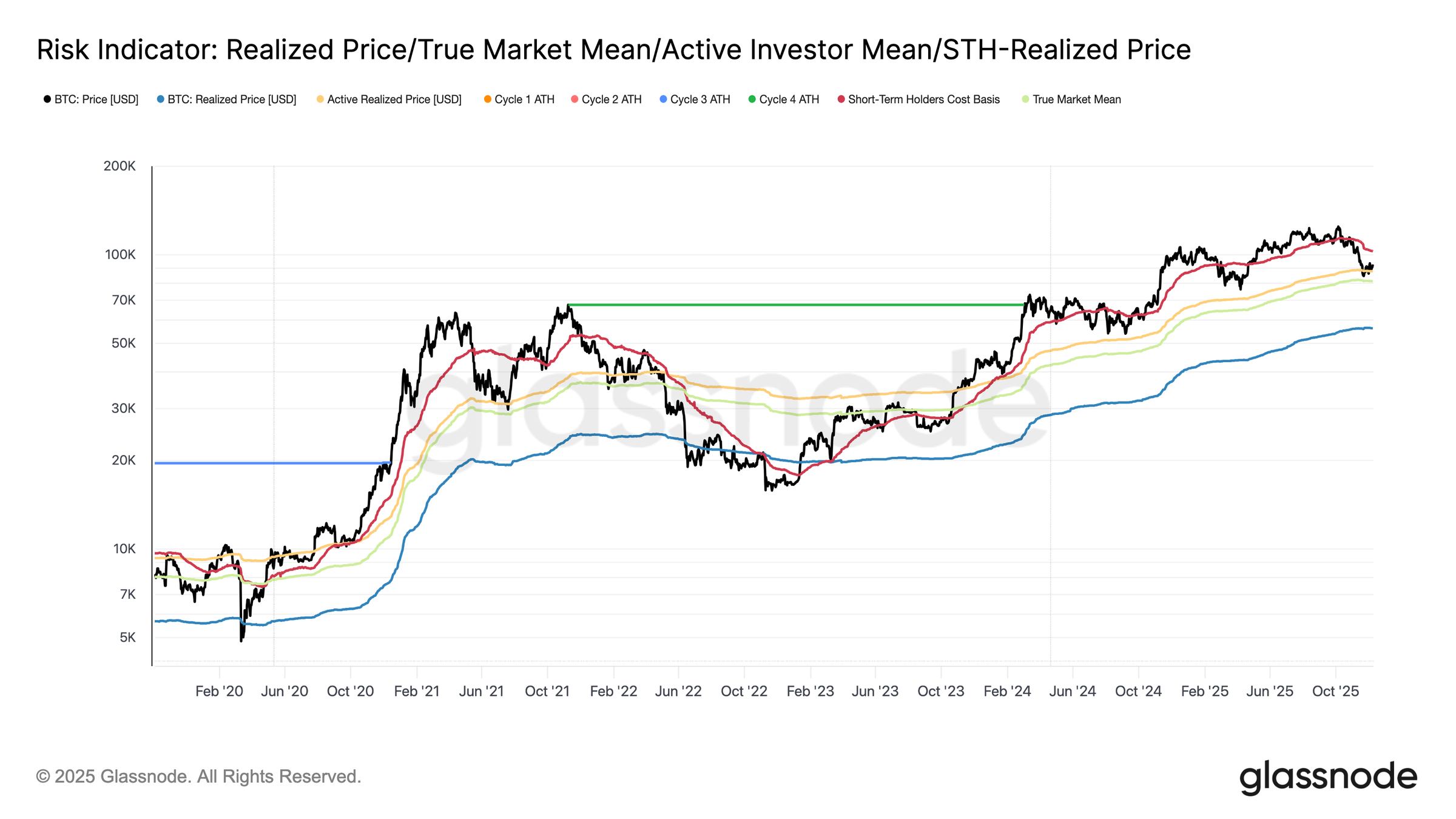
Realized price and true market mean for Bitcoin. Source: Glassnode

The 30-day simple moving average (SMA) of relative unrealized loss has risen to 4.4%, breaking out of a two-year sub-2% range and signaling an entry into a higher-stress market environment. Despite Bitcoin's rebound from the November 22 low to around $92,700, the entity-adjusted realized loss continues to climb, reaching $555 million per day, levels consistent with the FTX capitulation period.

Simultaneously, long-term holders (holding for over one year) are realizing over $1 billion in profits daily, with peaks hitting a record $1.3 billion. Capitulation from top buyers combined with massive distribution by long-term holders will likely keep BTC suppressed below key cost bases, preventing a reclaim of the $95,000–$102,000 resistance zone, which marks the upper bound of the fragile zone.
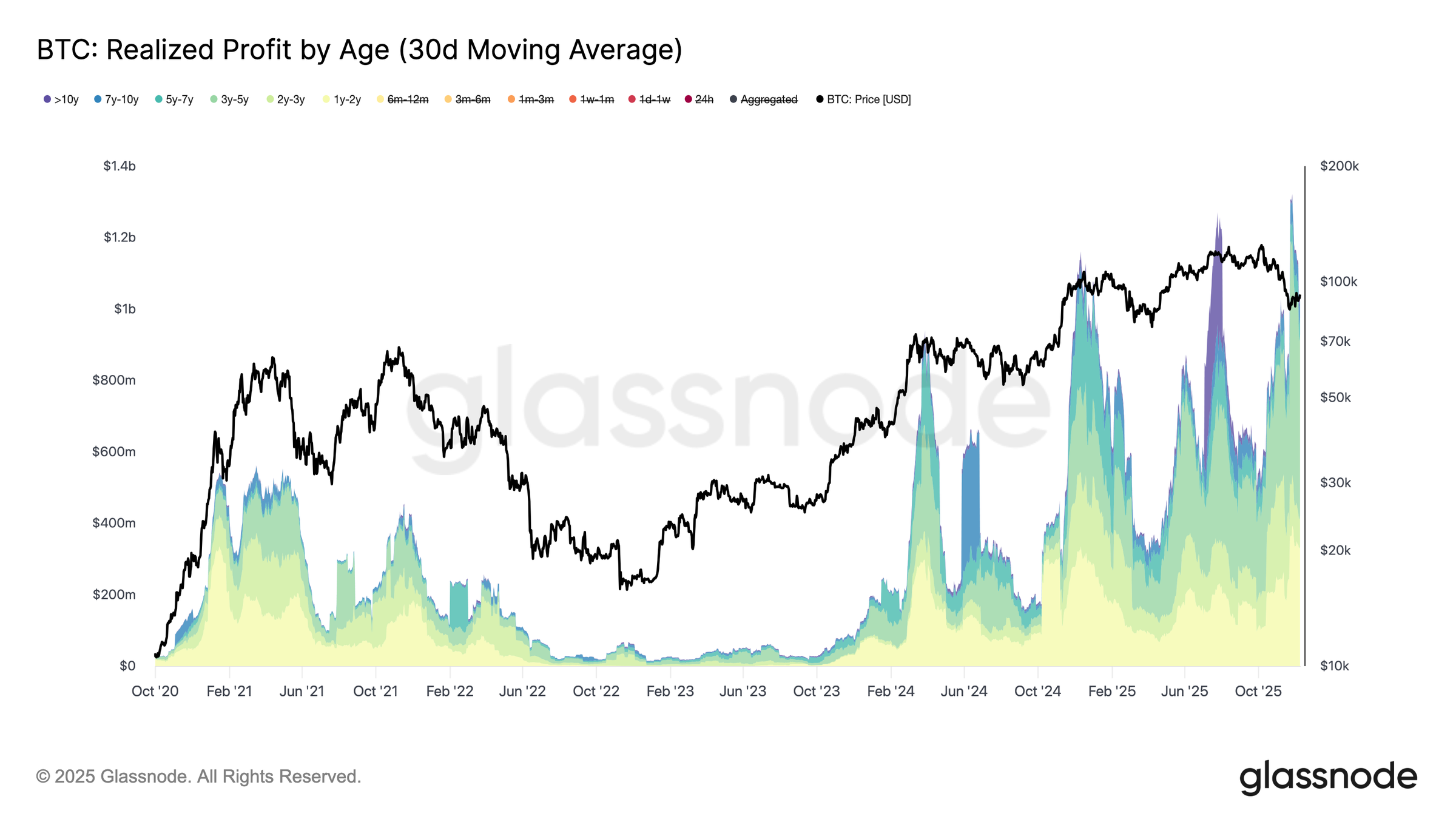
Realized profit by age. Source: Glassnode

Spot-Led Rally Meets a Shrinking Futures Market

Data from CryptoQuant shows that crypto markets typically rally ahead of FOMC meetings, but a significant divergence has recently appeared: Bitcoin's price is rising while open interest (OI) continues to decline.
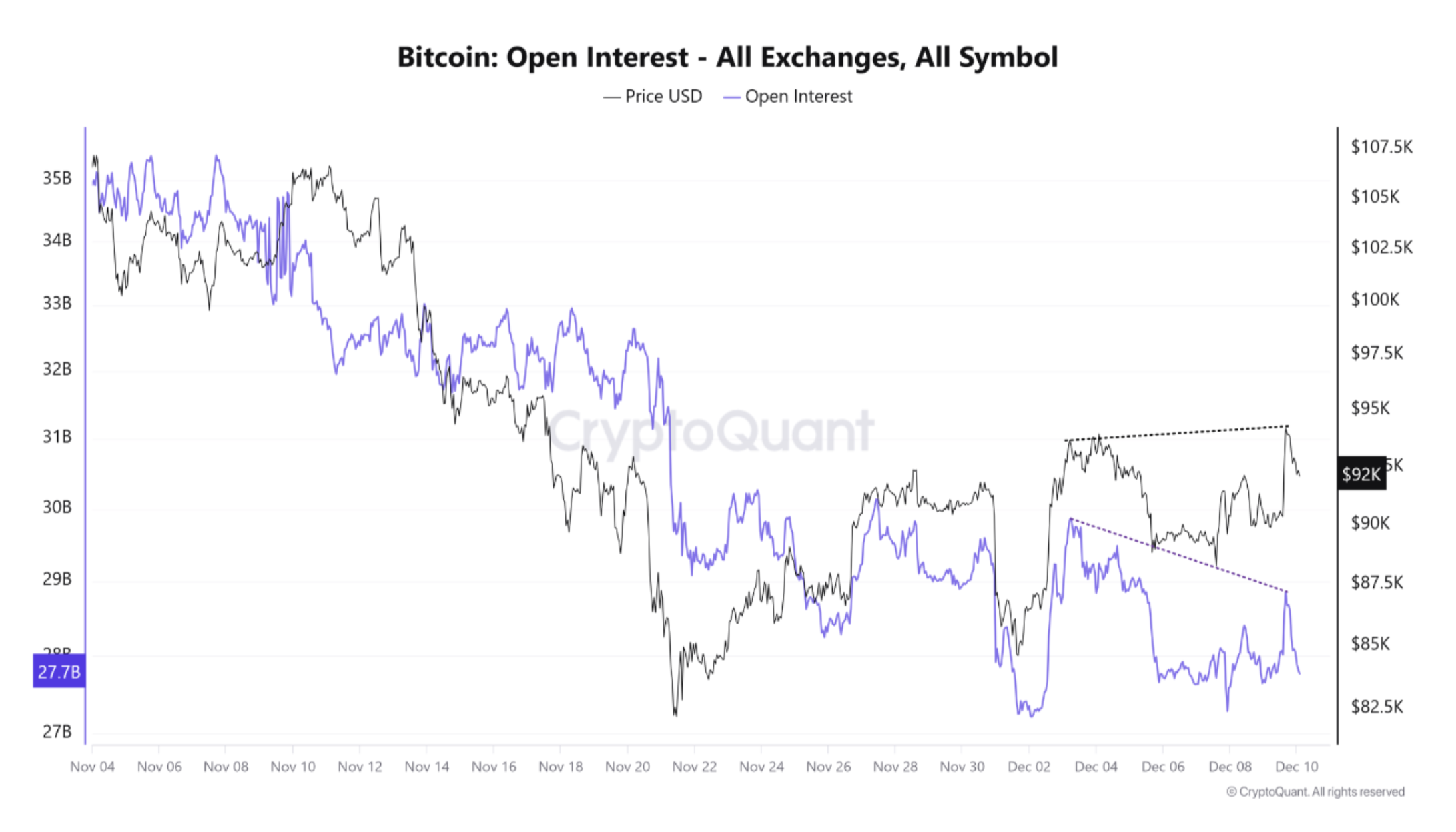
Bitcoin price versus open interest divergence. Source: CryptoQuant

Open interest has been declining throughout the correction since October, and even as Bitcoin found a bottom on November 21st and prices moved higher, OI continued to fall. This suggests the current rally is primarily driven by spot demand, not leveraged speculation.

CryptoQuant added that while spot-driven advances are generally healthier, sustained bullish momentum historically still requires a rise in leveraged positions. Given that derivatives trading volume structurally dominates the market—with spot volume accounting for only about 10% of derivatives activity—this spot-driven strength could be difficult to sustain if market expectations for future rate cuts weaken ahead of the meetings.


Related Questions

QWhat was the outcome of the recent Federal Reserve meeting regarding interest rates, and how did it align with market expectations?

AThe Federal Reserve approved a 25 basis point interest rate cut, which was the third cut of the year and in line with market expectations.

QAccording to Glassnode, what is the key price range trapping Bitcoin below $100,000, and what are the upper and lower bounds of this 'structurally fragile' zone?

ABitcoin is trapped in a structurally fragile range below $100,000, bounded by the short-term holder cost basis at $102,700 and the 'true market mean' at $81,300.

QWhat does the data show about the daily losses being realized in the Bitcoin market, and how does it compare to a previous significant event?

ARealized losses have surged to $555 million per day, which is the highest level since the FTX collapse in 2022.

QHow does the current market rally differ from previous ones in terms of the role of derivatives, and what does this suggest about its sustainability?

AThe current rally is primarily driven by spot demand rather than leveraged speculation, as indicated by declining open interest. While a spot-led rally is generally healthier, sustained bullish momentum has historically required an increase in leverage, which is currently absent.

QWhat two major groups of sellers are applying significant selling pressure, preventing Bitcoin from reclaiming a key resistance zone?

ALong-term holders (holding for over a year) are realizing profits at a record scale, and 'top buyers' are capitulating. These two groups are applying significant selling pressure, preventing Bitcoin from reclaiming the $95,000–$102,000 resistance zone.

Related Reads

$50 Million Funding Ignites Airdrop Anticipation, Variational Becomes New Focus of Perp DEX

Variational, a perpetual decentralized exchange (Perp DEX) on Arbitrum, has become a focal point in the crypto community after announcing a $50 million Series A funding round led by Dragonfly Capital, with participation from Bain Capital Crypto and Coinbase Ventures. This news caused a significant pre-listing price surge and increased predictions of a high fully diluted valuation (FDV) upon launch. A key feature of Variational is its zero-trading-fee model. It differentiates itself by aggregating multi-source liquidity, including traditional and crypto-native market makers, to address on-chain liquidity challenges. According to DefiLlama, it ranks fourth among Perp DEXs by open interest and is notable as the only top-five platform yet to issue a token. The primary way for users to engage is through its "Trade-to-Earn" Omni Points program. Points are awarded weekly based on trading activity, with bonuses for early users and a tiered reward system that incentivizes higher trading volumes. The program also includes a referral system offering USDC rewards and extra points. The design emphasizes organic trading over mere volume farming. While an exact Token Generation Event (TGE) date for the VAR token is not confirmed, official documentation states the points program will run at least until the end of Q3 2026. Community and prediction market sentiment generally expects the TGE to occur in Q3 or Q4 of this year.

Odaily星球日报9m ago

$50 Million Funding Ignites Airdrop Anticipation, Variational Becomes New Focus of Perp DEX

Odaily星球日报9m ago

Morning Brief | Deloitte Acquires Crypto Infrastructure Firm Blocknative; Stablecoin Firm Checker Raises $8M; a16z Likely Becomes Largest External Holder of HYPE

ChainCatcher Daily Update - May 21st Major headlines include Deloitte's acquisition of crypto infrastructure firm Blocknative, signaling further traditional finance adoption. In funding news, stablecoin infrastructure company Checker secured $8 million, while decentralized derivatives platform Variational raised $50 million in a Series A round led by Dragonfly Capital. Significant corporate moves saw Tether acquire SoftBank's entire stake in Twenty One Capital (XXI), and Mastercard pivot its strategy by investing in BVNK for stablecoin payments after abandoning Zerohash. VC giant Andreessen Horowitz (a16z) is reported to be a major external holder of HYPE, with positions exceeding $356 million. On the institutional front, MicroStrategy's CEO noted that 13 of its top 15 institutional shareholders increased their $MSTR holdings in Q1 2026, with aggregate positions growing 27%. Meanwhile, the parent company of the NYSE, ICE, announced plans to launch a futures market for AI computing power ("hashrate"). The report also features a "Meme Hot List" ranking trending tokens on Ethereum, Solana, and Base networks, and highlights several key articles. These include an analysis of renowned investor Duan Yongping's first crypto investment in Circle, concerns over talent drain and institutional selling pressure at the Ethereum Foundation, the growing business of crypto asset recovery, and an examination of the trillion-dollar potential and remaining hurdles for the tokenized asset market.

链捕手38m ago

Morning Brief | Deloitte Acquires Crypto Infrastructure Firm Blocknative; Stablecoin Firm Checker Raises $8M; a16z Likely Becomes Largest External Holder of HYPE

链捕手38m ago

147 Trillion vs 70 Billion: The Rise of On-Chain 'Risk Managers' and the Potential Dawn of a New Era in DeFi Asset Management

"147 Trillion vs 70 Billion: The Rise of On-Chain 'Risk Managers' and the Potential Dawn of a New Era in DeFi Asset Management" Key Points: The role of professional asset managers is emerging in DeFi, ending the era where protocols and governance dictated everything. While early DeFi protocols like Aave and Compound bundled risk management within their code, innovations like Morpho have separated infrastructure from risk judgment. This allows specialized "Risk Managers" to operate independent lending vaults, acting as on-chain asset managers. The market, though early with ~$7B in assets under management (AUM), is rapidly consolidating around top performers like SteakhouseFi (RWA focus), SentoraHQ (AI-driven models), and Gauntlet (crisis management). This modular structure mirrors TradFi's division of labor: distributors (e.g., exchanges) source capital, Risk Managers design strategies and set standards, and underlying protocols handle custody and execution. For traditional asset managers, this familiar structure presents clear entry paths: 1) **Distribution**: Partnering with Risk Managers as a backend service. 2) **Supply**: Bringing real-world assets (RWA) on-chain as collateral. 3) **Operation**: Becoming a Risk Manager themselves (e.g., Bitwise). The core competency required is shifting from coding to traditional risk underwriting and financial expertise—areas where established institutions hold a natural advantage. While the current DeFi market (~$80B) is minuscule compared to global asset management (~$147T), it represents a significant growth runway. The teams that build the trusted standards and rails for risk-managed capital now are poised to define the market's future as institutional capital seeks secure on-ramps.

marsbit46m ago

147 Trillion vs 70 Billion: The Rise of On-Chain 'Risk Managers' and the Potential Dawn of a New Era in DeFi Asset Management

marsbit46m ago

Trading

Spot
Futures

Hot Articles

Discussions

Welcome to the HTX Community. Here, you can stay informed about the latest platform developments and gain access to professional market insights. Users' opinions on the price of S (S) are presented below.

活动图片