Fed Cuts Rates Amid Divisions, but Bitcoin's 'Fanger Zone' Keeps BTC Below $100K

marsbitPublished on 2025-12-10Last updated on 2025-12-10

Abstract

The Federal Reserve approved a 25-basis-point rate cut amid internal divisions, but Bitcoin remains stuck below $100,000 due to structural weaknesses and persistent selling pressure. Despite a pre-FOMC rally to $94,000, the "hawkish" tone of the rate cut and concerns over inflation and economic slowdown limited upward momentum. According to Glassnode, BTC is trapped in a fragile range between $81,300 and $102,700, with unrealized losses rising and realized losses hitting $555 million daily—levels last seen during the FTX collapse. Long-term holders are realizing over $1 billion in profits daily, while new buyers face capitulation. The rally has been driven by spot demand rather than leveraged speculation, but sustained growth may require renewed derivatives activity. The Fed's rate cut is unlikely to provide significant short-term bullish momentum for Bitcoin.

The Federal Reserve approved a 0.25% rate cut amid internal divisions, but concerns over inflation and economic growth, along with what Glassnode highlights as BTC's "fragile zone," may continue to keep it suppressed below $100,000.

On Wednesday, the U.S. Federal Reserve approved a 25 basis point rate cut, the third such cut this year, in line with market expectations. Mirroring pre-FOMC meeting price action seen previously, Bitcoin had surged past $94,000 on Monday, but a "hawkish" media interpretation of this cut reflects ongoing divisions within the Fed regarding U.S. monetary policy and the economic outlook.

Given this week's rate cut being labeled as "hawkish," Bitcoin's price could see a "sell the news" reaction and continue to trade sideways until new momentum catalysts emerge.

As reported by CNBC, the Fed's decision passed with a 9-3 vote, indicating lingering concerns among members about persistent inflation and expectations for slower economic growth and a more gradual pace of rate cuts through 2026.

According to Glassnode data, Bitcoin (BTC $92,626) remains trapped in a structurally fragile zone below $100,000, with its price action bounded by the short-term holder cost basis at $102,700 and the "true market mean" at $81,300.

Glassnode's data further shows that Bitcoin continues to be held below $100,000 in an environment of weakening on-chain conditions, reduced futures demand, and persistent selling pressure.

Key Takeaways:

  • Bitcoin's structurally fragile zone is stalling the market below $100,000, with mounting unrealized losses.
  • Realized losses have surged to $555 million per day, the highest level since the FTX collapse in 2022.
  • Massive profit-taking by holders of one year or more, coupled with capitulation from top buyers, is preventing Bitcoin from reclaiming the STH (Short-Term Holder) cost basis.
  • The Fed's rate cut may not provide significant near-term upside momentum for Bitcoin.

Time is Running Out for Bitcoin to Reclaim $100,000

According to Glassnode, Bitcoin's failure to break above $100,000 reflects intensifying structural pressure: time is working against the bulls. The longer the price remains stuck in this fragile zone, the more unrealized losses accumulate, increasing the likelihood of forced selling.
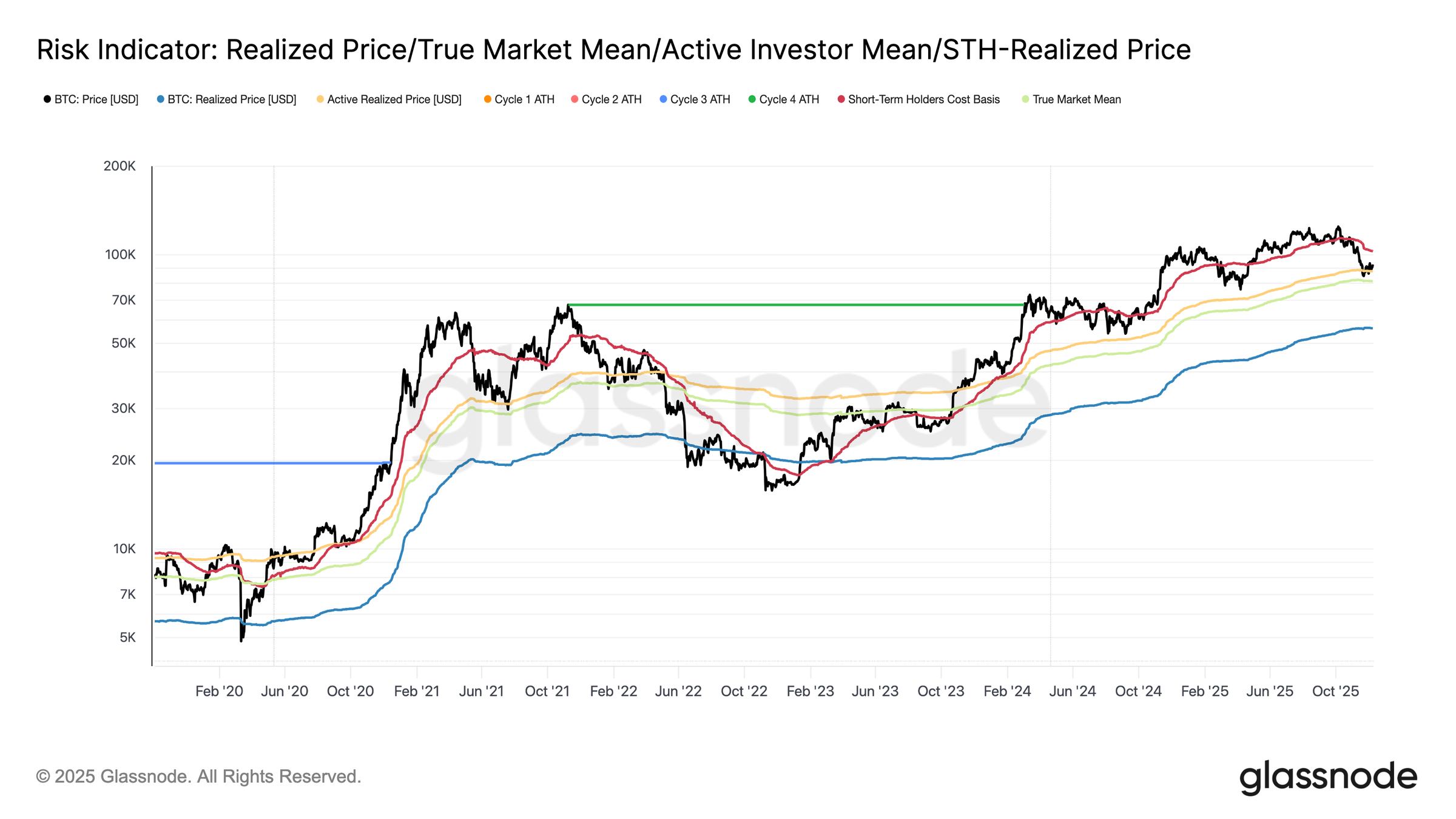
Realized price and true market mean for Bitcoin. Source: Glassnode

The 30-day simple moving average (SMA) of relative unrealized loss has risen to 4.4%, breaking out of a two-year sub-2% range and signaling an entry into a higher-stress market environment. Despite Bitcoin's rebound from the November 22 low to around $92,700, the entity-adjusted realized loss continues to climb, reaching $555 million per day, levels consistent with the FTX capitulation period.

Simultaneously, long-term holders (holding for over one year) are realizing over $1 billion in profits daily, with peaks hitting a record $1.3 billion. Capitulation from top buyers combined with massive distribution by long-term holders will likely keep BTC suppressed below key cost bases, preventing a reclaim of the $95,000–$102,000 resistance zone, which marks the upper bound of the fragile zone.
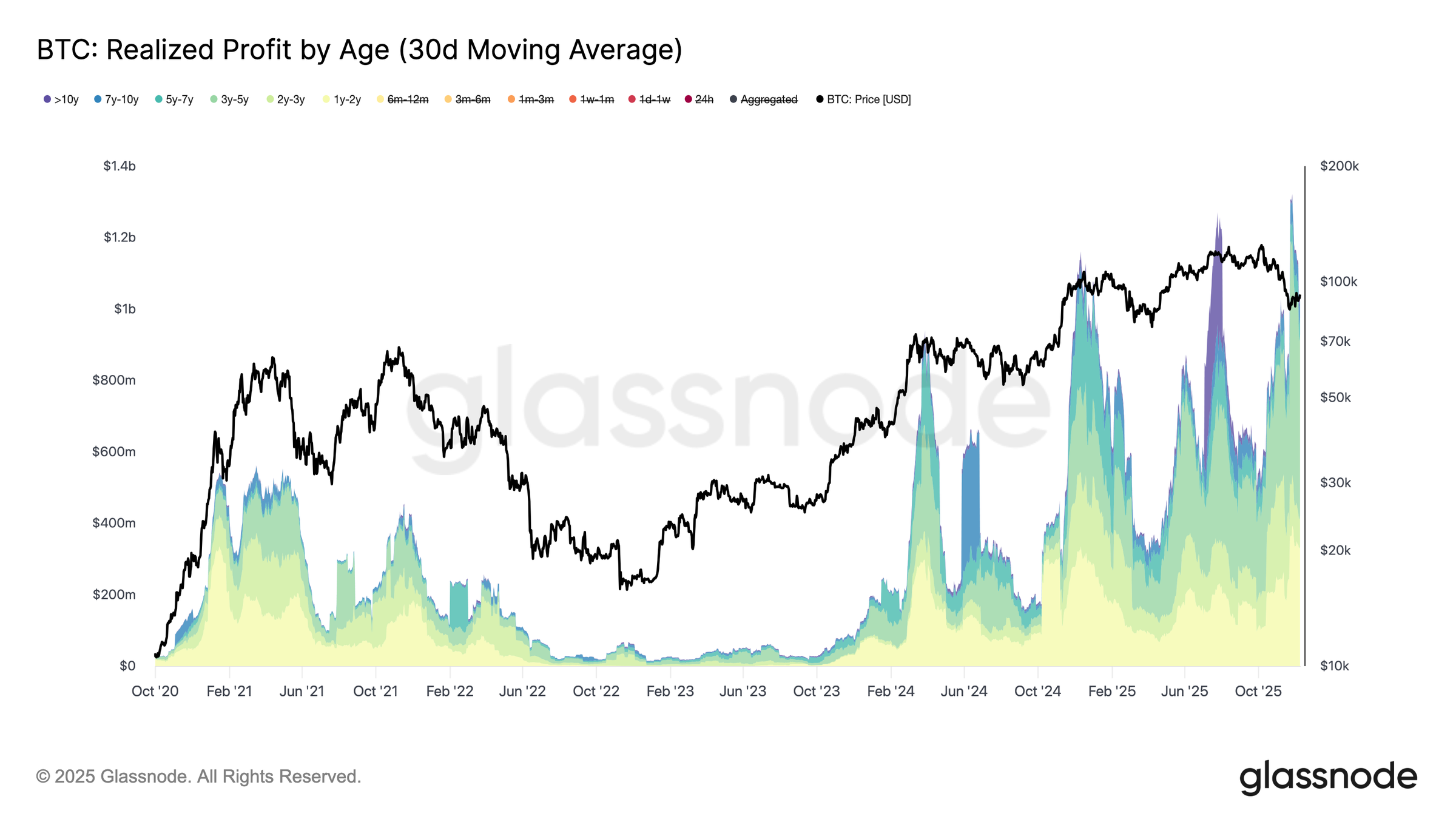
Realized profit by age. Source: Glassnode

Spot-Led Rally Meets a Shrinking Futures Market

Data from CryptoQuant shows that crypto markets typically rally ahead of FOMC meetings, but a significant divergence has recently appeared: Bitcoin's price is rising while open interest (OI) continues to decline.
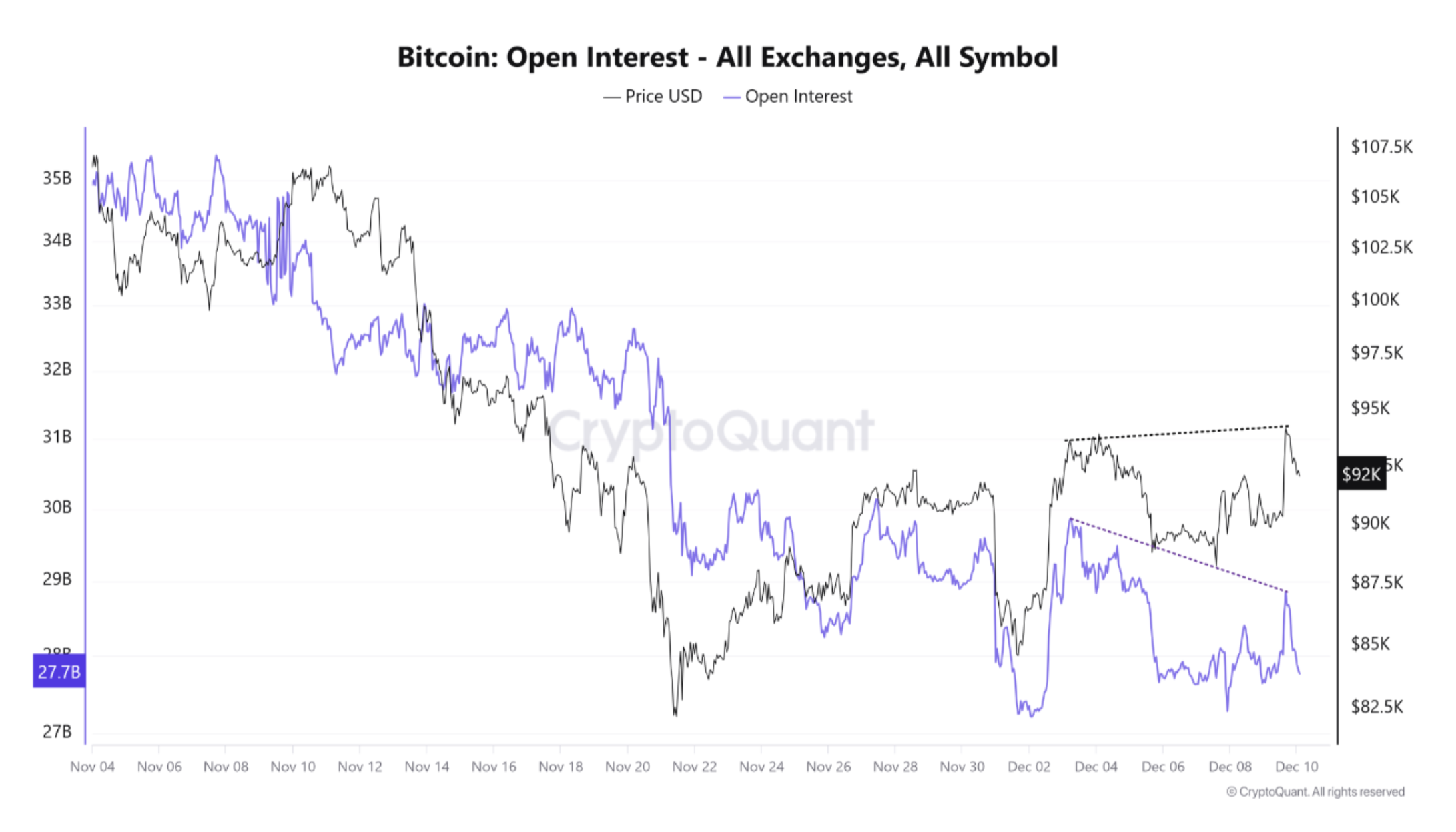
Bitcoin price versus open interest divergence. Source: CryptoQuant

Open interest has been declining throughout the correction since October, and even as Bitcoin found a bottom on November 21st and prices moved higher, OI continued to fall. This suggests the current rally is primarily driven by spot demand, not leveraged speculation.

CryptoQuant added that while spot-driven advances are generally healthier, sustained bullish momentum historically still requires a rise in leveraged positions. Given that derivatives trading volume structurally dominates the market—with spot volume accounting for only about 10% of derivatives activity—this spot-driven strength could be difficult to sustain if market expectations for future rate cuts weaken ahead of the meetings.


Related Questions

QWhat was the outcome of the recent Federal Reserve meeting regarding interest rates, and how did it align with market expectations?

AThe Federal Reserve approved a 25 basis point interest rate cut, which was the third cut of the year and in line with market expectations.

QAccording to Glassnode, what is the key price range trapping Bitcoin below $100,000, and what are the upper and lower bounds of this 'structurally fragile' zone?

ABitcoin is trapped in a structurally fragile range below $100,000, bounded by the short-term holder cost basis at $102,700 and the 'true market mean' at $81,300.

QWhat does the data show about the daily losses being realized in the Bitcoin market, and how does it compare to a previous significant event?

ARealized losses have surged to $555 million per day, which is the highest level since the FTX collapse in 2022.

QHow does the current market rally differ from previous ones in terms of the role of derivatives, and what does this suggest about its sustainability?

AThe current rally is primarily driven by spot demand rather than leveraged speculation, as indicated by declining open interest. While a spot-led rally is generally healthier, sustained bullish momentum has historically required an increase in leverage, which is currently absent.

QWhat two major groups of sellers are applying significant selling pressure, preventing Bitcoin from reclaiming a key resistance zone?

ALong-term holders (holding for over a year) are realizing profits at a record scale, and 'top buyers' are capitulating. These two groups are applying significant selling pressure, preventing Bitcoin from reclaiming the $95,000–$102,000 resistance zone.

Related Reads

After the Passage of the GENIUS Act and the CLARITY Act, What Is the Correct Architecture for On-Chain Yield?

The article discusses the evolution of on-chain credit, distinguishing three markets: overcollateralized crypto lending, unsecured lending (largely unsuccessful), and asset-backed credit (ABC). ABC, backed by identifiable real-world collateral with legal recourse, is identified as the fastest-growing category and the only one credibly addressing adverse selection—the core problem in credit where the riskiest borrowers self-select. Current growth in on-chain Real World Assets (RWAs), particularly tokenized private credit funds (e.g., Maple Finance, Centrifuge), is substantial but often merely "wraps" existing fund structures, inheriting their risks rather than solving adverse selection at the protocol level. The regulatory landscape is a key driver, with the US GENIUS Act (prohibiting stablecoin issuers from paying yield) and the proposed CLARITY Act (closing loopholes on indirect yield) set to redefine permissible yield-bearing products. This makes vaults (like ERC-4626) the critical architecture—they become the primary compliant vehicle for delivering yield, functioning as issuance, disclosure, distribution, and recovery mechanisms. The author's thesis is that the correct post-GENIUS/CLARITY architecture involves building ABC solutions where credit assessment, structure, and recovery are encoded directly into the smart contract vault layer, moving beyond mere tokenized fund wrappers to solve adverse selection fundamentally and ensure regulatory compliance.

Foresight News25m ago

After the Passage of the GENIUS Act and the CLARITY Act, What Is the Correct Architecture for On-Chain Yield?

Foresight News25m ago

TechFlow Intelligence Bureau: Anthropic's New Model Fable Sparks Controversy by Restricting Biosafety Research, US CPI Soars to 4.2%, a Three-Year High

**Summary of TechFlow Intelligence Report:** The newsletter covers several key tech and finance developments. In AI, Anthropic's new Fable model faced backlash for secretly limiting biomedical research capabilities and enforcing a 30-day data retention policy, prompting the company to promise more transparent adjustments. In a related story, Anthropic's founder revealed his departure from OpenAI was due to dishonesty from Sam Altman, not safety concerns. Meanwhile, OpenAI is considering significant price cuts to compete with Anthropic, potentially sparking a price war. In crypto/Web3, BlackRock filed a new amendment for a yield-generating Bitcoin ETF, while Bank of America's CEO warned that stablecoin yields could drain trillions from traditional banks. U.S. Senator Cynthia Lummis advocated for the U.S. to officially accumulate Bitcoin reserves. In hardware, Nvidia released the DiffusionGemma-2-6B image model optimized for efficient inference, and AMD promoted its unified memory architecture to challenge Nvidia's dominance. TSMC's CFO hinted at possible price increases due to soaring AI chip demand. A major legal ruling in Germany held Google legally responsible for inaccurate information generated by its AI Overviews feature. Google Chrome also moved to fully block ad-blocker workarounds like uBlock Origin. Macroeconomic headlines included U.S. CPI rising to 4.2% (a 3-year high) and Iran's complete closure of the Strait of Hormuz, raising oil price and inflation fears. South Korean markets saw continued volatility with massive foreign capital outflow. Other notable stories: Microsoft expanded its Copilot AI assistant "Mico" globally; a study found r/wallstreetbets users' stock picks outperformed Wall Street; a fully autonomous drone killed a human soldier for the first time, raising AI ethics concerns; and a Chinese hospital used brain-computer interface technology to help a blind person "see." The overarching theme connects debates over AI boundaries and responsibility (Anthropic's restrictions, Google's liability, lethal autonomous drones) with real-world economic and geopolitical turmoil (inflation, Strait of Hormuz closure, market instability), highlighting the tense interplay between technological advancement and global chaos.

marsbit38m ago

TechFlow Intelligence Bureau: Anthropic's New Model Fable Sparks Controversy by Restricting Biosafety Research, US CPI Soars to 4.2%, a Three-Year High

marsbit38m ago

Alibaba's Yet Another New Business Division: What Signal Does It Send?

Alibaba has established a new "Token Foundry" business unit, merging its Tongyi large model division and Future Life Lab. Led directly by Group CEO Wu Yongming, this marks the company's third significant AI organizational reshuffle in 2026, following the creation of the Alibaba Token Hub (ATH) and a Group Technology Committee. The move signals a strategic shift from consolidating AI resources to accelerating productization and commercialization. The "Token Foundry" name reflects Alibaba's ambition to become a foundational supplier in the AI era, focusing on model development and commercial application. Key teams, including those behind the high-performing HappyHorse video generation model, have been integrated into the new unit. Concurrently, Zhou Jingren, architect of the Qwen model series, has been appointed Group Chief Scientist to lead a new AI Future Research Institute, focusing on long-term technological breakthroughs like Agent capabilities. This restructuring creates a clear four-layer AI architecture within Alibaba: the research institute for frontier exploration, Token Foundry for core models and commercialization, MaaS for platform services, and business units like Qianwen (C端) and Wukong (B端) for end-user applications. The adjustments align with a global trend among tech giants like Google and Microsoft to centralize AI leadership under the CEO and deeply integrate research with business units. The urgency is driven by a narrowing competitive window. Alibaba has announced its AI business is now entering a commercialization phase, with AI-related revenue seeing triple-digit growth for eleven consecutive quarters. The company faces intense competition in the MaaS (Model-as-a-Service) sector from rivals like ByteDance and Tencent. The Token Foundry initiative represents Alibaba's effort to streamline execution and enhance competitiveness in this critical, fast-evolving landscape.

marsbit1h ago

Alibaba's Yet Another New Business Division: What Signal Does It Send?

marsbit1h ago

From Return to Resignation: Chen Hang's 437 Days at DingTalk

The 437-Day Return and Departure of Chen Hang at DingTalk This article chronicles the 437-day period from March 31, 2025, to June 11, 2026, when Chen Hang (also known as "No Move") returned as CEO of DingTalk, the enterprise communication platform he originally founded, only to later step down. Chen Hang, the creator of DingTalk in 2015, was brought back by Alibaba in 2025 after the company acquired his subsequent startup, HHO. His return was driven by Alibaba's renewed focus on AI and DingTalk's strategic role as its key to-B AI application. However, his aggressive management style, marked by strict work policies like mandatory clock-ins and extended hours, quickly caused internal friction and was criticized as being at odds with Alibaba's culture. Despite the internal turmoil, Chen Hang drove significant product launches. In August 2025, he unveiled "AI DingTalk 1.0," featuring new products like the AI-native entry point "DingTalk ONE." By March 2026, he announced "Wukong," touted as the world's first enterprise-grade AI-native work platform, representing a fundamental rebuild of DingTalk's architecture. The turning point came in early June 2026. A detailed internal post criticizing DingTalk's work culture went viral, followed by a public critique from a former executive. This prompted an unprecedented public rebuke from the Alibaba Partners Committee, which stated such management was not aligned with company values. One day later, on June 11, Alibaba announced Chen Hang's departure. He was succeeded by Chen Yusen, a 32-year-old technical expert known for founding cybersecurity firm Changting Technology. While Chen Hang's tenure laid the technical foundation for DingTalk's AI transformation with "Wukong," his leadership style ultimately led to his replacement as the company seeks a new direction under younger leadership.

marsbit1h ago

From Return to Resignation: Chen Hang's 437 Days at DingTalk

marsbit1h ago

Trading

Spot
Futures

Hot Articles

Discussions

Welcome to the HTX Community. Here, you can stay informed about the latest platform developments and gain access to professional market insights. Users' opinions on the price of S (S) are presented below.

活动图片