XRP transaction fees drop 89%: Is price headed below $1.75?

cointelegraphPublished on 2025-12-11Last updated on 2025-12-11

Abstract

XRP transaction fees on the XRP Ledger have plummeted 89% to approximately 650 XRP per day, a level not seen since December 2020. This significant drop coincides with a sharp decline in futures open interest and funding rates, indicating reduced confidence among derivatives traders. Technically, the XRP/USD pair is forming a descending triangle pattern. A break below the key support level of $2 could trigger a further decline, with a measured target of $1.73, representing a 15% drop from the current price. While social sentiment has entered a "fear zone," some analysts suggest this could be a precursor to a future rally.

XRP’s (XRP) drop toward $2 was preceded by a significant drop in transaction fees, which analysts said may fuel a deeper price correction.

Key takeaways:

  • XRP transaction fees have dropped to 650 XRP per day, levels last seen in December 2020.

  • XRP’s descending triangle targets $1.73.

XRP transaction fees drops to five-year lows

The total daily transaction fees on XRP Ledger (XRPL) have dropped significantly since the beginning of the year, according to onchain data provider Glassnode.

Related: XRP needs a Solana-style strategy to keep up: Ripple executive

The total fees paid daily on XRP have dropped to approximately 650 XRP per day from 5,900 XRP per day on Feb. 9, Glassnode said in a Thursday post on X, adding:

“This marks an 89% decline to levels last seen since December 2020.”
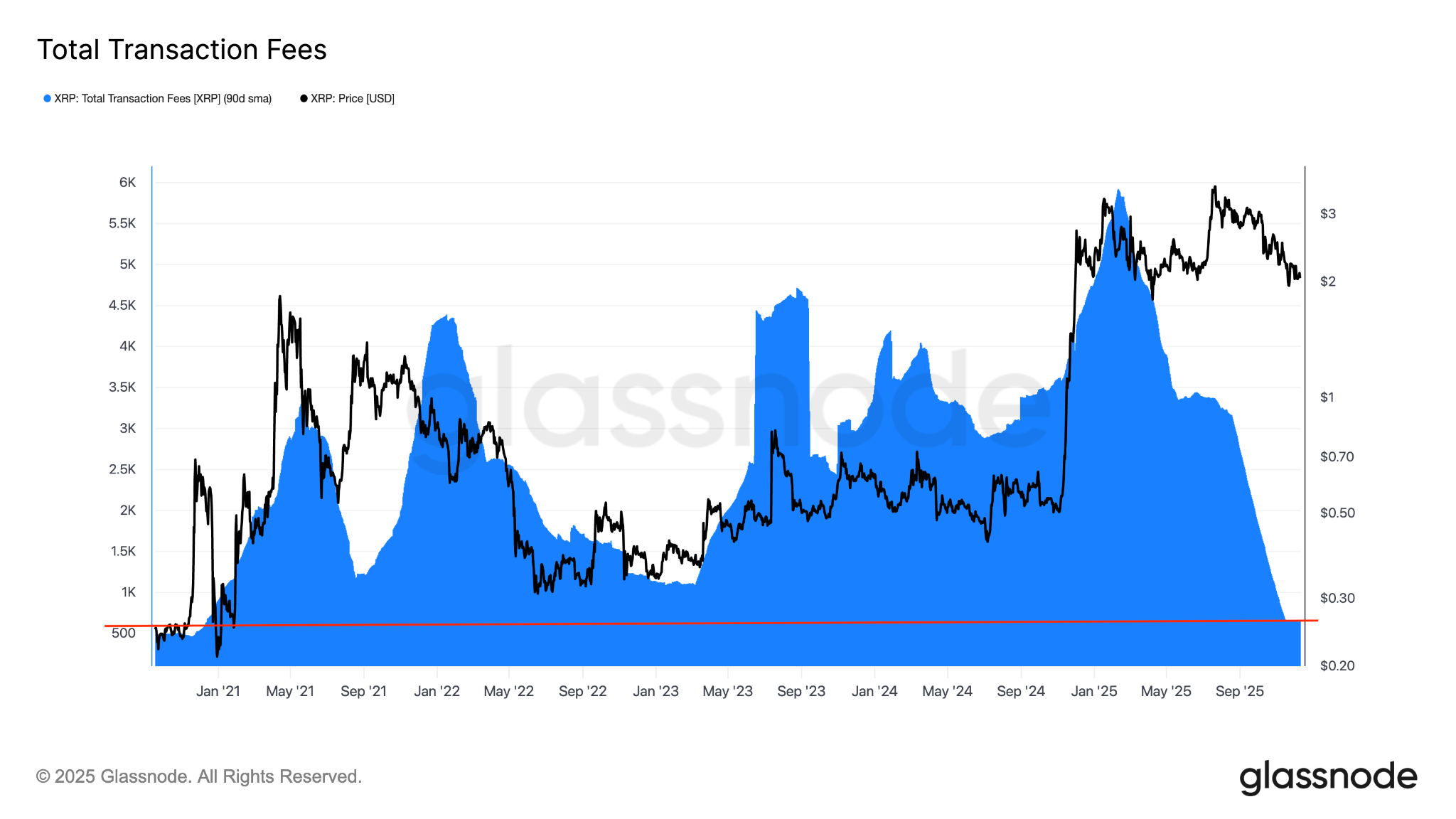
XRP transaction fees. Source: Glassnode

The drop in transaction fees coincides with a sharp drop in XRP’s futures open interest (OI), which has fallen to 0.74 billion XRP from 1.75 billion XRP in early October, representing a 59% flush-out.

Paired with the funding rates dropping to 0.001% from approximately 0.01% (7D-SMA), this suggests reduced confidence among derivatives traders in XRP’s ability to recover.
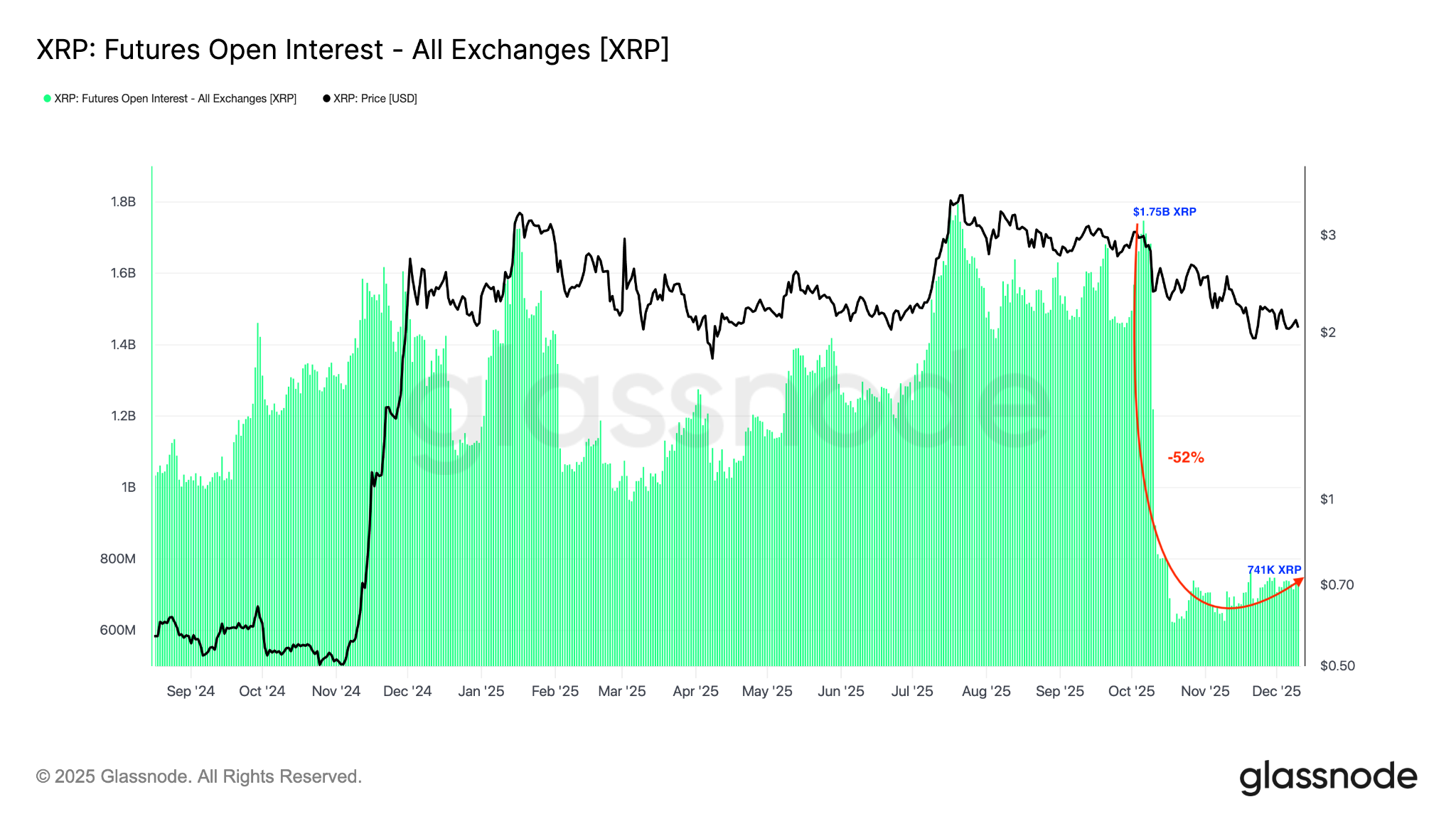
XRP: Futures open interest. Source: Glassnode

As Cointelegraph reported, social sentiment toward XRP has tanked into the “fear zone,” the most FUD since early October, but some analysts say such a drop could be a precursor for a massive rally in XRP price, as seen in the past.

XRP’s descending triangle targets $1.73

Price technicals for the XRP/USD pair are also showing a potential risk of dropping lower if it completes a descending triangle pattern.

The chart below points to more downside risk if the price breaks below the triangle’s support line at $2.

The measured target of the pattern, calculated by adding the triangle’s height to the breakout point, is $2.20, representing a 15% decline from the current price.
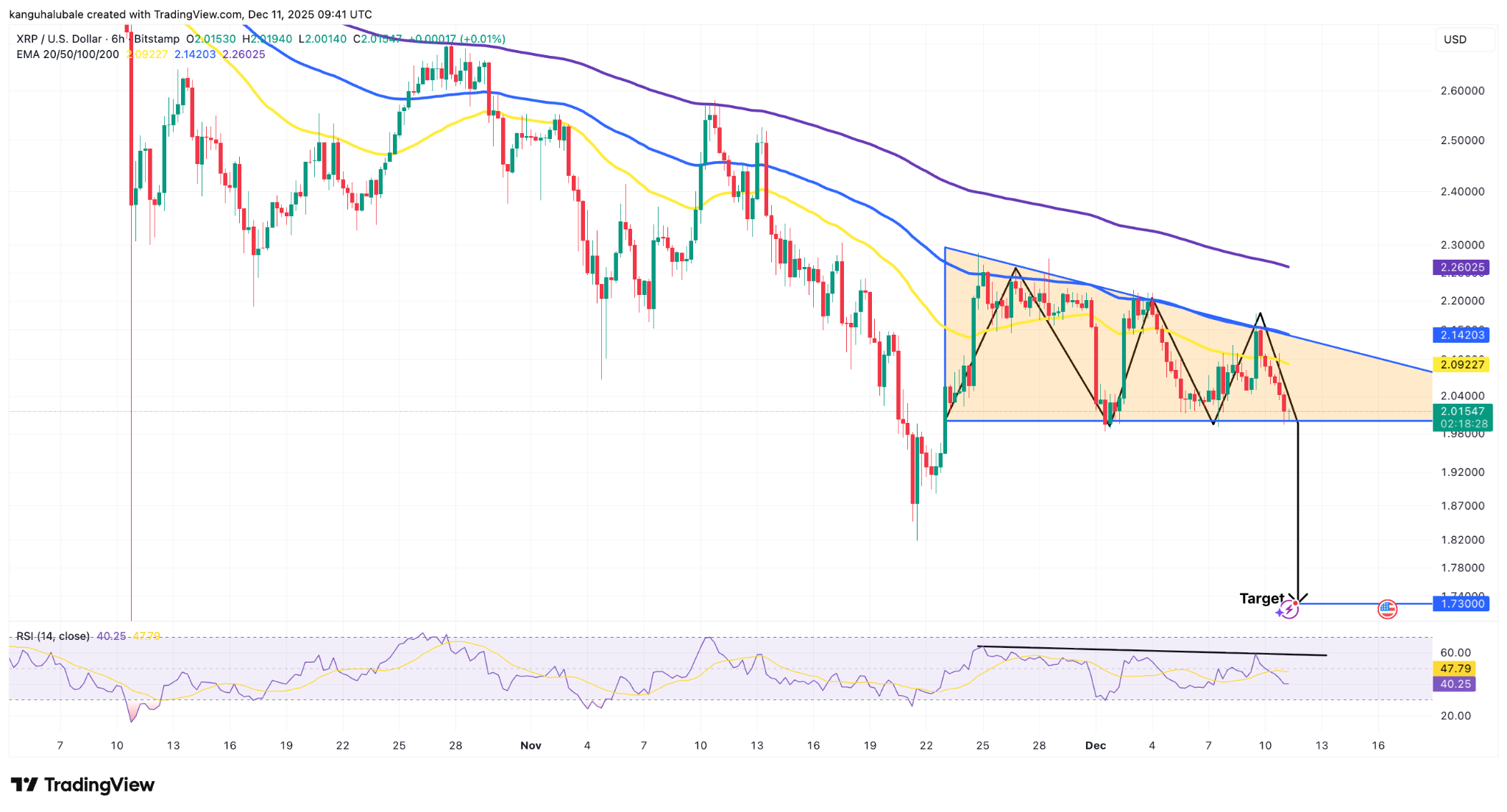
XRP/USD daily chart. Source: Cointelegraph/TradingView

As Cointelegraph reported, the area between $2 and $1.98 remains a key support zone for XRP, and holding is crucial to avoiding further losses to $1.61.

This article does not contain investment advice or recommendations. Every investment and trading move involves risk, and readers should conduct their own research when making a decision.



Trending Cryptos

Related Reads

Former Huawei 'Genius Teen' Who Questioned DeepSeek Interview Lands in 'Crossfire' from Web3 Investor

Former Huawei "Genius Youth" Li Bojie recently drew public attention by criticizing his interview experience with DeepSeek. The controversy escalated when Du Jun, co-founder of Web3 investment firm ABCDE Capital, publicly accused Li of being "the founder with the least sense of contractual spirit" he had ever cooperated with, sparking a dispute over Li's startup project, Metagent. Li detailed a frustrating DeepSeek interview where he was accused of potential plagiarism, leading him to end the session. The spotlight then shifted to his venture, Metagent, a Web3+AI project aiming to tokenize AI agents. ABCDE invested $1.5 million, with an initial $500k disbursed. Du Jun claimed the project's progress was severely lacking, with a poor-quality demo and minimal social media activity. He alleged Li stopped communicating, deleted his Telegram, and failed to provide proper financial reporting. In response, Li argued the remaining $1 million was never received, crippling operations and forcing salary cuts. He stated he left Metagent in October 2024 due to family reasons and Web3 compliance concerns, with board approval. He claimed to have fulfilled disclosure duties and that his subsequent projects avoided conflicting fields. Other investors, including ArkStream Capital, shared negative due diligence experiences, citing unprofessional contracts and evasive answers on tokenomics. Metagent's social media went silent in June 2024, effectively stalling. Li has since moved to a new consumer AI agent platform, Pine AI (formerly Logenic AI), which has raised $25 million in Series A funding. He served as its Chief Scientist but recently left, clarifying he was not the founder and departed due to a shift in research interests.

Foresight News3m ago

Former Huawei 'Genius Teen' Who Questioned DeepSeek Interview Lands in 'Crossfire' from Web3 Investor

Foresight News3m ago

SemiAnalysis: Anthropic's Q3 Profit to Exceed $1 Billion

Research firm SemiAnalysis reveals that Anthropic is reshaping the AI commercialization landscape with profitability and growth rates far exceeding competitors. Leveraging a high-margin, API-centric business model, Anthropic has become a leader in the B2B AI market. The report projects that Anthropic will achieve a GAAP EBIT of $1 billion in Q3 2026, with a 6% margin. Its Annual Recurring Revenue (ARR) has surged from $9 billion at the end of 2025 to over $60 billion currently. If it maintains a Net New ARR (NNARR) of approximately $15 billion per month, its ARR could reach $300 billion by the end of 2027, implying a $6 trillion enterprise value and making it the world's most valuable company. Anthropic secretly filed for an IPO on June 1st. SemiAnalysis argues the timing is strategically urgent due to narrowing capital market windows as rivals like Alphabet and Meta secure major funding. The superior financials and business model suggest Anthropic should go public before OpenAI to seize the competitive initiative. The performance inflection stems from the explosive adoption of Claude Code, which now accounts for over 7% of all GitHub commits, driving monthly NNARR from $3 billion in January to $11 billion in March. Anthropic's revenue structure differs significantly from OpenAI's. Approximately 75-85% of Anthropic's ARR comes from usage-based API fees, with consumer subscriptions constituting only about 5%. In contrast, over 65% of OpenAI's Q1 2026 revenue was from subscriptions, with ~40% from consumers. The API model's key advantage is no per-user revenue cap, enabling growth within existing accounts. Anthropic's Net Revenue Retention (NRR) is an extraordinary 500%. This drives superior gross margins, now in the mid-60% range versus -94% in 2024, with API margins exceeding 80%. Core drivers are improved inference efficiency and a largely enterprise-focused model without the cost of serving hundreds of millions of free users. The report introduces "EBTIT" (Earnings Before Training & Interest & Taxes) to measure re-investment capacity, projecting Anthropic's cumulative EBTIT through 2028 will be $250 billion higher than OpenAI's. Over 65% of lab ARR currently comes from programming use cases. Cybersecurity is seen as the next major vertical, with upcoming model releases like Fable expected to further increase token pricing and expand NNARR. Indirect sales via hyperscaler platforms (AWS Bedrock, Azure Foundry) now account for 15-20% of ARR. A core constraint is compute supply. By 2030, combined unconstrained compute demand from Anthropic and OpenAI could exceed 100 GW, far outstripping projected new capacity. IPO proceeds are seen as crucial to lock in future compute resources. Key risks include potential price cuts by OpenAI, competitive pressure from Google DeepMind and Meta in coding models, potential government restrictions on frontier model releases, and margin dilution from growing indirect "Token-as-a-Service" sales. Regulatory actions that narrow the capability gap between open-source and proprietary models are highlighted as a fundamental threat to Anthropic's moat.

marsbit16m ago

SemiAnalysis: Anthropic's Q3 Profit to Exceed $1 Billion

marsbit16m ago

Trading

Spot

Hot Articles

What is XRP 2.0

XRP 2.0: A New Frontier in the Cryptocurrency Landscape Introduction to XRP 2.0 In the ever-evolving realm of cryptocurrency, new projects continuously emerge, vying for attention and adoption. One such promising initiative is XRP 2.0, a novel cryptocurrency project designed to leverage advanced blockchain technology and robust encryption methodologies. While the name draws parallels with Ripple’s XRP, it’s crucial to note that XRP 2.0 operates independently, focusing on enhancing transaction security, privacy, and scalability. As the digital financial landscape increasingly embraces decentralized solutions, XRP 2.0 aims to contribute meaningfully to web3 and the overall expansion of crypto projects. What is XRP 2.0? At its core, XRP 2.0 is a cryptocurrency project that aims to create a secure and decentralized digital currency ecosystem. Its foundational technology integrates sophisticated blockchain principles with cutting-edge encryption techniques. The overarching goal of XRP 2.0 is to establish itself as a reliable and efficient platform enabling swift transaction execution while prioritizing enhanced privacy protections for its users. The project is promoted as a solution to many limitations faced by existing cryptocurrencies, proposing a system that can handle a higher volume of transactions with improved speed and privacy. This versatility positions XRP 2.0 as a significant contender in a marketplace riddled with various digital currencies. Who is the Creator of XRP 2.0? The identity of the creator behind XRP 2.0 has been flagged as ‘Wilbur.’ However, comprehensive details regarding Wilbur or their associated entity remain elusive. The anonymity of many cryptocurrency creators is not an uncommon phenomenon in the industry, often designed to maintain a degree of privacy and security. Who are the Investors of XRP 2.0? As of now, specific information related to the investment foundations or organizations supporting XRP 2.0 is not publicly available. In the cryptocurrency sector, the backing by reputed investors can significantly influence a project's credibility and success, yet the transparency regarding the financial supporters of XRP 2.0 has not been established. How Does XRP 2.0 Work? XRP 2.0 stands out by employing a combination of blockchain technology and advanced encryption algorithms that ensures secure and decentralized transactions. Its innovative structure includes unique features designed to foster user engagement and broaden functionalities beyond conventional cryptocurrency transactions. Among these features, XRP 2.0 incorporates AI-powered capabilities, such as text-to-image and text-to-speech functionalities. These additions are designed to enhance the interactive experience for users, promoting broader applicability across various sectors. By bridging technological advancements with user-centered design, XRP 2.0 aims to capture the attention of a diverse range of individuals and enterprises looking to integrate cryptocurrency solutions into their operational frameworks. Timeline of XRP 2.0 Understanding XRP 2.0 requires examining the milestones that have defined its journey thus far: July 23, 2023: XRP 2.0 is introduced as a novel cryptocurrency project, aiming to revolutionize secure and decentralized transaction capabilities in the blockchain domain. September 8, 2023: The launching of another project, XRP20, occurs, marking the emergence of an ERC-20 token on the Ethereum blockchain that remains unrelated to XRP 2.0. November 13, 2023: The XRP Ledger undergoes a significant update with the release of rippled server software version 2.0.0. It is essential to note that this development is disconnected from the XRP 2.0 cryptocurrency project. Key Points About XRP 2.0 To distill the essence of XRP 2.0, several critical factors emerge: Unique Features: The inclusion of features like AI-powered text-to-image and text-to-speech further diversifies the potential applications of XRP 2.0. Blockchain Technology: The framework utilizes advanced blockchain mechanisms and encryption protocols, ensuring a secure and decentralized environment for transactions. Scalability and Privacy: XRP 2.0 prioritizes enhanced privacy protections in transaction processes and the scalability necessary to accommodate a growing user base. No Affiliation with Ripple: Importantly, despite its name, XRP 2.0 does not have any allegiance or collaboration with Ripple’s XRP, distinguishing its operational framework and objectives within the cryptocurrency ecosystem. Conclusion XRP 2.0 represents an ambitious venture into the cryptocurrency sphere, aiming to offer a combination of security, privacy, and efficiency in digital transactions. By integrating sophisticated technologies and user-friendly features, the project sets out to broaden the horizons of what cryptocurrency can achieve in today's digital economy. While the anonymity of its creator and lack of disclosed investors might raise questions for some, XRP 2.0's focus on advanced functionalities and decentralisation enhances its appeal amidst an increasingly crowded crypto market. As the cryptocurrency landscape continues to evolve, XRP 2.0 may yet emerge as a pivotal player in the expansion of secure and scalable blockchain solutions.

1.1k Total ViewsPublished 2024.04.01Updated 2024.12.03

What is XRP 2.0

Discussions

Welcome to the HTX Community. Here, you can stay informed about the latest platform developments and gain access to professional market insights. Users' opinions on the price of XRP (XRP) are presented below.

活动图片