XRP Accounts for 23% of On-Chain Trading Volume in a Three-Hour Trading Period

cryptonews.ruPublished on 2026-08-20Last updated on 2026-08-20

Abstract

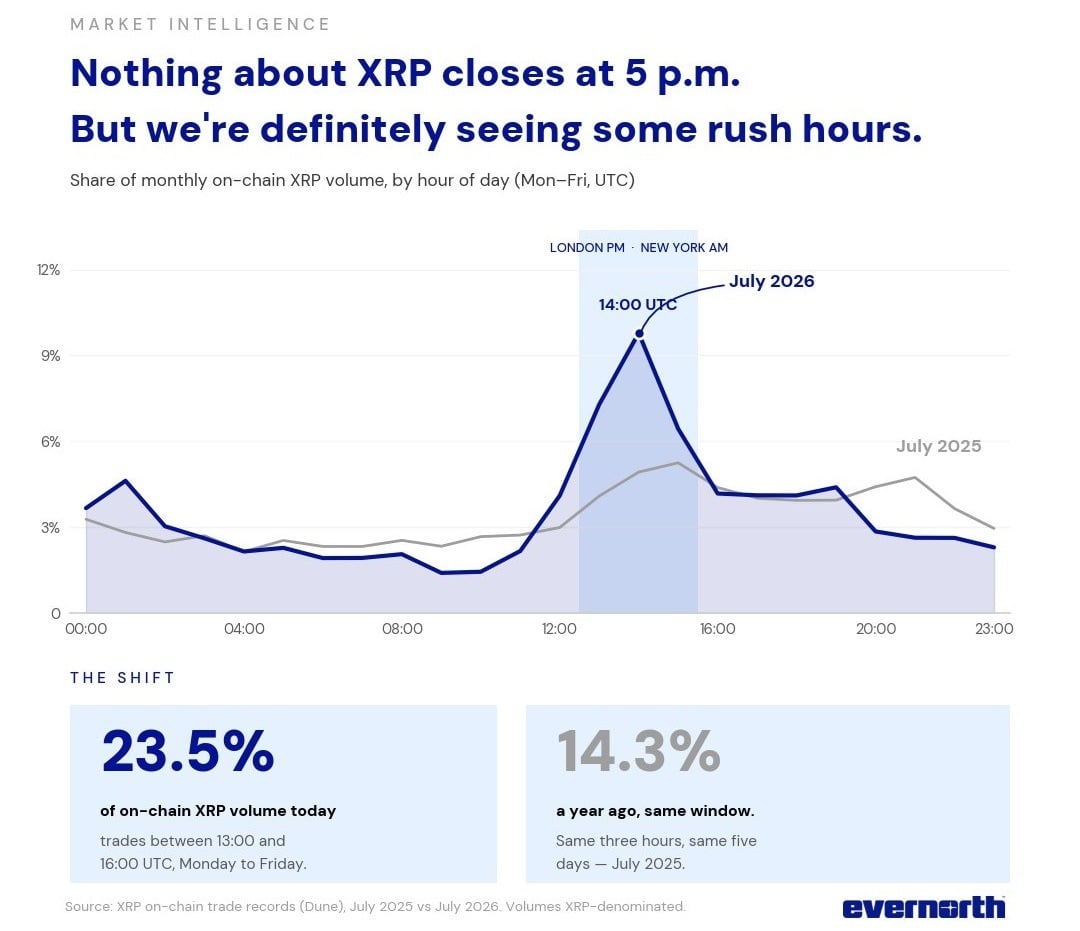
During a three-hour window from 13:00 to 16:00 UTC, which overlaps with the London afternoon and New York morning, approximately 23% of all on-chain XRP trading volume now occurs, up from 14% a year ago. Asset manager Evernorth, which released this analysis, links this concentration to growing institutional interest, as the peak aligns with traditional banking hours. This pattern is observed across XRPL's three primary trading channels: order books, automated market maker pools, and cross-currency payments. While the timing suggests institutional activity, the public ledger does not definitively identify the participants. The report also notes broader XRPL growth, including billions in tokenized assets and sustained ETF inflows. Evernorth, which is focused on expanding XRP's institutional role, emphasizes that while trading doesn't stop at 5 PM, clear peak hours are emerging.

On August 18, Evernorth, an asset management firm for $XRP, reported that weekday network activity is increasingly concentrated between 13:00 and 16:00 Coordinated Universal Time (UTC). In a post on X, the company linked this trend to growing interest from institutional investors, noting that nearly a quarter of the on-chain transaction volume for $XRP on weekdays occurs during this three-hour period when it's afternoon in London and morning in New York.

Evernorth stated:

"According to ledger data we analyzed last week, the on-chain market for $XRP is growing during banking hours. This aligns with increasing interest from institutional investors."

"Three hours a day (London afternoon and New York morning) now account for ~23% of all $XRP that changes hands on-chain. A year ago, that figure was ~14%," the company added.

A chart included in Evernorth's X post shows a sharp concentration of volume in July 2026 during the overlap of the London and New York trading days, with $XRP activity peaking at around 10% at 14:00 UTC. The highlighted three-hour period accounted for 23.5% of weekday on-chain transaction volume, compared to 14.3% in the same period in July 2025, indicating stronger concentration during traditional financial market hours.
This Pattern Holds Across Three XRPL Trading Venues

According to Evernorth, the same intraday concentration was observed in order book trades, automated market maker (AMM) pools, and cross-currency payments routed through the ledger's liquidity. Official $XRP Ledger documentation explains that offers function as limit orders, while AMMs provide a separate route for swaps. Cross-currency payments can utilize available offers when seeking an efficient conversion path.

Evernorth elaborated:

"The same trend holds across all three ways to trade on the XRPL, including the order book, AMM pools, and cross-currency payments routed through them."

Previous Evernorth research showed that activity related to the Ripple USD stablecoin ($RLUSD) expanded across all these market structures as its share of XRPL trading grew. Analysis of $RLUSD trading found that $RLUSD-$XRP trading volume reached approximately $900 million over six months, with order books handling about 80% of trades by 2026, whereas automated market makers previously held a larger share.

Broader adoption metrics have also shifted in parallel with on-chain trading activity, although these metrics do not establish who is responsible for the three-hour concentration. $XRP ecosystem data showed roughly $4 billion in tokenized assets on the XRPL, eight consecutive weeks of inflows into exchange-traded funds (ETFs), and a roughly 40% increase in new wallets by late June.

Ledger Timestamps Hint at Institutional Activity, Not Proof

The overlap of London and New York trading hours is significant for global finance, as both hubs operate simultaneously, creating a period of substantial liquidity in currency markets. A previous institutional transaction on the XRPL linked Ripple, Mastercard, Ondo Finance, and Kinexys (a J.P. Morgan division) through a tokenized treasury settlement, demonstrating that established financial firms have used the ledger for coordinated settlement workflows.

Evernorth is invested in expanding $XRP's institutional role, so when presenting its interpretation, it pays special attention to clearly citing sources. The company's strategy for its $XRP treasury holdings focuses on actively managing $XRP through a proposed public market structure backed by Ripple and other investors. Filed documents indicate expected gross proceeds of over $1 billion and a planned Nasdaq listing.

Public blockchain records disclose transaction details, timing, and market routes but typically do not reveal the identity of the participating account owners. The $XRP Ledger's design enables fast settlement, token trading, and cross-border payments via a decentralized network, allowing analysts to observe activity without the ability to confirm who initiated an operation—be it a bank, trading firm, individual, or automated system.

Evernorth noted:

"Nothing about $XRP ends at 5 p.m. But we are certainly seeing some peak hours."

end-content

Trending Cryptos

Related Questions

QAccording to Evernorth's analysis, what percentage of on-chain XRP trading volume now occurs during the three-hour window when London's afternoon and New York's morning overlap?

AApproximately 23% of the on-chain XRP volume now occurs during that three-hour window, up from around 14% a year ago.

QWhat trend in XRP on-chain activity did Evernorth observe during weekdays, and what time frame does it concentrate in?

AEvernorth observed that on-chain XRP activity on weekdays is increasingly concentrated between 13:00 and 16:00 UTC, which corresponds to London's afternoon and New York's morning.

QHow did Evernorth interpret the observed concentration of XRP trading volume during specific business hours?

AEvernorth linked this concentration to growing interest from institutional investors, noting it aligns with the operational hours of traditional financial markets.

QAcross which three XRPL trading channels did Evernorth report seeing the same intraday concentration pattern?

AThe same intraday concentration pattern was observed across the order book, Automated Market Maker (AMM) pools, and cross-currency payments routed through the ledger's liquidity.

QWhat does Evernorth's analysis suggest about who is responsible for the three-hour trading concentration, and what is the limitation of blockchain data in confirming this?

AThe analysis suggests institutional activity is a likely cause, but blockchain records typically do not reveal the identity of account holders, so it cannot definitively prove who initiated the transactions.

Related Reads

New Insider Trading in Prediction Market Exposed: It's Impossible to Lose When You Sit in That Position

PolyBeats reported on August 19 about a user who achieved a 120% return in just 89 seconds by betting that Russia would capture Konstantynivka on a prediction market platform, where the probability (and price) surged from 43% to 92%. This trade was notably the 14th in a series of perfect predictions related to the Russia-Ukraine war by this account, with a total profit of approximately $17,500. Eleven of these trades saw the probability jump to near 100% within five minutes of the purchase. The article suggests these consistent gains point to potential insider knowledge. The key is that these prediction markets on Polymarket settle based not on real-time battlefield events, but on whether the Institute for the Study of War (ISW) updates its official interactive map to show an area as controlled by Russia. Therefore, profiting reliably doesn't require military intelligence, but merely advance knowledge of when and where ISW will update its map. This mirrors a prior incident in November 2025, where an unauthorized, temporary edit to the ISW map regarding Myrnohrad allowed a trader to make over a 10,000% return before the edit was reversed. While ISW has since added safeguards like "pending review" statuses and duration requirements for map changes, the article argues the 14-trade winning streak indicates someone with access to the map update process—like an ISW staffer—could exploit the time gap between an internal decision and its public release, turning administrative knowledge into nearly guaranteed profits.

marsbit24m ago

New Insider Trading in Prediction Market Exposed: It's Impossible to Lose When You Sit in That Position

marsbit24m ago

Trading

Spot

Hot Articles

What is XRP 2.0

XRP 2.0: A New Frontier in the Cryptocurrency Landscape Introduction to XRP 2.0 In the ever-evolving realm of cryptocurrency, new projects continuously emerge, vying for attention and adoption. One such promising initiative is XRP 2.0, a novel cryptocurrency project designed to leverage advanced blockchain technology and robust encryption methodologies. While the name draws parallels with Ripple’s XRP, it’s crucial to note that XRP 2.0 operates independently, focusing on enhancing transaction security, privacy, and scalability. As the digital financial landscape increasingly embraces decentralized solutions, XRP 2.0 aims to contribute meaningfully to web3 and the overall expansion of crypto projects. What is XRP 2.0? At its core, XRP 2.0 is a cryptocurrency project that aims to create a secure and decentralized digital currency ecosystem. Its foundational technology integrates sophisticated blockchain principles with cutting-edge encryption techniques. The overarching goal of XRP 2.0 is to establish itself as a reliable and efficient platform enabling swift transaction execution while prioritizing enhanced privacy protections for its users. The project is promoted as a solution to many limitations faced by existing cryptocurrencies, proposing a system that can handle a higher volume of transactions with improved speed and privacy. This versatility positions XRP 2.0 as a significant contender in a marketplace riddled with various digital currencies. Who is the Creator of XRP 2.0? The identity of the creator behind XRP 2.0 has been flagged as ‘Wilbur.’ However, comprehensive details regarding Wilbur or their associated entity remain elusive. The anonymity of many cryptocurrency creators is not an uncommon phenomenon in the industry, often designed to maintain a degree of privacy and security. Who are the Investors of XRP 2.0? As of now, specific information related to the investment foundations or organizations supporting XRP 2.0 is not publicly available. In the cryptocurrency sector, the backing by reputed investors can significantly influence a project's credibility and success, yet the transparency regarding the financial supporters of XRP 2.0 has not been established. How Does XRP 2.0 Work? XRP 2.0 stands out by employing a combination of blockchain technology and advanced encryption algorithms that ensures secure and decentralized transactions. Its innovative structure includes unique features designed to foster user engagement and broaden functionalities beyond conventional cryptocurrency transactions. Among these features, XRP 2.0 incorporates AI-powered capabilities, such as text-to-image and text-to-speech functionalities. These additions are designed to enhance the interactive experience for users, promoting broader applicability across various sectors. By bridging technological advancements with user-centered design, XRP 2.0 aims to capture the attention of a diverse range of individuals and enterprises looking to integrate cryptocurrency solutions into their operational frameworks. Timeline of XRP 2.0 Understanding XRP 2.0 requires examining the milestones that have defined its journey thus far: July 23, 2023: XRP 2.0 is introduced as a novel cryptocurrency project, aiming to revolutionize secure and decentralized transaction capabilities in the blockchain domain. September 8, 2023: The launching of another project, XRP20, occurs, marking the emergence of an ERC-20 token on the Ethereum blockchain that remains unrelated to XRP 2.0. November 13, 2023: The XRP Ledger undergoes a significant update with the release of rippled server software version 2.0.0. It is essential to note that this development is disconnected from the XRP 2.0 cryptocurrency project. Key Points About XRP 2.0 To distill the essence of XRP 2.0, several critical factors emerge: Unique Features: The inclusion of features like AI-powered text-to-image and text-to-speech further diversifies the potential applications of XRP 2.0. Blockchain Technology: The framework utilizes advanced blockchain mechanisms and encryption protocols, ensuring a secure and decentralized environment for transactions. Scalability and Privacy: XRP 2.0 prioritizes enhanced privacy protections in transaction processes and the scalability necessary to accommodate a growing user base. No Affiliation with Ripple: Importantly, despite its name, XRP 2.0 does not have any allegiance or collaboration with Ripple’s XRP, distinguishing its operational framework and objectives within the cryptocurrency ecosystem. Conclusion XRP 2.0 represents an ambitious venture into the cryptocurrency sphere, aiming to offer a combination of security, privacy, and efficiency in digital transactions. By integrating sophisticated technologies and user-friendly features, the project sets out to broaden the horizons of what cryptocurrency can achieve in today's digital economy. While the anonymity of its creator and lack of disclosed investors might raise questions for some, XRP 2.0's focus on advanced functionalities and decentralisation enhances its appeal amidst an increasingly crowded crypto market. As the cryptocurrency landscape continues to evolve, XRP 2.0 may yet emerge as a pivotal player in the expansion of secure and scalable blockchain solutions.

1.6k Total ViewsPublished 2024.04.01Updated 2024.12.03

What is XRP 2.0

Discussions

Welcome to the HTX Community. Here, you can stay informed about the latest platform developments and gain access to professional market insights. Users' opinions on the price of XRP (XRP) are presented below.

活动图片