World Cup Kicks Off, Spotlight on 'Big Wins' and 'Major Losses' in Prediction Markets

Odaily星球日报Published on 2026-06-18Last updated on 2026-06-18

Abstract

"The World Cup has begun, showcasing dramatic gains and losses in prediction markets. With the 2026 FIFA World Cup expected to generate up to $10 billion in consumer betting volume, platforms like Polymarket have seen explosive activity. The article highlights several high-profile traders. One user (@mintblade) achieved a 100% win rate across four bets, earning $9.24 million in a single day, including a $7.34 million profit from correctly predicting Iran would not win against New Zealand. Another new wallet (@Fishalive) turned a $4.22 million bet on Spain not winning against Cape Verde into $13.28 million, a 1000%+ return after a shocking draw. Other successful traders include @LEEEROYJENKINS with $5.2 million in profits and @endlessFate, who turned early losses into over $7.85 million in weekly gains. However, significant losses also occurred. User @betoor619 lost nearly $1 million after a heavily favored Spain failed to defeat Cape Verde. Another user, @weatherman12, lost over $1.81 million betting against Argentina, which won 3-0 with a Lionel Messi hat-trick. The report serves as a reminder of the high volatility and risk in sports prediction markets, where unexpected outcomes are common."

Original|Odaily Planet Daily(@OdailyChina)

Author|Wenser(@wenser2010 )

The World Cup officially begins, bringing exponential growth opportunities in trading volume for prediction markets.

According to a report from asset management giant Bernstein, the 2026 FIFA World Cup is expected to generate up to $10 billion in consumer trading volume and over $3 billion in incremental funds for sports betting and prediction markets. Previously, various prediction markets and exchanges have launched incentive campaigns aiming to leverage this event to boost attention and trading volume. With the kickoff of the group stage, scripts such as favored teams losing to underdogs, weaker teams holding strong sides to draws, and dark horse upsets have unfolded one after another. Players in the prediction markets have also experienced their own moments of "striking it rich" and "suffering massive losses." (Recommended reading: "World Cup Prediction Battle Begins, How Are Major Exchanges Competing for This Wave of Event Traffic?" and "The World Cup's Second Scene: Inside the Prediction Markets.")

Odaily Planet Daily reminds readers that sports event prediction markets are highly prone to various upsets; caution is advised when copying trades.

World Cup Profit Representative Accounts: 4 Wins in 4 Bets, New Account Profits Nearly $10 Million

First, let's look at the profit leaderboard, which includes newly created wallets that have won nearly ten million dollars in profit with their first moves. While it raises suspicions of insider information, one can't help but marvel: "The ball is round; anything can happen on the World Cup stage."

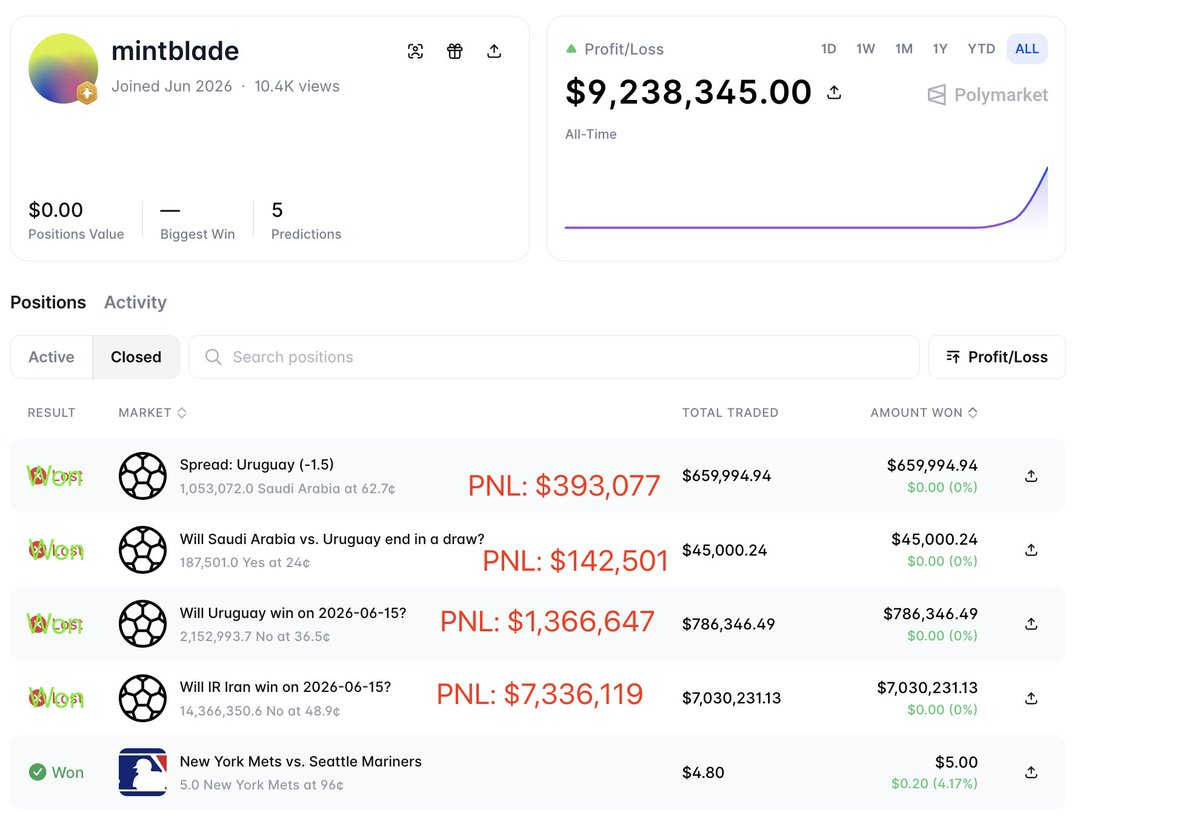
First Contestant: 4 Wins, Profiting $9.24 Million in a Single Day

Yesterday, a smart-money wallet (@mintblade) earned $9.24 million in profit from World Cup match predictions within a day, winning all 4 predictions it participated in, achieving a 100% win rate. In the match between Iran and New Zealand, this participant invested $7.03 million predicting "Iran will not win" and earned $7.34 million from that single prediction. It is worth noting that this user ranks first on Polymarket's weekly and monthly profit leaderboards.

Profile link: https://polymarket.com/zh/@mintblade
Second Contestant: First Bet Profits $9.06 Million, Biggest Winner from Spain's Upset Draw

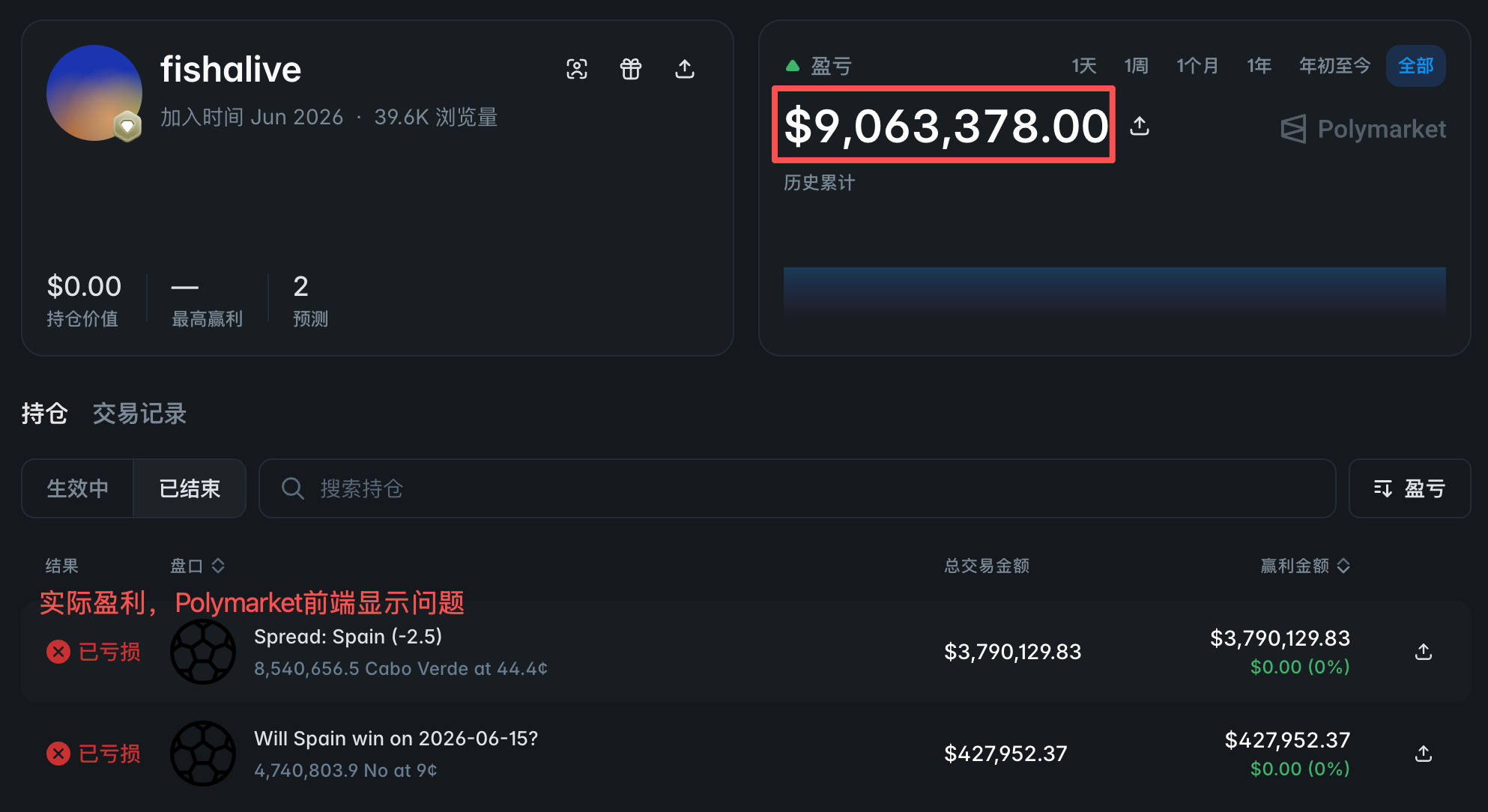
In the early hours of the 16th, the match between Spain and Cape Verde ended in a surprising draw. A new wallet (@Fishalive) spent $4.22 million on Polymarket predicting "Spain will not win the match" and "Cape Verde to win with a -2.5 handicap." Ultimately, the $4.22 million grew to $13.28 million, resulting in a $9.06 million profit.

It is worth noting that they bought approximately 4.7 million shares of "Spain will not win" at an average price of 9 cents probability. After the match concluded and settled at 100 cents, this single trade yielded a profit of about $4.31 million, representing a return of over 1000%. This user ranks second on Polymarket's weekly and monthly profit leaderboards with a $9.06 million profit.

Profile link: https://polymarket.com/zh/@fishalive
Third Contestant: 2 Trades, $5.2 Million Profit

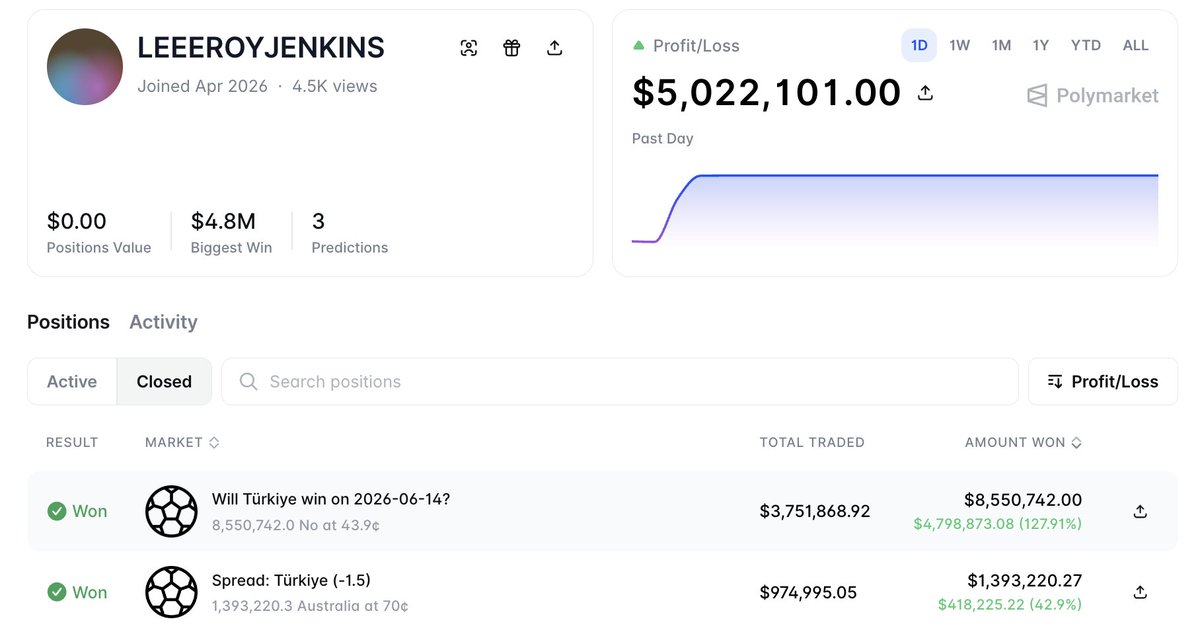
On the 15th, Polymarket user @LEEEROYJENKINS invested a total of $4.73 million predicting "Turkey will not win" and "Australia with a handicap of 1.5." Both trades were successful, resulting in a final profit of $5.2 million. In a single trade, this user achieved a 128% profit rate.

It is worth noting that, although their single highest profit reached $4.8 million, their overall trading history still shows nearly $2.58 million in losses.

Profile link: https://polymarket.com/zh/0x99aea8f9a64d0142b6b66a4b9d02a2211d45386f
Fourth Contestant: Rank 3 on Polymarket Profit Leaderboard, Over $7.85 Million Profit in Past Week

Polymarket user @endlessFate profited $4.7 million in the past week. Previously, in the match between Saudi Arabia and Uruguay, they boldly invested $2.48 million, predicting "draw," "Uruguay will not win," and "Saudi Arabia with a handicap of 1.5," ultimately earning a $5.67 million profit. In the "Australia vs. Turkey" match, they predicted "Australia with a handicap of 1.5."

In the currently ongoing match "Colombia vs. Uzbekistan," they invested nearly $7.5 million predicting "Colombia to win," currently profiting over $2.05 million. Currently, they rank third on Polymarket's weekly profit leaderboard with over $7.85 million in profit. Another noteworthy point is that this user started participating in predictions on Polymarket in April this year, with overall profits exceeding $6 million, despite multiple previous prediction losses.

Profile link: https://polymarket.com/zh/@endlessfate
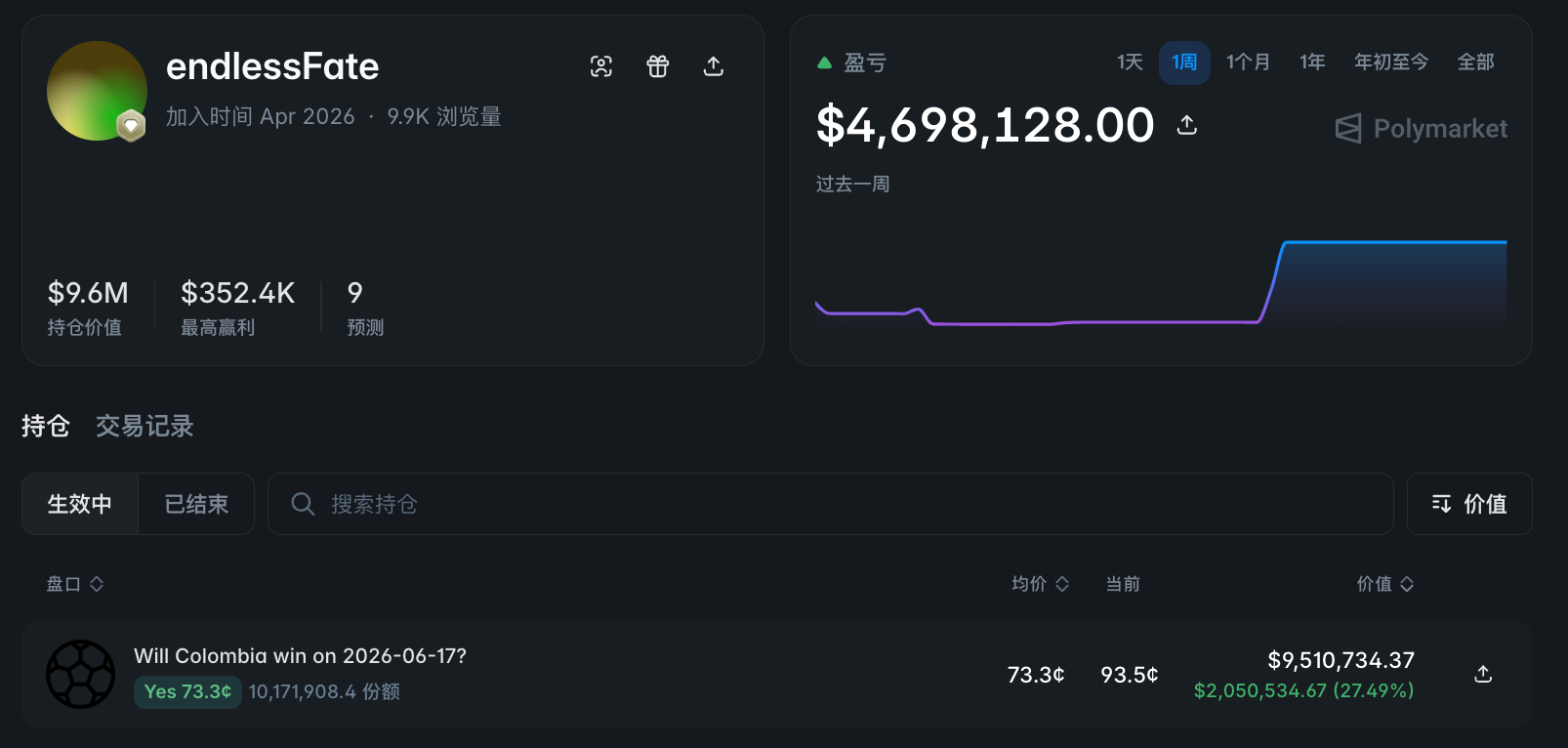
Current prediction for "Colombia VS Uzbekistan"
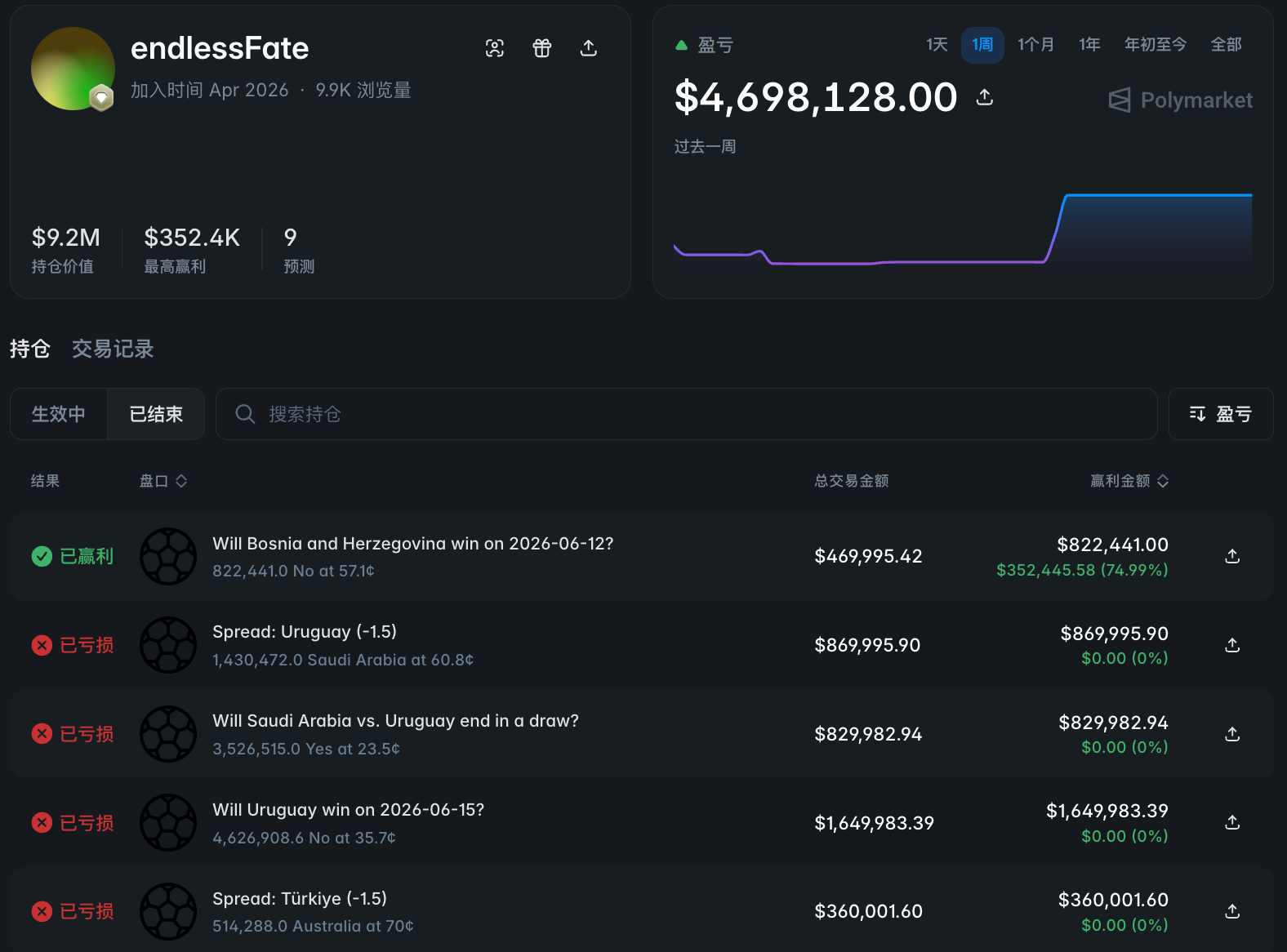
Account's weekly profit/loss performance

For more weekly profit accounts, please refer to the official leaderboard: https://polymarket.com/zh/leaderboard/overall/weekly/profit.

World Cup Loss Representative Accounts: $1 Million Loss from Upset, Over $1.8 Million Lost Betting Against Argentina

In prediction markets, for every winner, there is a loser. The opposing side always exists, just in a different identity and form.

Spain VS Cape Verde: 0:0 Draw Causes Single Account Loss of $1 Million

Polymarket data shows that account @betoor619 (address: 0x70088c990ffae782c699b9250f5aa6cbe4e3c666) bought "Spain to win" in the World Cup group stage match Spain vs. Cape Verde. The match ended 0:0, resulting in a $999,000 loss for this user.

It is worth noting that this user bought in at the 92-cent mark, meaning they risked $1 million in principal for an $85,000 potential profit—a seemingly sure-win trade. Ultimately, it resulted in a loss due to the stunning draw, credited to Cape Verde's 40-year-old goalkeeper's seven incredible saves and the team's exceptionally strong defense.

Profile link: https://polymarket.com/zh/@betoor619?tab=activity
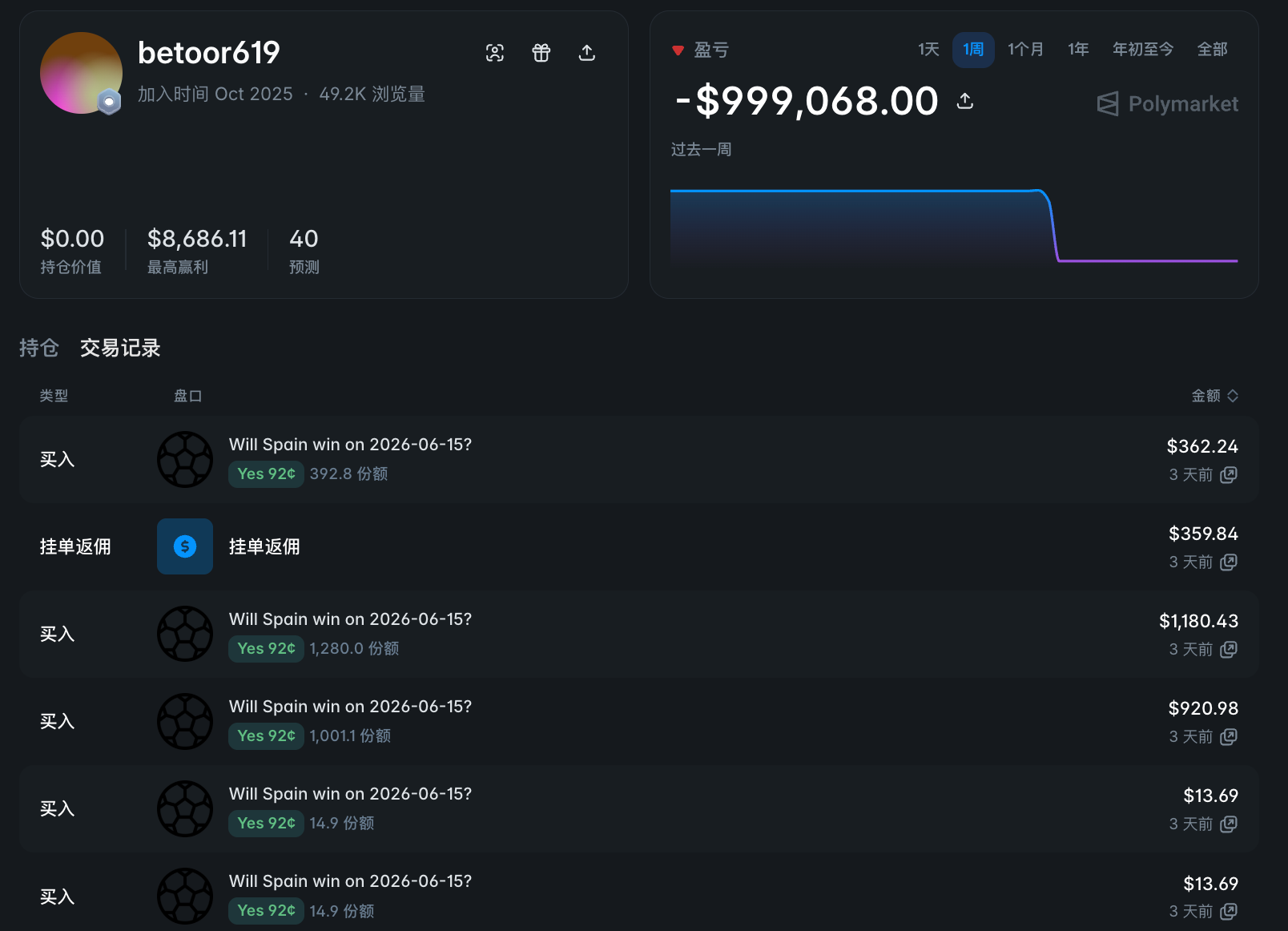
Lost the watermelon and didn't get the sesame either

Messi Scores Hat-Trick, Argentina Defeats Algeria, Single Trade Loss Exceeds $1.8 Million

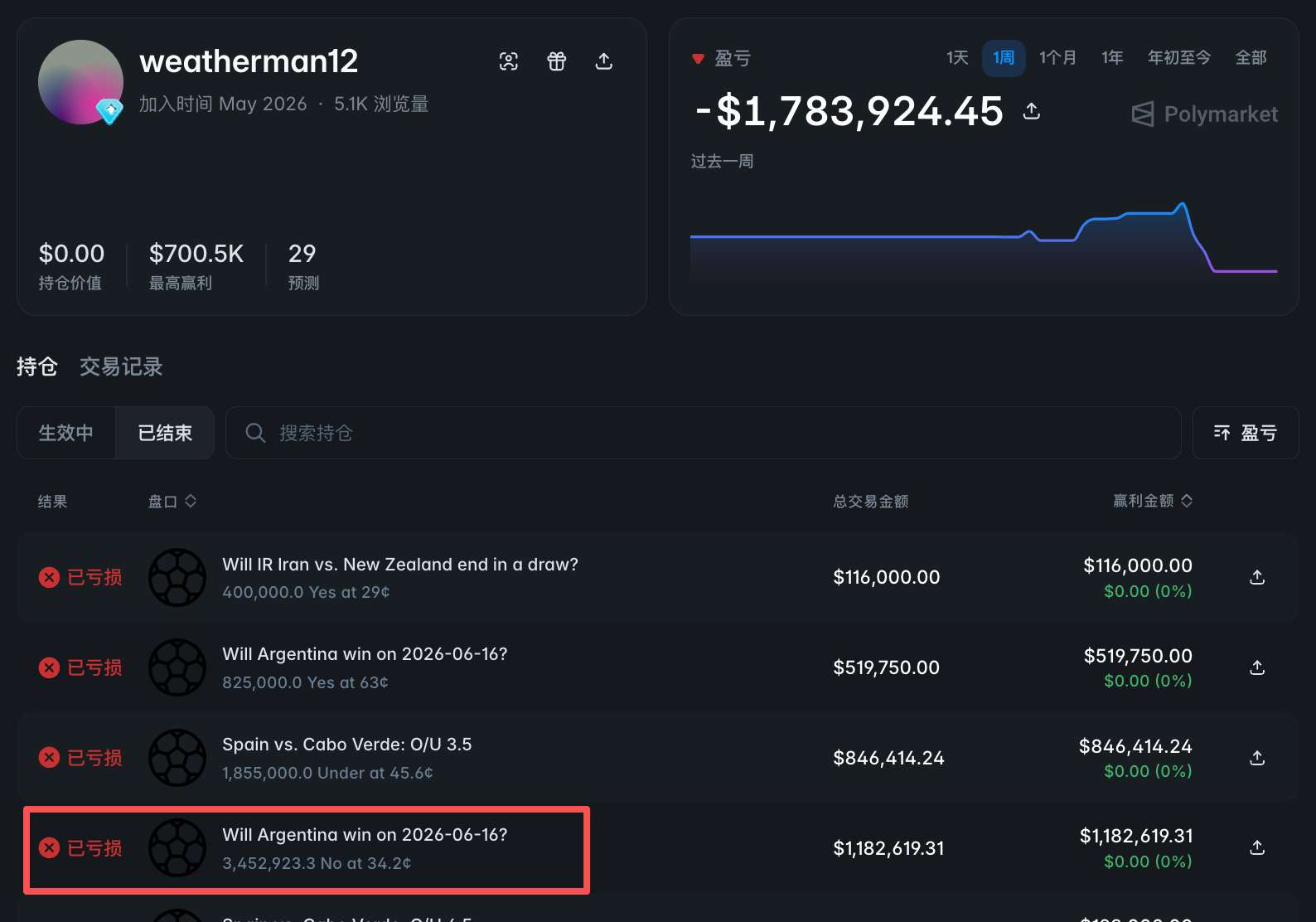
On the 17th, before the start of the World Cup match Argentina vs. Algeria, prediction market whale weatherman12 invested $1.81 million predicting "Argentina will not win" and "Algeria +1.5." If Argentina had drawn or lost, these two bets would have profited $2.65 million.

However, in the end, the Argentine team, led by Messi's "hat-trick" of three goals, successfully defeated Algeria, with the match ending "3:0." Consequently, all the funds invested by this user were lost.

Profile link: https://polymarket.com/zh/@weatherman12
Odaily Planet Daily will continue to monitor World Cup match-related predictions on prediction market platforms. Welcome to join the Odaily Prophet channel.


Related Questions

QWhat is the potential consumer trading volume estimated for the 2026 FIFA World Cup in sports betting and prediction markets according to Bernstein's report?

AAccording to Bernstein's report, the 2026 FIFA World Cup is estimated to bring up to $10 billion in consumer trading volume and over $3 billion in incremental funds to sports betting and prediction markets.

QWhich platform's users are highlighted in the article for their significant profits and losses on World Cup predictions?

AThe article highlights users on the Polymarket platform for their significant profits and losses on World Cup predictions.

QHow much profit did the user '@mintblade' reportedly make in a single day from World Cup predictions, and what was their success rate?

AThe user '@mintblade' reportedly made a profit of $9.24 million in a single day from World Cup predictions, with a 100% success rate on their four predictions.

QIn the match between Spain and Cape Verde, what bet did the user '@betoor619' make that resulted in a loss of nearly $1 million?

AIn the match between Spain and Cape Verde, the user '@betoor619' bet on Spain to win. The match ended in a 0-0 draw, resulting in a loss of $999,000 for the user.

QWhat was the outcome and financial result for the user '@weatherman12' after their bet on the Argentina vs. Algeria match?

AThe user '@weatherman12' bet over $1.81 million that Argentina would not win and that Algeria would have a +1.5 handicap. Argentina won 3-0, resulting in the user losing their entire investment.

Related Reads

My Coding Betting Dashboard is Profiting, but Polymarket is Truly Not a Good Place for 'Arbitrage'

The author built a custom monitoring dashboard for Polymarket, a prediction market platform, and tested it with $1,600, achieving over 30% returns. However, the core argument is that Polymarket is not a good venue for traditional arbitrage. The dashboard has two main sections: a "Portfolio Dashboard" for tracking active positions with key metrics like total capital, P&L, and a risk-control module using a tier system (T1, T2, T3), and an "Opportunity Watchlist" for monitoring markets. The article details a critical structural trap in binary markets: a bet with a high perceived probability of success still carries a 100% loss risk if wrong. The author's T1/T2/T3 system is designed to manage this by limiting position sizes based on conviction and time horizon, emphasizing that high confidence should not equal high concentration. A key insight is the danger of "pseudo-diversification"—betting on different markets driven by the same underlying variable. The author concludes that Polymarket offers few true low-risk, arbitrage opportunities. It is instead a high-risk environment where wins can create a false sense of mastery, leading to large losses. The platform is better viewed as a training ground for honing judgment through disciplined, framework-driven betting rather than a reliable income source. The tools help transform intuition into structured, rule-based decisions to mitigate the risk of catastrophic errors.

marsbit1h ago

My Coding Betting Dashboard is Profiting, but Polymarket is Truly Not a Good Place for 'Arbitrage'

marsbit1h ago

WeChat AI Card Hands-On Guide: Has the AI Shopping Era Arrived?

**"WeChat AI Card" Practical Test Guide: Has the Era of AI Shopping Arrived?** WeChat has officially launched the "AI Exclusive Card," a feature integrated into its Workbuddy AI assistant. This card is designed to handle payments for AI-initiated purchases. Our hands-on test reveals it's not yet a tool for fully autonomous AI shopping, but rather a controlled payment layer for AI agents. The AI Card functions as an isolated sub-wallet within WeChat Pay. Users must bind the card and transfer funds into it from their main wallet. Crucially, every transaction requires explicit user confirmation via smartphone scan; AI cannot spend autonomously. Currently accessible through the Workbuddy agent, the card targets specific digital consumption scenarios: purchasing paid content (reports, data), calling paid APIs/tools, and subscribing to services. Its design prioritizes security and control by separating funds and mandating approval for each payment. We tested a real-world scenario: ordering bubble tea via Workbuddy using a "Meituan Life Assistant" skill. The process encountered multiple hurdles: high "skill" usage costs (exceeding daily free credits), and most importantly, while a payment was successfully initiated, the AI purchased an incorrect product (a mismatched group-buy coupon instead of the desired drink). This highlights the current limitation: the **AI Card only solves the payment step**. The broader challenge lies in the **AI agent's execution chain**—accurately understanding intent, navigating third-party platforms, selecting the right product, and ensuring proper fulfillment. The payment succeeded, but the purchase failed to meet the user's need. In conclusion, the WeChat AI Exclusive Card is a cautious, early-step experiment in AI commerce. It provides a secure, user-controlled payment method for agent interactions but is not yet capable of reliable, end-to-end complex purchases. For now, it's best used for low-value, low-risk digital services with careful user verification at each step. The vision of AI handling complete shopping tasks remains a work in progress.

marsbit4h ago

WeChat AI Card Hands-On Guide: Has the AI Shopping Era Arrived?

marsbit4h ago

Deconstructing Notion's Growth: From a Note-taking Tool to 100 Million Users—How Notion Built a Triple Growth Flywheel Through Product, Templates, and Community

Notion's growth from a niche note-taking tool to a platform with 100 million users is powered by three interconnected flywheels: Product-Led Growth (PLG), a Template Economy, and Community-Driven Growth. First, Notion's PLG strategy relies on a highly flexible, "plastic" product that users can adapt to countless personal and team workflows. Its freemium model lowers the barrier to entry, while features like page sharing and collaboration drive organic, usage-based viral growth as users naturally invite others. Second, the Template Economy solves the "blank page" problem. Templates, created by both Notion and its community, transform abstract product capabilities into concrete, copyable solutions for specific scenarios (e.g., project management, content calendars). This dramatically lowers activation costs for new users and fuels SEO-driven discovery. Third, a vibrant Community acts as a distributed growth engine. Users and official Ambassadors create tutorials, share use cases, and host local events. This community not only educates users but also fosters a sense of identity around pursuing "better ways of working," strengthening loyalty and enabling global, low-cost expansion. Together, these flywheels create a self-reinforcing ecosystem: a great product attracts users who create templates and community content, which in turn attracts more users and deepens engagement. This system allowed Notion to scale from individuals to teams and enterprises through a bottom-up adoption path. Looking ahead, AI integration promises to accelerate these flywheels further by making templates smarter and the platform a potential AI-native work operating system. Ultimately, Notion's defensible advantage is not just its features, but this deeply entrenched network of user assets, creators, and community trust.

marsbit4h ago

Deconstructing Notion's Growth: From a Note-taking Tool to 100 Million Users—How Notion Built a Triple Growth Flywheel Through Product, Templates, and Community

marsbit4h ago

$10 Billion, Qualcomm to Acquire Chip Legend Jim Keller's Company

Global mobile chip giant Qualcomm is in advanced talks to acquire AI chip startup Tenstorrent in a deal valued between $8-10 billion, according to media reports. This potential acquisition would be one of the largest in the AI chip sector in recent years. Tenstorrent, led by legendary chip architect Jim Keller, has gained prominence for its RISC-V architecture and AI accelerator designs. The move highlights Qualcomm's strategic push to diversify beyond its core smartphone chip business. As the smartphone market matures, Qualcomm is aggressively targeting growth in automotive, data center, and cloud AI. Acquiring Tenstorrent would allow Qualcomm to rapidly enter the high-end AI computing market, bypassing lengthy in-house development cycles. Tenstorrent's cost-effective system architecture, which avoids expensive HBM memory and relies on standard Ethernet for clustering, offers a potential alternative to Nvidia's costly solutions. Furthermore, Tenstorrent's high-performance RISC-V CPU technology and its focus on the automotive and edge computing segments align with Qualcomm's strategic goals, including its "Snapdragon Digital Chassis" platform. Despite the strategic rationale, the high valuation has sparked some investor caution. The successful integration of Tenstorrent's open-source culture and independent team into Qualcomm's organization, along with the commercialization of its technology, remains a key challenge.

marsbit5h ago

$10 Billion, Qualcomm to Acquire Chip Legend Jim Keller's Company

marsbit5h ago

Trading

Spot
Futures
活动图片