WLFI's Insider Deal Again? The $5 Billion Investment Bank License Controversy

marsbitPublished on 2026-03-01Last updated on 2026-03-01

Abstract

The U.S. Office of the Comptroller of the Currency (OCC) faced scrutiny during a Senate hearing over World Liberty Financial (WLF), a crypto firm linked to the Trump family, which is seeking a national bank charter. WLF received a $500 million investment from Sheikh Tahnoon bin Zayed Al Nahyan, a UAE national security advisor and royal family member, raising concerns about potential conflicts of interest, foreign influence, and national security risks. Democratic senators, including Elizabeth Warren, questioned whether WLF disclosed the foreign investment and its implications, including possible AI chip exports to China. OCC officials declined to comment on specific applications but emphasized adherence to standard procedures. If approved, WLF could self-custody and issue its USD1 stablecoin. The firm denies any wrongdoing and claims the scrutiny is politically motivated.

Editor's Note: When crypto capital and political power intertwine on the same regulatory track, controversy often proves more penetrating than the technology itself.

The controversy surrounding the Trump family's crypto enterprise, World Liberty Financial (WLF), applying for a U.S. bank license has rapidly evolved from a routine financial approval process into a political issue involving conflicts of interest, foreign capital influence, and national security. A $5 billion investment from an Abu Dhabi royal family member, potential AI chip export arrangements, a stablecoin business layout, and the President's disclosed tens of millions of dollars in income have turned this hearing into far more than an industry matter. It has become a stress test for institutional boundaries and regulatory independence.

The OCC emphasized it would "process according to procedure," while Democratic lawmakers questioned transparency and review standards. At a time when stablecoins are increasingly seeking "bank-like" pathways, WLF's application is not only about one company's compliance process but also reflects the challenge the U.S. faces in balancing digital financial competition, geopolitical capital games, and political ethics.

Below is the original text:
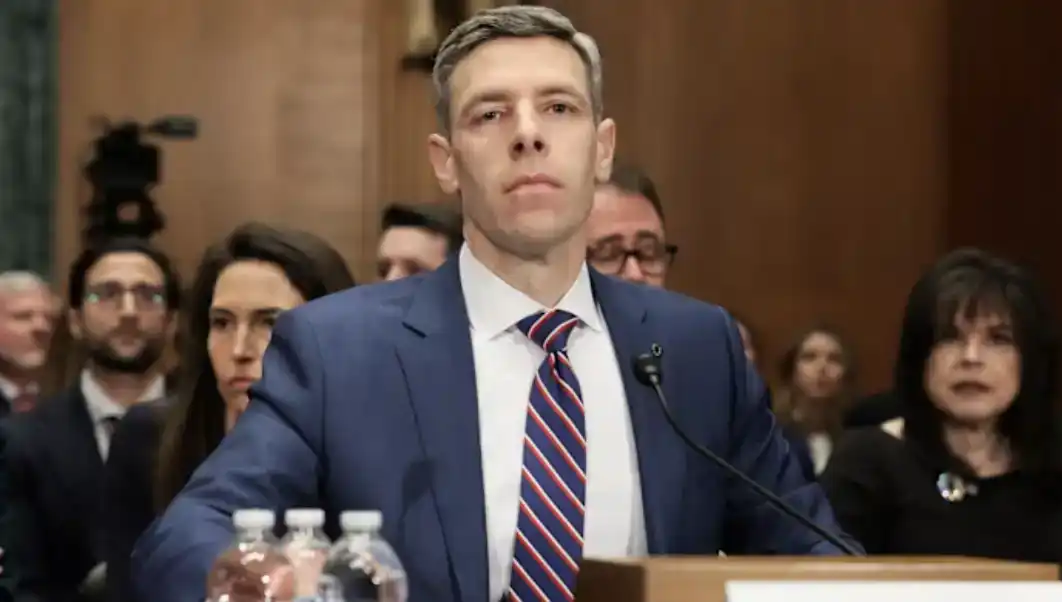
A U.S. banking regulatory official refused to disclose specific information about the application for a U.S. bank license by the crypto enterprise owned by the Trump family. The enterprise had previously received a $5 billion investment from a royal family member in Abu Dhabi.

The head of the Office of the Comptroller of the Currency (OCC), responsible for issuing federal bank licenses, declined at a Senate Banking Committee hearing on Thursday to disclose details of World Liberty Financial's (WLF) application as requested by lawmakers and denied that President Donald Trump had exerted any influence over the approval process.

Democratic lawmakers demanded that the OCC clarify whether WLF disclosed in its application the sale of a 49% stake to Sheikh Tahnoon bin Zayed Al Nahyan, the UAE National Security Advisor who also controls a vast business empire.

This transaction has further raised questions about whether the UAE has received policy "favors" due to its investment in a Trump family-controlled enterprise, including access to U.S. artificial intelligence chips, and whether there is a risk of related technology being transferred to China.

WLF denied that this $5 billion investment is linked to any chip acquisition arrangements. According to the company's website, Trump is listed as an "honorary co-founder." In his latest financial disclosure covering the 2024 period, Trump reported personal income of $57.3 million from WLF.

Democratic progressive figure Elizabeth Warren challenged OCC Acting Comptroller Jonathan Gould at the hearing over WLF's application, stating that given the Trump family's stake, the application posed an obvious risk of conflict of interest.

WLFI submitted the bank license application in early January this year through an entity named World Liberty Trust Company. Details of its equity deal with the UAE side, finalized just days before the presidential inauguration, were revealed by the media earlier this month.

Warren questioned Gould on whether WLF had disclosed in its application that Sheikh Tahnoon had become a "major shareholder of the proposed bank." Gould responded that he would not comment on any specific application. Warren further warned that if the license were ultimately approved, it would constitute "one of the most shameful corruption scandals in American history."

In response, Gould stated that the OCC would "review all applications according to established procedures" and retorted that the only "political pressure" he felt was from Warren herself.

Democratic Senator Chris Van Hollen also pressed on whether the OCC would consider in its review that Abu Dhabi investment vehicle MGX used $2 billion last year, involving WLF's stablecoin, to participate in acquiring shares of crypto exchange Binance. Another Democratic member, Andrew Kim, asked if the OCC had an enhanced review mechanism for applications involving foreign government officials that could impact national security. Gould said he would respond in writing later.

WLF responded that Democrats are "politicizing the matter" and smearing a U.S. private company undergoing strict regulatory scrutiny with "baseless allegations." The company emphasized that World Liberty Trust Company has submitted all necessary disclosure documents as required by regulators. Currently, five companies are in line with the OCC applying for national bank licenses, with WLF being one of them; crypto firms Coinbase and Laser Digital are also among the applicants.

If approved, WLF would be able to issue and hold reserves for its USD1 stablecoin itself. USD1 is a crypto token pegged 1:1 to the U.S. dollar; currently, related custody and issuance services are provided by third parties. According to disclosures, WLF will not engage in lending or accept public deposits in the future.

The proposed management includes WLF co-founder Zac Witkoff, whose father is the current U.S. Middle East envoy and real estate billionaire Steve Witkoff, and Jeffrey Weiner, CEO of Integrity Automotive Holdings. The latter heads an automotive dealership group operating in New York, New Jersey, and Connecticut.

Earlier this week, some founders' social media accounts were attacked, causing USD1 to briefly depeg. WLF subsequently stated that USD1 is "perfectly secure" and has stabilized.


Trending Cryptos

Related Questions

QWhat is the main controversy surrounding World Liberty Financial's (WLF) application for a U.S. bank license?

AThe controversy involves potential conflicts of interest, foreign capital influence, and national security concerns. This stems from a $500 million investment from an Abu Dhabi royal, questions about AI chip exports, and the fact that former President Donald Trump's family owns the company and he reported $57.3 million in income from it.

QWho is the foreign investor involved in WLF, and what concerns does this raise?

AThe investor is Sheikh Tahnoun bin Zayed Al Nahyan, the UAE's National Security Advisor. Concerns were raised about whether the UAE received policy 'favors' in return for the investment, such as access to U.S. AI chips, and the potential risk of technology transfer to China.

QHow did the Comptroller of the Currency (OCC) respond to lawmakers' questions about the WLF application?

AOCC Acting Comptroller Jonathan Gould refused to disclose details of the specific application, stating the OCC would 'follow established procedures for all applications.' He denied that former President Trump had exerted any influence on the process.

QWhat did Democratic Senator Elizabeth Warren warn would happen if the bank license was approved?

ASenator Warren warned that if the license was approved, it would constitute 'one of the most shameful corruption scandals in American history.'

QWhat would WLF be able to do if its national bank charter application is approved?

AIf approved, WLF would be able to issue and hold the reserves for its USD1 stablecoin itself. The company stated it would not engage in lending business or take public deposits.

Related Reads

Must-Watch Events Next Week|CLARITY Act Could Face Senate Vote; SpaceX, Circle to Report Earnings (8.3-8.9)

**Summary: Key Events and Developments to Watch (August 3-9)** The upcoming week is marked by significant financial disclosures, key legislative deadlines, and notable product updates. **Major Financial Events:** Several companies are scheduled to release their Q2 2026 earnings. American Bitcoin (ABTC) will report on August 3, followed by SpaceX and Hut 8 Mining Corp. on August 4, and Circle on August 5. Notably, a significant portion of SpaceX shares (up to 12% of total shares) will be unlocked on August 6 following their earnings release. **Key Legislative Deadline:** The U.S. Senate faces an August 7 deadline to secure 60 votes for the CLARITY Act, a bipartisan bill aiming to establish a federal regulatory framework for cryptocurrencies. The Senate may hold a full vote on the bill during the week. **Economic Data:** The U.S. July Non-Farm Payrolls report will be released on August 7, providing crucial labor market data. **Technology & Product Updates:** * **Shutdowns:** DeFi portfolio tracker Zapper and wallet app Ctrl Wallet will cease operations on August 3. * **Upgrades:** LayerZero will deprecate its v1 relayers on August 3. XRP Ledger's new version 3.3.0, featuring five new functions, is expected next week. * **AI:** Elon Musk announced that the advanced Grok 4.6 AI model is set for release around August 7. * **Bitcoin:** The BIP-110 forced signaling for a potential Bitcoin network change is scheduled to begin around August 8. **Other Notable Events:** Chinese robotics firm Unitree Tech has set its preliminary price inquiry for its IPO for August 5. South Korean exchange Upbit will delist AQT and AERGO tokens on August 3.

marsbit1h ago

Must-Watch Events Next Week|CLARITY Act Could Face Senate Vote; SpaceX, Circle to Report Earnings (8.3-8.9)

marsbit1h ago

Stocks Are Plummeting More Sharply Than Cryptocurrencies. Where Has the Money Gone?

Stock Markets Plunge Deeper Than Cryptocurrencies: Where Did the Money Go? In late July, Seoul's Kospi index triggered circuit breakers for two consecutive days, plummeting over 40% from its June high. The collapse was led by heavyweight stocks like SK Hynix, whose record profits still disappointed investors, and devastating leveraged ETFs, with one major product losing over 83% of its value. This signaled a global, forced deleveraging targeting the most crowded trades. Interestingly, while stocks exhibited extreme volatility akin to crypto markets, Bitcoin rose nearly 15% in July after a prior steep drop. Analysis shows the money fleeing equities did not flow into Bitcoin. Instead, Bitcoin had already absorbed its sell-off in May-June, when U.S. spot Bitcoin ETFs saw historic outflows. The true safe-haven beneficiary was gold, whose price rose over 20% year-on-year, highlighting a decoupling between Bitcoin and gold as "digital gold." The sell-off was a targeted unwinding of leveraged positions in tech and semiconductors, accelerated by broker-dealer risk management and shifts in the AI narrative, including new competition from Chinese memory chipmakers. The retreat path was clear: from high-valuation tech stocks to cash and U.S. Treasuries, then to gold. For Bitcoin to attract sustained institutional inflows, conditions like eased global liquidity pressure, a "soft-landing" Fed rate cut, and U.S. regulatory clarity via legislation like the stalled CLARITY Act are needed. Currently, Bitcoin is not a safe haven but an already-cleared asset. Its low correlation with tech stocks, however, makes it a potential diversification play for institutional portfolios once the storm passes. The money isn't here yet, but the positioning is underway.

marsbit1h ago

Stocks Are Plummeting More Sharply Than Cryptocurrencies. Where Has the Money Gone?

marsbit1h ago

In Conversation with Ray Dalio: We Are Currently in an AI Bubble, with 1% of My Portfolio in Bitcoin

Ray Dalio, founder of Bridgewater Associates, warns in an interview that the current AI boom shows classic bubble characteristics, which could lead to significant economic downturns as seen in past cycles like 1929 or 2000. He explains that speculative enthusiasm, fueled by debt and overvaluation, often precedes a crash when rising rates or taxation force asset sales, causing widespread losses and recession. Dalio also outlines his "Big Cycle" theory, describing an approximate 80-year pattern where widening wealth gaps, massive government deficits, and shifting geopolitical power (like China's rise) create internal conflict and global instability. He emphasizes that we are in a late-cycle, transitional phase where traditional powers like the US and UK face decline. For personal wealth protection, Dalio advises diversification beyond cash into assets like stocks, bonds, real estate, and particularly gold, which he prefers over Bitcoin. While he holds about 1% of his portfolio in Bitcoin as a non-printable hard asset, he views gold as more secure from technological or governmental threats. Regarding AI's impact, Dalio believes it will disproportionately benefit capital owners, worsening inequality by replacing both physical and cognitive labor. He suggests that human intuition and emotional intelligence, combined with AI, will be key for future workers. On taxation, Dalio argues that wealth taxes are impractical and risk triggering asset sell-offs, reducing productive investment. He points to the UK as a cautionary example of debt, low productivity, and political strife. Geopolitically, Dalio foresees a more regionalized world, with the US showing weakness in prolonged conflicts like with Iran, akin to past imperial declines. The ideal outcome, he suggests, is coexisting powerful blocs (e.g., Americas, China-Asia Pacific) without major war.

marsbit5h ago

In Conversation with Ray Dalio: We Are Currently in an AI Bubble, with 1% of My Portfolio in Bitcoin

marsbit5h ago

Trading

Spot

Hot Articles

Discussions

Welcome to the HTX Community. Here, you can stay informed about the latest platform developments and gain access to professional market insights. Users' opinions on the price of S (S) are presented below.

活动图片














