Will Japan's Interest Rate Hike Trigger a Global Liquidity Shock?

marsbitPublished on 2025-12-18Last updated on 2025-12-18

Abstract

As the Bank of Japan's December 19 monetary policy meeting approaches, market concerns are rising over a potential hawkish interest rate hike. A report by Western Securities on December 16 analyzes whether this move could end the era of cheap yen and trigger a global liquidity crisis. Key drivers for a rate hike include Japan’s sustained inflation above the 2% target, low unemployment supporting wage growth, and expansionary fiscal policy. These factors may push the BOJ toward tightening, raising fears of unwinding large-scale carry trades and causing global financial stress. However, the report suggests the most dangerous phase of liquidity shock may have already passed. Previous rate hikes in July and January had diminishing market impact, speculative short positions in yen have largely been closed, and the macro environment—including a resilient U.S. economy and Fed easing—reduces urgency for rapid unwinding. The Fed’s expanded balance sheet also acts as a buffer. Despite theoretical stability, global markets remain fragile after a six-year bull run, with elevated valuations and AI-related泡沫 concerns. A BOJ hike could act as a catalyst for a liquidity shock, though any sharp sell-off may prompt stronger Fed easing, leading to a quick recovery. Investors are advised to monitor the situation closely. If U.S. markets experience repeated “stock-bond-currency triple sell-offs,” it may signal a liquidity crisis. Over the medium term, global monetary easing is expected to con...

Original Author: Long Yue

Original Source: Wall Street News

As the Bank of Japan's monetary policy meeting on December 19 approaches, market concerns about a potential hawkish interest rate hike are intensifying. Could this move mark the end of the era of cheap yen and trigger a global liquidity crisis? A recent strategy report released by Western Securities on December 16 provides an in-depth analysis.

High Inflation Makes Hawkish Rate Hike by Japan Inevitable

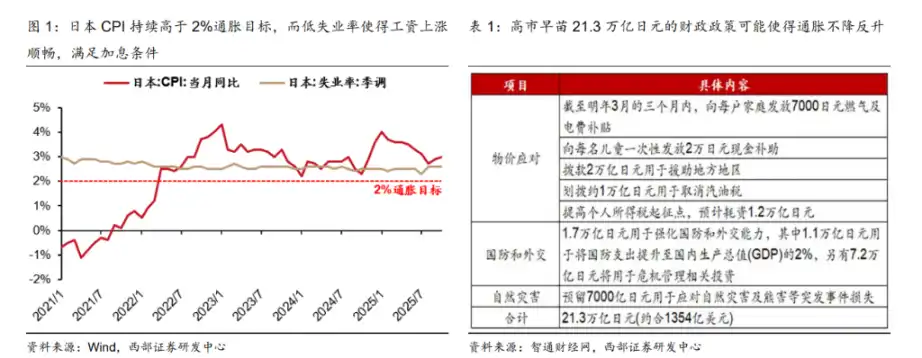
The report points out that multiple factors are behind the BOJ's potential rate hike. Firstly, Japan's CPI has consistently remained above the official 2% inflation target. Secondly, the unemployment rate has long stayed below 3%, creating favorable conditions for nominal wage growth. Market expectations for significant wage increases in next year's "Shunto" (spring labor negotiations) are high, which will further increase inflationary pressures. Finally, the 21.3 trillion yen fiscal policy introduced by Takayuki Kobayashi could also exacerbate inflation.

These factors collectively force the Bank of Japan to adopt a more hawkish stance. The market worries that once the rate hike is implemented, it could lead to the concentrated unwinding of the massive "carry trade" positions accumulated during Japan's YCC (Yield Curve Control) era, thereby causing a liquidity shock to global financial markets.

Theoretical Analysis: Why the Most Dangerous Phase of Liquidity Shock Might Be Over

Despite market anxieties, the report analyzes that, theoretically, the current impact of a Japanese rate hike on global liquidity is limited.

The report lists four reasons:

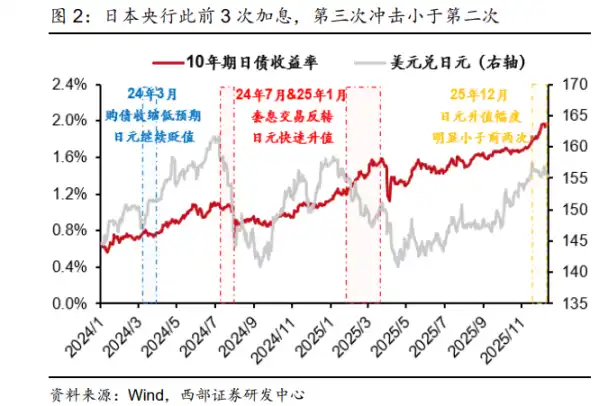
Risk Partially Released: The Bank of Japan has already implemented 3 rate hikes since March last year. Among these, the hike in July last year, coupled with the exit from YCC, did cause a significant liquidity shock, but the impact from the January hike this year has noticeably weakened, indicating increasing market adaptation.

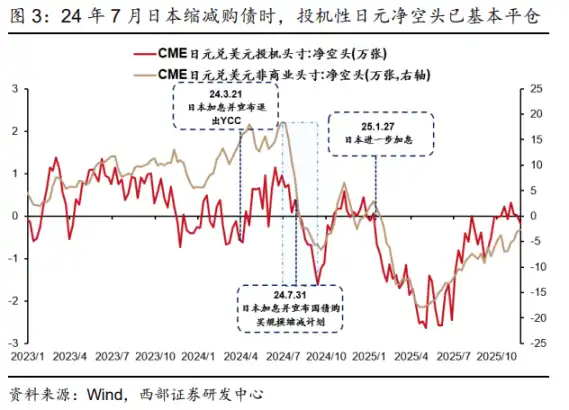
Speculative Positions Already Exited: Data from the futures market shows that most speculative yen short positions were unwound in July last year. This means the most active "carry trades" most likely to cause chain reactions have receded, and the most dangerous phase of the liquidity shock has passed.

Different Macro Environment: The current U.S. is not experiencing a "recession trade" similar to July last year, dollar depreciation pressure is not significant, and the yen itself remains weak due to geopolitical and debt issues. This weakens expectations for yen appreciation, thereby reducing the urgency to unwind "carry trades".

The Fed's "Safety Cushion": The report specifically mentions that the Federal Reserve has begun to pay attention to potential liquidity risks and has initiated balance sheet expansion (quasi-QE) policies, which can effectively stabilize market liquidity expectations and provide a buffer for the global financial system.
Actual Risk: A "Catalyst" in a Fragile Market

The report emphasizes that theoretical safety does not mean one can rest easy. The current fragility of global markets is the real root cause of the potential shock triggered by a Japanese rate hike. The report describes it as a "catalyst".

The report analyzes that the reason the July rate hike last year had such a large impact was the resonance of two major factors: "massive unwinding of active carry trades" and the "U.S. recession trade". Currently, the former condition has weakened. However, new risks are emerging: Global stock markets, represented by U.S. stocks, have experienced a 6-year "big water bull" market (prolonged bull market fueled by liquidity), accumulating substantial profits and inherent fragility. Simultaneously, concerns about an "AI bubble" are resurfacing in the U.S. market, leading to strong risk-off sentiment among investors.

In this context, the certainty of a Japanese rate hike could likely become a trigger, sparking panic selling and inducing a global liquidity shock. However, the report also offers a relatively optimistic judgment: such a liquidity shock would most likely force the Federal Reserve to introduce stronger easing policies (QE), so global stock markets, after a brief sharp decline, are very likely to recover quickly.

Watch and Wait, Monitor the Signal of "Stocks, Bonds, Forex Triple Kill"

Faced with this complex situation, the report advises investors to "watch and wait".

The report believes that since the Bank of Japan's decision is basically an "open secret," but capital flows are unpredictable, the best strategy is to observe.

Scenario One: If capital does not exhibit panic flight, the actual impact of the Japanese rate hike will be very limited, and investors need not take action.

Scenario Two: If capital panic does trigger a global liquidity shock, investors need to closely monitor a key signal—whether the U.S. market experiences 2-3 consecutive instances of a "stocks, bonds, forex triple kill" (simultaneous decline in stock, bond, and foreign exchange markets). The report points out that if a situation similar to early April this year repeats, it indicates a significantly increased probability of a liquidity shock.
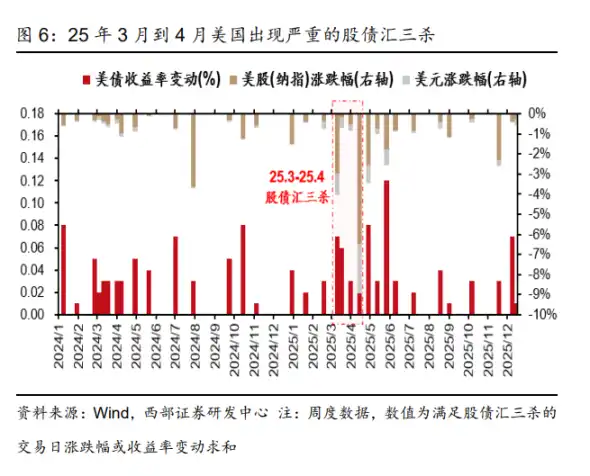
Finally, the report believes that even if a Japanese rate hike causes short-term turbulence, it will not change the broader long-term trend of global monetary easing. In this context, it continues to be bullish on the strategic allocation value of gold. Meanwhile, as China's export surplus expands and the Federal Reserve restarts interest rate cuts, the RMB exchange rate is expected to return to a medium-to-long-term appreciation trend, accelerating cross-border capital inflows, which is positive for Chinese assets. The report is optimistic about AH shares experiencing a "Davis Double Click" of earnings and valuation. For U.S. stocks and bonds, the report holds a震荡 (volatile/oscillating) view.


Trending Cryptos

Related Questions

QWhat are the main factors driving the Bank of Japan's potential hawkish interest rate hike?

AThe main factors include Japan's CPI consistently exceeding the 2% inflation target, a low unemployment rate below 3% that supports nominal wage growth, high expectations for wage increases in the upcoming 'Shunto' spring wage negotiations, and the inflationary pressure from the 21.3 trillion yen fiscal policy introduced by Takayuki Kobayashi.

QWhy does the report suggest that the most dangerous phase of a global liquidity shock from a BOJ hike may have already passed?

AThe report cites four reasons: risks have been partially released through three previous rate hikes since last March, speculative short positions in the yen were largely closed last July, the current environment lacks a 'recession trade' in the US and the one seen in July last year, and the Federal Reserve has begun expanding its balance sheet to provide a liquidity buffer.

QWhat role could a BOJ rate hike play in the current fragile global market, according to the report?

AThe report suggests that a BOJ rate hike could act as a 'catalyst', triggering a panic-driven capital flight and potentially inducing a global liquidity shock, given the existing fragility in markets like the US stock market after a 6-year bull run and rising concerns about an 'AI bubble'.

QWhat key signal should investors watch for to gauge the probability of a liquidity shock?

AInvestors should watch for a key signal of 2-3 consecutive occurrences of 'stock, bond, and currency markets falling together' (a 'triple kill') in the US market, similar to the situation in early April, which would indicate a significantly increased probability of a liquidity shock.

QWhat is the report's medium to long-term outlook for global monetary policy and its implications for assets?

AThe report believes that a BOJ hike will not change the medium to long-term trend of global monetary easing. It remains bullish on the strategic allocation value of gold, expects the RMB exchange rate to appreciate due to China's export surplus expansion and Fed rate cuts, and is optimistic about a 'Davis double play' for AH shares. It holds a震荡 (volatile/oscillating) view on US stocks and bonds.

Related Reads

Xi Jinping Attends Opening Ceremony of World Artificial Intelligence Conference 2026 and High-Level Meeting on Global AI Governance, Delivers Keynote Speech

On July 17, 2026, Chinese President Xi Jinping delivered a keynote speech titled "Working Together to Build a Fair and Equitable Global Governance System on Artificial Intelligence" at the opening ceremony of the 2026 World Artificial Intelligence Conference and High-level Conference on Global AI Governance in Shanghai. President Xi pointed out that the rapid development of AI, alongside the accelerated global changes, presents both significant opportunities and governance challenges. He raised critical questions for humanity regarding human-machine coexistence, safety, ethics, and bridging divides. China advocates for a people-oriented, benevolent approach to AI, making it a force for common prosperity and security, and jointly building a fair and reasonable global AI governance system. Xi Jinping put forward a four-point proposal: 1. **Uphold Openness for Win-Win Cooperation and Drive Innovation:** Seize the historic opportunity by encouraging open-source collaboration and sharing to foster AI innovation, industry growth, and application, empowering all sectors. 2. **Enhance Risk Awareness and Ensure Security and Controllability:** Attach great importance to AI's inherent and derivative risks. Build systems for laws, technical monitoring, risk warning, and emergency response to safeguard security, prevent misuse, and ensure human control. Oppose the practice of politicizing national security in AI. 3. **Encourage Inclusiveness and Promote Cultural Exchange:** Shape AI's values with humanity's common values. Use AI to enhance understanding and tolerance between civilizations, fostering a garden of diverse cultures. 4. **Advocate Solidarity and Improve Global Governance:** Practice true multilateralism, leverage the UN's role, and strengthen coordination on AI development strategies, governance rules, and technical standards to form a widely accepted global governance framework. Assist Global South countries in capacity building to bridge the digital divide and avoid new historical inequities. Xi highlighted that as a responsible major country, China, in its 15th Five-Year Plan period, is committed to being a provider of international public goods in AI, contributing Chinese solutions. China has promoted an "AI Plus" initiative, with its core intelligent economy exceeding RMB 10 trillion. To support global AI development, China will provide 5,000 AI training opportunities for developing countries, establish international AI application cooperation centers with regional organizations, and deploy its "Mazu" meteorological AI warning system in 30 countries. The establishment of the World Artificial Intelligence Cooperation Organization in Shanghai marks a significant milestone. Leaders from Kazakhstan, Cambodia, Thailand, and the UN Secretary-General delivered speeches, commending China's contributions to global AI governance and echoing President Xi's proposals. They agreed that AI's opportunities and challenges are borderless, requiring cooperative, inclusive, and equitable international efforts to ensure a secure, prosperous future that leaves no country behind. The conference issued a Chair's Statement. President Xi and his wife hosted a welcome banquet for international dignitaries on July 16. Senior Chinese officials attended the events.

链捕手4m ago

Xi Jinping Attends Opening Ceremony of World Artificial Intelligence Conference 2026 and High-Level Meeting on Global AI Governance, Delivers Keynote Speech

链捕手4m ago

Who Is Shaping Ethereum's Future: The Takeover by Token-Holding Companies Could Be the Best Thing for ETH in Years

**Title: Who is Building Ethereum's Future? Corporate ETH Holders Take Over Funding, Possibly the Best Thing for ETH in Years.** **Summary:** The Ethereum Foundation is scaling back due to fiscal concerns, but publicly traded companies holding large amounts of ETH, like Bitmine and SharpLink, are stepping in to fund protocol development. These firms collectively hold nearly 5% of ETH's circulating supply and are using their staking yields to pay for R&D. Unlike MicroStrategy, which merely accumulates Bitcoin, these ETH treasury companies are reinvesting profits directly into the protocol's development—potentially allowing all ETH holders to benefit from this free "spillover." Key drivers for this shift include these companies' stalled business model. Their "flywheel" of issuing stock to buy more ETH broke as their stock prices fell below the net value of their crypto holdings (mNAV < 1). With their ETH holdings also deeply underwater, simply waiting for price appreciation failed. By funding Ethereum's roadmap—through new non-profits like ETH Labs and Ethereum Institutional—they aim to increase the utility and value of the underlying asset that dominates their balance sheets. This creates a new alignment of interests: these companies are highly incentivized to see Ethereum succeed and are less likely to sell en masse. However, risks remain. The exact funding amounts are undisclosed, and these treasury firms themselves are vulnerable if ETH prices fall further, which could halt their contributions. **Additional Context:** The article also contrasts Jito's new "token-centric" proposal (JIP-38), which credibly directs platform fees to token buybacks, with Venice's less concrete promises, highlighting the importance of where revenue legally lands and who controls the mechanisms. Other notable industry updates include the rise of TradFi perpetuals on Hyperliquid, new Bitcoin staking via Stacks, and various DeFi product launches.

marsbit1h ago

Who Is Shaping Ethereum's Future: The Takeover by Token-Holding Companies Could Be the Best Thing for ETH in Years

marsbit1h ago

Trading

Spot

Hot Articles

Discussions

Welcome to the HTX Community. Here, you can stay informed about the latest platform developments and gain access to professional market insights. Users' opinions on the price of S (S) are presented below.

活动图片