Why This Next Altcoin Season Could Be More Explosive Than 2021 As Signals Go Crazy

bitcoinistPublished on 2026-04-04Last updated on 2026-04-04

Abstract

Despite Bitcoin hitting new all-time highs, the crypto market has not yet experienced an altcoin season comparable to 2021. However, signals suggest the next altcoin season could be even more explosive. Analyst Mark Chadwick notes that altcoins are showing a strong bullish pattern against Bitcoin, with the ALT/BTC chart marking four consecutive green monthly candles—a pattern last seen in 2021, which led to a historic altcoin rally. Several factors support a stronger altcoin season this time: the Fed is increasing market liquidity, the Clarity ACT may provide clearer crypto regulations, and the SEC is becoming more pro-crypto under the Trump administration. Additionally, rising crypto trading activity on major exchanges like NYSE and NASDAQ, along with growing institutional adoption—such as Fannie Mae accepting Bitcoin as loan collateral and Mastercard developing blockchain payment systems—suggest a bullish setup. These catalysts could drive altcoins to outperform Bitcoin significantly.

The crypto market is yet to have an altcoin season the likes of what was seen back in 2021, despite the Bitcoin price hitting new all-time highs over the last two years. This has alluded to the fact that the Bitcoin dominance over the market remains very high, thus not leaving any room for altcoins to run. Nevertheless, this has not deterred the expectations of an altcoin season among investors, and many believe that when it finally comes, it will be more explosive than 2021.

Altcoin Market Is Winning Against Bitcoin

Bitcoin has often led the cryptocurrency and by extension, its performance has influenced the advent of altcoin seasons. This is due to the way altcoins measure up to the leading cryptocurrency with each cycle, and this one looks to be prepping for a major rally.

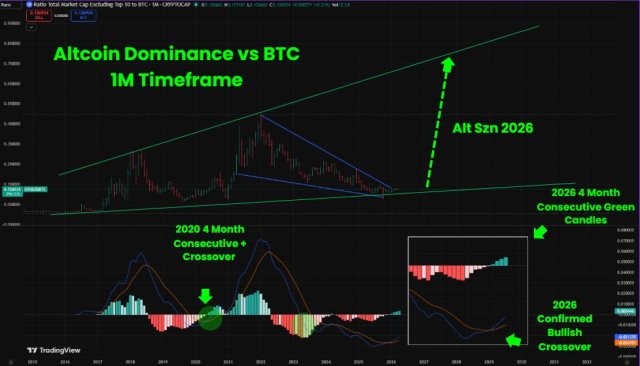
According to analyst Mark Chadwick on X, altcoins are already bringing a major bullish pattern against Bitcoin. This comes as the ALT/BTC chart has marked its fourth consecutive green monthly candle, and this has led to the confirmation of a bullish crossover.

The crypto analyst pointed out that the last time altcoins made such a bullish crossover against Bitcoin was back in 2021. The result of this was the most explosive altcoin season that the crypto market has seen to date, leading altcoins on runs that saw their values rise by many multiples.
Source: X

Why This Altcoin Season Will Be Better Than The Last

Despite the last altcoin season being one of legendary status, Mark believes that it will pale in comparison to what’s coming. A number of reasons were given for this as to why it will be a better altcoin bull market, and this has to do with the broader market optics.

Firstly, the analyst points out that the Fed is putting billions of dollars into the financial market. This is bullish as liquidity tends to drive growth. Next is that the Clarity ACT that will provide formal regulation for cryptocurrencies by putting them into categories of either securities or commodities.

Another bullish factor that the analyst points out is that the SEC is now pro-crypto with the Trump administration. Then, there is the fact that there has been rising activity from the NYSE and NASDAQ when it comes to crypto trading.

The last two of the catalysts given have to do with adoption. The first is the fact that Fannie Mae, the US Federal National Mortgage Association, announced last week that it will begin allowing Bitcoin as collateral for loans. Also, there is the fact that Mastercard is now building crypto rails to allow for payments using blockchain technology.

Taking all of these into account, Mark believes that it is a “setup of epic proportions.” If this plays out as expected, then the next altcoin season could surpass the previous one, and altcoins would end up winning against Bitcoin.

Altcoin market continues to struggle | Source: Crypto Total Market Cap Excluding BTC on Tradingview.com

Related Questions

QAccording to the article, what is the main reason why an altcoin season hasn't occurred despite Bitcoin's new all-time highs?

AThe Bitcoin dominance over the market remains very high, not leaving any room for altcoins to run.

QWhat specific bullish pattern on the ALT/BTC chart does analyst Mark Chadwick point to as a signal for an upcoming altcoin season?

AThe ALT/BTC chart has marked its fourth consecutive green monthly candle, confirming a bullish crossover.

QName two of the regulatory or institutional factors mentioned that could make the next altcoin season more explosive than 2021.

AThe Clarity ACT providing formal cryptocurrency regulation and the SEC being pro-crypto under the Trump administration.

QWhat recent announcement from Fannie Mae is cited as a bullish catalyst for crypto adoption?

AFannie Mae announced it will begin allowing Bitcoin as collateral for loans.

QBesides regulatory changes, what other major factor does the analyst attribute to driving market growth and a potential altcoin season?

AThe Fed is putting billions of dollars into the financial market, increasing liquidity which tends to drive growth.

Related Reads

Following US Ban on Fable 5, Zhipu AI's Stock Soars 47%

On June 15th, shares of Zhipu AI surged dramatically on the Hong Kong stock market, peaking at a 47.6% gain before closing 32.82% higher. This sharp increase was directly triggered by two recent industry events. On June 12th, Anthropic announced it was suspending global access to its latest flagship models, Claude Fable 5 and Claude Mythos 5, to comply with a U.S. government export control order. The next day, Zhipu AI announced it would open access to its latest open-source flagship model, GLM-5.2, under the permissive MIT license. The Anthropic incident highlighted a critical issue beyond raw model capability: the risk of sudden, unpredictable loss of access to advanced AI models, especially for developers and enterprises deeply integrated with them. This has shifted industry and market focus toward factors like stability, sustainable access, and controllability. Zhipu's move, promoting "frontier intelligence for all," positions its openly available model as a reliable and accessible alternative. The GLM-5.2 model emphasizes "Long Horizon Task" capabilities with a 1M context window, targeting complex, multi-step coding and engineering workflows where maintaining context is crucial. Analysts note this event exposes the risk of dependency on closed-source models subject to single jurisdictional controls, potentially accelerating a shift toward domestic base models and localized deployments. The market's reaction signals a new valuation dimension in AI: providers who can offer stable, long-term, and sustainably accessible AI capabilities are gaining strategic importance.

marsbit3m ago

Following US Ban on Fable 5, Zhipu AI's Stock Soars 47%

marsbit3m ago

Fully Entering the AI Era: Alipay Bets on Conversation, WeChat Holds Fast to Social

In May 2026, Alipay announced over 300 million AI payment transactions. Shortly after, WeChat opened its mini-programs for AI integration, sparking controversy by requiring developer source code access. This highlights their diverging approaches to AI integration. Alipay is testing "Project Treasure," an optional AI-native interface replacing traditional app grids with a conversational window. Users can command complex tasks (e.g., "book a ride and order coffee") handled end-to-end by AI. This shift follows an abandoned standalone AI app, focusing instead on enhancing its existing user base. For unmodified mini-programs, Alipay's AI uses "screen-reading" to simulate user interactions, bypassing the need for developer overhaul. It also introduced "Token Pay" for micro-transactions and "AI Wallets" for autonomous agent spending. WeChat, prioritizing its core social function, is taking an embedded approach. Its AI agent will operate within existing contexts like group chats and official accounts, assisting without a separate interface. To enable this, WeChat offers developers two paths: granting source code access for direct AI control ("Automatic Mode") or manually encapsulating services into standardized "Skills." Both place significant burden on developers. Key differences emerge in handling legacy services: WeChat demands developer cooperation (code or labor), while Alipay's screen-reading offers immediate, if potentially less stable, compatibility. Alipay's 3 billion AI transactions demonstrate user acceptance of AI-driven commercial actions. The divergent strategies may reshape mini-program ecosystems—Alipay passively "AI-fying" services, WeChat potentially favoring resource-rich developers—and set competing technical standards. Ultimately, the competition centers on where users entrust the command to "help me get things done."

marsbit3m ago

Fully Entering the AI Era: Alipay Bets on Conversation, WeChat Holds Fast to Social

marsbit3m ago

Apple Also Has to Pay Rent Now

Apple Pays Rent Too: The Two-Way Flow of "Traffic Tax" and "AI Capability Rent" Between Tech Giants For over two decades, Google has paid Apple an estimated $20 billion annually to remain the default search engine on Safari, a "traffic tax" for a critical user entry point. However, in 2026, the direction of this cash flow partially reversed. Apple agreed to pay Google roughly $1 billion per year to license its Gemini AI models, as Apple's own models reportedly struggled with complex tasks. This creates a unique dynamic: Apple acts as the "landlord" in the established search ecosystem, collecting rent from Google for access. Simultaneously, in the emerging AI arena, Apple becomes the "tenant," paying Google for access to cutting-edge AI capabilities it cannot currently match internally. While Apple claims its new models are "distilled" from Gemini outputs and contain "not a drop" of Google's original code, core dependencies remain. Its knowledge base is refined using Gemini's outputs, and its most powerful cloud model runs on Google's infrastructure. Apple has structured the deal as non-exclusive, allowing it to theoretically switch AI suppliers—a hedge against over-reliance. The future hinges on whether advanced AI models become a commodity (cheap and abundant) or remain a concentrated, scarce resource (expensive and controlled by few). Apple is betting on the former, leveraging its massive device ecosystem to be a powerful, choosy customer. If the latter proves true, its bargaining power could erode. This power dynamic is extending to developers. Apple, Google, and WeChat are all pushing for apps to expose their core functions as standardized "actions" or "intents" that their respective AI assistants (Siri, Gemini, WeChat AI) can directly call. The new scarce resource is no longer just app store visibility, but "being selected by the AI." The currency of "rent" has changed from a 30% revenue share to ceding control over how users interact with an app's functions.

marsbit1h ago

Apple Also Has to Pay Rent Now

marsbit1h ago

Trading

Spot
Futures
活动图片