Why Only Dollar-Cost Averaging Can Capture Bitcoin's Long-Term Dividends?

marsbitОпубліковано о 2026-03-06Востаннє оновлено о 2026-03-06

Анотація

The article argues that dollar-cost averaging (DCA) is the optimal strategy for capturing Bitcoin's long-term gains, supported by backtested data and forward-looking models. Historical analysis shows that a weekly DCA investment of $250 in Bitcoin starting in January 2021 would have yielded a 76% return by mid-2026, with significant upside potential at higher price levels. Even shorter-term DCA strategies, while susceptible to short-term drawdowns, show strong performance over time. Comparisons with the S&P 500 indicate that Bitcoin DCA outperforms traditional equity DCA despite higher risk. Long-term projections based on Bitcoin’s power-law growth model suggest substantial returns by 2030, with mid-range estimates around $430,000 per BTC. The key conclusion is that while entry timing affects short-term returns, long-term consistency is the primary driver of wealth accumulation in Bitcoin.

Written by: Cointelegraph

Compiled by: AididiaoJP, Foresight News

Both backtest data and forward-looking models indicate that using a dollar-cost averaging (DCA) strategy to buy Bitcoin is the best way to invest in BTC. Will this method still work in the next bull market?

Bitcoin has experienced a 50% crash over the past 5 months, and savvy investors adjust their strategies during such bear markets and correction periods. This strategy is called dollar-cost averaging (DCA), which involves investing a fixed amount regularly, regardless of market conditions.

By examining historical market cycle data and forward-looking BTC price simulations, we can more clearly see how this steady investment approach performs across different entry times and investment horizons.

Five Years of DCA in Bitcoin Yields Substantial Net Gains

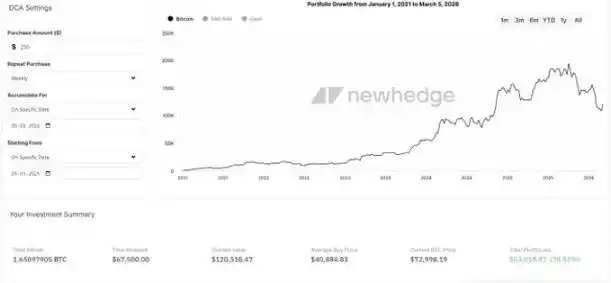
Starting from January 2021, investing $250 weekly in Bitcoin via DCA, the total investment over five years would be $67,500. According to DCA simulation data, this strategy would have accumulated 1.65097905 BTC, with an average purchase price of $40,884.

At Bitcoin's current price of nearly $71,000, this 1.65097905 BTC is worth approximately $120,500, resulting in a profit of $53,000 (a 76% increase). If Bitcoin rises to $100,000, the holdings would be worth about $165,000; and at the cycle peak of around $126,000 in October 2025, the holdings would reach a value of $208,000.

2021-2026 Bitcoin DCA Cycle Source: Newhedge

Now, consider a shorter investment period to see the impact of entry timing on early returns. Starting from January 2024, investing $250 weekly, the total investment would be $28,500, accumulating 0.36863166 BTC with an average purchase price of $77,312.

At the current price of $71,000, these bitcoins are worth approximately $26,909, representing a 6% paper loss. If the price reaches $100,000, the holdings would be worth $36,863; and at the cycle peak of $126,000, the holdings would be valued at $46,448.

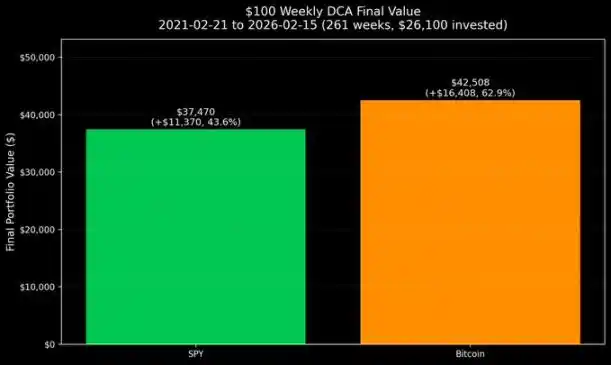
In February of this year, Swan Bitcoin analyst Adam Livingston compared on platform X the returns of DCA into BTC versus the S&P 500 over the past five years. Investing $100 weekly, BTC yielded $42,508, while the S&P 500 yielded $37,470, with returns of 62.9% and 43.6% respectively.

Livingston noted that although Bitcoin is highly volatile, historical data shows that persisting with DCA during downturns leads to higher long-term gains.

Weekly $100 DCA: BTC vs. S&P 500 Source: Adam Livingston/X

Long-Term Model: Time is the Key Factor

Forward-looking simulation studies have also tested the effectiveness of DCA starting in 2026. From January 2026, investing $250 weekly until March 2030, the total investment would be approximately $54,250.

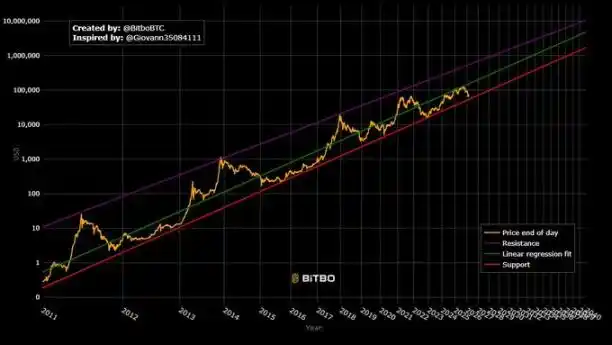
The price prediction is based on Bitcoin's long-term power law growth curve (which tracks the relationship between Bitcoin's historical price and time on a logarithmic scale). This model generates a rising support band and a median trendline, which aligns well with previous market cycles.

Bitcoin Power Law Growth Curve Source: Bitbo.io

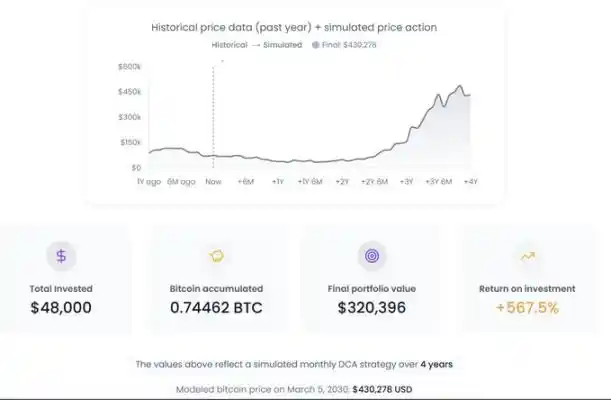
Based on this model, analysts estimate that the long-term trend support level could break through $100,000 by 2028, which also serves as the foundational assumption for future DCA modeling. Bitcoin Well's simulation shows that by March 2030, the median price projection is approximately $430,000.

Considering potential price deviations, the model also accounts for the upper and lower bounds of the power law channel, providing a lower estimate (around $274,000) and a higher estimate (around $900,000).

Based on these assumptions, four years of DCA would accumulate roughly 0.30 BTC:

  • If BTC price is $274,000, the holdings are worth approximately $82,200.
  • If BTC price is $430,000 (median projection), the holdings are worth approximately $129,000.
  • If BTC price is $900,000, the holdings are worth approximately $270,000.

DCA Investment Results as of March 2030 Source: Bitcoin Well

In November 2025, Bitcoin researcher Sminston With conducted a study using a similar predictive model to test the impact of entry time on long-term returns. The results found that even buying at a price 20% higher than the then price of $94,000 and selling at a price 20% lower than the projected 2035 median price, the remaining holdings after ten years would still yield a profit of nearly 300%.

In this simulation, the final total assets were 7.7 times the initial investment.

The study concluded: Entry timing affects the level of returns, but long-term holding is the key determinant of the magnitude of gains.

Пов'язані питання

QWhat is the main investment strategy discussed in the article for capturing Bitcoin's long-term gains?

AThe main strategy discussed is Dollar-Cost Averaging (DCA), which involves investing a fixed amount of money at regular intervals, regardless of market conditions.

QAccording to the article, how much profit was generated from a 5-year DCA strategy starting in January 2021 with a weekly investment of $250?

AThe 5-year DCA strategy generated a profit of $53,000, representing a 76% return on the initial investment of $67,500.

QWhat model is used to predict Bitcoin's long-term price growth in the article?

AThe article uses Bitcoin's long-term power law growth curve model, which tracks the historical relationship between Bitcoin's price and time on a logarithmic scale to predict future prices.

QHow does the performance of DCA in Bitcoin compare to the S&P 500 over a 5-year period, as mentioned in the article?

AOver a 5-year period, a weekly DCA of $100 in Bitcoin yielded $42,508 (62.9% return), while the same strategy in the S&P 500 yielded $37,470 (43.6% return).

QWhat is the key factor that determines the magnitude of returns in Bitcoin investment, according to the research cited in the article?

AThe key factor is the length of time the investment is held. While entry timing affects the level of returns, long-term holding is crucial for determining the overall magnitude of gains.

Пов'язані матеріали

MoonPay Launches PayBox

MoonPay, a developer of payment solutions for crypto and traditional currencies, has launched PayBox, a new type of payment wallet that enables AI assistants in Claude and ChatGPT to conduct transactions. Users can manage digital assets and pay for online services directly within chat interfaces. Upon user request, the AI can perform actions such as purchasing PYUSD, swapping tokens, cross-chain transfers, depositing funds into DeFi protocols, and booking flights. All transactions require user confirmation via an access key before execution. PayBox supports Solana and EVM-based blockchains like Ethereum, Base, Arbitrum, Polygon, Hyperliquid, Tempo, and Robinhood Chain, with plans to add more networks. It can store both crypto wallets and payment cards. Security is provided via MPC (Multi-Party Computation) technology and secure execution environments, ensuring no single entity—including MoonPay or the AI assistant—has full access to user funds. The wallet offers two permission modes: "Always Ask," requiring manual approval for each transaction, and "Standalone," where the AI can operate autonomously within user-set limits. Permissions can be modified or revoked at any time. PayBox is built on technology from Sodot, a secure crypto wallet solutions provider acquired by MoonPay earlier this year. This infrastructure reportedly secures over $50 billion in digital assets across more than 10 million wallets.

cryptonews.ru10 хв тому

MoonPay Launches PayBox

cryptonews.ru10 хв тому

Now the Greatest Regret Is to My Family: Crypto Experts Took a Stumble in the Stock Market

Summary: This article examines the significant losses recently suffered by cryptocurrency traders and influencers who ventured into the stock market, specifically by heavily investing in AI-related and semiconductor storage stocks. The narrative centers on the dramatic reversal in the Korean and US equity markets in late July, with stocks like SK Hynix and related leveraged ETFs experiencing historic plunges, erasing massive gains. The analysis highlights several key factors behind the "flip." Traders, accustomed to crypto's high volatility and frustrated by a stagnant market, chased the apparent momentum in AI-themed equities. Many made fatal mistakes: applying high-leverage strategies common in crypto (e.g., 2x ETFs, on-chain perpetual contracts) to stocks, and failing to understand the distinct rules of different stock markets (like Korean pre-market trading). This led to widespread liquidations, especially when a thin Korean pre-market trade triggered a cascading flash crash on a decentralized exchange. Post-crash reflections from prominent figures reveal deep regret and self-criticism. They acknowledge misjudging their expertise, overestimating their edge against sophisticated institutional players, and the dangers of leverage. The article concludes that while such setbacks are part of trading, surviving long-term requires recognizing one's limitations and the inherent risks of cross-market strategies.

marsbit54 хв тому

Now the Greatest Regret Is to My Family: Crypto Experts Took a Stumble in the Stock Market

marsbit54 хв тому

US Senate Makes Important Amendments to "Conflict of Interest" Section of Cryptocurrency Bill

The U.S. Senate has taken a key step regarding the CLARITY Act, which could shape the future of the U.S. crypto market. On July 29, Senators Tom Tillis and Ruben Gallego finalized amendments to the bill's "conflict of interest" rules, one of its most contentious aspects. The bipartisan bill aims to tighten restrictions on high-level federal officials' ties to digital assets. The new text, crafted as an alternative to a White House-endorsed ethics code, is expected to impose stricter rules limiting officials' ability to issue or directly participate in digital asset projects. However, with Congress entering an August recess and the revised text not yet reviewed by much of the Senate, the bill's timeline is uncertain. Senate Majority Leader John Thune indicated a procedural vote could occur between July 29 and August 1 but expressed doubt the full bill could pass before the break. The House-approved CLARITY Act, passed in July 2025, has been under Senate negotiation for over a year. Key goals of the CLARITY Act include clarifying jurisdictional boundaries between the SEC and CFTC, setting rules for digital commodity spot markets, and addressing topics like stablecoin yields, DeFi, and illicit financing. The stablecoin yield provisions could significantly impact U.S.-based DeFi protocols, exchanges, and issuers, affecting their global competitiveness. The outcome is being closely watched by both the U.S. and global digital asset markets.

cryptonews.ru1 год тому

US Senate Makes Important Amendments to "Conflict of Interest" Section of Cryptocurrency Bill

cryptonews.ru1 год тому

Pavel Durov Designated as a Terrorist in Russia. What Does This Mean for Telegram Users?

Pavel Durov, the founder of Telegram, has been added to Russia's list of terrorists and extremists by Rosfinmonitoring, as published on July 30. The entry includes his name and date of birth. The designation follows an announcement by the Russian Federal Security Service (FSB) on July 29, which charged Durov with aiding terrorist activity. The FSB alleges that a Telegram dating bot named "DaiVinchik" was used to recruit 46 individuals for attacks on police and arson, orchestrated by Ukrainian special services. The FSB also accuses Telegram's administration of failing to remove channels and bots used by Ukrainian intelligence and extremist groups. Durov is reportedly subject to an international arrest warrant. Inclusion on the Rosfinmonitoring list leads to significant restrictions: the freezing of Durov's bank accounts and assets, severe limitations on financial transactions, and a ban on election participation, media interaction, and event organization. Transfers to his accounts may be considered terrorism financing. For ordinary Russian Telegram users, purchasing Telegram Premium is not classified as financing terrorism, according to an IT expert. General use of the messenger—messaging, managing channels—does not automatically make a user a participant in extremist activity. There has been no official decision to ban Telegram itself. It is noted that French authorities are also investigating Durov over allegations of inadequate measures against criminal activity on the platform and insufficient cooperation with law enforcement. Durov denies all charges.

cryptonews.ru1 год тому

Pavel Durov Designated as a Terrorist in Russia. What Does This Mean for Telegram Users?

cryptonews.ru1 год тому

Торгівля

Спот
活动图片