Where Is Crypto VC Money Flowing in 2025? Analyzing 6700+ Funding Rounds

marsbitPublished on 2026-01-08Last updated on 2026-01-08

Abstract

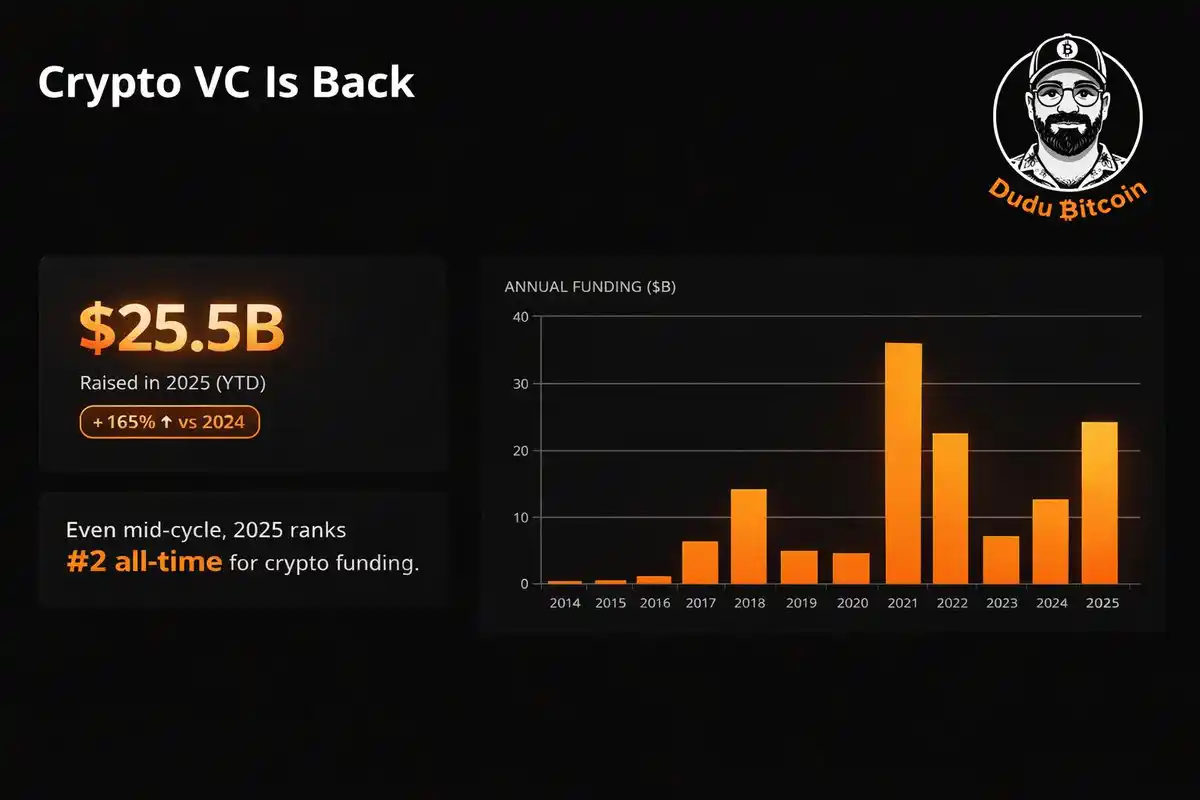
In 2025, cryptocurrency funding rebounded strongly, reaching $25 billion—the second-highest year on record after 2021. A key difference this year is the more sustainable nature of the investments. After analyzing 6,723 funding rounds, three major trends emerged: Prediction markets (e.g., Polymarket and Kalshi) were the biggest winners, becoming the only Web3 sector to attract mainstream adoption. Real-world assets (RWA) and cybersecurity also saw significant investment, reflecting crypto’s maturation as part of the global financial system. Seed-stage funding has evolved: AI enables leaner product development, allowing startups to bootstrap longer and raise later with stronger traction. The largest funding rounds highlight crypto’s divergence into three parallel tracks: speculative and cultural assets (e.g., meme coins, niche L1s like Monad), information and prediction markets, and financial infrastructure (e.g., stablecoins from Circle, Ripple, and Bullish). Major exchanges like Kraken and Gemini also raised pre-IPO rounds. Overall, the data shows crypto is maturing, with growing institutional participation and clearer use-case differentiation.

Written by: Dudu Bitcoin

Compiled by: Saoirse, Foresight News

In 2025, the rebound in cryptocurrency funding has momentum comparable to Dennis Rodman (the former American professional basketball player known for his explosive power and stable competitive form) in his prime.

The total annual funding reached $25 billion, making it the second-highest year on record, second only to the frenzy of 2021.

But there's a key difference this year:

The current funding heat is actually more sustainable.

To figure out where the money is flowing, I spent weeks analyzing 6723 funding rounds.
Winning Sectors: Prediction Markets, AI Storage & RWA

Prediction markets emerged as the biggest winners, which is actually not surprising.
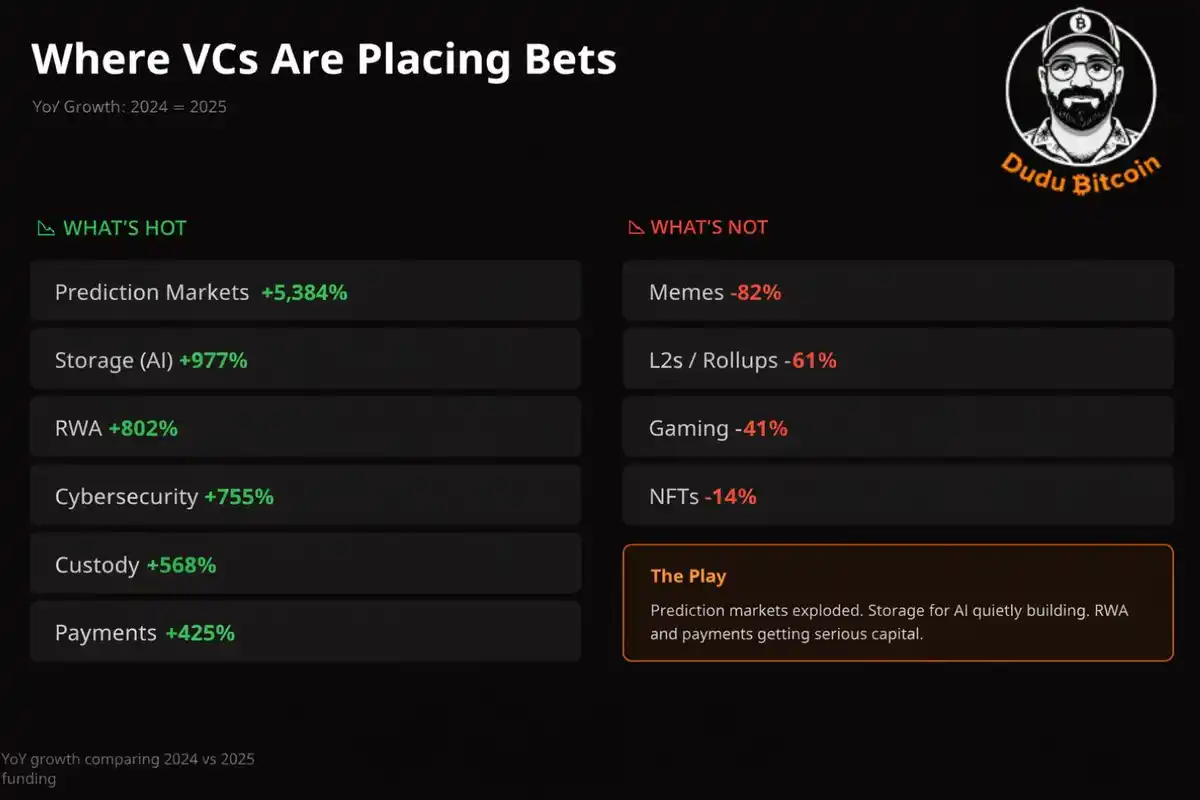
For prediction markets, 2025 was a bumper year — it is the only sector in Web3 that has successfully attracted mainstream consumer groups.

Platforms like Polymarket and Kalshi are locked in fierce competition, both striving to secure more top-tier partnerships.

Now, prediction markets are embedded in Google Search and major mainstream media outlets, further integrating into mainstream scenarios.

The fact that Real World Assets (RWA) and cybersecurity sectors ranked among the top funding hotspots also confirms a core view: Cryptocurrency is gradually maturing and becoming an increasingly solid part of the financial system.

However, for entrepreneurs focused on NFT development, the situation this year was not optimistic.

Seed Round Funding is Maturing
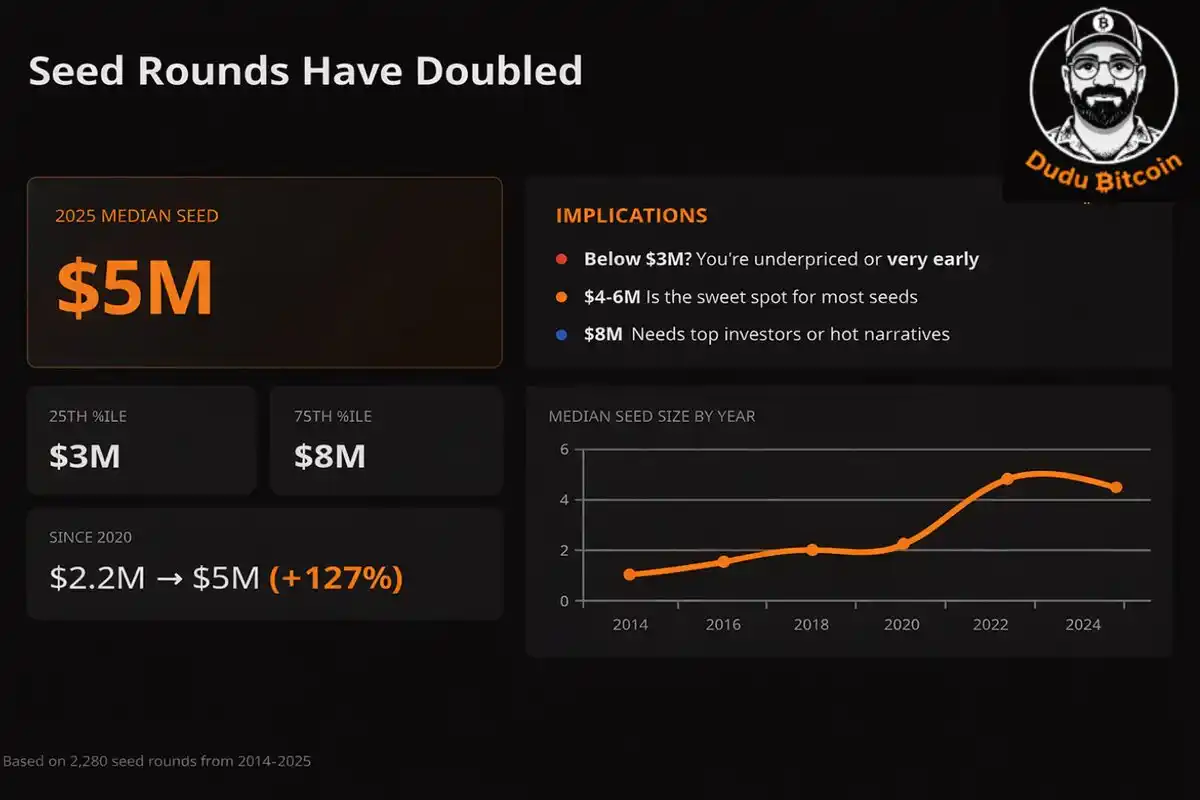
The era of launching projects with small seed funds is long gone. In the AI era, the resources required to develop a usable product have significantly reduced. This means entrepreneurs can bootstrap (self-fund) for longer periods and only need to seek funding when they have tangible results to show.

Advice: Strive to Partner with Coinbase Ventures
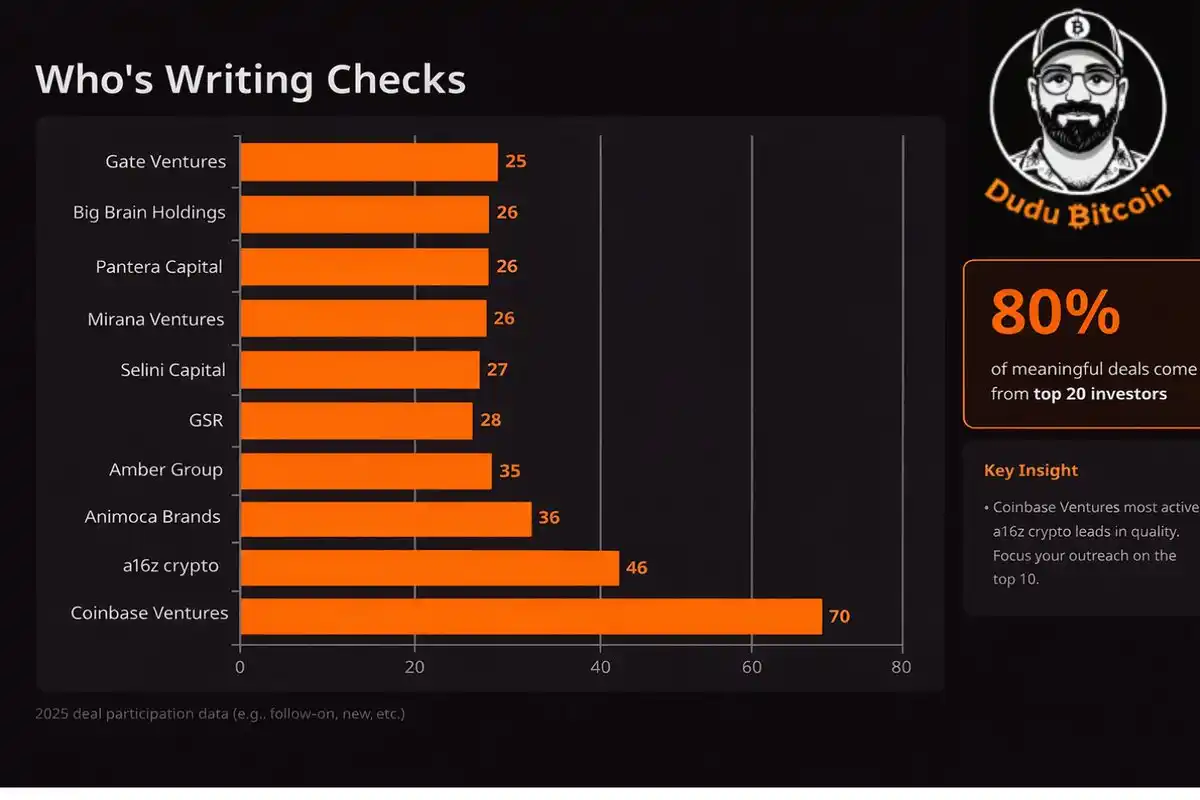
I've seen too many so-called 'VC matchmakers' — they connect entrepreneurs with investors but take a commission. More importantly, these matchmakers mostly only know third-tier investors, making the time cost for entrepreneurs simply not worth it. So, aim to find someone who can connect you with top-tier institutions like Coinbase Ventures, not niche ones like the 'Soulja Boy Fund' (Note: Soulja Boy is an American rapper, and his namesake fund is relatively small with limited investment influence).

Cryptocurrency is Gradually Maturing
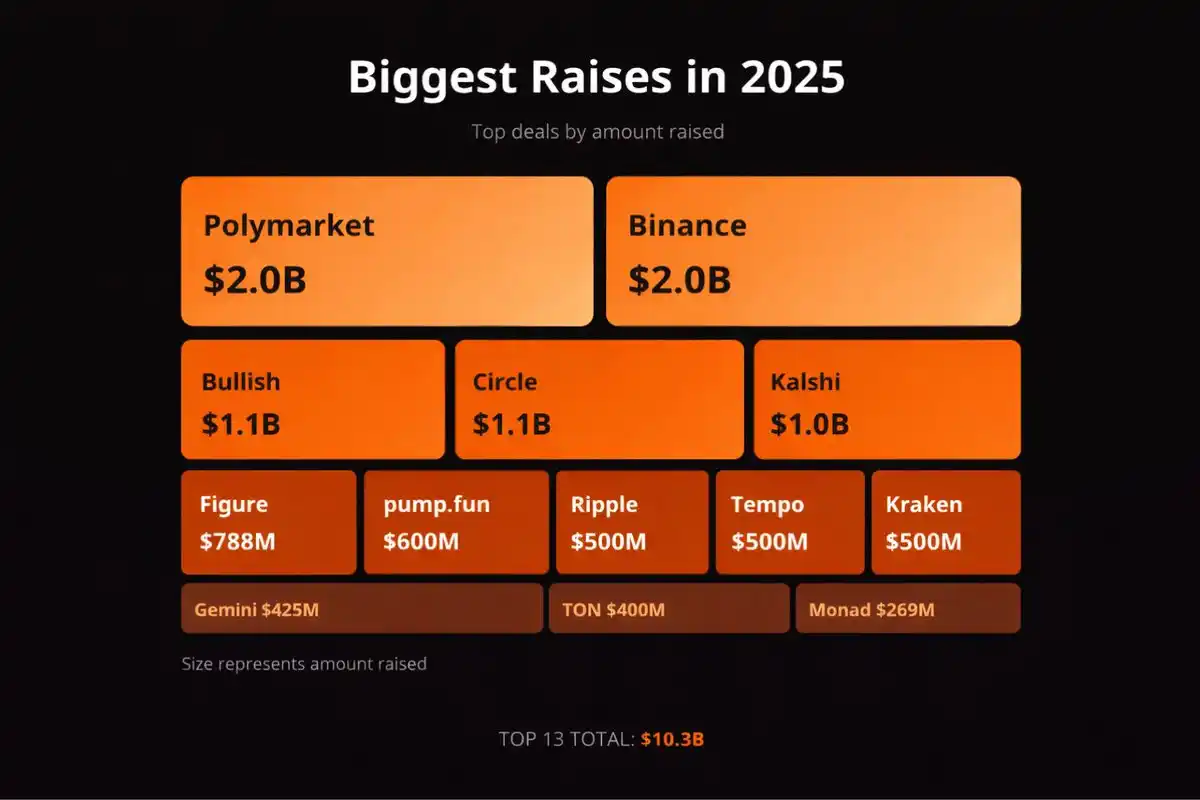
Looking at the projects with the largest funding rounds this year, the trend is quite clear.

Of course, the crypto space still has some of its 'speculative vitality' (referring to the high-risk, high-speculation trends unique to the crypto field):

  • Binance: Secured massive funding from the UAE to build a top altcoin trading platform;
  • Pump.fun: Set records for the number of Meme coins issued per second;
  • TON: Gained significant attention leveraging Telegram's widespread adoption in crypto;
  • Monad: Its L1 blockchain built substantial community hype, but the subsequent TGE performance was disappointing.

Every industry cycle needs some 'stimulating elements,' but if you look beyond the short term, you can clearly see the maturing trend of the crypto space.

Two of the largest funded projects this year came from prediction markets — Polymarket and Kalshi.

As mentioned before, 2025 was a banner year for prediction markets, the only Web3 sector that truly attracted mainstream consumers. Polymarket and Kalshi are still fiercely competing, striving to secure more top-tier partnerships, and their services are now embedded in Google Search and major mainstream media.

The stablecoin sector also performed exceptionally well in 2025:

  • Bullish: Co-founded by Brendan Blumer, previously controversial for the EOS project, raised $1 billion in its IPO;
  • Ripple: Successfully attracted Wall Street capital to enter the stablecoin space;
  • Circle: Raised $1 billion through its IPO, followed by a significant surge in its stock price;
  • Payment giant Stripe: Its launched L1 blockchain 'Tempo' proves that fintech companies are also actively entering the crypto space;
  • Figure: Completed a billion-dollar IPO, also focused on stablecoin-related business.

Finally, cryptocurrency exchanges Kraken and Gemini also completed funding rounds, likely their last before their IPOs.

The total funding for the aforementioned 4 'speculative' projects was approximately $3.27 billion;

The prediction market sector raised a total of $3 billion;

While projects in the more mature sectors of Web3 raised a total of $3.4 billion.

Cryptocurrency today is no longer confined to a single attribute.

It is splitting into three parallel tracks:

  • The speculation and culture track (e.g., Meme coins, niche blockchains);
  • The information and truth market track (centered around prediction markets);
  • The financial infrastructure for the real economy track (e.g., stablecoins, RWA).

Related Questions

QWhich sectors were the biggest winners in crypto VC funding in 2025 according to the article?

AThe biggest winners were prediction markets, AI storage, and Real World Assets (RWA).

QWhat was the total amount of crypto funding in 2025 and how does it compare to previous years?

AThe total funding in 2025 was $25 billion, making it the second-highest year on record, only behind the frenzy of 2021.

QWhy does the article suggest that the current funding boom is more sustainable?

AThe funding is more sustainable because it is driven by more mature sectors like prediction markets and RWA, which are becoming integrated into the mainstream financial system, rather than just speculative projects.

QWhat advice does the article give to entrepreneurs seeking venture capital?

AThe article advises entrepreneurs to seek connections with top-tier investors like Coinbase Ventures, rather than using 'VC matchmakers' who often only have access to lower-tier investors.

QInto what three parallel tracks is the cryptocurrency ecosystem splitting, as described in the article?

AThe three tracks are: 1) Speculation and culture (e.g., meme coins, niche L1s), 2) Information and truth markets (with prediction markets at the core), and 3) Financial infrastructure for the real economy (e.g., stablecoins, RWA).

Related Reads

You Bet on the News, the Pros Read the Rules: The True Cognitive Gap in Losing Money on Polymarket

The article explains that the key to profiting on Polymarket, a prediction market platform, lies not just predicting real-world events correctly, but in meticulously understanding the specific rules that govern how each market will be resolved. It illustrates this with examples, such as a market on Venezuela's 2026 leader, where the official rules defining "officially holds" the office overruled the intuitive answer of who was in practical control. Other examples include debates over the definition of a "token" or what constitutes an "agreement." The core argument is that a "reality vs. rules" gap creates pricing discrepancies that savvy traders ("车头" or "whales") exploit. The platform has a formal dispute resolution process managed by UMA token holders to settle ambiguous outcomes. This process involves proposal submission, a challenge window, a discussion period, and a final vote. However, the article highlights a critical flaw in this system compared to a traditional court: the lack of separation between the arbiters (UMA voters) and the interested parties (traders with financial stakes in the outcome). This conflict of interest undermines the discussion phase, leads to herd mentality, and results in opaque final decisions without explanatory rulings. Consequently, the system lacks a body of precedent, making it difficult for users to learn from past disputes. The ultimate takeaway is that success on Polymarket requires a lawyer-like scrutiny of the rules to identify and capitalize on the cognitive gap between how events appear and how they are contractually defined for settlement.

marsbit21m ago

You Bet on the News, the Pros Read the Rules: The True Cognitive Gap in Losing Money on Polymarket

marsbit21m ago

Will the Fed Still Cut Interest Rates? Tonight's Data Is Crucial

The core debate surrounding the Federal Reserve's potential interest rate cuts is intensifying amid geopolitical conflict and rebounding inflation. The key question is whether high energy prices will cause persistent inflation or weaken consumer demand enough to force the Fed to cut rates. Citigroup presents a bullish case for cuts, arguing that oil supply disruptions from the Strait of Hormuz are temporary and will not lead to lasting inflationary pressure. They point to receding bond yields and oil prices as evidence the market is pricing in a short-lived shock. Citi's data also shows tightening financial conditions, a stabilizing labor market, and healthy tax returns, supporting their view that the path to lower rates remains open. Conversely, Deutsche Bank offers a starkly contrasting, more hawkish outlook. They argue the Fed's current policy is already neutral and expect rates to remain unchanged indefinitely. Their view is based on stalled disinflation progress and a shift toward more hawkish rhetoric from key Fed officials like Waller, who cited risks from prolonged Middle East conflict and tariffs. Other officials, including Williams and Hammack, signaled rates would likely stay on hold for a "considerable time." The market pricing has shifted dramatically, now forecasting zero cuts in 2026. The imminent release of the March retail sales "control group" data is highlighted as a critical test. This metric, which excludes gas station sales, will reveal if high gasoline prices are eroding consumer spending in other areas. A weak reading could support the case for imminent rate cuts, while a strong one would bolster the argument for the Fed to hold steady. This data is pivotal for determining the near-term policy path.

marsbit41m ago

Will the Fed Still Cut Interest Rates? Tonight's Data Is Crucial

marsbit41m ago

Trading

Spot
Futures

Hot Articles

What is $BITCOIN

DIGITAL GOLD ($BITCOIN): A Comprehensive Analysis Introduction to DIGITAL GOLD ($BITCOIN) DIGITAL GOLD ($BITCOIN) is a blockchain-based project operating on the Solana network, which aims to combine the characteristics of traditional precious metals with the innovation of decentralized technologies. While it shares a name with Bitcoin, often referred to as “digital gold” due to its perception as a store of value, DIGITAL GOLD is a separate token designed to create a unique ecosystem within the Web3 landscape. Its goal is to position itself as a viable alternative digital asset, although specifics regarding its applications and functionalities are still developing. What is DIGITAL GOLD ($BITCOIN)? DIGITAL GOLD ($BITCOIN) is a cryptocurrency token explicitly designed for use on the Solana blockchain. In contrast to Bitcoin, which provides a widely recognized value storage role, this token appears to focus on broader applications and characteristics. Notable aspects include: Blockchain Infrastructure: The token is built on the Solana blockchain, known for its capacity to handle high-speed and low-cost transactions. Supply Dynamics: DIGITAL GOLD has a maximum supply capped at 100 quadrillion tokens (100P $BITCOIN), although details regarding its circulating supply are currently undisclosed. Utility: While precise functionalities are not explicitly outlined, there are indications that the token could be utilized for various applications, potentially involving decentralized applications (dApps) or asset tokenization strategies. Who is the Creator of DIGITAL GOLD ($BITCOIN)? At present, the identity of the creators and development team behind DIGITAL GOLD ($BITCOIN) remains unknown. This situation is typical among many innovative projects within the blockchain space, particularly those aligning with decentralized finance and meme coin phenomena. While such anonymity may foster a community-driven culture, it intensifies concerns about governance and accountability. Who are the Investors of DIGITAL GOLD ($BITCOIN)? The available information indicates that DIGITAL GOLD ($BITCOIN) does not have any known institutional backers or prominent venture capital investments. The project seems to operate on a peer-to-peer model focused on community support and adoption rather than traditional funding routes. Its activity and liquidity are primarily situated on decentralized exchanges (DEXs), such as PumpSwap, rather than established centralized trading platforms, further highlighting its grassroots approach. How DIGITAL GOLD ($BITCOIN) Works The operational mechanics of DIGITAL GOLD ($BITCOIN) can be elaborated on based on its blockchain design and network attributes: Consensus Mechanism: By leveraging Solana’s unique proof-of-history (PoH) combined with a proof-of-stake (PoS) model, the project ensures efficient transaction validation contributing to the network's high performance. Tokenomics: While specific deflationary mechanisms have not been extensively detailed, the vast maximum token supply implies that it may cater to microtransactions or niche use cases that are still to be defined. Interoperability: There exists the potential for integration with Solana’s broader ecosystem, including various decentralized finance (DeFi) platforms. However, the details regarding specific integrations remain unspecified. Timeline of Key Events Here is a timeline that highlights significant milestones concerning DIGITAL GOLD ($BITCOIN): 2023: The initial deployment of the token occurs on the Solana blockchain, marked by its contract address. 2024: DIGITAL GOLD gains visibility as it becomes available for trading on decentralized exchanges like PumpSwap, allowing users to trade it against SOL. 2025: The project witnesses sporadic trading activity and potential interest in community-led engagements, although no noteworthy partnerships or technical advancements have been documented as of yet. Critical Analysis Strengths Scalability: The underlying Solana infrastructure supports high transaction volumes, which could enhance the utility of $BITCOIN in various transaction scenarios. Accessibility: The potential low trading price per token could attract retail investors, facilitating wider participation due to fractional ownership opportunities. Risks Lack of Transparency: The absence of publicly known backers, developers, or an audit process may yield skepticism regarding the project's sustainability and trustworthiness. Market Volatility: The trading activity is heavily reliant on speculative behavior, which can result in significant price volatility and uncertainty for investors. Conclusion DIGITAL GOLD ($BITCOIN) emerges as an intriguing yet ambiguous project within the rapidly evolving Solana ecosystem. While it attempts to leverage the “digital gold” narrative, its departure from Bitcoin's established role as a store of value underscores the need for a clearer differentiation of its intended utility and governance structure. Future acceptance and adoption will likely depend on addressing the current opacity and defining its operational and economic strategies more explicitly. Note: This report encompasses synthesised information available as of October 2023, and developments may have transpired beyond the research period.

363 Total ViewsPublished 2025.05.13Updated 2025.05.13

What is $BITCOIN

Discussions

Welcome to the HTX Community. Here, you can stay informed about the latest platform developments and gain access to professional market insights. Users' opinions on the price of BTC (BTC) are presented below.

活动图片