Original | Odaily Planet Daily (@OdailyChina)
Author | Golem (@web 3_golem)

On February 27, when a user on platform X asked Peter Steinberger, the founder of OpenClaw, for "the best advice for 20-year-olds," Peter Steinberger bluntly stated, "Don't waste your time on cryptocurrency." As the founder of one of the hottest AI products currently, Peter Steinberger has not hidden his disdain for cryptocurrency. He has warned cryptocurrency practitioners not to harass him, and even mentioning Bitcoin in OpenClaw's Discord could result in a ban.
This sharp remark sparked collective memes and self-mockery in the crypto community. However, unlike the market downturn where crypto practitioners chant "crypto is dead," when "don't waste your time on cryptocurrency" is given as advice to young people by a top AI entrepreneur, it stung the crypto industry.
It laid the anxiety right before our eyes—crypto is no longer the optimal solution for young people in the current era.
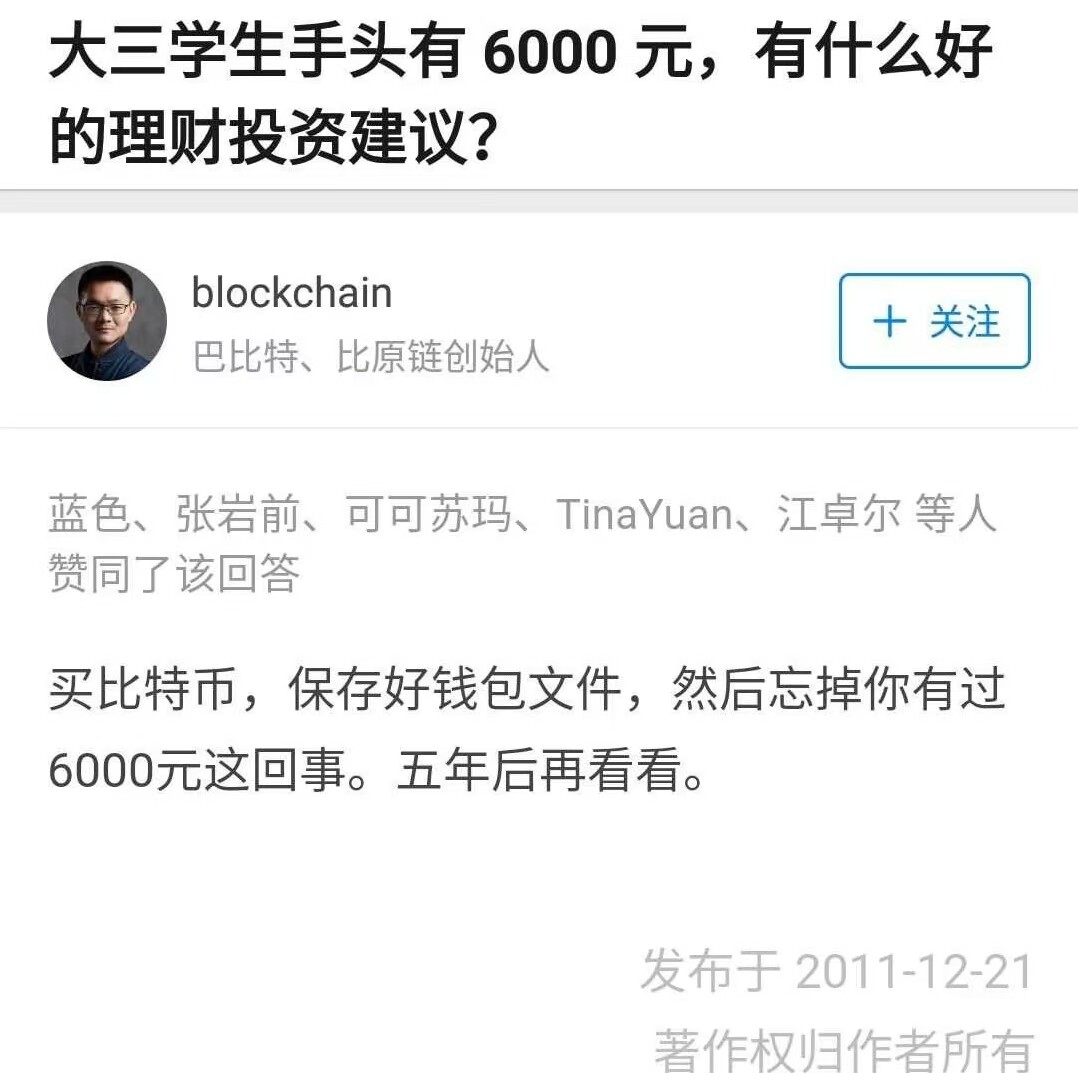
Looking back to 2011, the advice from crypto OG and Babbitt founder Chang Jia, who suggested a college student invest all 6,000 yuan in Bitcoin, was once considered one of the strongest examples of the crypto industry's long-termism and suitability for young people to join. However, Chang Jia himself did not remain in the crypto industry indefinitely. In 2023, Babbitt stopped publishing cryptocurrency-related content and shifted to covering AI, the metaverse, and other fields. In 2024, after turning to AI entrepreneurship, Chang Jia completely disappeared from the crypto circle.
Chang Jia, who was ahead of the curve, once drew much criticism, but now the siphoning of the crypto circle by AI has become an indisputable fact. Talent is migrating, capital is being reallocated, and attention is shifting.
Talent Migration: OGs Are Becoming AI Bloggers
Another crypto OG, Shen Yu, co-founder and CEO of Cobo, is also a representative figure in the early Bitcoin mining circle. As a survivor of multiple cycles, Shen Yu often shares his understanding of market phases and investment insights on social media, which is well-received in the crypto community.
However, recently, Shen Yu has transformed from a crypto OG into an AI blogger. Over the past month, over 80% of his social media content has been about OpenClaw, with very little related to crypto. Shen Yu himself has jokingly claimed a successful transformation.

Shen Yu's exploration and focus on AI remain at a personal level, as his company's business and personal career are still primarily crypto-focused. Therefore, we can temporarily interpret his obsession with AI as a good habit of actively improving himself and keeping up with the cutting edge during "market garbage time." However, the migration of talent from crypto to AI is indeed happening.
Anthony Rose, an executive at zkSync, announced on February 4 that after working at Matter Labs for four years, he would leave and likely turn to AI. Nader Dabit, Developer Advocacy Director at EigenLayer, also announced on February 5 that he was leaving EigenLayer to become Growth Lead at an AI company, stating that "he joined the future."
The most notable recent example of leaving the circle is Multicoin Capital co-founder Kyle Samani announcing his departure from crypto to focus on AI, robotics, and other fields. Kyle Samani is known for his early bet on Solana, so his exit dealt a blow to the crypto community's confidence. Even more离谱的是, on the day he left, Kyle Samani disparaged the crypto industry, saying, "Crypto just isn't as interesting as many people (including myself) once thought."
Recommended reading: "Is There More to Kyle Samani's Exit?"
Capital Migration: Native Crypto VCs Begin Allocating to AI
Native crypto VCs are also unwilling to waste more time on the crypto industry.
On February 28, according to the Wall Street Journal, crypto venture capital firm Paradigm is planning to raise a new fund focused on AI and robotics, with a target size of up to approximately $1.5 billion. Paradigm is one of the purest crypto-native capitals. It gained fame in 2019 by investing in and incubating Uniswap. Subsequent early investments in other crypto projects (such as Lido, Optimism, dYdX, Blur) were also successful, making this "research-driven" VC an institution on par with a16z crypto.
Precisely because of this, Paradigm's shift is of symbolic significance.
If crypto were still in a period of rapid innovation, continuously generating projects capable of bearing billion-dollar-level investments, Paradigm would not need to establish a heavily weighted fund specifically for AI. But the reality is that the infrastructure narrative in the crypto industry (e.g., L1, L2, DEX, etc.) is highly saturated, and the number of truly "paradigm-shifting" quality early-stage projects is few and far between.
The entire crypto VC sector has few good projects to invest in. The data is more直观: over the past four years, the number of venture capital deals in the crypto industry has declined year by year. In 2022, there were 1,639 financing deals in the crypto primary market, which dropped to 829 deals in 2025, with the proportion of early-stage financing also falling from 50% to below 35%.
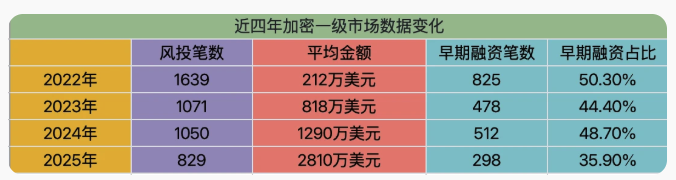
Source: What Can the Crypto Market Still Trade in a Year?
When there's nothing left to invest in within the crypto industry, AI, as a booming sector, naturally becomes the best destination for crypto capital. From foundational large models to AI Agents, from computing power chips to the robotics industry, AI can not only absorb capital规模 but also continuously create growth stories, making it the largest reservoir for global capital today.
For a VC managing over $12.7 billion in assets, the core proposition is never "whether faith is shaken" but "whether the return function still holds." When the number of projects the crypto industry can support decreases, a sole focus on crypto means increased portfolio risk and reduced收益弹性. In this context, continuing to insist on being "crypto-native" becomes irrational.
Therefore, Paradigm's active expansion into AI is also forced by the trends of the times. This is not a strategic issue for个别机构 but a signal of the industry's stage.
Attention Migration: When Crypto Players Become Obsessed with AI
In terms of market attention, Crypto is an industry that is best at蹭热点. Whether it's political hotspots, technological frontiers, or social headlines, any火爆 event总能 find related hyped projects or Memes in the crypto circle. In the past, every time the AI industry experienced a technological upgrade or product innovation, the crypto circle would see related "Crypto+AI" projects or Meme coin speculation, attracting market attention.
After OpenClaw became popular, although the crypto circle immediately found angles to蹭, such as炒作同名 Meme coins, commanding OpenClaw to trade tokens automatically, and predicting markets to make bets for profit, crypto players later became more纯粹, shifting from "how to crypto-fy OpenClaw" to "how to actually use OpenClaw."
Many crypto researchers began continuously producing OpenClaw installation and usage tutorials, publicly sharing their AI workflows, even detailing how to train personal AI Agents to help write code, conduct research, generate content, etc. Some crypto KOLs even started side businesses charging fees to install OpenClaw for beginners.
Offline AI exchange events organized by the crypto circle are also "packed." Recently, the most popular offline event was the "Web4 China Tour" promoted by crypto OG Kong Jianping. The event ran from February 25 to March 8, held offline in five Chinese cities, with main topics being OpenClaw and Agent,几乎没有加密相关.
This is no longer蹭热点 but a genuine migration of attention. Crypto players who pride themselves on progressive thinking are开始害怕 falling behind in the AI era.

Crypto circle AI offline event现场座无虚席
Why are crypto practitioners so obsessed with AI?
The crypto circle inherently has the highest concentration of "super individuals," with many independent developers, traders, and content creators. These people naturally pursue improvements in tool efficiency to compensate for limitations in personal efficiency. Therefore, when AI can significantly amplify individual productivity, crypto players are among the first to embrace it.
Furthermore, the core of crypto culture has a strong geek spirit and technology worship. Although the "technology narrative" has been diluted in recent years, most crypto players still believe that "underlying technology can change the world." and如今 AI possesses more of a technological revolutionary气质 than blockchain, hence it naturally attracts the疯狂追捧 of crypto players.
Of course, the more realistic reason is the crypto market's idle period. AI is continuously creating "new things," while Crypto has been重组旧叙事. Without native crypto innovation, without significant wealth effects, the entire crypto circle is barely hanging on by a thread with the little externality brought by prediction markets and RWA. At this time, the new discussion topics and cognitive stimulation provided by the AI industry, rather than seizing crypto attention, are filling the spiritual void of crypto players after the market节奏放缓.
Time to Talk About Things Beyond Crypto and AI
Finally, returning to the beginning of this article, the reason the OpenClaw founder's statement caught the crypto circle's attention is not because it was dismissive, but because it vocalized what many crypto people are quietly验证 with their actions—the smartest people are重新分配 their time.
We are now facing a period of declining wealth generation rates and exploding technological productivity.
On one hand, as the crypto cycle slows, Alpha contracts, and wealth growth curves flatten, the marginal returns of the past year's behavior of simply "scraping information—chasing hotspots—gambling for returns" through枯坐 are diminishing for crypto players. On the other hand, AI is compressing the "time required to solve problems." Tasks that previously required significant time investments, such as writing code and creating content, can now be completed by models in minutes, with problem-solving efficiency far exceeding that of individual humans.
When the "process volume of seeking results" is highly concentrated by AI, then perhaps we反而拥有 more free time to do things not aimed at efficiency and making money—to seek "carbon-based meaning," to experience the world, to build cognitive systems independent of market fluctuations, and to construct our own value coordinates.
In the AI future, what will truly differentiate people might be aesthetics, independent judgment, and the construction of personal meaning.