Whale Dumps ADA, Market Tense — But Price Holds Firm, Cardano's Recovery May Be Faster Than You Think

金色财经Published on 2025-12-11Last updated on 2025-12-11

Abstract

On December 10, a significant transfer of 750 million ADA to Binance by a whale raised concerns about potential selling pressure. However, ADA’s price remained stable around $0.46, demonstrating market resilience. This event was seen as a test of buyer strength rather than an immediate sell signal. Cardano broke out of a downtrend that had persisted since early autumn, signaling a shift in momentum. Key resistance levels to watch are $0.48, $0.60, and $0.6975. The RSI also climbed above 50.56, indicating improving short-term bullish momentum. Strong spot buying absorbed most of the selling pressure, reinforcing buyer confidence and validating the breakout. Rising Cumulative Volume Delta (CVD) further confirmed growing demand, even amid whale activity. Open interest surged by 10.15% to $815 million, suggesting increased leverage trading and potential short-term volatility. Liquidation heatmaps highlight $0.48–$0.50 as a critical zone where price fluctuations may intensify. In summary, ADA shows improved market structure with strengthening CVD, open interest, and RSI. If it holds above the breakout zone and reclaims $0.48–$0.50, it could target higher resistance points. While short-term volatility remains, the overall trend appears healthier.

On December 10, whale activity emerged — a massive 750 million ADA suddenly flowed into Binance, a clear whale move, instantly boosting liquidity. The first reaction was: with such a large capital inflow, does it mean selling pressure is coming?

However, the price of ADA held firm, showing resilience around $0.46, which relieved many. The market views this capital inflow as a "stress test" for buyer strength, not necessarily an immediate sell-off. Buyers also took the opportunity to test price support, making the market more stable than expected.

Farewell to the Decline, Cardano Warms Up

This time, ADA broke through the descending trendline since early autumn, indicating a shift in momentum. More importantly, it held above the pullback resistance, boosting market confidence in a rebound. Next, key resistance levels to watch are $0.48, $0.60, and $0.6975; breaking through these could lead to a larger rally.
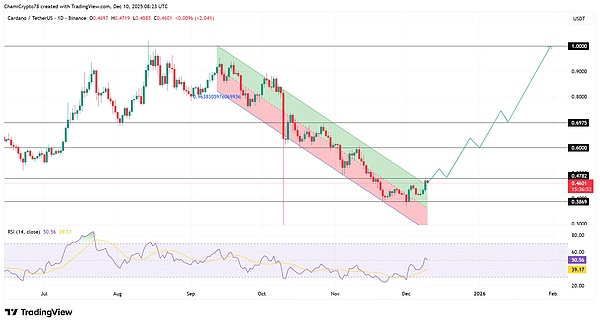
The RSI indicator also climbed to around 50.56, above the average line, showing improving short-term momentum, allowing short-term traders to go long. Each retest has strengthened the price structure, making the market healthier.

Spot Buyers Withstand Selling Pressure

Over the past few days, spot buying has been very strong, absorbing almost all the selling pressure. This indicates sufficient buyer confidence and validates the breakout. The rising CVD indicator also shows increasing demand, as even the whale's entry didn't scare the market.
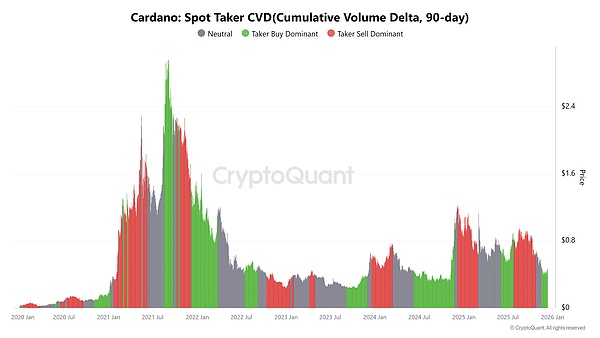
Of course, a strong CVD doesn't completely eliminate downside risks, but it does provide a solid foundation for ADA. The supply-demand structure is imbalanced, allowing bulls to continuously push prices higher, making it difficult for short-term sellers to reverse the situation.

Leverage Players Return, Volatility May Increase
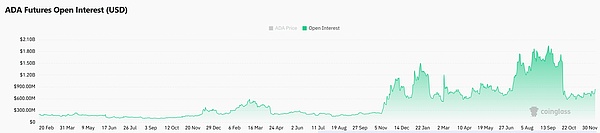
Open interest surged by 10.15%, reaching $815 million, indicating renewed activity in leveraged trading. This means short-term volatility may amplify, with prices potentially pushed higher or lower by liquidation waves. Pay special attention to the resistance zone around $0.48–$0.50, where open interest is dense, making rapid fluctuations likely.

Heatmap Reveals a Small Secret

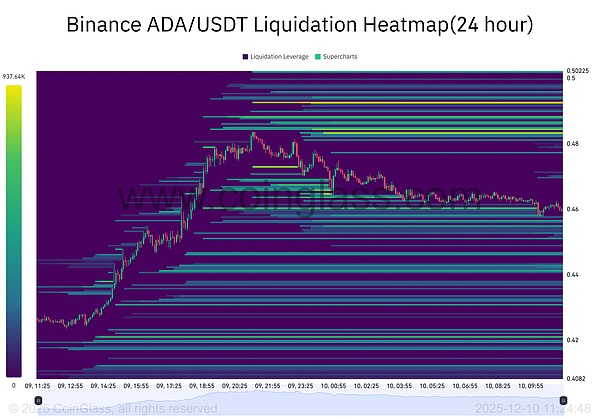
Binance's liquidation heatmap shows that $0.48 and $0.50 are dense areas for long liquidations, acting like magnets attracting the price. Each time the price reaches these levels, volatility occurs, but it also provides opportunities for bulls to attack again.
Summary: Is ADA Ready to Push Higher?

Overall, ADA's structure has improved after breaking the downtrend, with CVD, open interest, and RSI all strengthening. The whale's entry brings short-term uncertainty, but spot buyers have withstood the pressure, stabilizing the price.

As long as ADA holds above the breakout area and reclaims $0.48–$0.50, it has a chance to challenge $0.60 or even $0.6975.

Cardano is testing market resilience and accumulating rebound energy — short-term volatility is high, but the trend may be slowly becoming healthier.

Like, share, and follow me, to catch more market trends and ride the bull and bear waves with a smile! Let's go!

Struggling in the crypto space? Don't force it!Xiao Yunshares real-time swing and long-term strategies, letting you stand on the shoulders of giants, quickly leap wealth classes — missing one wave could mean missing 100x gains! Join us!


Trending Cryptos

Related Questions

QWhat was the market's initial reaction to the 750 million ADA inflow to Binance on December 10th?

AThe market's initial reaction was concern that this large inflow from a whale might indicate impending selling pressure.

QWhat key resistance levels does the article mention for ADA's potential upward movement?

AThe key resistance levels mentioned are $0.48, $0.60, and $0.6975.

QWhat does the RSI indicator's position above 50.56 suggest about ADA's short-term momentum?

AIt suggests that short-term momentum is improving, indicating a potential opportunity for short-term traders to go long.

QHow did the spot market buyers react to the selling pressure from the whale's activity?

ASpot market buyers were very strong and managed to absorb almost all of the selling pressure, demonstrating strong buyer confidence.

QWhat does the 10.15% surge in Open Interest to $815 million indicate for ADA's price action?

AIt indicates that leverage trading is becoming active again, which could lead to amplified short-term volatility and price swings due to potential liquidation waves.

Related Reads

Former Huawei 'Genius Teen' Who Questioned DeepSeek Interview Lands in 'Crossfire' from Web3 Investor

Former Huawei "Genius Youth" Li Bojie recently drew public attention by criticizing his interview experience with DeepSeek. The controversy escalated when Du Jun, co-founder of Web3 investment firm ABCDE Capital, publicly accused Li of being "the founder with the least sense of contractual spirit" he had ever cooperated with, sparking a dispute over Li's startup project, Metagent. Li detailed a frustrating DeepSeek interview where he was accused of potential plagiarism, leading him to end the session. The spotlight then shifted to his venture, Metagent, a Web3+AI project aiming to tokenize AI agents. ABCDE invested $1.5 million, with an initial $500k disbursed. Du Jun claimed the project's progress was severely lacking, with a poor-quality demo and minimal social media activity. He alleged Li stopped communicating, deleted his Telegram, and failed to provide proper financial reporting. In response, Li argued the remaining $1 million was never received, crippling operations and forcing salary cuts. He stated he left Metagent in October 2024 due to family reasons and Web3 compliance concerns, with board approval. He claimed to have fulfilled disclosure duties and that his subsequent projects avoided conflicting fields. Other investors, including ArkStream Capital, shared negative due diligence experiences, citing unprofessional contracts and evasive answers on tokenomics. Metagent's social media went silent in June 2024, effectively stalling. Li has since moved to a new consumer AI agent platform, Pine AI (formerly Logenic AI), which has raised $25 million in Series A funding. He served as its Chief Scientist but recently left, clarifying he was not the founder and departed due to a shift in research interests.

Foresight News3m ago

Former Huawei 'Genius Teen' Who Questioned DeepSeek Interview Lands in 'Crossfire' from Web3 Investor

Foresight News3m ago

SemiAnalysis: Anthropic's Q3 Profit to Exceed $1 Billion

Research firm SemiAnalysis reveals that Anthropic is reshaping the AI commercialization landscape with profitability and growth rates far exceeding competitors. Leveraging a high-margin, API-centric business model, Anthropic has become a leader in the B2B AI market. The report projects that Anthropic will achieve a GAAP EBIT of $1 billion in Q3 2026, with a 6% margin. Its Annual Recurring Revenue (ARR) has surged from $9 billion at the end of 2025 to over $60 billion currently. If it maintains a Net New ARR (NNARR) of approximately $15 billion per month, its ARR could reach $300 billion by the end of 2027, implying a $6 trillion enterprise value and making it the world's most valuable company. Anthropic secretly filed for an IPO on June 1st. SemiAnalysis argues the timing is strategically urgent due to narrowing capital market windows as rivals like Alphabet and Meta secure major funding. The superior financials and business model suggest Anthropic should go public before OpenAI to seize the competitive initiative. The performance inflection stems from the explosive adoption of Claude Code, which now accounts for over 7% of all GitHub commits, driving monthly NNARR from $3 billion in January to $11 billion in March. Anthropic's revenue structure differs significantly from OpenAI's. Approximately 75-85% of Anthropic's ARR comes from usage-based API fees, with consumer subscriptions constituting only about 5%. In contrast, over 65% of OpenAI's Q1 2026 revenue was from subscriptions, with ~40% from consumers. The API model's key advantage is no per-user revenue cap, enabling growth within existing accounts. Anthropic's Net Revenue Retention (NRR) is an extraordinary 500%. This drives superior gross margins, now in the mid-60% range versus -94% in 2024, with API margins exceeding 80%. Core drivers are improved inference efficiency and a largely enterprise-focused model without the cost of serving hundreds of millions of free users. The report introduces "EBTIT" (Earnings Before Training & Interest & Taxes) to measure re-investment capacity, projecting Anthropic's cumulative EBTIT through 2028 will be $250 billion higher than OpenAI's. Over 65% of lab ARR currently comes from programming use cases. Cybersecurity is seen as the next major vertical, with upcoming model releases like Fable expected to further increase token pricing and expand NNARR. Indirect sales via hyperscaler platforms (AWS Bedrock, Azure Foundry) now account for 15-20% of ARR. A core constraint is compute supply. By 2030, combined unconstrained compute demand from Anthropic and OpenAI could exceed 100 GW, far outstripping projected new capacity. IPO proceeds are seen as crucial to lock in future compute resources. Key risks include potential price cuts by OpenAI, competitive pressure from Google DeepMind and Meta in coding models, potential government restrictions on frontier model releases, and margin dilution from growing indirect "Token-as-a-Service" sales. Regulatory actions that narrow the capability gap between open-source and proprietary models are highlighted as a fundamental threat to Anthropic's moat.

marsbit16m ago

SemiAnalysis: Anthropic's Q3 Profit to Exceed $1 Billion

marsbit16m ago

Trading

Spot

Hot Articles

Discussions

Welcome to the HTX Community. Here, you can stay informed about the latest platform developments and gain access to professional market insights. Users' opinions on the price of S (S) are presented below.

活动图片