Wall Street’s bid on crypto dominated 2025 but what’s the demand outlook for 2026?

cointelegraphPublished on 2025-12-22Last updated on 2025-12-22

Abstract

Wall Street's embrace of crypto dominated 2025, with massive institutional inflows into spot Bitcoin ETFs reaching $57 billion. However, the market faced a correction late in the year, raising questions about 2026's demand outlook. Key factors include the continuation of institutional adoption, the impact of AI industry growth on risk assets, and potential regulatory clarity from the Clarity Act. Federal Reserve policy shifts and rate cuts are viewed as bullish, but may collide with a softening job market and rising consumer costs. The performance of tech equities and the monetization of AI investments will also significantly influence crypto markets. Overall, 2026 presents a bullish macro backdrop, but its trajectory hinges on these complex, interconnected narratives.

2025 was a blockbuster year for Bitcoin (BTC) and the wider crypto market as crypto-friendly legislators platformed growth-focused regulation and Wall Street finally accepted Bitcoin, Ether (ETH), and numerous altcoins as a valid asset class worthy of inclusion in an investment portfolio.

The global bid on Bitcoin, Ether and Solana’s SOL (SOL) token was near immeasurable, with total net flows into the spot Bitcoin ETFs reaching $57 billion and the total net assets across the ETFs reaching $114.8 billion.
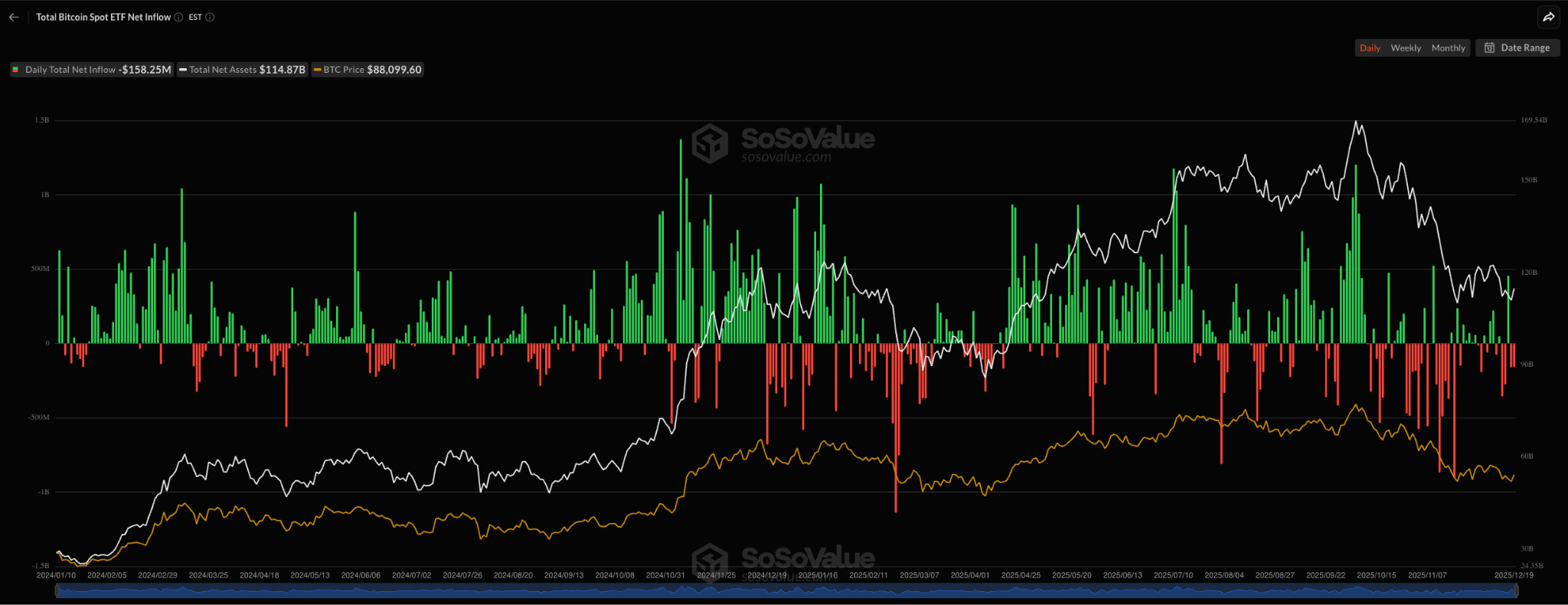
Spot Bitcoin ETF netflows in 2025. Source: SoSoValue.com

Going into 2026, the real question is, will the pace of institutional, corporate and government-level adoption, which were critical price drivers in 2025, continue? Since October, the robust inflows to the spot Bitcoin ETF tapered off and, in some cases, turned into a sellers' market for weeks on end, and this was followed by a 30% correction in BTC and 50% in Ether.

In an interview with Schwab Network’s Nicole Petallides, Cointelegraph Head of Markets Ray Salmond said that the crypto market’s performance in early 2026 will depend on a range of factors.

Given how the narratives surrounding AI, Fed rate cuts, a strategic Bitcoin reserve and ETF flows drove the market, I’m curious to see if the same narratives catalyze price upside in 2026 or will a new narrative need to emerge to bring buyers back into the markets?”

Beyond the ETF flows and demand across spot markets like Binance and Coinbase, investor sentiment regarding the immense size of the AI industry buildout and the performance of the tech-heavy S&P 500 is likely to have a direct impact on crypto markets.

The AI buildout, company valuations, fundraising, IPO performance, and whether datacenter hyperscalers continue to propel the equities markets alongside MAG7 will remain at the forefront of everyone’s mind.

In the interview, Salmond explained that rapid balance sheet expansion was a strategy that supercharged tech-related equities in 2025 as hyperscalers spent double-digit billions on data centers, compute, Nvidia GPUs and energy. At some point in 2026, the expectation will be that these companies demonstrate that they can monetize their investments, or at least finance the expansions from their internal cash flow.

In the latter half of 2025, Oracle, Meta and Nvidia saw their stock prices fall as the market questioned whether there was a chance that some of these companies’ free cash flow could go negative. If investors smell smoke related to debt-heavy, cash-poor AI and quantum computing companies in 2026, there’s likely to be some negative reaction. How these shockwaves carry over to the SPX, DOW, and, by proxy, crypto is something investors will need to keep on the watch list.

Will passing the Clarity Act supercharge altcoins, DeFi and large caps?

A bullish event worth watching in the early part of 2026 will be whether or not the Clarity Act becomes law. The crypto lobby aimed to have this act passed into law before the end of the year, but the lengthy government shutdown delayed progress on hammering it out.

If passed, the Clarity Act will provide clearer rules and the necessary environment for FinTech innovators to sandbox in the US, and the hope is that more offshored crypto businesses will headquarter back in the United States.

It will define which regulatory bodies (SEC and CFTC) have jurisdiction over various crypto assets, depending on whether they are classified as securities or commodities. There’s also a strong emphasis on consumer protections, and a better framework in this area could provide the necessary transparency that businesses and consumers need to confidently invest in crypto assets.

Will a Trump-aligned Fed chair and easy money policy turbocharge markets?

The Federal Reserve’s policy shift is expected to further morph into an easy money regime, and President Trump’s early 2026 Fed chair selection is anticipated to bring up to 100 basis points in rate cuts.

According to Salmond,

“Crypto investors view Fed rate cuts as bullish for risk assets, but we’ve got a Tale of Two Cities scenario where the data collides with the most bullish perspectives.”
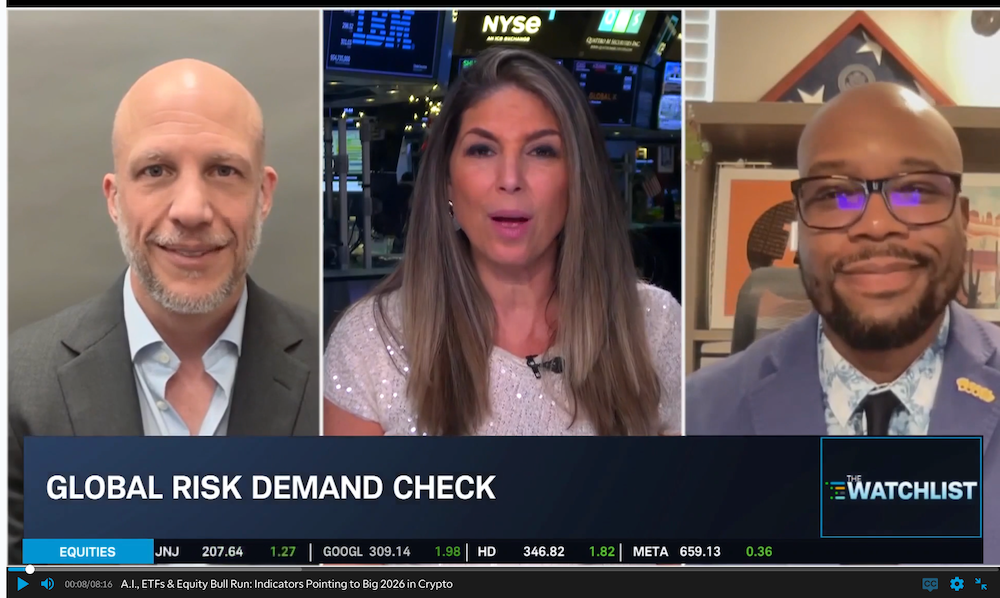
AI, ETFs and Equities Bull Run in 2026. Source: Schwab Network

Salmond explained that” the job market is softening and this cooling trend is predicted to carry on in 2026. The 'transitory' impact of the Trump tariffs has resulted in elevated goods and services costs, health insurance premiums will rise, and retail investor confidence may drop as layoffs are announced, consumer debt rises, and disposable income falls.”

At the same time, “investors expect Fed rate cuts to result in lower mortgage rates, compel banks to loosen the purse strings for lending, and lure consumers to go buy more stuff. But, the potential return of easy money policy and big government spending essentially confirms that the US is kicking the debt bomb further down the road.”

Related: JPMorgan explores crypto trading for institutional clients: Report

In Q1 2026, the dilemma investors will have to contend with is whether there are signals that prove that the Fed's easy money trade is being front-run and possibly sold on confirmation, or will the evolving Fed policy also reinvigorate the bull market seen across equities in 2025 and extend to crypto?

Investors who prioritize optionality and a nimble footprint should be able to avoid some of the pitfalls of a narrative and speculation-driven market, where the MAG7 and AI markets could prove to be overvalued.

On paper, the big picture view for 2026 is bullish, especially when considering the Trump economic mandate, Fed policy, and crypto-friendly regulation, but it’s the unknown outcomes of the AI buildout and the actual impact of rate cuts on the consumer and economy that are going to determine the direction markets take in Q1 and Q2.

This article does not contain investment advice or recommendations. Every investment and trading move involves risk, and readers should conduct their own research when making a decision. While we strive to provide accurate and timely information, Cointelegraph does not guarantee the accuracy, completeness, or reliability of any information in this article. This article may contain forward-looking statements that are subject to risks and uncertainties. Cointelegraph will not be liable for any loss or damage arising from your reliance on this information.



Trending Cryptos

Related Reads

Unitree's IPO Frenzy: The Real Mystery is How It Will Spend the 42 Billion Raised

Unitree, a Chinese robotics company, is set for a public listing after its IPO registration was approved by regulators. The company, which started with quadruped robots and has expanded into humanoids, plans to raise approximately 4.2 billion yuan through its offering. The article traces Unitree's rapid growth from its founding in 2016 to its current status. It highlights key milestones like the 2021 CCTV Spring Festival Gala performance, the 2023 launch of its affordable Go2 robot dog and the H1 humanoid robot, and a series of subsequent product launches. By 2025, the company reported revenue of 1.71 billion yuan, profitability, and sales exceeding 5,500 humanoid robots. As the first publicly-listed humanoid robot company on China's STAR Market, Unitree's main challenges are sustaining growth and deploying its newly raised capital effectively. The humanoid robot sector in China is crowded, with over 140 companies. Competitors include UBTech (focusing on industrial and consumer markets), Fourier, and international players like Tesla Optimus and 1X NEO. The article outlines three critical challenges for Unitree: establishing a strong second product line beyond its quadruped robots, maintaining its price advantage while ensuring quality, and successfully advancing its embodied AI capabilities through partnerships like the one with NVIDIA for the H2 Plus platform. Unitree's likely strategy involves a "developer tools + industry benchmarks" approach: using low-cost models like the R1 and G1 to build developer adoption and volume, leveraging high-end platforms for AI training, and securing pilot projects in sectors like logistics and manufacturing to build case studies. The company's future success hinges on converting its current momentum in shipments and pilot programs into sustainable, large-scale commercial contracts as the broader market evolves.

marsbit21m ago

Unitree's IPO Frenzy: The Real Mystery is How It Will Spend the 42 Billion Raised

marsbit21m ago

Examining the Open USD Partner Lineup: Follow Who's Joining to See Where the Money Flows

**Title: Deciphering the Open USD Partner Roster: Following the Money** The launch of Open USD is notable less for the stablecoin itself and more for its expansive list of over 140 founding partners, which reads like a "who's who" of global finance and tech. This coalition, including asset managers like BlackRock, card networks Visa and Mastercard, banks (BNY Mellon, Standard Chartered, etc.), tech giants (Google, IBM), merchants (Shopify), and crypto firms (Coinbase, Ripple, Aave, MetaMask), signals a strategic shift. The diverse membership reveals that stablecoins are increasingly viewed not as products to compete over, but as shared infrastructure too critical to be left to any single entity. Each partner category has distinct motives. Asset managers like BlackRock seek to manage the large, sticky cash reserves, a lucrative fee-generating opportunity. Merchants like Shopify aim for lower-cost settlement and potential yield on balances. Banks join defensively to retain custody and settlement roles, fearing deposit outflows to stablecoins. Tech companies bet on programmable money for future machine-to-machine commerce. Crypto firms gain mainstream legitimacy and distribution channels. Remarkably, the consortium includes direct competitors (Visa vs. Mastercard, Coinbase vs. Ripple), indicating that the fear of exclusion from this emerging financial layer outweighs competitive rivalries. However, this shared governance could also lead to slow decision-making. The roster's composition is the real message: it represents a collective bet that a widely accepted, consortium-owned stablecoin is preferable to proprietary versions or having none at all. For incumbents like Circle and Tether, this alliance poses a significant threat, as potential clients have collectively chosen to build their own alternative. The absence of major U.S. retail banks (busy with their own tokenized deposit networks) is equally telling. In essence, the partner list maps where the industry believes value and risk will flow in a tokenized dollar future, marking stablecoin's evolution from a product to a utility.

Foresight News44m ago

Examining the Open USD Partner Lineup: Follow Who's Joining to See Where the Money Flows

Foresight News44m ago

IOSG: Q-Day Countdown, Will Quantum Computing End Cryptocurrency?

IOSG: The Q-Day Countdown – Will Quantum Computing End Cryptocurrency? This analysis explores the looming threat quantum computing poses to blockchain technology. Quantum computers, leveraging Shor's algorithm, could theoretically break the elliptic curve cryptography (ECC) underpinning cryptocurrencies like Bitcoin and Ethereum. The article outlines a hypothetical "Q-Day" scenario where exposed public keys from dormant assets are compromised, leading to fund theft and a deep governance crisis. The core risk is not the complete erasure of blockchains but a systemic reset of public-key cryptography. Bitcoin faces significant challenges due to its "code-is-law" ethos and the immense social consensus required for migration. Its primary vulnerability lies in legacy UTXOs with publicly exposed keys. Ethereum's path involves a more complex, full-stack cryptographic agility upgrade across execution, consensus, and data layers. The industry has a limited "engineering comfort window" of 5-8 years to coordinate a migration to post-quantum cryptography (PQC), such as lattice-based or hash-based signatures. While the existential threat is often overstated, the real bottleneck is the immense coordination required across protocol developers, node operators, wallet providers, exchanges, and custodians. Market repricing of crypto assets may occur well before an actual Q-Day if quantum hardware roadmaps accelerate or regulatory pressure mounts. The article concludes that quantum computing is not a doomsday weapon but a severe stress test for blockchain's foundational security model and governance structures.

marsbit1h ago

IOSG: Q-Day Countdown, Will Quantum Computing End Cryptocurrency?

marsbit1h ago

Trading

Spot

Hot Articles

Discussions

Welcome to the HTX Community. Here, you can stay informed about the latest platform developments and gain access to professional market insights. Users' opinions on the price of S (S) are presented below.

活动图片