Wall Street Wolves, Stop Rushing into 2x and 3x Leveraged SK Hynix ETFs

marsbitPublished on 2026-07-16Last updated on 2026-07-16

Abstract

The author warns of the significant risks associated with single-stock leveraged ETFs, using the recent case of the GraniteShares 2x Long LCID Daily ETF (LCDL) as a stark example. This ETF, which aimed to deliver 2x the daily return of Lucid Group (LCID) stock, was liquidated and delisted after LCID shares plunged 57% on a false bankruptcy rumor. Even though LCID recovered most of its losses by the close, LCDL investors lost everything with no chance of a rebound, illustrating how these products can be wiped out by short-term volatility. The article highlights that these high-risk ETFs have gained popularity among retail investors, particularly for betting on AI and memory chip stocks like SK Hynix. However, the amplified gains come with equally amplified risks. The potential for total, irreversible loss distinguishes these ETFs from holding the underlying stock, where investors can wait for a recovery. Citing growing systemic and social concerns, the piece notes that South Korean financial authorities are preparing to discuss stricter regulations for single-stock leveraged ETFs. This follows reports of social issues, including alleged suicides and a violent assault linked to major investment losses, underscoring how financial risk from these high-leverage products can spill over into societal problems.

Author | Azuma (@azuma_eth)

If you were to ask what the most talked-about concept is in the global capital markets this year, the answer would undoubtedly be memory.

As AI infrastructure construction continues to advance, HBM (High Bandwidth Memory) is in short supply. Major memory manufacturers like SK Hynix, Samsung, and Micron have once become the focus of market hype. Surging capital has driven their stock prices to soar rapidly. Even after experiencing significant recent pullbacks, their year-to-date gains remain quite substantial.

When a stock keeps rising, there will always be people in the market who feel "it's not rising fast enough." Thus, a type of product that was once relatively niche has rapidly entered investors' sight — Single Stock Leveraged ETFs. Unlike traditional ETFs that track a basket of stocks or an index, these products track only a single stock and use financial derivatives like swaps and futures to amplify the stock's daily price movements by 2 times or even 3 times. In other words, if the underlying stock rises 10% in a day, the corresponding 2x leveraged ETF would theoretically rise by about 20%; conversely, if the stock falls 10%, the product would also lose about 20%.

Because of this, single-stock leveraged ETFs are becoming a new tool for increasingly aggressive investors to bet on popular AI stocks. This year, as hot money seeking to amplify returns from the AI and memory trends continues to pour in, the scale of single-stock leveraged ETFs centered on hot AI concept companies like SK Hynix has also been expanding.

However, what many investors overlook is that on the flip side of amplified returns, risks are amplified by the same multiple — under extreme market conditions, the underlying stock might still stage a rebound, but a single-stock leveraged ETF may not even have the chance to wait for that rebound.

A Vivid Case: The Delisting Path of a 2x Leveraged ETF

Don't think this is alarmist. A case that occurred during the US stock market session the night before last is enough to reveal just how dangerous single-stock leveraged ETFs can be.
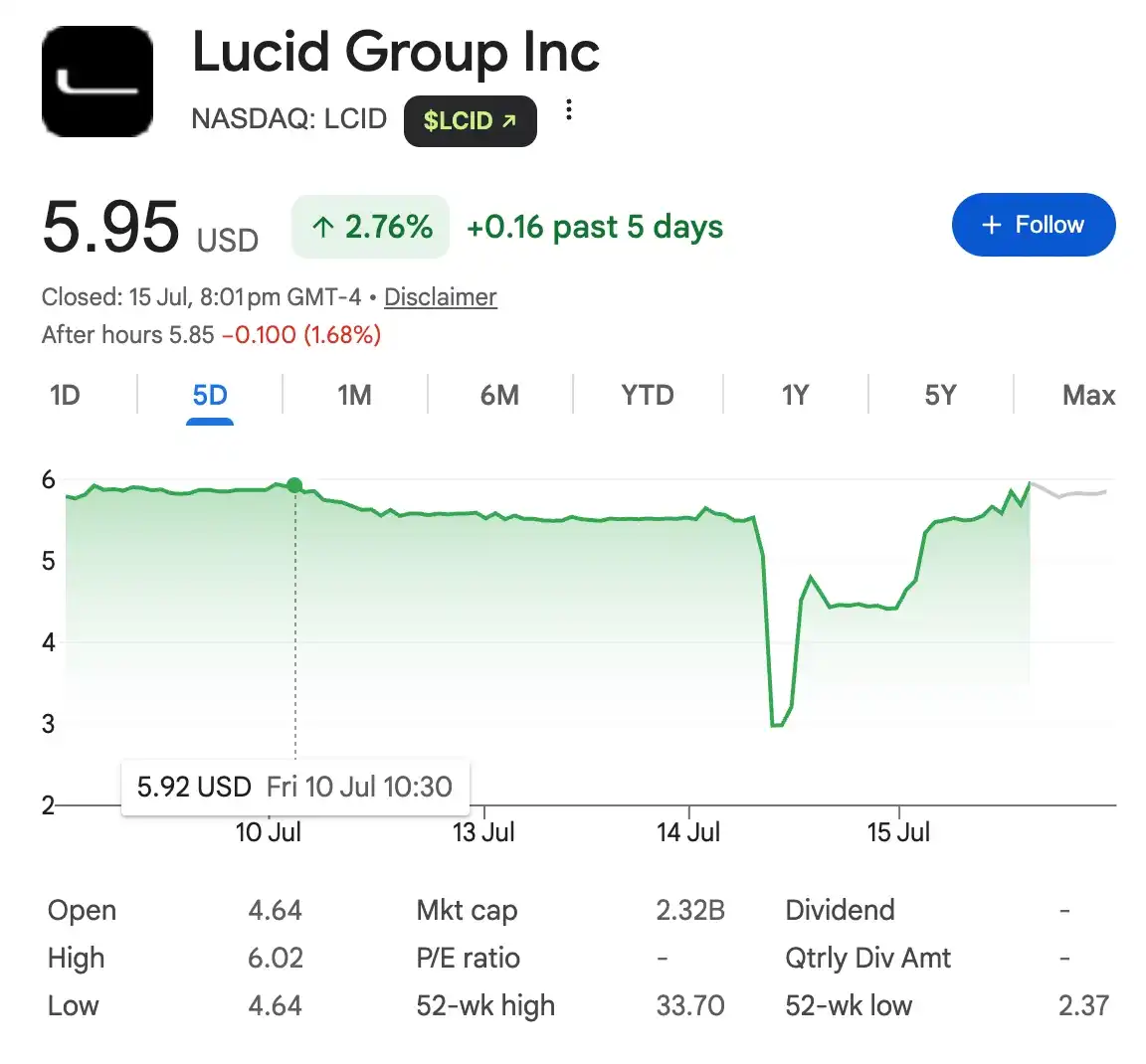
The chart above shows the recent stock price movement of the American electric vehicle manufacturer Lucid (LUID). On the evening of July 14th local time, rumors suddenly circulated during the trading session that Lucid was considering filing for bankruptcy protection. Impacted by this negative news, LUID's stock price plummeted by up to 57%, triggering multiple trading halts during the session and marking its largest intraday decline since its listing.

However, the plot soon reversed. Lucid subsequently issued a statement clarifying that while the company had indeed hired the consulting firm AlixPartners to conduct a comprehensive review of its operations to optimize performance, cut costs, and advance new model development, the rumors about filing for bankruptcy were "completely false." Lucid also emphasized that it currently has sufficient liquidity to support operations until next year and that AlixPartners was only engaged for operational optimization work and had not made any bankruptcy recommendations to management or the board.

As Lucid rushed to dispel the rumors, market sentiment quickly recovered, and Lucid's stock price rebounded from its intraday low, ultimately closing with a loss narrowed to about 16%. For investors holding Lucid stock, this was more like a thrilling "roller coaster" ride.

Yet, for another group of investors, the story ended at the moment the crash occurred.

During Lucid's plunge, the 2x Long ETF tracking its stock performance — the GraniteShares 2x Long LCID Daily ETF (LCDL) — was directly wiped out. The fund manager, GraniteShares, subsequently confirmed via announcement that the fund had liquidated all its LCID holdings that day. As its net asset value had turned negative, the fund would formally initiate the delisting process.
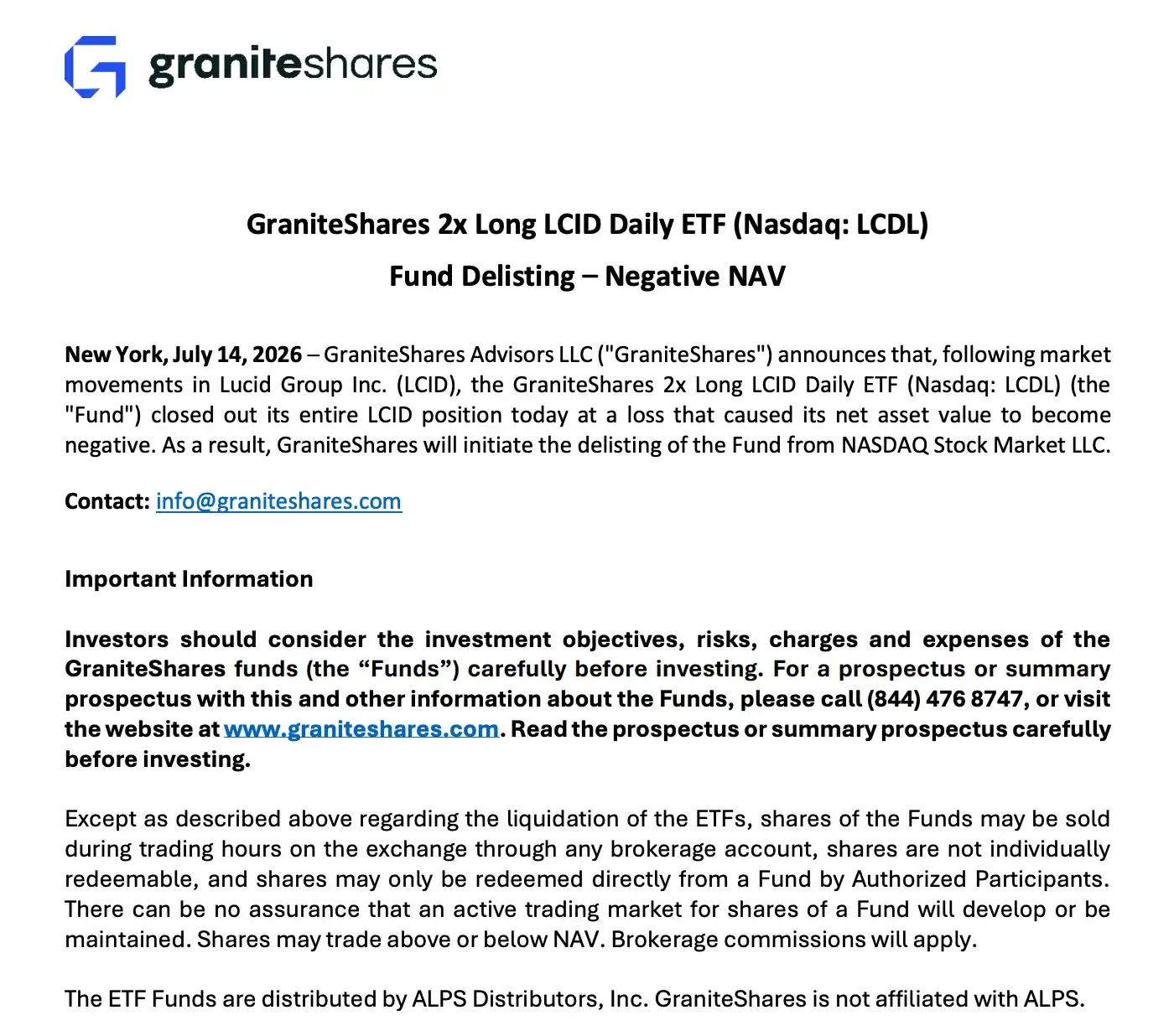
This means that when Lucid's stock price subsequently rebounded rapidly, this ETF no longer held any positions to recover its net asset value. For all holders of LCDL, there was also no longer any opportunity to participate in LCID's subsequent rise.

This is precisely the biggest difference between a single-stock leveraged ETF and an ordinary stock. A stock, even after a crash, offers investors a chance to wait for a rebound as long as the company still exists; but once a single-stock leveraged ETF "triggers a death mechanism" during extreme volatility, even if the underlying stock recovers its losses later, investors may never live to see that day.

Social Issues Emerge, South Korean Government Begins to Fear

The delisting of LCDL is by no means an isolated case. In fact, as single-stock leveraged ETFs rapidly gain popularity on hot AI stocks, regulators have begun to re-examine the systemic risks such products may bring.

Among them, South Korea's stance is particularly representative.

In mid-July, according to a report by The Korea Times, South Korea's four major financial authorities — the Ministry of Economy and Finance, the Financial Services Commission, the Financial Supervisory Service, and the Bank of Korea — will hold a special meeting under the framework of the government's Macroeconomic and Financial Issues Coordination Mechanism (F4) to discuss the risks and regulatory measures for single-stock leveraged ETFs. Market discussions are focusing on directions such as raising margin requirements, limiting daily price fluctuation ranges, and reducing leverage multiples.

In recent years, as South Korean retail investors have continued to pour into the stock market, the AI trend has almost evolved into a nationwide investment frenzy. Heavyweight stocks like Samsung Electronics and SK Hynix have become the focus of capital pursuit, and leveraged ETFs centered on these individual stocks have further amplified market sentiment and stock price volatility. The concern of regulators is that as more and more investors start using high-leverage products to chase popular stocks, the impact of a sharp market swing is no longer just a change in numbers on investment accounts but may further evolve into a social problem.

And as the memory concept faces pressure and corrects, multiple extreme events have occurred consecutively in the South Korean capital market. On one hand, rumors of suicide incidents triggered by failed stock investments have appeared on social media; The Chosun Ilbo also reported yesterday that a YouTuber who runs a stock investment channel in Busan was stabbed multiple times on the street by a man in his 20s. Preliminary police investigations show the suspect was a subscriber to the channel. Believing in the stock recommendations made by the channel's host and suffering significant losses, he harbored resentment and carried out the attack.

Although the above-mentioned incidents were not directly caused by single-stock leveraged ETFs, for regulators, the signals they release are highly consistent — when high-risk investment tools continuously lower the participation barrier and overlap with dissemination channels like social media and live-streamed stock recommendations, financial risks may ultimately spill over into social risks.

For the South Korean government, this is the most frightening prospect.

Related Questions

QAccording to the article, what is the most talked-about concept in the global capital market this year, and why?

AAccording to the article, the most talked-about concept in the global capital market this year is storage. This is because with the continuous advancement of AI infrastructure construction, High Bandwidth Memory (HBM) is in short supply, making major memory manufacturers like SK Hynix, Samsung, and Micron the focus of market attention and driving rapid stock price increases.

QWhat is a single-stock leveraged ETF, and how does it differ from a traditional ETF?

AA single-stock leveraged ETF tracks a single stock, unlike a traditional ETF which tracks a basket of stocks or an index. It uses financial derivatives like swaps and futures to magnify the stock's daily price movement by 2x or even 3x. This means gains and losses are amplified at the same multiple based on the underlying stock's daily performance.

QUsing the example of the Lucid (LCID) ETF (LCDL), what key risk of single-stock leveraged ETFs does the article highlight?

AThe article uses the example of the GraniteShares 2x Long LCID Daily ETF (LCDL) to highlight the risk of liquidation. When Lucid's stock price plummeted due to a false bankruptcy rumor, the 2x leveraged ETF's net asset value fell below zero, triggering its complete liquidation and delisting. Even though Lucid's stock later recovered, the ETF investors had no position left to benefit from the rebound.

QWhy is the South Korean government concerned about single-stock leveraged ETFs, and what actions are they considering?

AThe South Korean government is concerned because the widespread use of high-leverage products like single-stock leveraged ETFs on popular AI stocks (e.g., SK Hynix) can amplify market volatility. They fear that the resulting financial losses could spill over into social problems, as hinted by reports of investment-related suicides and violence. Regulatory bodies are considering measures like raising margin requirements, limiting daily price fluctuation ranges, and reducing leverage multiples.

QWhat broader societal risk does the article suggest is linked to the popularity of high-risk investment tools?

AThe article suggests that when high-risk investment tools lower participation barriers and combine with social media and live-streaming stock recommendations, financial risks can escalate and spill over into societal risks. This includes potential consequences like increased mental health crises, social unrest, and even acts of violence stemming from significant investment losses.

Related Reads

Bitcoin Shifts to Building a Bottom, with Selling Pressure from Long-Term Holders Significantly Easing

Bitcoin is transitioning into a basing phase, with significant selling pressure from long-term holders showing signs of easing. The market is testing overhead resistance, with Bitcoin responding more positively to favorable macro data like soft inflation reports than major equity indices. Its correlation with stocks is weakening while its inverse relationship with the US dollar strengthens, indicating a shift in primary drivers towards liquidity factors rather than risk sentiment. On-chain analysis reveals that long-term holder profit-taking has largely dried up, and the wave of capitulation selling from this cohort has peaked and begun to recede. Buyers successfully absorbed selling pressure at the June lows. Bitcoin currently trades between the network's average realized price (a support floor) and the short-term holder cost basis near $69k, which will be a key resistance level. A breakout above this level is needed to signal a more sustained recovery. In derivatives markets, traders are unwinding bearish bets, with put/call ratios falling and crash protection premiums declining. However, this futures and options positioning adjustment has not been accompanied by significant spot buying. US spot ETF outflows have slowed but not reversed. Volatility has compressed to low levels. In summary, the foundations for a bottom are forming: long-term holder selling is subsiding, demand absorbed the recent low, and the market is reacting to positive catalysts. However, confirmation is still lacking, requiring a spot-driven breakout and hold above the short-term holder cost basis around $69k.

Foresight News11m ago

Bitcoin Shifts to Building a Bottom, with Selling Pressure from Long-Term Holders Significantly Easing

Foresight News11m ago

Altman Returns to Stanford and Admits Mistake: Outsourcing Thinking to AI, a Generation's Brains Are Atrophying

Sam Altman returned to Stanford University and admitted he was wrong about AI's impact on education. He predicted that after an initial phase of student cheating with ChatGPT, the education system would rapidly reform itself to teach more critical thinking. However, three and a half years later, while AI has advanced dramatically, teaching and assessment methods remain largely unchanged—still focused on memorization, standardized answers, and closed-book exams. Altman expressed deep concern that this disconnect is causing a "cognitive atrophy," where outsourcing thinking to AI erodes students' critical reasoning skills. Research supports this: grades have dropped in high-stakes exams after ChatGPT's introduction, and while assignment scores in writing and coding have inflated due to AI use, exam performance hasn't improved, indicating "outsourcing" rather than learning. He argues the problem lies in institutional inertia. The education system, built on the premise that tasks are time-consuming, hasn't adapted to a world where AI makes shortcuts effortless. Students are being evaluated by outdated standards, risking a generational gap in essential cognitive skills. Altman proposes a shift: education should move from testing memorization to fostering judgment, creativity, and the ability to ask better questions. Core practices like writing and programming remain vital not for their outputs, which AI can generate, but for the thinking process they train. The urgent need is to teach students not just to use AI, but to critically verify its outputs. Without reform, we risk a generation losing its capacity for independent thought.

marsbit24m ago

Altman Returns to Stanford and Admits Mistake: Outsourcing Thinking to AI, a Generation's Brains Are Atrophying

marsbit24m ago

Clearing Giant with $114 Trillion in Assets Tokenizes Securities, Has Crypto Won?

On July 15, the US securities settlement giant DTCC conducted its largest production-level test for tokenization, marking a significant shift from previous workarounds. The test involved approximately 40 institutions, including major players like JPMorgan, Citadel Securities, and State Street, as well as crypto-native firms such as Circle, Chainlink, and Ondo Finance. For the first time, DTCC, which custodies over $114 trillion in securities, directly created on-chain "digital twin" tokens for stocks, ETFs, and U.S. Treasuries held in its depository (DTC). These tokens share the same CUSIP identifiers and legal rights as the underlying assets. Key transactions included JPMorgan tokenizing an Invesco QQQ ETF to post as collateral at CME Group and DriveWealth settling a tokenized equity trade with Vanguard. The test paves the way for the official launch of the DTCC Tokenization Service in October. This move centralizes the issuance authority for tokenized traditional securities with the core market infrastructure itself. While projects like Ondo Finance (which participated in the test) will continue providing distribution and DeFi integration, their underlying collateral can now be DTCC-issued tokens, enhancing transparency and credit backing. The initiative aims to unlock liquidity in collateral by enabling 24/7 settlement and transfer across venues, a direct efficiency gain for DTCC. The test culminates years of DTCC's blockchain exploration, utilizing two key infrastructures: a private Hyperledger Besu chain for internal control and the Canton network (co-chaired by DTCC and Euroclear) for interoperable, privacy-focused transactions with external institutions. The event signals institutional tokenization moving into a new, mainstream phase led by traditional finance incumbents.

Foresight News28m ago

Clearing Giant with $114 Trillion in Assets Tokenizes Securities, Has Crypto Won?

Foresight News28m ago

Trading

Spot
活动图片