
Wall Street Is Calculating the 'AI Apocalypse', While Justin Sun Bets on Web4.0

marsbitPublished on 2026-03-04Last updated on 2026-03-04

Abstract

Wall Street is calculating an "AI apocalypse," while Justin Sun bets on Web4.0. A recent thought experiment report by Citrini Research, titled "2028 Global Intelligence Crisis," predicts that AI agents will eliminate "friction" in human interactions, destroying traditional business models built on information asymmetry and intermediation. Coinciding with this, Sun, a prominent Web3 figure, declared 2026 as a "year of miracles," urging people to embrace AI-driven interactions. While Wall Street fears the collapse of the old order, Sun sees it as an opportunity to accelerate the arrival of Web4.0. The convergence of AI and Crypto is inevitable. Both rely on computational power and electricity, with tokens representing digitalized energy. AI agents, lacking physical form, will require programmable, low-cost, and instant settlement systems—making blockchain-based cryptocurrencies their native financial infrastructure. Stablecoins like USDT on TRON, which Sun oversees, are ideal for machine-to-machine transactions. Sun’s strategy leverages TRON’s dominance in stablecoin circulation, seeks to break through Web3’s stagnation by aligning with AI, and aims to build a decentralized Web4.0 stack—combining storage, settlement, and compute—without relying on centralized cloud providers. As AI reshapes commerce, those controlling core infrastructure will lead the new era.

Recently, Wall Street research firm Citrini Research released a thought experiment report titled "2028 Global Intelligence Crisis," sparking widespread discussion in the market. The core deduction of the report points to an extremely cold business reshuffling logic: AI Agents will completely eliminate "friction" in human interaction, thereby destroying all old business empires built on information asymmetry and intermediary models.

Coincidentally, just as this Wall Street "apocalypse report" went viral online, Justin Sun, a iconic figure in the Web3 industry, also made quite eye-catching statements on social media. He declared 2026 as "the time for miracles to happen" and even urged young people: "If you can chat with AI, don't chat with humans... fully embrace the future!"

In the eyes of the public, this might be just another one of Sun's characteristically flamboyant "traffic stunts." But if we peel back the emotional surface and compare these remarks with the macro deductions of the "2028 Global Intelligence Crisis," we discover a thought-provoking truth: the "collapse of the old order" that Wall Street fears in its macro models is precisely the "Web4.0 new era" that Sun, in his micro-actions,极力推崇s and attempts to accelerate embracing.

Facing the same future, pessimists see an abyss, while Justin Sun sees a ladder to the singularity.

Computing Power, Electricity, and Token: The Fated Convergence of AI and Crypto

The picture of "friction extinction" depicted in the "2028 Global Intelligence Crisis" is essentially an extremely cold, AI-driven disintermediation revolution.

The report sharply points out that when omniscient and omnipotent AI Agents can perform supply-demand matching, execute transactions, and provide services instantly with near-zero cost, the moats upon which modern businesses survive will be completely breached.

For a long time, countless business models, from traditional financial intermediaries and advertising distribution platforms to law firms and consulting agencies that charge high fees, have essentially parasitized human cognitive limitations, decision-making delays, and information blind spots. Once AI flattens these artificially created "frictions," these old empires will inevitably collapse like dominoes.

This trend coincides remarkably with the historical resonance of the "decentralization" banner held high by blockchain since its inception.

If the Web3 movement that emerged over a decade ago attempted to dismantle the "trust monopoly" of centralized institutions through cryptography and distributed ledgers at the underlying architectural level, then the rise of AI Agents today is a more thorough and efficient way to directly remove the necessity of "trust" itself in many scenarios—because intelligent agents can not only automatically verify facts but also autonomously complete value exchanges.

A deeper alignment lies in the fact that the material foundation supporting this dual revolution is entirely homologous.

Whether it's the inference tokens generated by AI or the crypto tokens in blockchain networks, behind them lies a long-underestimated yet incredibly solid physical truth: they are both digital incarnations of electricity.

Every inference by a large AI model consumes real computing power; the confirmation of every on-chain transaction, the execution of every smart contract, also relies on the continuous energy burned by miners or validator nodes. Tokens are not magic; they are vouchers of energy conversion, the value projection of electricity traversing chips, algorithms, and protocols into the digital world. In this light, it forms a perfect闭环 with Sun's previous assertion: "Short-term lack of chips, long-term lack of energy, forever lack of storage."

Thus, we see two seemingly opposing yet homologous forces converging: on one side, capital elites foresee the collapse of their own power structures in model projections; on the other, crypto natives actively welcome a new civilizational protocol without intermediaries, friction, or redundancy in code and slogans. This narrative of the "post-intermediary era," co-written by AI and blockchain, has perhaps just begun.

Why is AI Destined to Choose Crypto for Settlement?

However, this grand historical convergence is not merely a resonance at the philosophical and physical levels. When the narrative lands on specific business operations, an extremely practical problem looms before AI: in this new world about to be taken over by machine execution, who will provide financial services for these disembodied "silicon-based life forms"?

Centralized payment networks are designed for "humans."

McKinsey divides AI-driven business automation into six levels. Levels 0 to 4 can still operate within the existing financial system because transactions are always linked to human identity. But at Level 5, agents begin to transact directly with other agents without human instruction. At this point, there is no "human identity" to inherit, nor can they rely on traditional KYC processes; payments must be programmable, condition-triggered, settled in milliseconds, and the agent's reputation must be portable across platforms. Blockchain thus becomes indispensable.
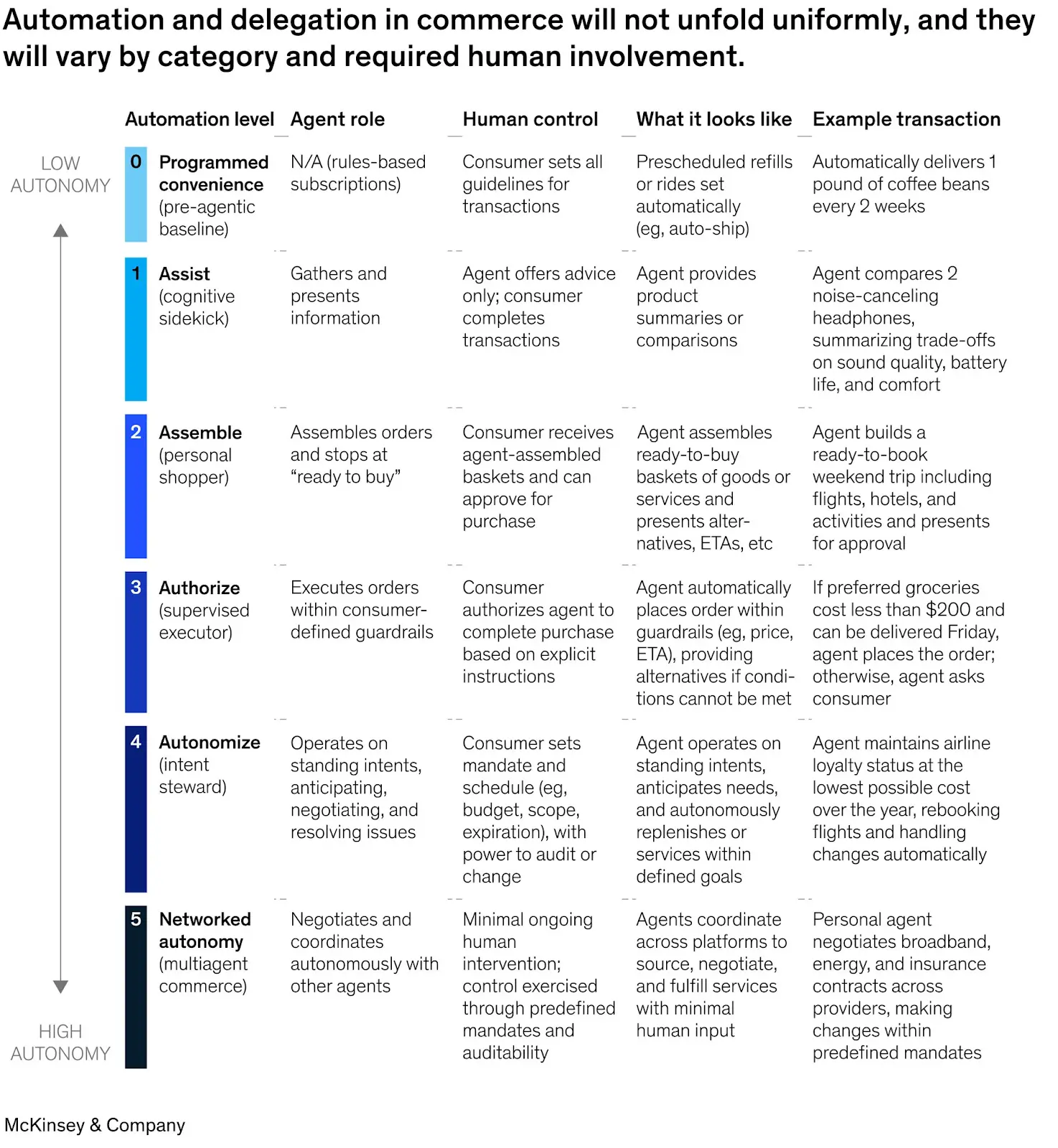
AI has no physical form, let alone the ability to hold an ID card and queue for KYC. For them, a string of an asymmetrically encrypted private key is an account; a blockchain that enables second-level settlement, near-zero fees, and supports programmable smart contracts is the perfect clearinghouse.

The "2028 Global Intelligence Crisis" contains a very realistic deduction: The room for price matching and information aggregation is ultimately limited. Once agents start transacting with each other, the most direct and effective path is to eliminate various handling fees. They begin to seek payment methods faster and cheaper than credit cards. Most eventually choose to settle using stablecoins via Solana or Ethereum Layer 2 networks, where transactions are almost instant, with fees as low as a fraction of a cent.

Precisely for this reason, crypto wallets are destined to become the "native banks" for AI Agents.

This also completely shatters the long-standing stereotypical perception of Crypto: issuing tokens is not just for secondary market speculation. In an AI-dominated future, crypto tokens and peer-to-peer payments will truly settle as the underlying financial infrastructure for high-frequency collaboration among intelligent agents.

Justin Sun's All-in Conspiracy: Where Does the Confidence and Ambition Come From?

Justin Sun's choice to bet on Web4.0 is backed by extremely meticulous business logic and strategic imperative.

First, Tron's "Stablecoin Hegemony" is the natural settlement layer for Web4.0.

As is well known, the Tron TRON network carries the largest circulation of USDT globally. As mentioned before, the core of Web4.0 is payment interaction between machines. AI needs a payment network that is fast, has low fees, and possesses immense liquidity. Tron's USDT payment network perfectly meets the underlying financial needs of AI Agents. Sun simply needs to build a set of payment APIs on the Tron network for AI to seamlessly call, and he can continue to profit effortlessly in the Web4.0 era.

Second, finding a breakthrough point in the "post-Web3 era."

Traditional Web3.0 has entered a存量博弈 (stock game), lacking new breakout stories. Meanwhile, AI has become the world's most certain and capital-rich incremental track. Sun敏锐地意识到 (sharply realizes) that the fate of Crypto must be tied to AI. By "All in Web4.0," he can channel the AI funds and attention from the traditional tech circle back to the crypto market. Tron previously established a $100 million AI development fund, a clear signal of preparing for Web4.0.

Third, establishing a closed loop for the "decentralized network."

Sun holds BitTorrent (decentralized storage/transmission), the Tron public chain (underlying settlement), and Huobi's massive crypto user base. If decentralized computing power and AI models are integrated, he has the opportunity to build a full-stack Web4.0 infrastructure that does not rely on Amazon AWS or Google Cloud.

The irony of history often lies in the fact that the night watchmen of the old order are still calculating the losses from the城墙倒塌 (collapse of the city walls), while the barbarians of the new world have already laid the foundation on the ruins.

This transformation co-written by AI and crypto is not yet complete, but the direction is clear. The real question is no longer whether AI will reshape business, but who can preemptively occupy the core position of the infrastructure in this restructuring.


Related Questions

QWhat is the core prediction of Citrini Research's '2028 Global Intelligence Crisis' report regarding AI Agent?

AThe report predicts that AI Agent will eliminate 'friction' in human interactions, destroying old business empires built on information asymmetry and intermediary models.

QAccording to the article, why is blockchain considered essential for AI Agent transactions at Level 5 automation?

AAt Level 5, AI Agents transact autonomously without human instruction, lacking human identity for traditional KYC. Blockchain provides programmatic, near-instant, low-cost settlement with cross-platform reputation portability.

QHow does the article describe the relationship between AI-generated tokens and crypto tokens?

ABoth AI inference tokens and crypto tokens are digital manifestations of electricity, representing energy converted through chips, algorithms, and protocols into value in the digital world.

QWhat strategic advantages does Justin Sun's Tron network possess for Web4.0 according to the article?

ATron hosts the largest USDT circulation globally, offering fast, low-fee, high-liquidity payments ideal for AI Agent transactions, positioning it as a natural settlement layer for Web4.0.

QWhat three reasons does the article give for Justin Sun's push into Web4.0?

A1) Tron's stablecoin dominance aligns with AI's payment needs; 2) AI is a new growth narrative to attract traditional tech funds to crypto; 3) Integrating decentralized storage (BitTorrent), settlement (Tron), and users (Huobi) to create a full-stack Web4. infrastructure independent of centralized clouds.

Related Reads

Arthur Hayes Analysis: AI Bubble Nears Burst, Crypto Market Faces Short-Term Pressure

Arthur Hayes argues that the current AI market is a bubble poised to burst, which will exert downward pressure on the crypto market in the near term. The core trigger is rising oil prices due to the US-Iran conflict and a blockade of the Strait of Hormuz. Higher energy costs directly increase the operational expenses of AI data centers, squeezing profit margins for companies like Google, Anthropic, and OpenAI. Hayes predicts that persistent inflation from high oil prices will force Trump, in a bid to win the November election, to turn public sentiment against the AI industry. He may propose regulations and taxes on data centers and AI companies to appeal to voters concerned about costs and job displacement. Such political rhetoric could shatter market confidence. Furthermore, the market is unlikely to healthily absorb the massive concurrent IPOs of SpaceX, Anthropic, and OpenAI, which together seek valuations in the trillions. The combination of soaring energy costs, overwhelming equity supply, and negative political pressure will puncture the AI bubble. Hayes notes that nearly all new USD liquidity since 2022 has flowed into AI, leaving crypto like Bitcoin behind. When the AI bubble bursts, liquidity will contract sharply, pulling down all risk assets, including cryptocurrencies. In response, Hayes's fund, Maelstrom, has sold all AI-related stocks and non-core cryptocurrencies. It maintains core positions in Bitcoin and Ethereum while increasing exposure to energy sector equities, betting on rising oil and gas prices. He expects Bitcoin to bottom after the AI-led market decline, before rallying again with future monetary easing.

Foresight News14m ago

Arthur Hayes Analysis: AI Bubble Nears Burst, Crypto Market Faces Short-Term Pressure

Foresight News14m ago

To C, To B, and the Next Big Thing Called To A

After To C and To B, the Next Wave is To A: Serving AI Agents In a recent quarterly earnings call, Meituan's Wang Xing introduced a new concept: To A (To Agent), signifying that future business services will increasingly target AI Agents as primary clients, not just consumers or merchants. This shift implies that internet giants must now consider how to make their services more appealing for AI Agents to recommend, fundamentally altering traditional distribution logic. This "To A era" is prompting an unusual trend of alliances among major tech companies. Unlike previous competitive battles, firms like Meituan, Tencent, JD.com, Huawei, OPPO, and OpenAI are rapidly forming partnerships. The reason is strategic: as AI Agents become the primary user interface, handling tasks from a single command (e.g., "Book a Japanese restaurant for tomorrow"), the risk for platforms is being bypassed entirely. Companies are positioning themselves within this new value chain. Three primary strategies are emerging: 1. **Super-Entry Points + Service Providers:** Platforms like Tencent's Yuanbao, WeChat, and ChatGPT aim to be the first-stop Agent, integrating various services (food delivery, shopping, travel) from partners like Meituan and JD.com. 2. **Apps as Callable Services:** Companies like Meituan, JD.com, and Uber are ensuring their core services remain accessible and callable by external Agents, shifting from front-end apps to back-end capabilities. 3. **System-Level Agent Entry Points:** Smartphone makers (Huawei, Honor, OPPO) are leveraging their OS-level AI assistants to control the initial user command, redistributing it to relevant service apps. While alliances offer mutual benefit—entry points gain service capabilities, and service providers gain traffic—inherent conflicts of interest exist. A dominant Agent platform could eventually attempt to connect directly with suppliers (restaurants, hotels), bypassing current aggregators like Meituan or Ctrip. Other unresolved challenges include the potential for Agent recommendations to become a new form of paid ranking and unclear accountability for faulty recommendations. The current rush to form alliances is a defensive move by service providers to secure their position before the landscape solidifies. In this To A-driven restructuring, the greatest risk is not losing the race but failing to hear the starting gun.

marsbit23m ago

To C, To B, and the Next Big Thing Called To A

marsbit23m ago

The More Lifelike the Robot, the More Terrifying? Unveiling the 'Uncanny Valley Effect' in the Era of Humanoid Robots

As humanoid robots become increasingly lifelike, they confront a significant psychological barrier known as the "Uncanny Valley Effect," a concept proposed by Japanese roboticist Masahiro Mori in 1970. This phenomenon describes a dip in human comfort and acceptance when robots appear almost, but not perfectly, human. Minor imperfections in facial expressions, eye movements, or skin texture trigger a subconscious sense of unease, as the brain detects something trying, yet failing, to mimic a person. Examples range from the controversial human-like robot Sophia to animated characters in films like *The Polar Express*. The effect poses a key design challenge for robotics companies. Some, like Boston Dynamics, avoid it entirely by creating highly capable but visibly mechanical robots. Others, like Hanson Robotics, push for greater human likeness despite the risk. For consumer robots, especially in homes, most manufacturers opt for stylized or clearly mechanical designs to ensure broader acceptance. While the Uncanny Valley remains a powerful force, its impact may diminish over time through technological advancements that achieve near-perfect realism or through generational familiarity as people grow accustomed to interacting with humanoid machines. Ultimately, navigating this psychological frontier requires as much understanding of human perception as of robotics technology itself.

marsbit24m ago

The More Lifelike the Robot, the More Terrifying? Unveiling the 'Uncanny Valley Effect' in the Era of Humanoid Robots

marsbit24m ago

Trading

Spot
Futures

Hot Articles

Discussions

Welcome to the HTX Community. Here, you can stay informed about the latest platform developments and gain access to professional market insights. Users' opinions on the price of AI (AI) are presented below.

活动图片














