Wall Street goes on-chain: DTCC gets SEC nod to tokenize $99T market

ambcryptoPublished on 2025-12-12Last updated on 2025-12-12

Abstract

The Depository Trust & Clearing Corporation (DTCC) has received a critical No-Action Letter from the SEC, allowing its subsidiary DTC to begin tokenizing traditional securities. This regulatory milestone permits the use of blockchain technology to introduce features like 24/7 trading and programmable assets into the $99 trillion market. The initial phase will focus on highly liquid assets like Russell 1000 stocks and U.S. Treasuries. DTCC will leverage its proprietary ComposerX platform to ensure these digital tokens maintain the same legal rights, investor protections, and operational resiliency as their counterparts. This move is a major step in bridging traditional finance and DeFi, accelerating the global shift toward real-world asset (RWA) tokenization.

The foundation of U.S. securities trading is officially preparing to go digital.

On the 11th of December, the Depository Trust & Clearing Corporation (DTCC) made an important announcement.

DTCC, which processes the majority of U.S. securities transactions, revealed that its subsidiary, the Depository Trust Company (DTC), had secured a critical No‐Action Letter (NAL) from the SEC.

This development marks a significant regulatory milestone for the organization and its operations.

Why was it important?

That said, the SEC’s approval allows DTCC to bring blockchain features, such as 24/7 trading and programmable assets, into its $99 trillion market.

This ensures digital assets maintain established legal rights and investor protections.

All in all, it is the strongest step so far toward Wall Street adopting distributed ledger technology.

Additionally, the NAL lets DTC offer this tokenization service on pre-approved blockchains for three years, but with clear limits to keep the rollout cautious.

Investors are guaranteed that the digital asset will carry the same rights, protections, and ownership claims as the traditional version.

In this process, DTC will also maintain the same high standards of safety and resiliency.

Notably, the first phase focuses only on highly liquid, blue-chip assets like Russell 1000 stocks, major-index ETFs, and U.S. Treasury bills, bonds, and notes.

This ensures the earliest tokenized assets come from the most trusted and stable markets.

Execs weigh in...

Expressing the same, Frank La Salla, President & CEO, DTCC, noted,

“We welcome this opportunity to further enable and innovate for the industry, our participants and their clients.”

Echoing similar sentiments, Brian Steele, Managing Director, President of Clearing & Securities Services at DTCC, added,

“In partnership with our clients and the broader market, we will tokenize securities with uncompromising security, sound legal footing and seamless interoperability, all backed by the resilience that has anchored traditional markets for decades.”

DTCC leverages ComposerX

In support of this strategic move, DTCC will use its proprietary ComposerX platform to power the new tokenization service.

This technology will support their goal of giving DTC participants a more resilient, inclusive, cost-effective, and efficient financial system.

Importantly, DTCC aims to create a single pool of liquidity that connects traditional finance and DeFi. This unified structure is intended to reduce the fragmentation and inefficiencies that currently exist between the two systems.

For those unaware, this momentous step by DTCC is the culmination of nearly a decade of institutional exploration into DLT.

The goal has been to harness blockchain’s core benefits while preserving the bedrock protections and accountability of the DTC.

By authorizing a limited production environment across L1 and L2 providers for three years, the SEC is enabling a controlled integration.

What’s more?

Finally, the DTCC’s entry is not an isolated event but accelerates a massive paradigm shift.

The global financial system is now definitively moving toward real-world asset (RWA) tokenization, a sector projected to swell into a $13–$30 trillion opportunity by 2030.

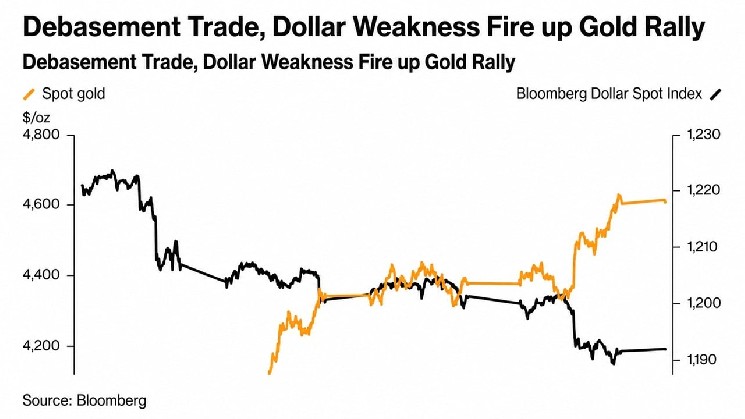
This acceleration is perhaps best exemplified by the explosion of tokenized gold.

Fuelled by a 50% price surge in 2025 and growing geopolitical instability, gold’s $29 trillion market value has intensified institutional interest.


Final Thoughts

  • The No-Action Letter finally provides regulatory clarity, allowing trillions in traditional assets to move on-chain without risking legal rights or investor protections.
  • It also aligns U.S. finance with the global shift toward real-world asset tokenization, a market expected to reach $30 trillion by 2030.


Trending Cryptos

Related Reads

The first to catch the wave of the Robinhood Chain hype is Arbitrum, up nearly 20%

"ARB, the native token of Arbitrum, surged nearly 20% recently, emerging as a top-performing L2 token. This rally is attributed to the launch of 'Robinhood Chain,' a Real-World Asset (RWA) Layer 2 built using Arbitrum's technology. The launch has brought renewed attention to the 'Arbitrum Expansion Plan' (AEP), a year-and-a-half-old program. AEP allows external projects to build their own chains using Arbitrum's Orbit technology. In return, these 'tenant' chains that do not settle on Arbitrum's main networks must share 10% of their net protocol revenue with the Arbitrum ecosystem—8% to the DAO treasury and 2% to the developer guild. While smaller chains like Degen Chain previously triggered AEP, Robinhood Chain is the first major, high-profile tenant, making the revenue-sharing model economically significant for the first time. Initial data from Robinhood Chain is impressive, with over 35 million transactions, 350,000 addresses, $2.5 billion in TVL, and over $1 billion in DEX volume shortly after launch. However, its current protocol revenue, at roughly $146,000 net, translates to only a minimal payout to Arbitrum DAO. The ARB price surge thus reflects the market's anticipation of future revenue as Robinhood's vast $324 billion platform assets potentially migrate on-chain. This 'landlord' model mirrors Optimism's approach with its OP Stack and Superchain. However, Optimism's model faces pressure as its largest tenant, Base, announced plans to depart, causing a significant drop in OP's price. Similarly, analysts question Robinhood Chain's long-term dependence on Arbitrum, noting its daily sequencer revenue already nears three times that of Arbitrum itself. There is speculation that, like Base, it may eventually seek independence, with ETH potentially being its primary economic token rather than ARB."

Foresight News27m ago

The first to catch the wave of the Robinhood Chain hype is Arbitrum, up nearly 20%

Foresight News27m ago

The Ethereum Foundation is Dead, The Era of Ethereum's Pluralistic Organizations Has Dawned

The Ethereum Foundation (EF) has announced the dissolution of its Protocol Support Team, marking a significant organizational shift. This move, described as the largest layoff in EF's history with a 20% staff reduction, follows a major internal restructuring announced in late June. The restructuring, which EF framed as necessary to streamline for future challenges, has drawn criticism for its perceived cold execution. Concurrently, several new independent non-profit organizations have emerged, founded by former EF members. These include Ethlabs, a research and development lab, and Ethereum Institutional, which focuses on promoting institutional adoption of Ethereum. Their rise is seen as both filling roles vacated by EF's downsizing and signaling a fragmentation of the Ethereum ecosystem's leadership. Amidst these changes, EF is also integrating advanced AI tools into its security operations. The security team has begun using AI agents to conduct red-team testing, which has already uncovered vulnerabilities in Ethereum's code. While EF states that AI complements rather than replaces human researchers, this technological shift hints at potential future reductions in human-centric roles within the organization. The article posits that these developments—massive layoffs, the exodus of key personnel like former Executive Director Xiaowei Wang, the rise of rival organizations, and AI integration—collectively point to a decline in EF's central authority. Once the undisputed leader of the Ethereum ecosystem, EF now faces questions about its future role, with speculation that it may evolve into more of a symbolic "ecosystem mascot" rather than a driving force for growth and adoption. This organizational turmoil unfolds against a backdrop of ongoing market pressure and community debate over Ethereum's value proposition.

marsbit32m ago

The Ethereum Foundation is Dead, The Era of Ethereum's Pluralistic Organizations Has Dawned

marsbit32m ago

The Ethereum Foundation Has Perished, Long Live a Plurality of Ethereum Organizations

The Ethereum Foundation (EF) has entered a period of significant upheaval, marked by major organizational restructuring and a shift towards a more decentralized leadership model. The EF's Protocol Support Team has officially disbanded, part of what is described as its largest-ever round of layoffs, cutting 20% of its staff. This follows the high-profile resignation of Executive Director Aya Wang and the departure of at least eight senior figures this year. This internal transformation coincides with the rise of new, independent non-profit organizations like Ethlabs and Ethereum Institutional, founded by former EF researchers. These entities aim to take on roles in research, development, and institutional adoption that were previously associated with the EF, signaling a fragmentation of the ecosystem's central guiding body. Simultaneously, the EF's security team is evolving its approach by deploying specialized AI agents to perform red-team testing on the Ethereum network, a process that has already identified real vulnerabilities. While the EF states AI complements rather than replaces human researchers, this technological shift presents further questions about the foundation's future structure and staffing. Criticism of the EF's centralized decision-making and market influence has been growing within the community. Faced with these internal reforms, external competition, and technological changes, the article suggests the Ethereum Foundation may be transitioning from a central leadership role to a more symbolic, "mascot-like" position within a increasingly diversified and complex ecosystem.

Odaily星球日报36m ago

The Ethereum Foundation Has Perished, Long Live a Plurality of Ethereum Organizations

Odaily星球日报36m ago

Trading

Spot

Hot Articles

How to Buy T

Welcome to HTX.com! We've made purchasing Threshold Network Token (T) simple and convenient. Follow our step-by-step guide to embark on your crypto journey.Step 1: Create Your HTX AccountUse your email or phone number to sign up for a free account on HTX. Experience a hassle-free registration journey and unlock all features.Get My AccountStep 2: Go to Buy Crypto and Choose Your Payment MethodCredit/Debit Card: Use your Visa or Mastercard to buy Threshold Network Token (T) instantly.Balance: Use funds from your HTX account balance to trade seamlessly.Third Parties: We've added popular payment methods such as Google Pay and Apple Pay to enhance convenience.P2P: Trade directly with other users on HTX.Over-the-Counter (OTC): We offer tailor-made services and competitive exchange rates for traders.Step 3: Store Your Threshold Network Token (T)After purchasing your Threshold Network Token (T), store it in your HTX account. Alternatively, you can send it elsewhere via blockchain transfer or use it to trade other cryptocurrencies.Step 4: Trade Threshold Network Token (T)Easily trade Threshold Network Token (T) on HTX's spot market. Simply access your account, select your trading pair, execute your trades, and monitor in real-time. We offer a user-friendly experience for both beginners and seasoned traders.

12.3k Total ViewsPublished 2024.03.29Updated 2026.06.02

How to Buy T

Discussions

Welcome to the HTX Community. Here, you can stay informed about the latest platform developments and gain access to professional market insights. Users' opinions on the price of T (T) are presented below.

活动图片